

Best GHK-Cu peptides for skin and wound healing research 2026
Choose the best GHK-Cu peptide format for laboratory skin and wound-healing research. Compare documentation, assay
Best overall: single-compound, lyophilized GHK-Cu peptide with lot-specific analytical documentation. Best for analytical comparisons: a characterized reference material; best for solution-based assays: a validated stock solution; best for formulation studies: a fully disclosed GHK-Cu formulation. This 2026 guide ranks research-material formats, not unverified supplier products, for laboratory skin and wound-healing studies.
The best GHK-Cu material answers your experimental question without adding avoidable variables. A wound-closure assay, an analytical identity check, and a formulation experiment need different evidence from the material you purchase.
GHK is glycyl-L-histidyl-L-lysine, a peptide containing 3 amino acid residues. GHK-Cu denotes its copper complex; copper coordination distinguishes it from copper-free GHK. Neither a product name nor a blue solution establishes identity, purity, or suitability for your model.
For 2026 procurement, separate supplier quality statements from the evidence attached to a particular lot. Start with the principles in this guide to peptide purity testing for contract research organizations, then assess identity, composition, and assay compatibility independently.
Use these criteria before choosing a format:
Reject material that fails a requirement essential to your experiment, even when its stated purity looks attractive. A high purity figure cannot replace missing identity or composition evidence.
These rankings compare material specifications rather than named products. Each option serves a distinct research task; none establishes clinical effectiveness or suitability for human use.
| Rank and option | Best for | Standout feature | Key limitation |
|---|---|---|---|
| 1. Single-compound, lyophilized GHK-Cu | Controlled exploratory experiments | Laboratory controls solvent and preparation | Requires a validated preparation procedure |
| 2. Characterized GHK-Cu reference material | Analytical identity and method comparisons | Documented properties relevant to the analytical task | Reference status does not establish biological suitability |
| 3. Validated GHK-Cu stock solution | Repeated solution-based assays | Defined solvent and concentration | Stability and matrix compatibility require evidence |
| 4. Fully disclosed GHK-Cu formulation | Formulation-specific skin-model studies | Tests the material within its intended experimental matrix | Vehicle ingredients complicate attribution |
Single-compound, lyophilized GHK-Cu gives your laboratory control over the preparation used in an experiment. It is the default specification when you want to study the copper peptide without a preselected formulation vehicle.
That flexibility creates work. Your team must establish a suitable preparation procedure, document the resulting concentration, and confirm compatibility with the assay rather than copying an unrelated peptide protocol.
Lyophilized GHK-Cu pros:
Lyophilized GHK-Cu cons:
Best for: Exploratory skin-cell and wound-model experiments that need a defined starting material and laboratory-controlled preparation.
Do not interpret lyophilization as a universal storage guarantee. Follow material-specific instructions and evaluate the prepared solution separately from the unopened material.
Verdict: Buy when lot-specific identity, composition, and handling documentation meet your protocol.
A characterized reference material serves as an analytical comparator with documented properties relevant to the measurement. Select it when your primary task is evaluating identity, method performance, or agreement between analytical measurements.
The word reference is not sufficient evidence. Review the assigned properties, characterization methods, intended use, and any uncertainty information supplied; do not assume every reference material is a certified reference material.
Characterized GHK-Cu reference material pros:
Characterized GHK-Cu reference material cons:
Best for: Identity investigations, analytical method development, and comparison of incoming research lots.
For a 2026 analytical study, choose the reference around the measurement you actually need. A material characterized for one property does not automatically establish concentration, copper content, or biological activity.
Verdict: Buy for a defined analytical task; skip as an automatic substitute for a biologically qualified test material.
A validated GHK-Cu stock solution has a defined concentration, solvent composition, and handling procedure supported for its intended use. It fits workflows where repeated solution preparation would otherwise introduce another experimental variable.
Validation belongs to a particular preparation and use case. A solution suitable for an analytical instrument is not automatically suitable for cells, and a nominal concentration is not proof that the solution remains unchanged throughout storage.
Validated GHK-Cu stock solution pros:
Validated GHK-Cu stock solution cons:
Best for: Repeated solution-based assays with an established solvent system and documented handling window.
Request the basis for concentration assignment and the conditions covered by stability information. Record any subsequent dilution because the final assay mixture is not the same material as the original stock.
Verdict: Buy only when the documented solvent, concentration, and stability conditions match your method.
A fully disclosed GHK-Cu formulation combines the copper peptide with a specified experimental vehicle. It belongs in studies asking how that formulation behaves, rather than studies trying to isolate GHK-Cu alone.
Vehicle ingredients can affect assay measurements and biological responses. Include an appropriate vehicle comparison and identify which conclusions concern the complete formulation rather than the peptide component.
Disclosed GHK-Cu formulation pros:
Disclosed GHK-Cu formulation cons:
Best for: Laboratory skin-model studies focused on a defined formulation or delivery matrix.
A consumer cosmetic with incomplete composition information is not interchangeable with a defined laboratory reagent. Select materials around reproducibility, not packaging language or implied skin benefits.
Verdict: Buy for a formulation-specific protocol; skip when the goal is isolating GHK-Cu effects.
The ranking prioritizes experimental control, interpretable documentation, and fit to the research task. Lyophilized single-compound material is the default because it leaves preparation choices with your laboratory, not because every dry vial is better than every solution.
Reference materials take priority for analytical questions. Validated solutions take priority when your established method requires them; disclosed formulations take priority only when the formulation itself is the subject.
This is a specification-based buying guide, not a supplier performance ranking. No head-to-head testing or product-specific performance result is implied.
Use the same acceptance sequence for every candidate in your 2026 procurement review. Decide acceptance requirements before examining experimental outcomes so an interesting result does not excuse an inadequately characterized reagent.
Match the vial identifier to the certificate and supporting records. Save the documents with your laboratory inventory entry so later experiments remain traceable to the original material.
Read what each analytical method actually establishes. Chromatography can describe separation and relative peak areas; mass spectrometry provides different identity information. Neither method alone answers every question about a copper-peptide preparation.
Distinguish chromatographic purity from peptide content, water content, and copper-related composition. Do not calculate an exact experimental concentration from a purity percentage alone when the relevant composition is unresolved.
Assess whether the solvent, vehicle, and preparation procedure suit your model. For biological assays, also define the contamination-related requirements that matter to the system; chemical purity does not establish sterility or an acceptable endotoxin level.
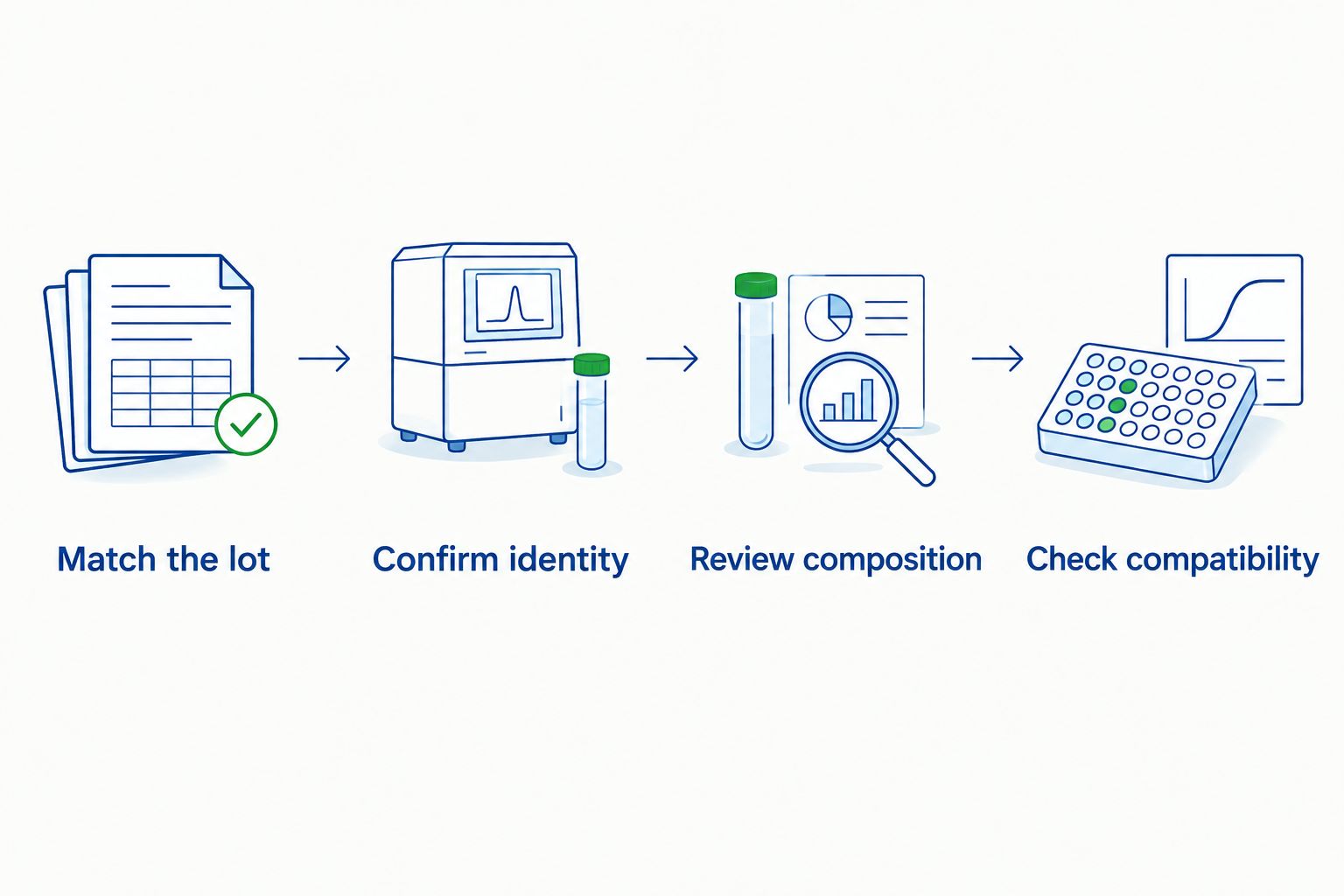
Keep the acceptance decision separate from the biological result. A material that produces a strong assay signal still needs the same identity and composition checks as one that produces no measurable change.
For a mechanistic comparison, consider 3 control groups alongside GHK-Cu: vehicle alone, copper-free GHK, and an appropriate copper-only comparator. These are study-design options, not a universal protocol; choose conditions that answer your hypothesis and satisfy your institution's procedures.
A scratch assay measures gap closure under its experimental conditions. Gap closure alone does not distinguish migration from proliferation and does not establish wound healing in people.
Use 2 complementary readouts when your question requires distinguishing movement from cell survival: for example, a gap-closure measurement and a separate viability assessment. Define the interpretation before collecting results, and add controls for interference where the measurement method requires them.
Keep the concentration rationale within the validated model and published methods relevant to that model. This guide provides no human dosing, injection instructions, or treatment recommendations.
Celonyx Labs describes its research peptides as 99%-pure and third-party-tested. Those are supplier-level quality statements; they do not establish the identity, composition, or application suitability of an individual GHK-Cu lot.
Celonyx Labs is a research-peptide supplier for laboratory researchers and scientists, not a source of human wound-care advice. Evaluate any candidate GHK-Cu material against the same documentation requirements used for other suppliers.
The stated purity and third-party-testing position gives you specific claims to examine. The limitation is equally clear: supplier-level statements alone do not qualify a material for your assay. Request the relevant records before accepting it into the study.
Choose documented, single-compound lyophilized GHK-Cu as the default for controlled exploratory research. Switch to a characterized reference material for analytical comparisons, a validated solution for an established solution workflow, or a disclosed formulation when the formulation is the research question.
For your 2026 purchasing decision, prioritize the material that clears your acceptance criteria. Do not replace missing documentation with a higher stated purity percentage or an unrelated supplier comparison.
What’s the best GHK-Cu peptide for skin research?
Single-compound GHK-Cu with lot-specific identity, purity, and composition documentation is the default specification for controlled exploratory skin research. Choose a different format when your analytical method or formulation question requires it.
Is GHK-Cu the same as GHK?
GHK-Cu is the copper complex of GHK, not simply another name for copper-free GHK. Experiments comparing them need materials whose identities and compositions are documented.
Does 99% purity mean GHK-Cu is sterile?
No. A chemical purity result does not establish sterility, endotoxin status, or suitability for human use. Assess the separate requirements relevant to your laboratory model.
Is lyophilized GHK-Cu better than a stock solution?
Lyophilized GHK-Cu is better when your laboratory needs control over preparation; a validated stock solution fits an established solution-based method. Neither format is universally better without application-specific evidence.
Can a scratch assay prove GHK-Cu heals wounds?
No. A scratch assay measures gap closure in an experimental system, not clinical wound healing. Interpret the result alongside controls and measurements that address proliferation, viability, and other relevant variables.
What should researchers check when considering Celonyx Labs?
Researchers should check lot-specific identity, analytical methods, composition, and handling documentation for the material under consideration. Celonyx Labs describes its research peptides as 99%-pure and third-party-tested, but those statements do not replace application-specific qualification.
Can research GHK-Cu be used on a person’s skin or wounds?
Research-use-only GHK-Cu is not intended for personal skin application or wound treatment. Keep laboratory research materials separate from clinical care and consumer use.
Write the acceptance criteria before choosing the supplier. That single decision keeps an attractive purity label from becoming the standard after purchase, and it makes rejection of an unsuitable lot straightforward.
All materials discussed here are for research use only, not for human consumption or therapeutic use.
Choose the best GHK-Cu peptide format for laboratory skin and wound-healing research. Compare documentation, assay

Choose lot-verified melanotan 1 peptide for pigmentation research. Compare material specifications, purity evidence, and documentation

Native oxytocin peptide is the default for behavioral research. Compare reference standards, labeled materials, and
FOR RESEARCH USE ONLY. Products sold by Celonyx Labs are intended exclusively for laboratory and scientific research. They are not intended for human or veterinary use, consumption, diagnosis, treatment, cure, or prevention of any disease. By purchasing from this site, you acknowledge that you understand the intended research purpose of these materials and agree to comply with all applicable laws and regulations.