
BPC 157 500mcg Explained: What the Evidence Shows
500 mcg equals 0.5 mg, a labeled research quantity, and no published human study establishes
500 mcg equals 0.5 mg, a labeled research quantity, and no published human study establishes it as an effective or safe dose for any use. Popular advice treats that number as if it's a recommendation because it looks small and familiar. A small number isn't a safety argument, and frequency isn't evidence. You still need to know what material is in the vial, how exposure changes by weight and route, and what proof exists in people.
The 500 mcg label identifies a quantity, not a pharmacological dose or a demonstrated level of exposure. BPC-157 is a synthetic peptide of 15 amino acids, derived from a sequence found in gastric juice. Researchers study it in laboratory and animal models for tissue repair, gut protection, and tendon or ligament healing. It has no approved medical use and remains investigational.
For BPC-157 500 mcg, the label can refer to nominal vial content, a marketed serving amount, or a mistaken recommendation. These meanings are not interchangeable: the label alone does not identify what a study sample contains or support using the amount as guidance.
Marketing can pair promising animal findings with impressions of human tolerability, although those are different kinds of evidence. For broader context on how practitioners discuss peptides, see peptide therapy in Aurora, and distinguish clinic marketing from evidence specific to this compound.
Practical rule: Ask what the 500 mcg refers to, which route is specified, and which lot documents support the stated contents.
Without lot documentation that identifies and characterizes the material, the label is not enough to establish that a vial is a verified research sample.
A 500 mcg amount works out to about 7.1 µg/kg for a 70 kg adult, between the lowest rat and dog intramuscular reference points. Those animal values, 20 µg/kg in rat programs and 6 µg/kg in dog programs, provide comparison only; they do not establish a human dose. The animal dose values are reported in FDA materials on route-specific human pharmacokinetics.
500 mcg equals 0.5 mg, or 500 micrograms. Converting units clarifies the quantity, while body weight provides a per-kilogram comparison. Neither calculation establishes how much reaches circulation or what effect it produces.
| Reference point | Amount | Comparison with 500 mcg label | What it tells you |
|---|---|---|---|
| Labeled research quantity | 500 mcg (0.5 mg) | Baseline | Nominal vial content, not a delivered dose |
| Same 500 mcg per kilogram, 70 kg adult | About 7.1 µg/kg | Baseline per-kilogram figure | Weight changes the per-kilogram meaning |
| Lowest rat intramuscular dose | 20 µg/kg, reported in FDA materials | About 2.8 times the 70 kg figure | Animal scale, not transferable to people |
| Lowest dog intramuscular dose | 6 µg/kg, reported in FDA materials | Below the 70 kg figure | Different species, different scaling |
| Human intravenous volunteers (two) | 10 mg and 20 mg, reported in FDA materials | 20 and 40 times the label; half-life under 30 minutes | Route and amount differ substantially from the label |
| Human subcutaneous, oral, nasal or transdermal routes | No human pharmacokinetic studies reported in FDA materials | Not comparable | Route-specific exposure remains unknown |
The FDA materials report human intravenous pharmacokinetic findings in two volunteers, including doses of 10 mg and 20 mg and a plasma half-life under 30 minutes. They report no human pharmacokinetic studies for oral, subcutaneous, nasal, or transdermal administration. Intravenous findings cannot establish what another route delivers. Route affects the path into circulation, and therefore can affect peak concentration, timing, and total exposure.
For container comparisons, peptide vial sizes and nominal contents help distinguish stated packaging amounts from pharmacological exposure. Treat 500 mcg as a quantity for calculation, not a proven dose or evidence of exposure.
A 500 mcg label can look conservative while saying little about the strength of the evidence or the exposure a person would receive. A 2025 systematic review identified 36 publications, with 35 preclinical and only 1 clinical, according to ChatPEP's summary of the 2025 systematic review. The 35 of 36 preclinical share is roughly 97.2%. These counts describe the literature, not a validated human dose.
Animal findings can help researchers decide what to investigate. They cannot establish that people absorb BPC-157 similarly, respond at comparable exposure, or avoid harms that emerge only in humans. The small published human studies offer limited additional evidence: their designs do not separate treatment effects from natural recovery and expectation as controlled trials could.
| Evidence layer | What the record shows | Practical limit |
|---|---|---|
| Preclinical animal studies | 35 of 36 publications in a 2025 systematic review | Narrow dose sets make dose-response conclusions unreliable |
| Clinical publication | 1 of 36 publications in the same review | Not enough to establish safety or efficacy |
| Published human studies | Three studies, fewer than 30 participants in total | Small, uncontrolled or weak designs; none randomized |
| Registered Phase I study NCT02637284 | Planned for 42 healthy volunteers, safety and pharmacokinetics | Terminated with no published results report |
| Registered 2025 gummy study | 500 mcg per serving, 40 physically active adults, 8 weeks | Completed November 2025 with no results posted |
The human evidence remains thin. The three published studies involved fewer than 30 participants in total, and none were randomized controlled trials, according to a scientific review of the preclinical and clinical record. That review also notes that NCT02637284 was planned for 42 healthy volunteers but terminated without a published results report. Its registration cannot establish safety, pharmacokinetics, or dose selection.
The gummy study also has no public outcome data. The Longevity Archive's record of the 2025 BPC-157 gummy study reports 500 mcg per serving in 40 physically active adults over 8 weeks, with completion in November 2025 and no results posted. Without results, the study provides no basis to infer benefit, absence of harm, or exposure.
A registration records an intention to study a question. It doesn't answer the question.
A BPC-157 peptide research listing provides product context, not evidence that a sample matches material used in research. Establishing that requires documents linking a specific sample to analytical testing. The broader evidence gaps include validated assays, route-specific pharmacokinetics, dose-ranging, repeated-dose safety, and immunogenicity. Until researchers address them, BPC-157 500 mcg remains a labeled quantity, not a validated human regimen.
A 500 mcg label specifies an amount, not a proven safe dose. Risk depends on exposure, route, formulation, and duration, while the available human evidence does not establish how those variables affect BPC-157. Short, uncontrolled reports can miss uncommon or delayed harms, and brief follow-up cannot establish long-term risk.
Coverage of the FDA advisory panel and the underlying evidence review reports that clinical safety data remain insufficient. The review discussed there is consistent with the conclusion of a later orthopaedic review, which rated certainty very low because of bias, indirectness, and imprecision. This assessment limits what researchers can conclude about safety; it does not establish that the compound causes harm.
| Source | Stated position | What it means for a research buyer |
|---|---|---|
| FDA | Not an FDA-approved drug; clinical safety information judged insufficient | No approved use exists to cite |
| FDA route review | No human studies for oral, subcutaneous, nasal or transdermal routes | Route-specific claims lack human data |
| WADA | Classified S0, unapproved substance (WADA Prohibited List) | Prohibited for athletes subject to testing |
| USADA | No human clinical trials establish efficacy for diagnosis or treatment | Materials should not imply therapeutic benefit |
FDA regulatory materials stating the approval and safety position state that BPC-157 is not an FDA-approved drug, that clinical safety information is insufficient, and that the agency found no human studies using the proposed oral, subcutaneous, nasal, or transdermal routes. WADA S0 classification also has practical consequences for athletes subject to testing, irrespective of claims circulating on social media. Research use does not change that status.
For a lab buyer, the distinction is between a labeled quantity and an exposure supported by evidence. A vial marked 500 mcg does not establish a validated dose for any route, nor does it show that the contents match the label. Keep descriptions limited to preclinical research, record adverse observations, and halt work that exceeds the laboratory's approvals or competence. The evidence and regulatory record cannot support claims that a labeled sample is safe, effective, or approved.
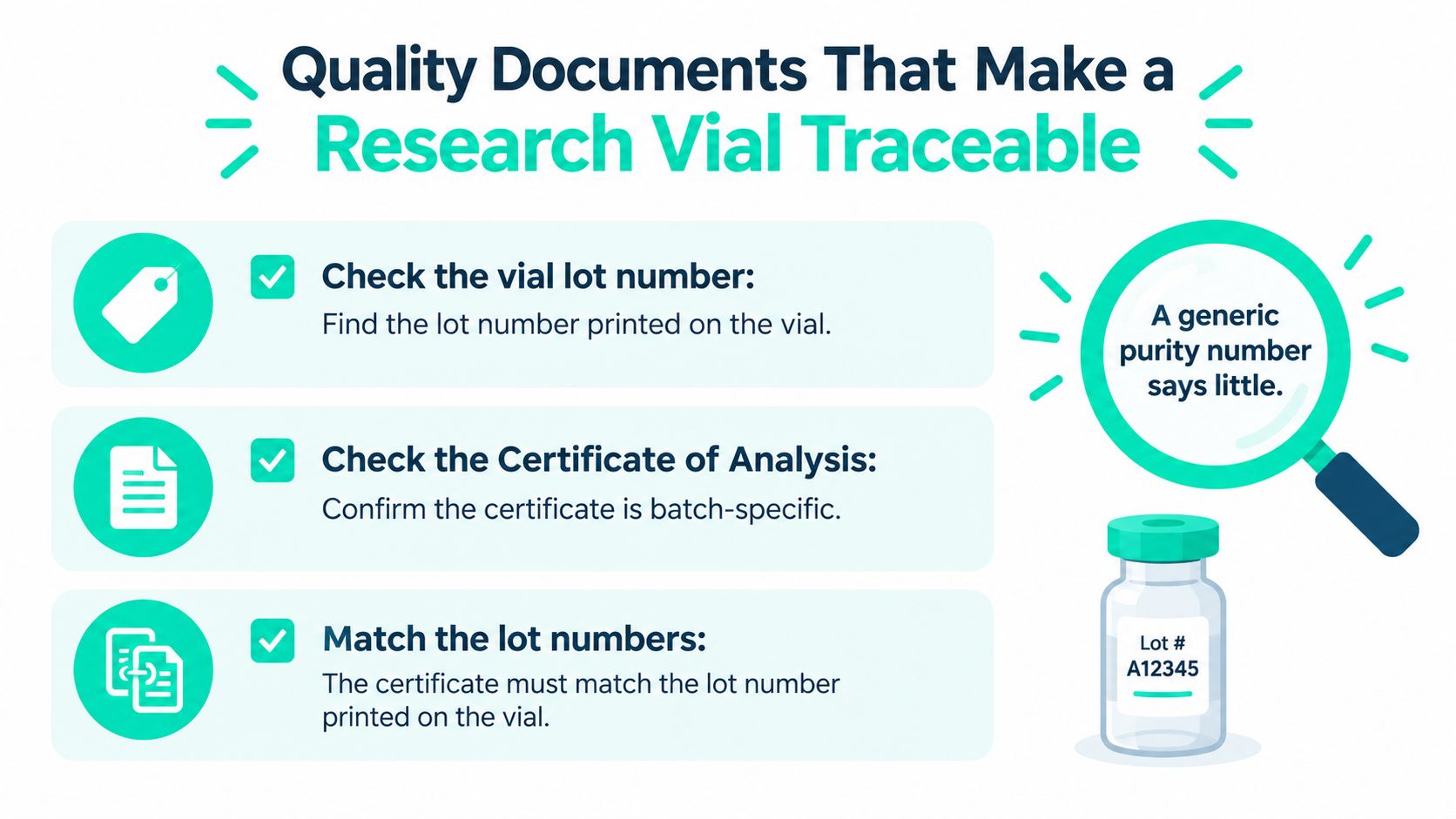
Start with the lot-number test. A generic purity number says little unless a batch-specific Certificate of Analysis matches the lot printed on the vial in your hand. If those identifiers don't align, the document may describe a different batch entirely.
Use this visual checklist to make the matching step explicit before you review the full file.
| Document element | What to verify | Red flag |
|---|---|---|
| Lot number | Matches the vial label and the certificate | Lot missing or mismatched |
| Test date | Recent and tied to the same batch | Undated or generic certificate |
| Purity method | HPLC or UPLC with reported percentage | Purity given without a method |
| Identity | Mass spectrometry or LC-MS on the same batch | No identity test |
| Peptide content and salt form | Net peptide stated alongside purity | Only a purity percentage given |
| Moisture content | Reported value | Absent |
| Storage and temperature history | Conditions from supplier to lab | Unknown history |
| Chain of custody | Supplier-to-lab transfer record | No transfer record |
Warm transit can undermine even well-tested material, so practical guidance on checking refrigerated medication deliveries can help receivers decide what to inspect and record on arrival. You should log the package condition, temperature indicators, receipt time, and transfer to storage. Gaps in that history become alternative explanations for failed or inconsistent experiments.
This short video provides another way to review the traceability workflow before you build the research file.
Watch for the purity trap. Net peptide content can differ from the purity percentage because purity describes the proportion attributable to the intended peptide signal, while salt form and other mass components affect how much peptide is present. A high purity result therefore doesn't prove that the vial contains exactly 500 mcg of peptide.
A sound research file ties identity, analytical purity, salt form, route, dose per kilogram, sampling schedule, and validated assay conditions to the lot, consistent with the documentation approach described in the preclinical pharmacokinetic review. When evaluating outside verification, review what third-party tested peptides documentation should include, then check the lot-level certificate yourself. Treat any supplier website claim as unverified until the certificate, vial, and transfer record agree.
A 500 mcg label does not establish a usable exposure or answer a human-use question. A sample fits a defined research question only if the design, approvals, assays, and controls can address it. Questions about human exposure or therapeutic benefit require evidence beyond a labeled vial.
Stop at any stage where the evidence doesn't support the next one.
The escalation path should follow the strength of the evidence. Exploratory laboratory work can support a better-designed preclinical study only when identity, controls, and measurements are credible. Ethically approved preclinical work may then help establish whether regulated human research is warranted; it does not replace dose-ranging, pharmacokinetic assessment, or safety monitoring. The practical decision is whether the research question, exposure measurement, and lot documentation make the labeled quantity scientifically interpretable.
If you're sourcing BPC-157 500 mcg for a defined laboratory question, Celonyx Labs offers research peptides through an online catalog with customer support for order and product questions. Visit the catalog, request the lot-specific documentation you need, and verify identity, purity method, storage history, and chain of custody before incorporating any sample into your study file.
500 mcg equals 0.5 mg, a labeled research quantity, and no published human study establishes

Choose the best GHK-Cu peptide format for laboratory skin and wound-healing research. Compare documentation, assay

Choose lot-verified melanotan 1 peptide for pigmentation research. Compare material specifications, purity evidence, and documentation
FOR RESEARCH USE ONLY. Products sold by Celonyx Labs are intended exclusively for laboratory and scientific research. They are not intended for human or veterinary use, consumption, diagnosis, treatment, cure, or prevention of any disease. By purchasing from this site, you acknowledge that you understand the intended research purpose of these materials and agree to comply with all applicable laws and regulations.