
BPC 157 Vial Guide: Form, Storage and Quality Checks
Buy the highest purity number you can find and you're covered. That's the most popular
Buy the highest purity number you can find and you're covered. That's the most popular advice for a BPC 157 vial, and it's wrong in the way that matters most in a laboratory. A purity percentage can describe one chromatographic result on one lot. It can't confirm the peptide is the right substance, tell you how much peptide is in the fill, or prove the material stayed stable after you reconstituted it.
Treat purity as one signal, not a verdict. A buyer who judges a vial lot by lot, checking identity, peptide content, form, storage history, and documentation together, can decide whether that specific lot fits a specific assay. A buyer who shops on percentage alone carries every other source of variation straight into the experiment, where it will look like biology.
Start with the spec sheet, not the marketing claim. A sealed vial holds dried peptide in glass until reconstitution, so the label should state a fill quantity, a purity claim, and storage conditions, not a dose. Each row below gives you something checkable and leaves something else open.
| Attribute | Typical value | What it tells the buyer |
|---|---|---|
| Peptide sequence | GEPPPGKPADDAGLV, 15 amino acids | Confirms the chain identity that identity tests should match |
| Approximate molecular weight | about 1,419 Da | Gives the expected mass for mass spectrometry checks |
| Physical form | White lyophilized (freeze-dried) powder | A dry solid until reconstituted; appearance alone does not confirm identity |
| Listed fill sizes | 5 mg and 10 mg per vial | Sets the peptide quantity to verify against the protocol |
| Stated purity | At least 98% by HPLC (supplier claim) | Chromatographic purity only, not sterility or safety; confirm on the lot report |
| Long-term storage | −20°C | Slows degradation of the dry powder |
| Packaging and closure | Glass vial with stopper and seal | Confirms vial type and seal; ask the supplier |
| Intended use | Laboratory research only | Not for human consumption, medical or veterinary use |
The sequence, spelled out as Gly-Glu-Pro-Pro-Pro-Gly-Lys-Pro-Ala-Asp-Asp-Ala-Gly-Leu-Val, is the reference your identity test must match. The molecular weight gives mass spectrometry a target to confirm or reject. Neither line proves your vial contains that peptide, only that you know what to test for.
A 5 mg or 10 mg fill states what's supposed to be in the glass. It doesn't state how much of that mass is peptide versus water, counterions, or other material, which is why peptide content matters for calculations. A stated purity of at least 98% by HPLC describes chromatographic behavior. It doesn't establish sterility, endotoxin level, or concentration after reconstitution.
Use the table as your opening checklist. The values become meaningful only when storage conditions were maintained and lot testing confirms them.
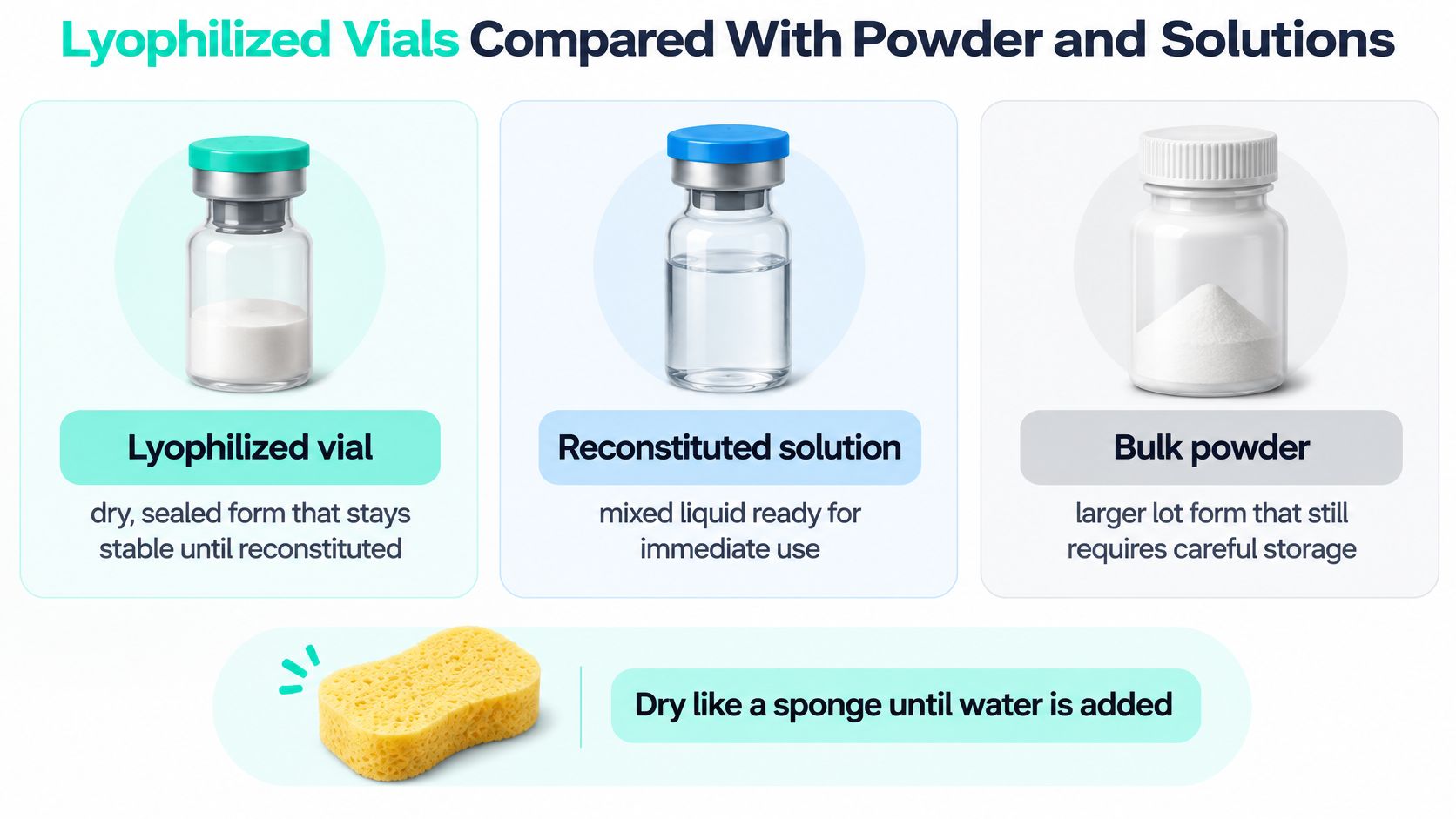
The three forms differ less in chemistry than in how much handling stands between the supplier and your assay.
| Form | Physical state | Main handling risk | Typical research use |
|---|---|---|---|
| Lyophilized vial | Dry solid sealed in glass with a stopper | Moisture uptake and temperature swings before reconstitution | Stock storage and aliquoting |
| Reconstituted solution | Liquid made with a stated solvent | Concentration drift, surface adsorption and a short usable window | Single-session assays |
| Bulk powder | Larger dry lot, often divided into smaller units | Repeated division adds contamination and weighing error | Method development and reference work |
Think of the dry peptide like a sponge. Dry, it sits stable and inert. Once water is added, every step counts, including solvent choice, mixing, time on the bench, and how often the container is opened.
Your protocol must state the solvent before you open the vial, because the solvent becomes part of the experimental conditions. Don't assume concentration from fill weight alone. Verify it after preparation, and aliquot the solution so you aren't reopening one container across sessions.
Say you reconstitute a 5 mg vial in 1 mL of the stated solvent. The nominal result is 5 mg/mL, but your working figure should use peptide content from the lot report, not gross fill weight. Any molar calculation must use the molecular weight for the confirmed form, since free base and acetate don't share the same mass. Confirm which form you hold before converting.
Choose the sealed vial for stock you will store, freshly prepared solution for a single session, and bulk powder only when method development justifies the extra weighing, division, and documentation burden.
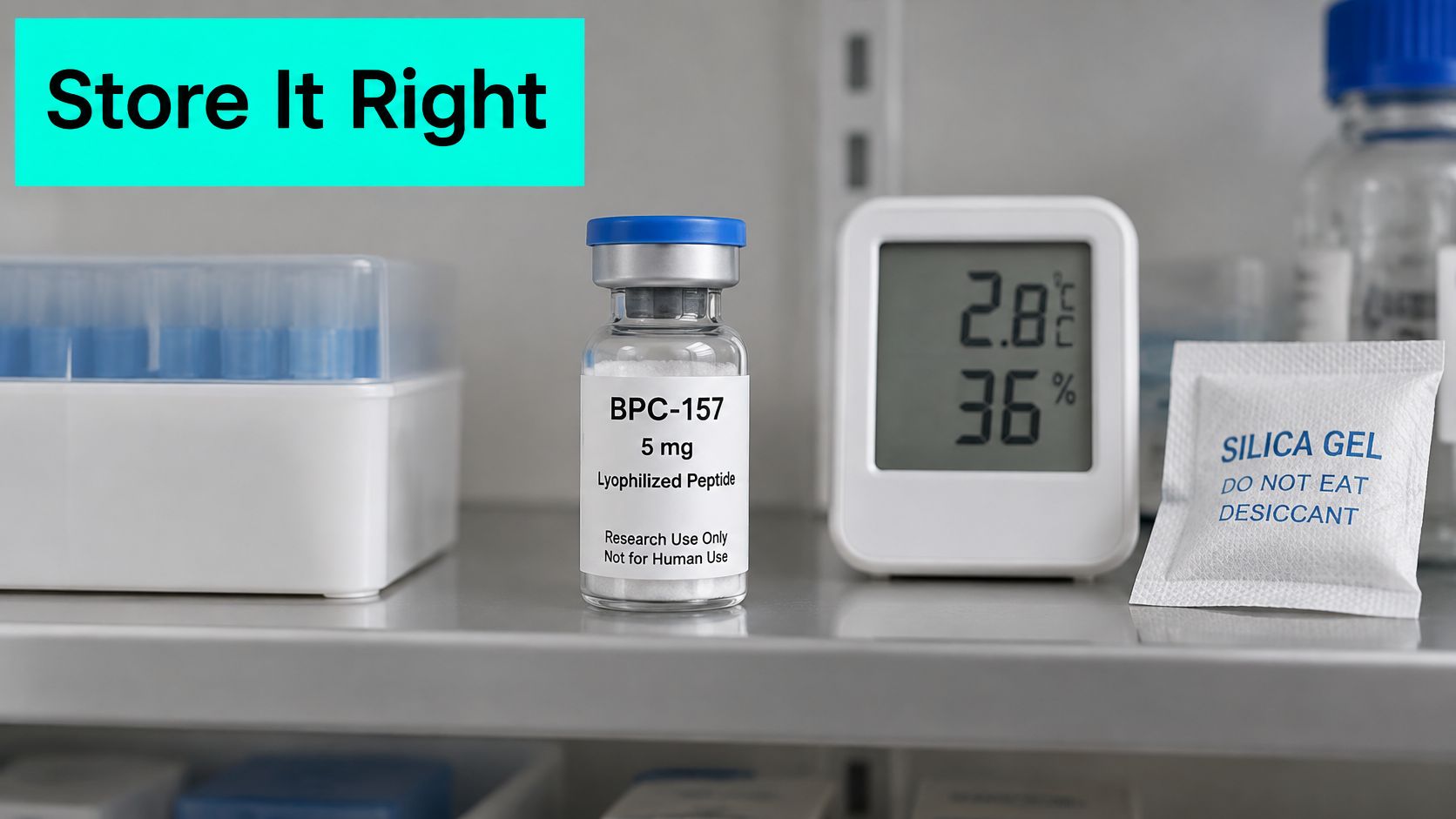
Storage is the main lever you control after receipt. The condition on arrival and the discipline afterward determine whether the lot you tested is the lot you use.
| Stage | Recommended condition | Check before use |
|---|---|---|
| Unopened lyophilized vial | −20°C long-term, protected from light | Lot number and expiry or retest date on the label |
| After opening | Reseal promptly and return to cold storage | Visual check for caking or discoloration |
| Reconstituted solution | Refrigerated, used within the window set by your own stability data | Time-point HPLC to confirm purity and concentration |
| Repeated freeze-thaw | Minimise cycles and aliquot before freezing | Compare purity against an unthawed control |
| Shipping and receipt | Confirm the cold-chain indicator or condition on arrival | Record temperature and time out of storage |
Don't confuse clearance in an animal with degradation in glass. The animal pharmacokinetic study in rats and beagle dogs found prototype BPC-157 had a systemic elimination half-life of less than 30 minutes, with intramuscular absolute bioavailability averaging about 14–19% in rats versus 45–51% in beagle dogs. That's a statement about living systems, species, and route. It doesn't prove a stored or reconstituted sample has degraded, and you shouldn't extrapolate it across species or routes.
Run HPLC plus mass spectrometry at set time points under your actual handling conditions, against an unthawed control. A workable pattern looks like this. You reconstitute on Monday, then sample Monday, Wednesday, and Friday, recording purity and mass each time. A drop across those points shows degradation. A flat line supports your usable window.
The short video below reinforces the temperature discipline behind that testing.
Log temperature, time out of storage, and lot number every time the vial moves. Our guide to peptide vial storage conditions covers the logging format in detail. Without that record, a failed assay leaves you guessing whether storage or biology caused it.
Read a purity number as one result among several. Orthogonal methods check different properties, so a vial needs both a purity test and an identity test before either result means much.
| Test | What it measures | What a pass supports | What it does not show |
|---|---|---|---|
| Reversed-phase HPLC | Chromatographic purity | Few UV-detectable peptide-related impurities | Sterility, endotoxin or true concentration |
| LC-MS or mass spectrometry | Molecular mass and sequence-related impurities | Expected mass near 1,419 Da and identity | Biological activity or safety |
| Peptide content | Peptide weight as a share of total fill mass | Realistic amount per vial for calculations | Purity of the peptide itself |
| Endotoxin test | Bacterial endotoxin level | Low pyrogen risk for in vitro work | Chemical identity or stability |
| Sterility test | Microbial contamination at time of test | Microbial control at that point | Stability after opening |
| Residual solvent and water content | Leftover synthesis solvents and moisture | Dryness and solvent control | Identity or purity |
Reversed-phase HPLC quantifies chromatographic purity and rules out many UV-detectable peptide-related impurities. It says nothing about sterility or true concentration. Mass spectrometry confirms the expected mass near 1,419 Da and flags sequence-related impurities. The published characterization of preclinical BPC-157 material reported material at 99% HPLC purity or above 95%, with 1-des-Gly BPC-157 identified as a principal impurity in some preparations.
Consider two lots. One shows 99% HPLC purity with the wrong mass. It fails identity, so the purity describes the wrong substance. Another shows the correct mass at 92% purity. It fails purity, so a real share of your material is something else. Neither lot belongs in an assay.
A purity percentage without a matching mass is a clean measurement of an unconfirmed substance.
Peptide content then converts a passing lot into usable math by comparing peptide weight with total fill mass. Endotoxin testing matters for sensitive cell work, sterility testing describes microbial control only at the moment of testing, and residual solvent and water content show dryness and synthesis control. If any test is missing, request the method name, lot number, and test date before accepting the vial. Our explanation of peptide certificates of analysis shows how those fields should appear on a lot report.
Accept a delivery only after the paperwork survives inspection. Work through these checks in order, because each one depends on the lot identity established by the first.
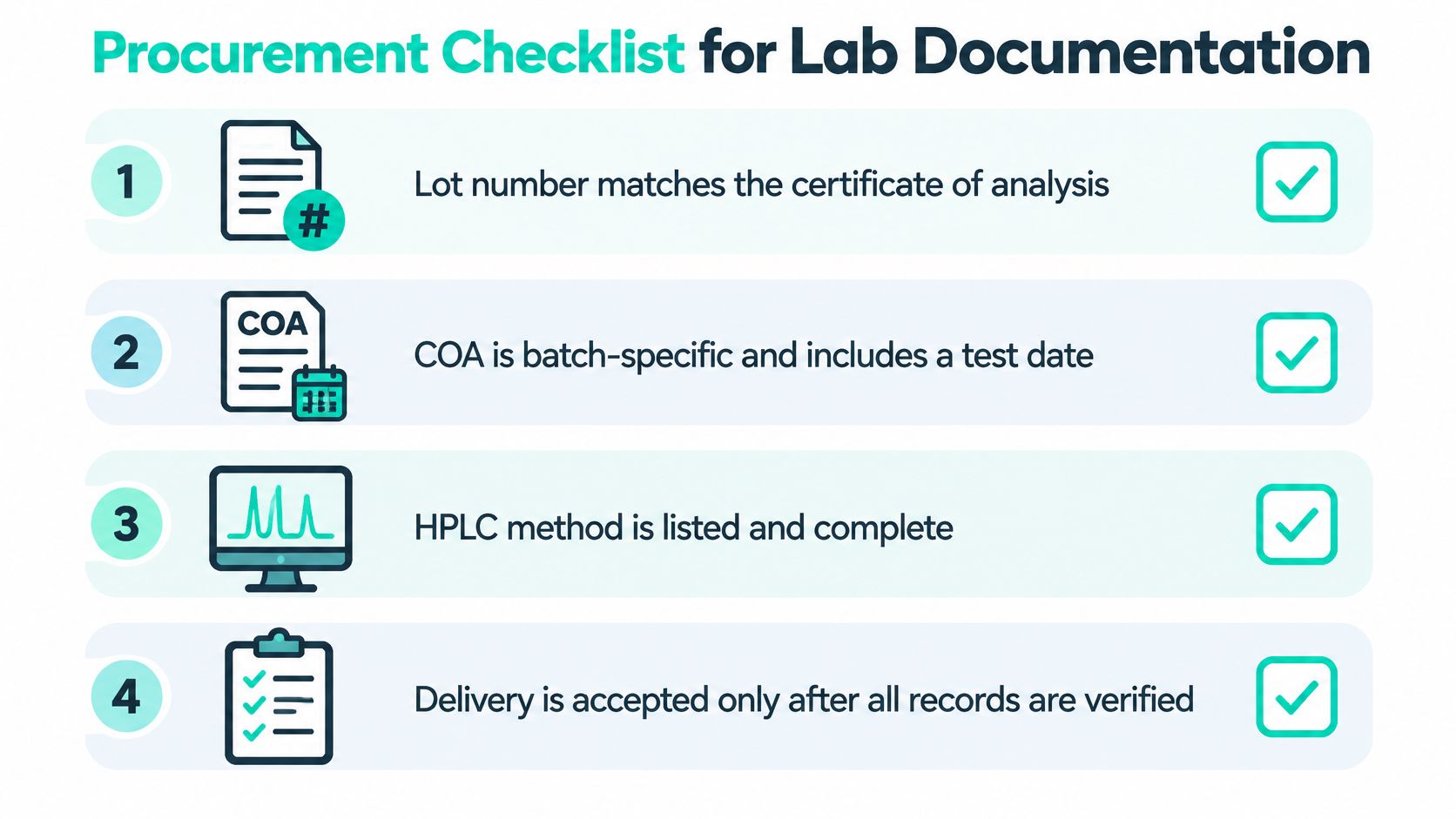
A complete file supports fitness for a defined assay. It doesn't establish human safety. The FDA briefing document on BPC-157 found no applicable USP or National Formulary monograph for BPC-157 free base or acetate and identified no human studies for oral, subcutaneous, nasal, or transdermal administration routes.
Quarantine rule. If any check fails, quarantine the vial and request written clarification before use.
A generic COA listing purity without a lot number tells you almost nothing. Keep the completed checklist as a traceable audit trail for procurement and ethics review, so any result can be traced back to the exact lot that produced it.
A research vial's label can establish what the supplier says is in the container. It cannot establish that BPC-157 is safe or effective for people. The published evidence remains limited, and much of the research described here concerns animals.
The ClinicalTrials.gov record for study NCT02637284 describes a Phase 1 trial registered in 2015 that used oral doses of 1, 3, or 6 tablets, with 1 mg in each tablet. A systematic review of human pilot studies identified three studies involving 16 people treated intra-articularly for knee pain, 12 treated intravesically for interstitial cystitis, and 2 in an intravenous safety study. The review judged the studies methodologically weak and the overall certainty very low.
These findings do not establish human safety, absorption, effective dose, or long-term risks. Animal research can inform laboratory hypotheses, but it does not provide dosing guidance for people.
A research vial has no approved medical use. The regulatory summary of FDA and anti-doping status states that BPC-157 has not received FDA approval for a medical indication, was classified by the FDA in 2023 as a Category 2 bulk drug substance associated with significant safety concerns, and is listed by the World Anti-Doping Agency under section S0, beginning with the 2022 Prohibited List.
For laboratory work, document the research purpose in the protocol, confirm institutional permission for the material and study design, and avoid describing the vial as a treatment. A research-use label and a purity result do not establish clinical safety.
Make the final decision from the protocol outward, not from the product page inward.
Our overview of peptide vial sizes helps you map fill size to protocol demand. At Celonyx Labs, we list BPC-157 at $35.95 for 5 mg and $49.95 for 10 mg, and every batch undergoes HPLC, mass spectrometry verification, and batch consistency testing. Confirm pricing at order time and check those statements against the lot report for the vial you will receive.
Which lot-specific report covers the vial I am about to order?
That's the single question to put to any supplier, including us. If the answer names a lot, a method, and a test date, you can judge the vial on evidence. The material is for laboratory research only and is not for human consumption.
Before your next order, send us your lot documentation questions and we'll point you to the batch-specific HPLC and mass spectrometry records for the BPC-157 vial you're considering, in 5 mg or 10 mg lyophilized form for laboratory research only. Visit Celonyx Labs to review the catalog, confirm current pricing, and place your order with the paperwork your protocol requires.
Buy the highest purity number you can find and you're covered. That's the most popular

Research peptides for toxicology testing need more than purity claims. Learn to verify identity, control

Choose research peptides for regenerative medicine by assay fit, not recovery claims. Compare candidates, verify
FOR RESEARCH USE ONLY. Products sold by Celonyx Labs are intended exclusively for laboratory and scientific research. They are not intended for human or veterinary use, consumption, diagnosis, treatment, cure, or prevention of any disease. By purchasing from this site, you acknowledge that you understand the intended research purpose of these materials and agree to comply with all applicable laws and regulations.