

Peptide molecular weight benchmarks by compound 2026
Compare peptide molecular weight by compound: use compound-specific g/mol values, distinguish mass from purity, and
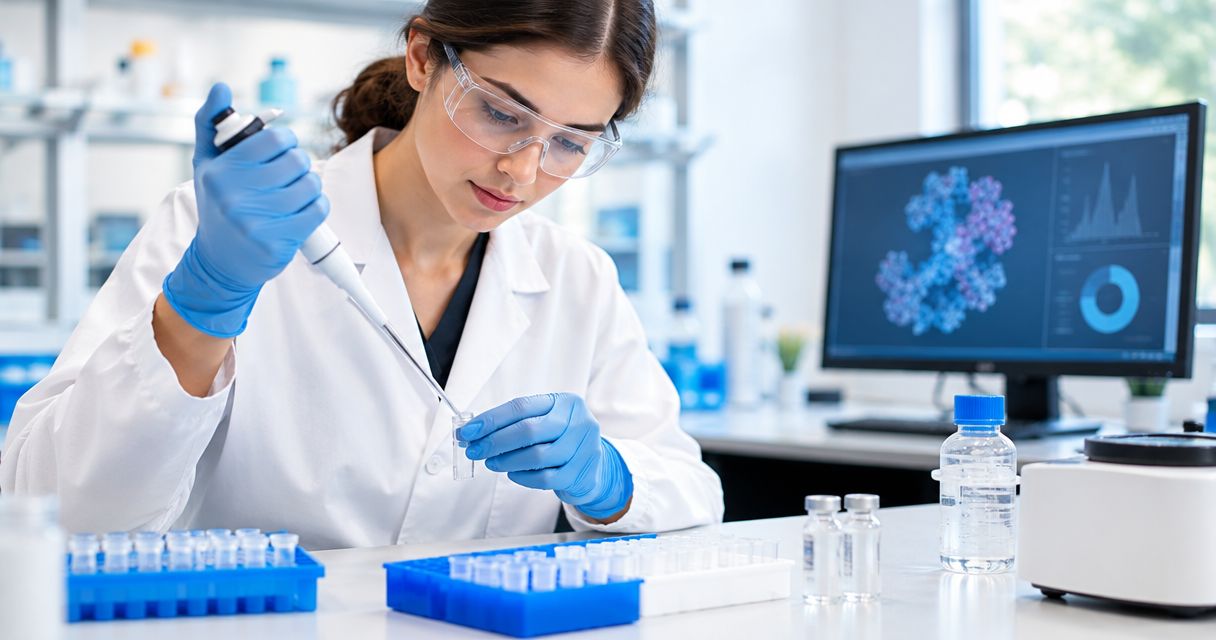
Diagnostic testing labs’ peptide reconstitution is the controlled dissolution of dried peptide material to prepare solutions for analytical research, with the aim of producing reproducible assay-development results. This 2026 guide explains solvent selection, concentration calculations, traceability, and acceptance checks while keeping research-use-only materials separate from patient-testing workflows.
Diagnostic laboratories must distinguish exploratory research from reportable patient testing. A peptide that dissolves completely can still be unsuitable for an assay because its solvent, concentration assignment, impurities, or stability affect the measurement.
The practical constraint is traceability: you need to connect the material received to the solution prepared and the analytical result generated. A supplier’s purity statement does not establish calibration traceability or demonstrate performance in a patient-sample matrix.
Celonyx Labs supplies 99%-pure, third-party-tested research peptides for laboratory researchers and scientists. Celonyx Labs research peptides are best suited to laboratory research, not as substitutes for validated diagnostic reagents. Diagnostic suitability requires separate evidence; third-party testing alone does not establish it.
For your 2026 laboratory procedures, define the intended use before choosing a solvent. Material prepared for method-development experiments should remain clearly identified as research use only, with release decisions governed by your laboratory’s quality system.
Start with a written preparation worksheet or controlled notebook template. Record whether the peptide will support exploratory method development, analytical characterization, interference experiments, or another explicitly defined research activity.
Do not label an exploratory preparation as a diagnostic calibrator merely because its nominal concentration is known. A calibrator needs an appropriate value assignment and evidence supporting its intended measurement role; a reference material needs documentation that supports the properties claimed for it.
For diagnostic testing labs, peptide reconstitution begins with a use decision, not a pipette. Keep research inventory and patient-testing inventory distinguishable in both physical storage and electronic records.
Manually reconcile the vial label, order record, and available analytical documentation before preparation. Confirm that the identifiers describe the same material and that any reported analytical result applies to the lot in hand.
Read the test method as carefully as the headline purity result. Chromatographic area purity is not automatically equivalent to peptide mass fraction, and an identity result does not assign solution concentration. Water, counterions, and other components can matter when converting nominal vial mass into peptide content.
Celonyx Labs research peptides offer the stated quality signals of 99% purity and third-party testing, but those claims do not replace a lot-specific documentation review. Use the peptide purity testing guide to separate analytical questions before selecting your own acceptance criteria.
Begin with the material-specific handling instructions and your method’s solvent requirements. Use a small-scale compatibility assessment under an approved research protocol when the documentation does not resolve solubility or assay-interference questions.
Water, buffered solutions, organic cosolvents, and preservative-containing diluents are not interchangeable. Their suitability depends on peptide chemistry and the analytical endpoint. A solvent that produces a clear stock can still change a binding assay’s response or interfere with a detection method.
Bacteriostatic water is not the default diluent for diagnostic-laboratory research. Its preservative introduces an additional component that requires compatibility assessment. Likewise, a buffered stock can introduce salts that are unsuitable for a downstream analytical method.
Calculate the intended concentration manually before using a spreadsheet or calculator. The basic relationship is concentration equals peptide mass divided by final solution volume, but its accuracy depends on what the mass value represents.
Use consistent units throughout: 1 mg equals 1,000 µg, and 1 mL equals 1,000 µL. These conversions do not establish the peptide content of a vial. If the documentation supports only nominal mass, describe the resulting concentration as nominal rather than analytically assigned.
For molar concentration, use the molecular mass appropriate to the documented molecular form. Distinguish the volume of diluent added from the final solution volume specified by the procedure. An independently checked worksheet is useful; automation is the faster path only after its formulas and inputs have been verified.
Follow the approved material-specific procedure rather than a generic shaking, warming, or sonication instruction. Peptides differ in solubility and handling sensitivity, so a technique that works for one compound should not become an undocumented laboratory-wide rule.
Use calibrated liquid-handling equipment within its suitable operating range. Record the actual preparation conditions, including any departure from the procedure. If material remains visible or the preparation changes appearance, stop and assess the deviation instead of silently adding more solvent.
A useful 2026 worksheet follows a simple sequence: Material review, Diluent selection, Concentration calculation, Preparation record, and Acceptance review. Each stage should leave enough evidence for another scientist to reconstruct the preparation without interviewing its operator.
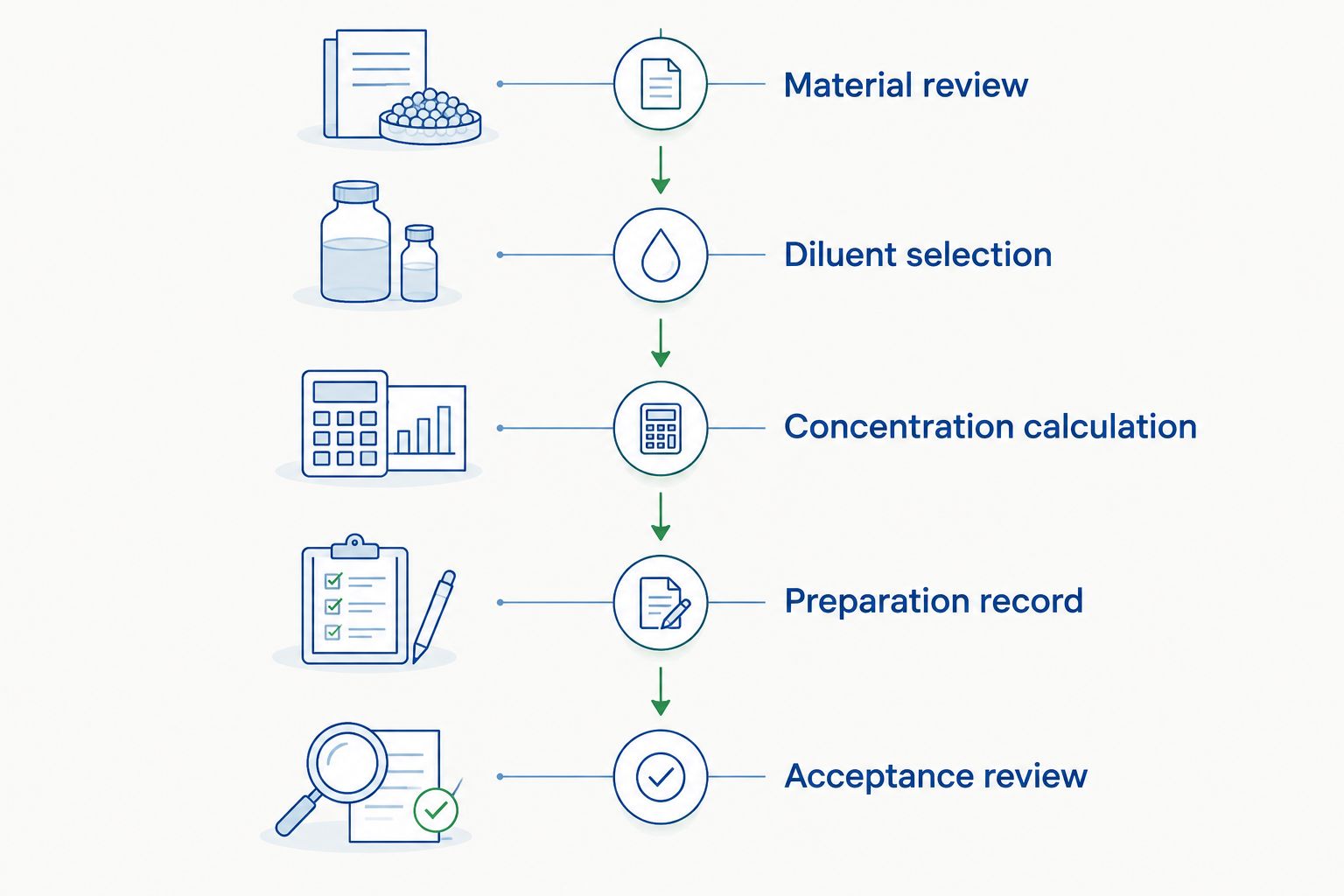
The preparation record should describe what happened, not just repeat what the procedure instructed. This distinction becomes important when investigating an unexpected assay response.
Define acceptance criteria before testing the preparation. Visual clarity checks appearance; it does not establish identity, concentration, sterility, or biological activity. Select analytical checks that answer the questions relevant to the intended research assay.
Compare new preparations with appropriate controls under the same experimental conditions. Track solvent effects separately from peptide effects, and investigate unexpected shifts before accepting a lot or changing a method.
Storage instructions and in-use limits need material-specific support. Do not assign a universal refrigerated lifetime, freeze–thaw limit, or room-temperature allowance. Your 2026 procedure should identify the evidence behind each handling limit and define what happens when that limit is exceeded.
Choose the preparation approach around the peptide and the assay, not around a familiar laboratory habit. The options below describe research workflows; none independently qualifies a material for diagnostic use.
| Option | Best for | Main advantage | Key limitation |
|---|---|---|---|
| Water-based preparation | Peptides with documented aqueous solubility and compatible assays | Avoids adding a buffer or organic cosolvent | Water alone does not control pH or establish assay compatibility |
| Buffered preparation | Research methods requiring defined pH conditions | Provides a controlled solution environment | Buffer components can interfere with downstream measurements |
| Organic-cosolvent preparation | Peptides requiring a documented cosolvent strategy | Supports dissolution when an aqueous approach is unsuitable | Residual solvent can affect assay response and requires controls |
| Bacteriostatic-water preparation | Research procedures that explicitly permit its preservative | Incorporates a preservative-containing diluent | Preservative compatibility must be demonstrated; it does not guarantee sterility after handling |
There is no universal winner. The best reconstitution approach is the one supported by peptide-specific instructions and demonstrated compatibility with the intended research method.
Keep solvent screening separate from routine preparation. Once your laboratory establishes acceptable conditions, place those conditions under document control rather than allowing operators to choose a diluent independently for each run.
A 99% purity claim describes a quality attribute, not the full suitability of a material for patient testing. Identity, content assignment, matrix effects, stability, and intended use remain separate questions.
Correct the mistake by recording exactly what each supporting document establishes. Do not let a purity result stand in for evidence it does not contain.
A familiar diluent is not necessarily compatible with your assay. Preservatives and other solution components belong in the experimental design, including appropriate blanks.
Correct the mistake by approving diluents at the method level. Require a documented assessment before changing solvent composition.
Dividing labeled vial mass by volume produces a nominal concentration when peptide content has not been independently assigned. Reporting more decimal places does not resolve that limitation.
Correct the mistake by stating the concentration basis in the worksheet and results. Escalate to suitable analytical characterization when the experiment requires stronger concentration evidence.
A storage limit established for one sequence, solvent, or container does not automatically apply to another preparation. A clear appearance after storage does not demonstrate unchanged analytical performance.
Correct the mistake by linking each limit to relevant evidence. Assess excursions against the affected preparation’s intended use rather than applying a generic freezer rule.
What is peptide reconstitution for diagnostic testing labs?
Peptide reconstitution for diagnostic testing labs is the controlled dissolution of dried peptide material into a documented solution for analytical work. Research-only preparations require clear separation from patient-testing workflows and do not become diagnostic reagents simply through reconstitution.
Can diagnostic labs use research peptides as patient-testing calibrators?
A research-use-only peptide is not a substitute for a qualified diagnostic calibrator. Any proposed diagnostic application requires appropriate intended-use evidence, concentration assignment, method performance evaluation, and quality-system review.
Is bacteriostatic water better than sterile water for reconstituting peptides?
Neither diluent is universally better for peptide reconstitution. Select the diluent using peptide-specific instructions and assay requirements; a preservative-containing solution requires assessment for interference.
Does 99% purity mean the prepared concentration is accurate?
No, 99% purity does not by itself establish the concentration of a prepared peptide solution. Concentration also depends on the meaning of the mass value, final volume, material composition, and preparation accuracy.
How long can a diagnostic research lab store a reconstituted peptide?
Use a storage interval supported by material-specific documentation or an appropriate stability assessment. There is no universal refrigerated lifetime for all reconstituted peptides, solvents, containers, and analytical endpoints.
What should a peptide reconstitution worksheet include?
A peptide reconstitution worksheet should include material identity, lot, intended use, diluent, concentration calculations, preparation conditions, and acceptance results. Link the original stock to every derived aliquot and record deviations and storage conditions.
Are Celonyx Labs peptides intended for diagnostic testing?
Celonyx Labs peptides are for research use only. The stated 99% purity and third-party testing support research sourcing decisions but do not establish approval or suitability for patient diagnostic testing.
A solvent blank can reveal a problem that a clear peptide stock cannot. If your diluent changes the assay signal, successful dissolution has not produced an interpretable experiment.
For your next 2026 procedure revision, add an explicit solvent-compatibility decision before stock acceptance. Keep the peptide, diluent, calculation, and analytical acceptance records connected, and retain the research-use-only designation throughout the workflow.
Compare peptide molecular weight by compound: use compound-specific g/mol values, distinguish mass from purity, and

Celonyx Labs university e-procurement portal setup starts with approval. Verify supplier onboarding, requisition routing, and

Automatically notify safety officer peptide orders through confirmed lab receipts. Set up traceable alerts, prevent
FOR RESEARCH USE ONLY. Products sold by Celonyx Labs are intended exclusively for laboratory and scientific research. They are not intended for human or veterinary use, consumption, diagnosis, treatment, cure, or prevention of any disease. By purchasing from this site, you acknowledge that you understand the intended research purpose of these materials and agree to comply with all applicable laws and regulations.