

Integrity Research BPC 157: How to Judge Vendor Claims
The advice you'll hear most often about buying BPC-157 for the bench is short: demand

To verify cagrilintide peptide specifications, match the vial’s lot number to a batch-specific certificate of analysis, then check identity, chromatographic purity, peptide content, and handling requirements against your laboratory’s acceptance criteria. A purity percentage alone does not establish identity, usable peptide quantity, sterility, or suitability for your assay. Release the material for research only after the documentation and supporting analytical results agree.
Verify the actual lot, not just the product description. Your acceptance decision should connect the physical vial, its certificate of analysis, the underlying test results, and the intended experiment.
Start with these checks in your 2026 receiving procedure:
A batch can meet a chromatographic purity specification while leaving other experimental requirements unresolved. The distinction matters when you compare results across lots or calculate solution concentrations from labeled vial mass.
For the broader distinction between purity and suitability, see whether 99% purity establishes research suitability. Treat that percentage as a defined analytical result, not a complete quality assessment.
Different analytical approaches answer different questions. Use the table to identify what a report establishes—and what still needs separate evidence.
| Evidence | Best for | What it supports | Main limitation |
|---|---|---|---|
| Lot-specific certificate of analysis | Documenting batch release | Reported specifications, results, and disposition | A summary does not replace underlying analytical evidence |
| HPLC or UPLC chromatogram | Reviewing chromatographic purity | Separation and relative response of detected components | Co-elution and detector response affect interpretation |
| Mass spectrometry report | Checking molecular identity | Agreement between observed mass and the expected species | Matching intact mass alone does not establish the complete structure |
| Quantitative content assay | Establishing peptide amount | Peptide quantity on a stated measurement basis | Requires a suitable method and calibration |
| Water and counterion results | Interpreting material composition | Contributions that affect mass-based calculations | Do not independently establish peptide identity or purity |
| Application-specific testing | Addressing assay requirements | Evidence for the particular attribute tested | Results do not transfer automatically to untested attributes |
Use complementary evidence rather than choosing a single “best” test. Chromatography supports purity assessment; mass spectrometry supports identity assessment. Neither substitutes for a quantitative content measurement when your experiment requires one.
A certificate should identify which tests actually occurred. If a field says only “conforms,” request the acceptance criterion, method reference, and supporting result before relying on it.
Check identifiers before interpreting analytical graphs. A technically convincing report for another batch does not verify the material in your freezer.
Use 1 lot per release record as a practical documentation rule. Attach the corresponding vial identifiers, certificate, analytical files, receiving observations, and review decision to that record; keep any links to parent manufacturing batches explicit.
Check these document fields:
For a 2026 receipt, do not confuse the receipt date with the analysis date. Record both, then evaluate the material against its documented storage history and any applicable retest or expiry information.
A third-party laboratory name is useful only when you can connect its report to the supplied lot. If authenticity is uncertain, confirm the report through independently verified laboratory contact information rather than relying solely on a forwarded attachment.
Ask 2 analytical questions separately: “Is this the specified material?” and “What proportion of the detected material meets the purity definition?” A strong answer to the second question cannot repair a weak answer to the first.
For cagrilintide, request the supplier’s structural specification, including the sequence and relevant modifications. Compare the analytical interpretation with that specification rather than with an informal product nickname.
A mass spectrometry review should explain the expected species, observed signal, charge-state assignment where relevant, and the basis for the reported molecular mass. Compare like with like: an observed mass-to-charge value is not directly interchangeable with a neutral molecular mass.
Intact mass agreement supports identity but does not prove every structural detail. Sequence isomers and some structural differences require additional characterization. Ask for sequence-level or other orthogonal evidence when your study depends on features that intact mass cannot distinguish.
Do not impose an arbitrary universal mass tolerance. The appropriate criterion depends on the analytical method, instrument performance, and the laboratory’s validated or otherwise justified procedure.
A 99% purity statement needs an analytical definition. Establish whether the result is an integrated chromatographic area percentage, a quantitative assay result, or another measurement before using it in calculations.
For HPLC or UPLC evidence, request enough method information to interpret the separation. Relevant details include the stationary phase, mobile phases, gradient or elution conditions, detection approach, sample preparation, and integration rules.
Review the supporting chromatogram for:
Chromatographic area percentage is not automatically peptide mass percentage. Detector response differs between substances, and components that the method does not detect are not fully represented by the peak-area calculation.
For your 2026 specification review, preserve the method identifier alongside the result. A percentage without its method loses important context when you compare batches later.
Labeled mass, dry material mass, and measured peptide content are not interchangeable. Water, counterions, and other non-peptide components can contribute to the material’s total mass without being represented as peptide-related chromatographic impurities.
Request a clear statement of what the labeled quantity means. If your assay requires an accurately assigned peptide concentration, ask whether a quantitative content result is available and how it was determined.
Your calculation record should distinguish these fields:
Do not correct a labeled amount by multiplying it by an HPLC purity percentage unless the analytical basis justifies that calculation. Purity correction is not a substitute for content determination.
Keep the initial specification review separate from solution preparation. Once material is dissolved, preparation errors and solution stability introduce additional questions that the original certificate cannot answer.
Specification results depend on what was tested and how the result was expressed. These factors explain why apparently similar documents need careful comparison:
Do not treat different results as contradictory until you compare their methods and reporting bases. Equally, do not dismiss a meaningful discrepancy as routine variation without an investigation.
Use a defined sequence: Document match, Identity review, Purity review, Content review, and Release decision. Each review should point to evidence rather than an unchecked box.
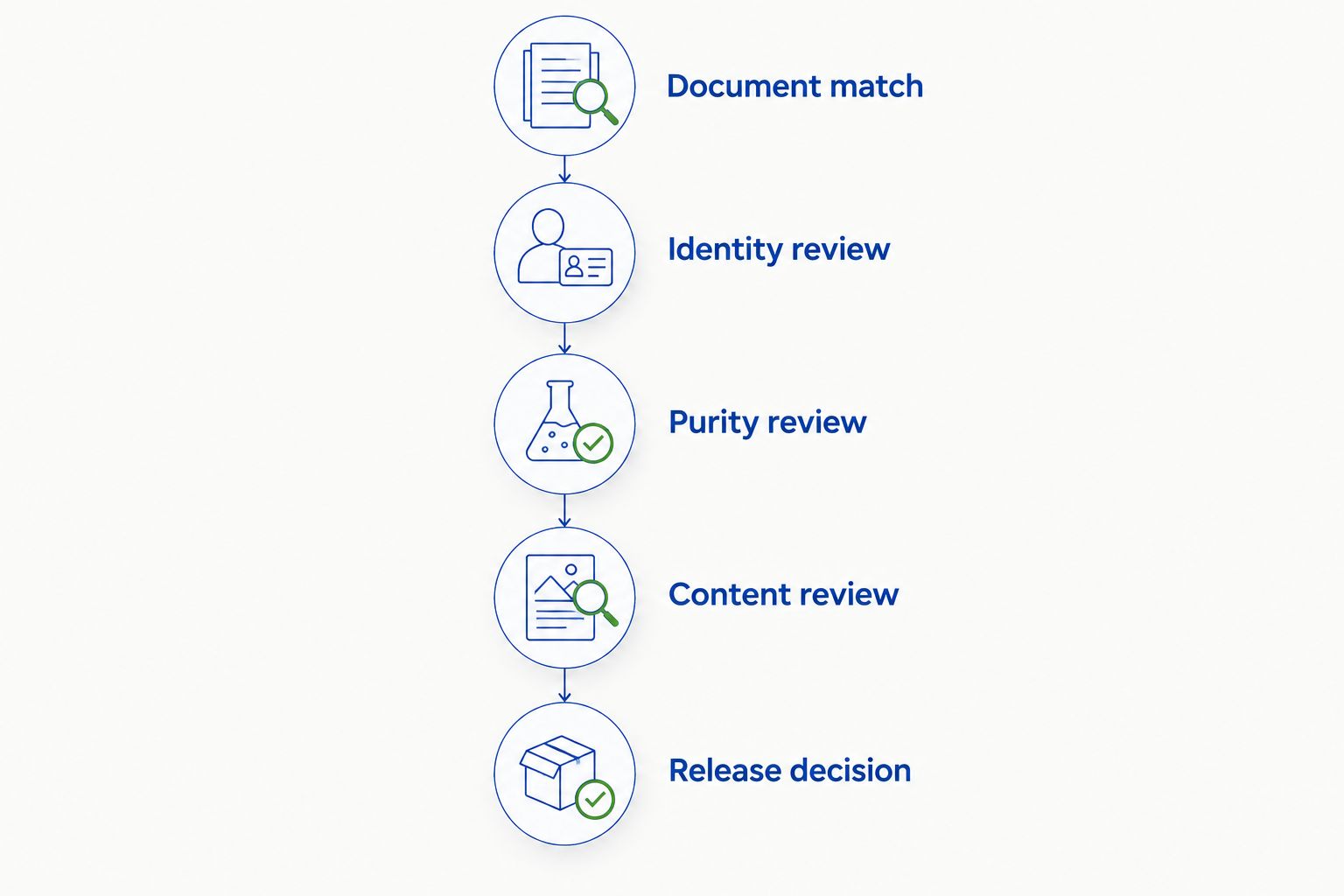
For your 2026 release record, write the actual conclusion and its scope. “Accepted for the specified analytical experiment” is more useful than an undefined statement that the peptide is “good.”
Place the lot on hold when identifiers conflict, the report lacks essential interpretation, or a required attribute remains untested. Request clarification or additional testing; do not silently convert missing evidence into a passing result.
If your laboratory proceeds under a documented exception, record the unresolved issue and its implications for the experiment. An exception does not turn an unverified attribute into a verified specification.
99% purity does not establish assay suitability by itself. The result addresses the attribute defined by its analytical method, not every possible contaminant, biological response, or handling concern.
Define additional requirements from the experiment. Sterility, bacterial endotoxins, residual solvents, or other attributes require relevant evidence when they matter to the study; do not infer them from a chromatography report.
A certificate of analysis supports verification when it is lot-specific, traceable, and backed by appropriate analytical evidence. A generic certificate or a summary with unexplained results leaves important questions unanswered.
Request underlying files when the decision depends on interpreting identity, separation, or content. Independent testing is appropriate when supplier evidence cannot resolve a material discrepancy.
Celonyx Labs is best for laboratory researchers seeking research-use-only peptides described as 99%-pure and third-party tested. Those stated quality signals are a starting point for document review, not a substitute for lot acceptance.
For Celonyx Labs research peptides, apply the same identity, purity, content, and traceability checks used for any supplier. A general catalog description does not establish a cagrilintide-specific result or a particular lot’s suitability.
Celonyx Labs quality claims should therefore be evaluated at the level your experiment requires. The strength is the stated emphasis on purity and external testing; the limitation is that those statements alone do not answer every analytical question.
What documents do I need to verify cagrilintide peptide specifications?
You need a lot-matched certificate of analysis and supporting evidence for the specifications your experiment requires. Include identity, purity, content where necessary, and relevant handling records.
Is HPLC enough to confirm cagrilintide identity?
HPLC alone does not establish complete cagrilintide identity. Use appropriate identity evidence, such as interpreted mass spectrometry, and request additional structural characterization when the study requires it.
Does 99% purity mean the vial contains 99% peptide by mass?
99% chromatographic purity does not automatically mean 99% peptide by mass. Confirm the reporting basis and request a quantitative peptide-content result when mass accuracy matters.
Should the lot number on the vial match the laboratory report?
The vial and laboratory report need a documented lot connection. Different manufacturing and packaging identifiers require traceable records explaining their relationship.
Does third-party testing prove a research peptide is sterile?
Third-party testing establishes only the attributes actually tested. Sterility requires its own relevant test evidence and cannot be inferred from identity or purity testing.
Can I accept a certificate that only says the material conforms?
A conformance statement needs a defined specification and supporting evidence. Request the method, acceptance criterion, and underlying result before relying on an unexplained statement.
What should I do if cagrilintide reports disagree?
Hold the lot while you compare identifiers, methods, reporting bases, and sample histories. Resolve the discrepancy through documented clarification or appropriate additional testing before release.
The most useful missing field is often the measurement basis. Before requesting another purity percentage, ask whether the existing number describes chromatographic area, peptide content, or total material mass.
Add that field to your 2026 receiving template. It prevents a precise-looking result from answering the wrong question. All materials discussed here are for research use only, not for human or veterinary use.
The advice you'll hear most often about buying BPC-157 for the bench is short: demand

Can cagrilintide be combined with GLP-1 peptides? Yes, in controlled research. Understand mechanisms, study controls,

Can Selank be combined with nootropic peptides? Yes, in controlled laboratory studies. Learn the controls,
FOR RESEARCH USE ONLY. Products sold by Celonyx Labs are intended exclusively for laboratory and scientific research. They are not intended for human or veterinary use, consumption, diagnosis, treatment, cure, or prevention of any disease. By purchasing from this site, you acknowledge that you understand the intended research purpose of these materials and agree to comply with all applicable laws and regulations.