

Integrity Research BPC 157: How to Judge Vendor Claims
The advice you'll hear most often about buying BPC-157 for the bench is short: demand
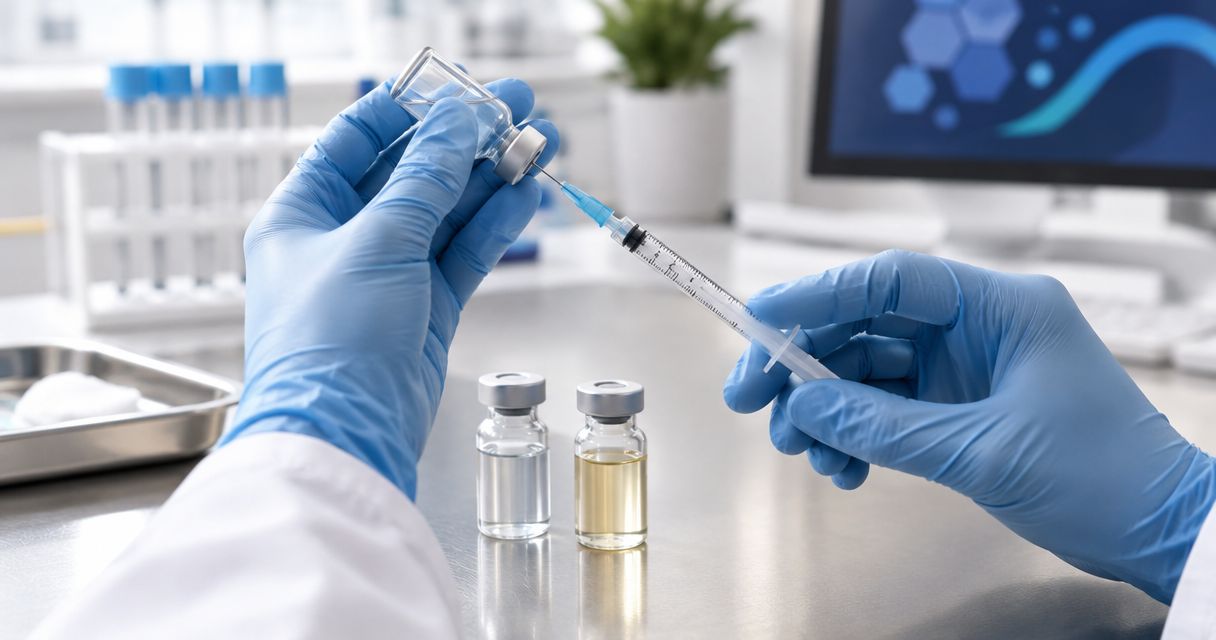
No—do not move the same single-use syringe between two different peptide vials; use a new sterile syringe and needle for each vial entry. Changing only the needle does not make a used syringe suitable for another vial, and separate syringes do not establish that the peptides are chemically compatible; this guidance concerns laboratory research, not self-administration.
Moving a syringe between peptide stocks creates a route for chemical carryover and microbial contamination. Once material enters another stock vial, the problem extends beyond the sample you intended to prepare: subsequent experiments draw from a potentially altered source.
Celonyxlabs sells research peptides for laboratory researchers and scientists. For a 2026 laboratory workflow, keep supplier quality documentation and bench handling controls separate: neither replaces the other.
The practical distinction is simple. A syringe that looks empty is not evidence of a clean, uncontaminated fluid path.
Do not reuse a single-use syringe across different peptide vials. Residual liquid in the needle, hub, or barrel can carry material from the first vial into the second, even when you do not deliberately dispense liquid back into it.
Use the following distinctions when writing your laboratory procedure. These are handling choices, not peptide-specific compatibility findings.
| Handling approach | Best for | Advantage | Limitation or problem | Verdict |
|---|---|---|---|---|
| New sterile syringe and needle for each vial entry | Keeping source stocks separate | Avoids transferring residue from a previously used syringe | Requires additional consumables and correct aseptic technique | Use |
| Same syringe with a replacement needle | No routine cross-vial use | Replaces the needle component only | Leaves the previously used barrel and fluid path in service | Skip |
| Same syringe and needle across different vials | No routine cross-vial use | Reduces consumable use | Creates a direct route for carryover and contamination | Skip |
| Validated reusable laboratory dispensing equipment | Methods specifically designed for reusable equipment | Supports controlled repeated transfers | Requires documented cleaning and carryover acceptance criteria | Use only within validation |
The reusable-equipment exception does not turn a disposable syringe into a reusable instrument. Follow the device labeling and your approved laboratory procedure rather than improvising a cleaning method.
For cross-vial handling, treat a syringe as used once it has contacted a stock solution, sample, or another potentially contaminating surface. It does not need to have contacted a person or animal to create a laboratory carryover problem.
A syringe used only for diluent still has a handling history. Once the assembly enters a peptide vial, do not return it to a shared diluent container or use it to access another peptide stock.
The no-reuse rule for single-use syringes stays the same. The additional controls depend on what your laboratory needs to protect:
These factors explain why a laboratory procedure needs more detail than simply stating that the materials are research grade. They do not justify moving a used disposable syringe between stocks.
For a 2026 procedure review, build separation into the workflow before opening containers. Do not rely on remembering which syringe contacted which solution halfway through preparation.
The purpose is source protection, not merely a tidy bench. Separate equipment loses its value if labels are exchanged or a working sample is returned to the wrong stock.
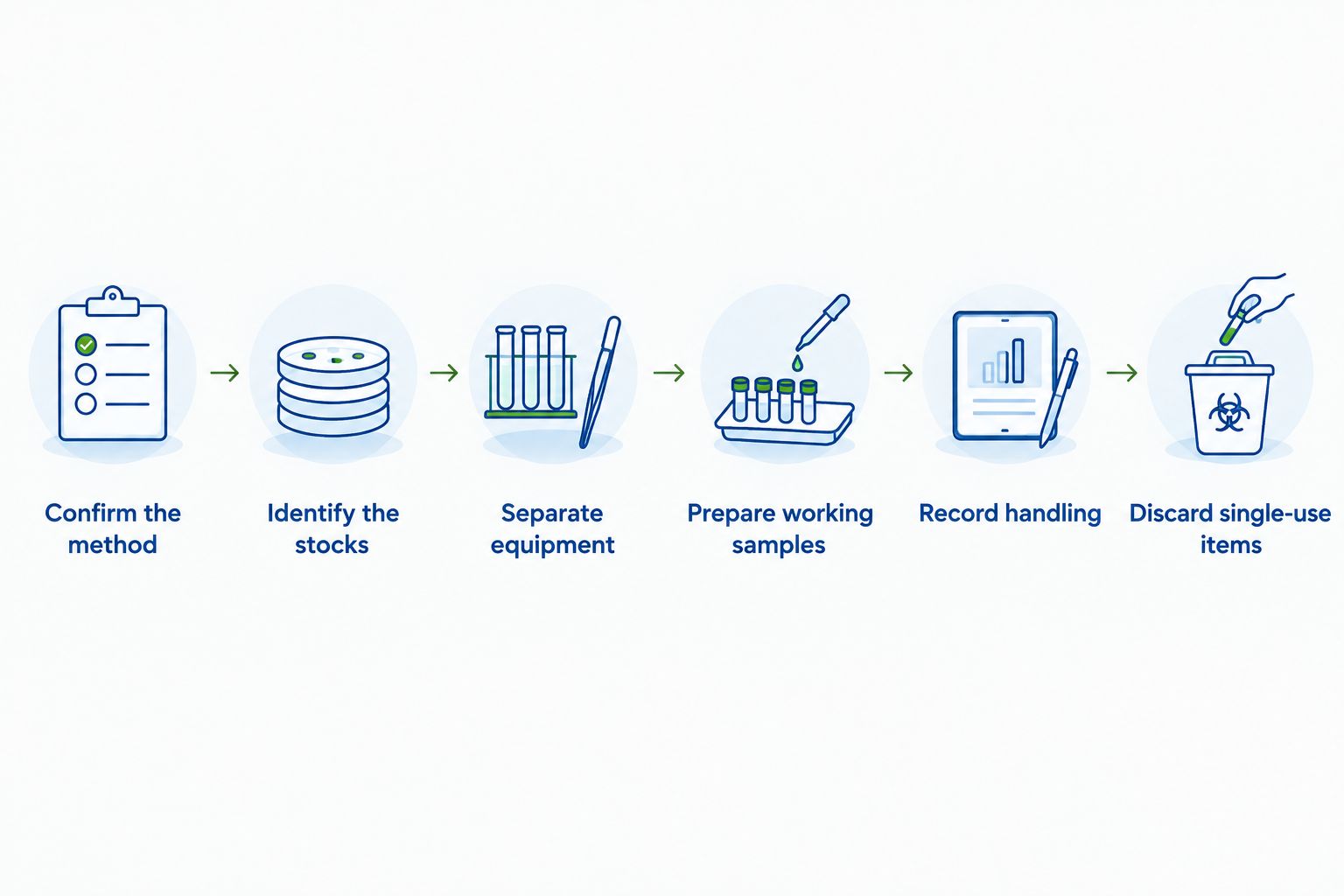
A working aliquot also needs its own controls. Label its contents and follow the method's storage and use instructions; transferring material into another vessel does not establish a new shelf life.
No. Replacing the needle does not replace the syringe barrel or remove its residual contents. The new needle becomes connected to an already used fluid path.
This distinction matters even when your concern is analytical purity rather than infection. A trace of another peptide or buffer can introduce an uncontrolled variable without producing visible cloudiness or discoloration.
Do not use rinsing, wiping, or an alcohol treatment as an improvised reset for a single-use syringe. A validated cleaning procedure for reusable laboratory equipment is a different process, with defined acceptance criteria and documented evidence.
No. Bacteriostatic water does not remove peptide carryover or sterilize previously used transfer equipment. Its preservative function is not permission to move the same syringe between containers.
Chemical carryover and microbial contamination are separate problems. Even where a preservative inhibits susceptible microorganisms, it does not identify or remove an unintended peptide, buffer component, or other residue.
For your 2026 handling procedure, distinguish the permitted use of the diluent container from the permitted use of the transfer device. A container intended for repeated access still requires a new sterile needle and syringe for each entry.
No—high peptide purity does not establish sterility, compatibility, or freedom from handling-related contamination. Those are separate quality questions.
Celonyxlabs describes its research peptides as 99%-pure and third-party-tested. Those quality signals support sourcing decisions, but they do not validate syringe reuse or establish the condition of a preparation after laboratory handling.
A label stating 5 mg or 10 mg describes material quantity, not permission to share transfer equipment. Likewise, a purity percentage does not tell you whether a second compound has entered the vial after opening.
Celonyxlabs research peptides are for laboratory researchers, not human administration. Review the scope of each test report instead of treating a purity result as a substitute for every other quality attribute.
Yes. Deliberately combining peptides is an experimental-design decision; sharing transfer equipment is a contamination-control decision. Permission to study compounds together does not establish permission to move one used syringe between their stock vials.
Compatibility depends on the actual compounds and preparation conditions, including solvent, pH, concentration, contact time, and container materials. A clear-looking mixture does not demonstrate preserved identity, stability, or biological activity.
The question can you mix two different peptides in the same syringe therefore requires a separate assessment from whether you can reuse the transfer device. Keep source stocks separate even when an approved method calls for combining separately withdrawn aliquots.
Document the intended mixture and its supporting evidence in the method. Do not let accidental carryover become an undocumented substitute for a controlled combination experiment.
A 2026 research-handling article does not establish a treatment regimen. Research-use-only labeling is not an instruction for human injection, and laboratory handling controls do not establish clinical safety.
The clinical question of combining Sermorelin with GLP-1 medication concerns medication use, not permission to share a syringe between research stocks. Even when compounds appear in the same clinical discussion, that association does not establish physical compatibility or authorize combining preparations.
If your question concerns prescribed medication rather than a laboratory assay, ask the prescribing clinician or dispensing pharmacist about the specific products and devices. Do not transfer conclusions from research materials to medicines intended for patients.
Stop using the affected materials and document the event before continuing the experiment. Set aside the implicated vials under your laboratory's deviation procedure so another researcher does not unknowingly use them.
Record the source and destination containers, lot identifiers, transfer sequence, and any subsequent samples prepared from them. Describe what happened without assuming that an empty-looking syringe transferred nothing.
Have the responsible laboratory lead or quality function assess the impact. Depending on the study and available evidence, the disposition can involve testing, replacement, or rejection of affected material; visual inspection alone cannot establish that carryover did not occur.
Do not attempt to correct the problem by adding more solvent or withdrawing liquid from the second vial. Neither action establishes the identity or amount of unintended material already introduced.
No—absence of injection does not eliminate cross-vial carryover. A syringe that has contacted the first peptide solution can transfer residue to the second stock, so use new sterile single-use equipment for the next vial entry.
No—matching peptide names do not make different stock vials interchangeable. Separate vials can have different lots, preparation histories, or concentrations, and shared equipment compromises that separation.
Do not reuse a syringe labeled for single use after improvised cleaning. Reusable laboratory equipment belongs under a validated cleaning procedure; household washing, flushing, or wiping does not supply that validation.
Can I use the same syringe for multiple peptides?
No—do not move a used single-use syringe between different peptide vials. Use a new sterile syringe and needle for each vial entry to avoid transferring residue or contamination.
Is a new needle enough when switching peptide vials?
No—a new needle leaves the previously used syringe barrel and fluid path in service. Replace the complete single-use assembly rather than only the needle.
Can I reuse a syringe if it only touched bacteriostatic water?
Do not reuse single-use transfer equipment between vial entries. Bacteriostatic water does not sterilize a used syringe or remove chemical residue from its fluid path.
Does 99% peptide purity mean a vial is sterile?
No—99% purity does not establish sterility. Purity and sterility require different assessments, and handling after opening introduces separate contamination risks.
Can I mix two research peptides if I use separate syringes?
Separate syringes control one route of carryover but do not establish peptide compatibility. Combine materials only when the approved research method and supporting evidence cover the actual preparation conditions.
What should a laboratory do after accidental syringe reuse between vials?
Stop using the implicated materials and document the transfer sequence. Follow the laboratory’s deviation procedure so the responsible lead can assess affected stocks and experiments.
Does this 2026 guidance apply to injecting research peptides?
No—this guidance concerns laboratory handling, not human administration. Research-use-only peptides are not instructions or recommendations for self-injection.
The most important container to protect is the source vial. A compromised working sample affects that preparation; a compromised stock can affect every later experiment supplied from it.
Before starting your next preparation, make the clean-to-used boundary visible on the bench. Keep unopened transfer equipment separate from discarded equipment, and never return a used assembly to the source-access area.
The advice you'll hear most often about buying BPC-157 for the bench is short: demand

Can cagrilintide be combined with GLP-1 peptides? Yes, in controlled research. Understand mechanisms, study controls,

Can Selank be combined with nootropic peptides? Yes, in controlled laboratory studies. Learn the controls,
FOR RESEARCH USE ONLY. Products sold by Celonyx Labs are intended exclusively for laboratory and scientific research. They are not intended for human or veterinary use, consumption, diagnosis, treatment, cure, or prevention of any disease. By purchasing from this site, you acknowledge that you understand the intended research purpose of these materials and agree to comply with all applicable laws and regulations.