

Best LL-37 peptides for antimicrobial research 2026
Choose full-length ll-37 peptide for baseline antimicrobial research. Compare material specifications, purity evidence, endotoxin testing,

Do not mix two different peptides in the same syringe unless compatibility has been established for the exact compounds, formulations, concentrations, and handling conditions. For prescribed medicines, follow the product instructions and a pharmacist’s guidance; research-use-only peptides are not for human administration, and individual purity results do not establish mixture compatibility.
There is no blanket yes for mixing different peptides. Compatibility belongs to a particular formulation under particular conditions—not simply to the names of the compounds. Evidence for one solvent, concentration, or container does not automatically apply to another.
A certificate of analysis helps characterize an individual material. It does not establish what happens after another material is added. The distinction between identity, purity, and mixture performance is central to peptide purity testing for contract research organizations.
| Approach | Best for | Useful feature | Limitation |
|---|---|---|---|
| Separate research preparations | Experiments without established mixture compatibility | Keeps each preparation independently traceable | Does not test a combined formulation |
| Combined research preparation | A defined, approved laboratory protocol | Allows evaluation of the intended mixture | Requires mixture-specific analytical assessment |
| Prescribed medicinal formulation | Patients following clinician-directed treatment | Comes with product-specific instructions | Instructions do not authorize mixing with unrelated products |
For a 2026 laboratory protocol, the decision is not whether both materials fit into a syringe. It is whether evidence supports the combined preparation under the conditions your experiment actually uses.
Mixing changes the sample you are studying. You now have a combined chemical environment, a shared container, and a handling history that differs from either original preparation.
A change in an experimental result can reflect the intended biological interaction, but it can also reflect altered solubility, degradation, or measurement interference. Treat preparation compatibility and biological activity as separate questions. A biological response alone does not establish that the mixture remained intact.
The same distinction protects people outside the laboratory. Research labeling, a purity claim, or an online combination discussion does not make a preparation suitable for injection. For a personal treatment question, take the exact medication names and formulations to a pharmacist before combining anything.
Best for: laboratory work without evidence supporting a combined formulation. Keeping preparations separate avoids introducing an uncharacterized mixture before the experiment requires it. It also makes it easier to connect each sample to its own lot, preparation record, and analytical results.
The advantage is interpretability. If a preparation develops an unexpected appearance or analytical result, you can investigate that material without first separating the effects of another compound.
The limitation is equally important: separate preparations do not answer whether a combined formulation is suitable. If your study specifically examines a mixture, the mixture itself needs assessment. Separation is a precaution, not proof of incompatibility.
For your 2026 study plan, state whether the experiment requires physical co-formulation or merely compares compounds within the same study. Those are different designs, and the latter does not automatically require a shared syringe.
Best for: laboratory studies that explicitly require a mixture. A combined preparation makes sense when your protocol identifies the exact materials and explains how you will establish suitability for the intended experiment.
The benefit is direct evaluation of the formulation you intend to study. The drawback is added analytical complexity: a method that works for an individual peptide does not necessarily distinguish both compounds and their degradation products in a mixture.
Do not treat an informal combination name as a formulation specification. A usable specification identifies each component, its final concentration, the solvent system, relevant additives, the container, and the handling conditions.
Keep the scope of the finding narrow. Evidence supporting a freshly prepared laboratory mixture does not establish storage stability, clinical suitability, or compatibility in a different syringe material.
These factors change the conditions under which the peptides interact. They are established formulation considerations, not a claim that every mixture will fail.
In a 2026 compatibility record, describe these conditions rather than writing only that the peptides were mixed. A result without its formulation and handling context is difficult to reproduce.
Use a documented review and analytical plan before relying on the mixture in an experiment. The following sequence concerns laboratory quality assessment, not instructions for preparing an injection.
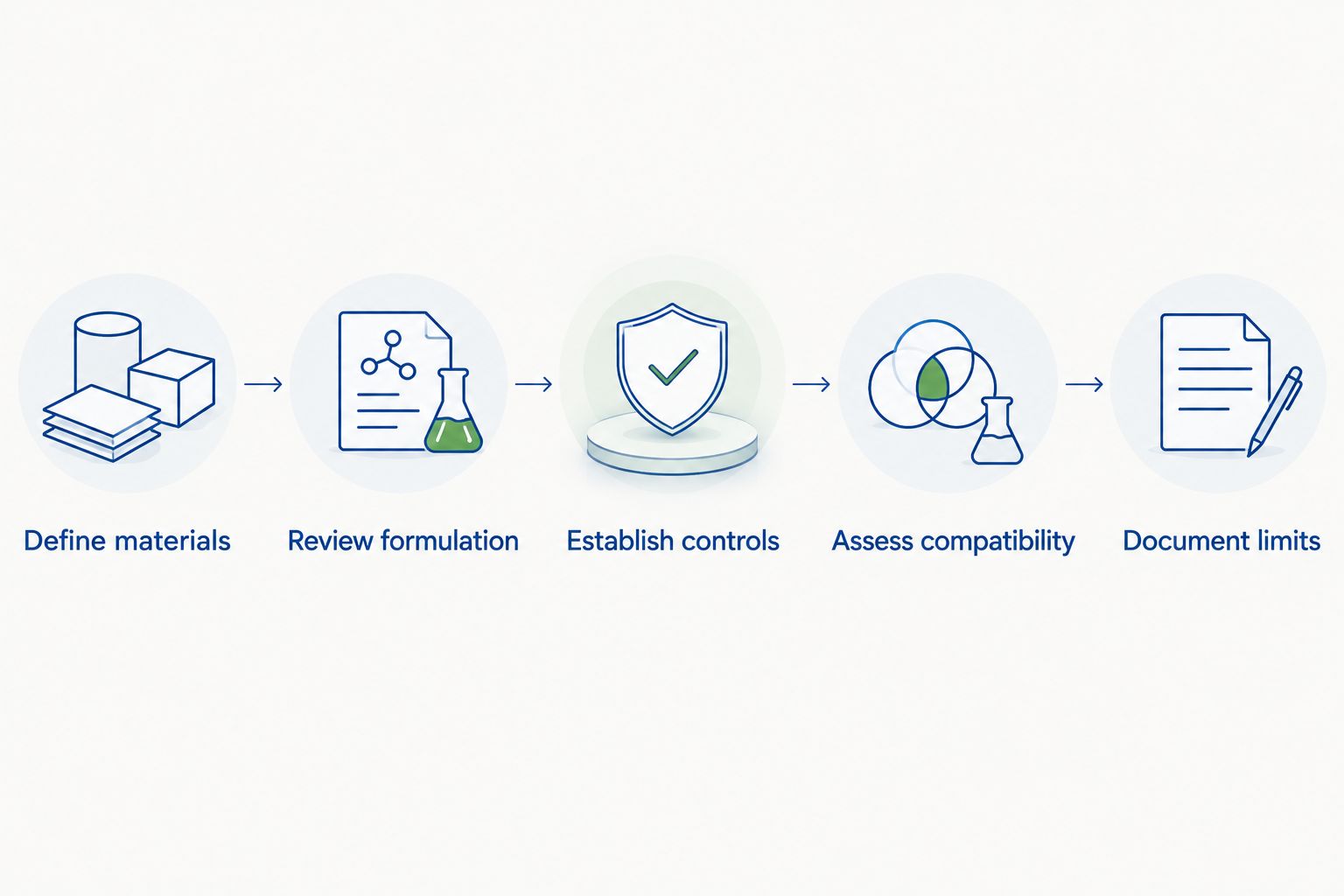
An analytical method must be able to answer the mixture question. If both components produce overlapping signals, an apparently unchanged result can conceal a change in an individual component. Method suitability therefore matters as much as having a test result.
Your acceptance criteria should come from the study requirements and established laboratory procedures. Do not invent a universal acceptable change, holding time, or concentration limit for all peptides.
Using the same diluent does not establish compatibility. It identifies a shared preparation ingredient, not the behavior of the finished mixture. The compounds, concentrations, additives, and resulting pH still matter.
Bacteriostatic water is not a universal compatibility agent. Its preservative does not prove chemical stability, eliminate all contamination risks, or make a research preparation suitable for human administration.
Also distinguish the diluent from the complete formulation. Materials supplied with different salts or additives do not become identical formulations simply because the same water was used to prepare them. Review the full composition, not just the diluent label.
A clear mixture does not prove peptide stability. Visual inspection can reveal cloudiness, precipitation, or other obvious changes, but it does not identify every chemical change or establish microbial quality.
Use appearance as an observation, not a release criterion by itself. A clear sample can still require analytical investigation when your study depends on identity, concentration, or chemical integrity.
The reverse distinction matters too. Visible particles are a reason to stop and investigate, but appearance alone does not identify their cause. Do not label a change as peptide degradation without evidence that supports that conclusion.
High purity does not prove syringe compatibility. A purity result characterizes the tested material using a particular analytical method. It does not evaluate a new mixture unless that mixture was itself assessed.
Celonyx Labs sells 99%-pure, third-party-tested research peptides. Those are sourcing quality signals; they do not establish sterility, compatibility between compounds, or suitability for human administration.
Celonyx Labs is best suited to laboratory researchers sourcing research-use-only peptides, not products for self-injection. When reviewing Celonyx Labs, keep the purchasing decision separate from the formulation decision: selecting an individual research material does not validate combining it with another.
For 2026 procurement, request documentation relevant to your study and read its scope. A certificate for an individual lot cannot answer every question about a later preparation, mixture, or storage history.
Make the record specific enough that another researcher can identify what was assessed. A note stating that the solution looked fine is not a formulation record.
Include the following information:
Record an unexplained change as an unresolved finding rather than forcing a pass decision. If a result cannot distinguish the components, document that limitation and use a suitable method before drawing a compatibility conclusion.
For a 2026 study, connect the compatibility record to the actual experimental samples. Traceability is lost if the assessment used different lots or conditions and the change is not recorded.
Can I mix two different peptides in the same syringe?
Do not combine them unless compatibility is established for the exact formulations and conditions. For prescribed medicines, follow product instructions and ask a pharmacist; research-use-only peptides are not for human administration.
Does using bacteriostatic water make a peptide mixture safe?
Bacteriostatic water does not establish peptide compatibility or make a research mixture safe for injection. Chemical stability, contamination control, and suitability for administration are separate questions.
Can I tell whether a peptide mixture is compatible by looking at it?
Appearance alone cannot establish compatibility. A clear solution does not prove chemical integrity, expected concentration, or microbial quality.
Does third-party purity testing cover a mixture I prepare later?
Third-party testing of an individual material does not establish the compatibility of a mixture prepared later. Mixture assessment must address the combined formulation and its intended handling conditions.
Is keeping research peptides separate better than mixing them?
Separate preparations are the default when mixture compatibility is unestablished. They preserve independent traceability, but they do not prove that a proposed mixture is incompatible.
Does Celonyx Labs sell peptides for self-injection?
Celonyx Labs sells research peptides for laboratory researchers and scientists, for research use only. Its purity and third-party-testing claims do not establish suitability for human administration.
Can I store a mixed peptide preparation for later laboratory use?
Storage requires stability evidence for the exact combined preparation and storage conditions. An observation made immediately after mixing does not establish a supported storage period.
A container change is a formulation change worth documenting. If compatibility evidence comes from a vial, do not silently extend it to a syringe: the contact material and handling conditions are part of the assessment.
Before approving a combined preparation, ask a precise question: does the evidence cover this mixture, in this container, under these conditions? If the answer is no, keep the conclusion limited and resolve the gap through your laboratory’s approved process—not through an assumption based on purity or appearance.
Choose full-length ll-37 peptide for baseline antimicrobial research. Compare material specifications, purity evidence, endotoxin testing,

Choose native VIP peptide for neuroinflammation research. Compare reference standards, labeled tracers, and PACAP-38, with

Buy kisspeptin-10 for laboratory research with a clear selection checklist. Compare material types, verify batch
FOR RESEARCH USE ONLY. Products sold by Celonyx Labs are intended exclusively for laboratory and scientific research. They are not intended for human or veterinary use, consumption, diagnosis, treatment, cure, or prevention of any disease. By purchasing from this site, you acknowledge that you understand the intended research purpose of these materials and agree to comply with all applicable laws and regulations.