

Integrity Research BPC 157: How to Judge Vendor Claims
The advice you'll hear most often about buying BPC-157 for the bench is short: demand

DSIP can be purchased for legitimate laboratory research when the transaction complies with applicable federal, state, and import requirements; a research-use label alone does not establish legality. In 2026, the key distinction is between buying a laboratory reagent and buying a substance intended for human treatment. Do not treat a research-only DSIP purchase as permission for self-administration or clinical use.
A supplier accepting your order does not establish that your proposed use is lawful. Payment processing, delivery, analytical purity, and permission to conduct research answer different questions.
For a U.S. laboratory purchasing DSIP in 2026, the practical task is to document the intended experiment and identify the rules that apply before ordering. Start with the broader distinction explained in research peptide purchasing rules in the United States, then assess the specific transaction rather than assuming every peptide has the same status.
There is no blanket authorization created by the words “for research use only.” A genuine laboratory purchase and a product marketed for human treatment raise different regulatory questions, even when the vial carries the same chemical name.
DSIP stands for delta sleep-inducing peptide and contains 9 amino acid residues. Its name does not establish an approved medical indication, and its use in a published experiment does not authorize a different buyer's proposed application.
The following comparison separates purchasing contexts. These are compliance distinctions, not declarations that a particular order has received regulatory approval.
| Purchasing context | What supports the research purpose | What remains unresolved |
|---|---|---|
| Analytical laboratory work | A defined identity, purity, or method-development objective | Applicable purchasing rules and material suitability |
| Nonclinical biological research | A documented protocol and relevant institutional review | Whether the specific model requires additional oversight |
| Human-subject investigation | A formal regulatory and ethics assessment | Whether an investigational new drug application or an exemption applies |
| Personal sleep experimentation | A seller's research label does not establish a legitimate clinical pathway | Human-use legality, safety, and medical authorization |
| Overseas procurement | Accurate compound identification and transaction records | Import admissibility and destination-specific requirements |
Separate 2 decisions: whether your institution can acquire the material and whether your institution can conduct the proposed experiment. Approval of the first decision does not settle the second.
For analytical or other nonclinical work, describe what you intend to measure before selecting a supplier. A useful procurement description identifies the compound, the experimental system, the endpoint, and the responsible laboratory.
Avoid vague descriptions such as personal research when the intended activity is self-administration. Calling an activity research does not change what actually happens to the material.
A defensible purchasing file should let someone outside the project understand why DSIP is needed. Include the protocol reference, requested material specifications, receiving location, and person responsible for accepting the shipment.
For a 2026 procurement review, preserve the supplier's product description as it appeared when you assessed the purchase. This records the representations you considered; it does not prove that those representations were accurate or legally sufficient.
Recommended approach: approve a defined research purpose, not merely a product name. A purchase request that says only DSIP leaves the central intended-use question unanswered.
A laboratory reagent purchase does not authorize administration to people. Human-subject research introduces separate requirements involving the protocol, participant protection, institutional review, and applicable drug-investigation rules.
FDA's investigational new drug framework appears in Title 21 of the Code of Federal Regulations, Part 312. Section 312.2 addresses applicability and exemptions; Section 312.40 addresses general requirements for use of an investigational new drug in a clinical investigation.
Do not assume that describing a study as academic, exploratory, or investigator-led removes these requirements. Whether an exemption applies depends on the actual investigation and the conditions in the regulation.
Pause procurement for human administration until the responsible regulatory and ethics reviewers establish the applicable pathway. A supplier's willingness to ship is not a substitute for that determination, and an institutional purchase order does not constitute FDA authorization.
Buying DSIP with the intention of using it to treat sleep problems is different from acquiring it for a laboratory assay. The distinction rests on actual intended use, not the wording you select at checkout.
FDA's intended-use regulation, Title 21 CFR Section 201.128, addresses evidence relevant to a product's intended use, including representations and circumstances surrounding distribution. A disclaimer is therefore not the only relevant evidence.
Do not use supplier testimonials, informal protocols, or a purity report as instructions for human administration. Those materials do not establish clinical safety or authorization to market a treatment.
If your objective is managing a sleep concern, consult a licensed clinician about appropriate evaluation and treatment. Research-only DSIP is not a substitute for a clinical care pathway.
The question is not answered by purity alone. Your 2026 assessment should address the circumstances of the proposed transaction and experiment.
Do not infer the answer for DSIP from a different peptide. Similar product categories do not establish identical regulatory treatment, and a supplier's general research disclaimer does not replace a compound-specific assessment.
Use a documented review sequence rather than treating checkout as the compliance checkpoint. Assign a responsible person to resolve unanswered questions before the laboratory commits to the order.
This sequence keeps legal assessment, analytical assessment, and experimental authorization distinct. None of these checks substitutes for the others.
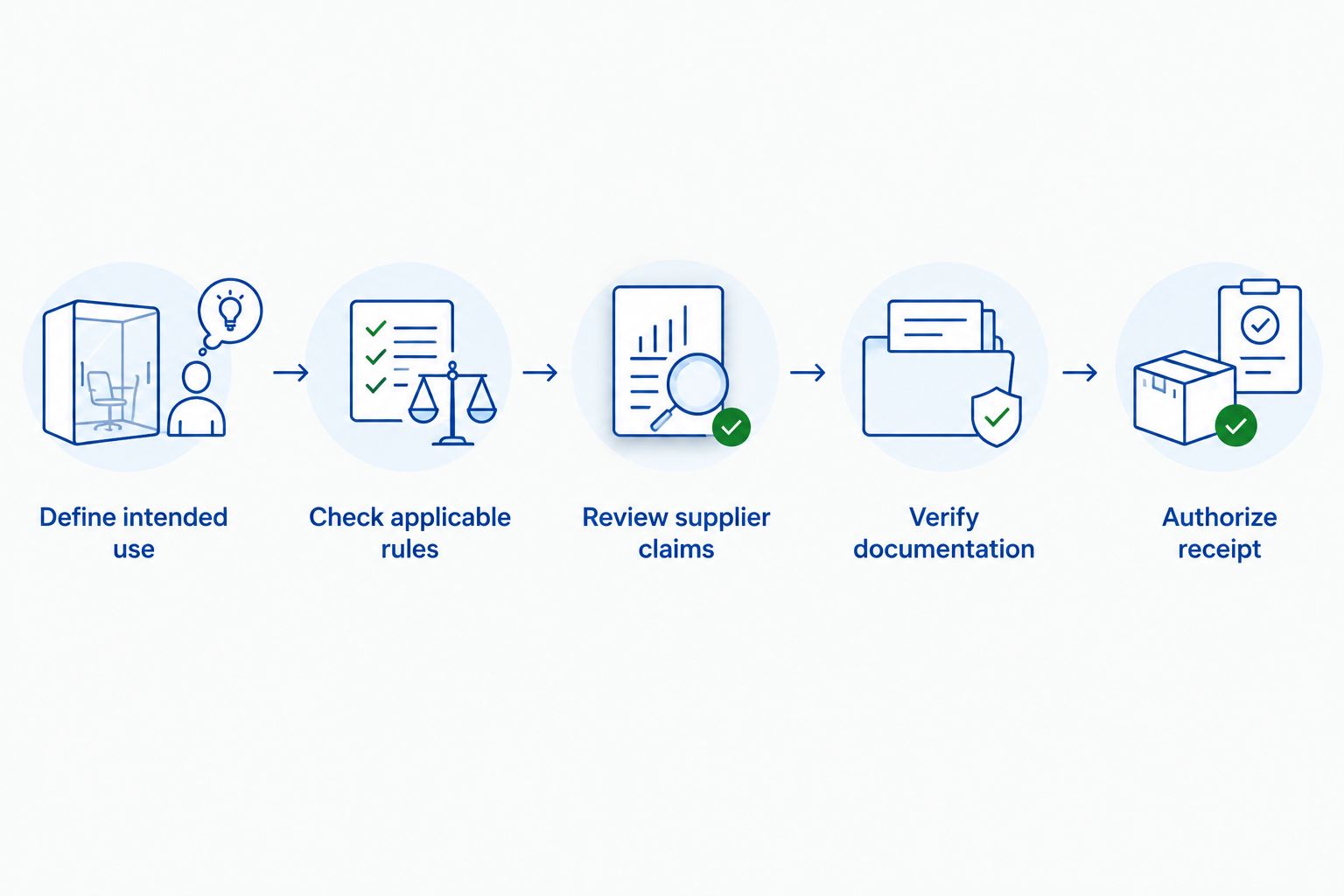
A useful stopping rule is straightforward: if you cannot explain the intended use or identify the responsible reviewer, do not release the purchase. Missing analytical documents and unresolved legal questions require different follow-up, but both belong upstream of experimental use.
Third-party testing addresses analytical questions, not legal authorization. A laboratory report can support an assessment of identity or purity within the scope of the methods reported; it does not authorize human administration, importation, or a clinical investigation.
Read a certificate of analysis as a method-specific document. Check the lot identifier, test date, reported method, result, and connection to the supplied material rather than relying on a badge or headline percentage.
A reported 99% purity result does not mean that every property relevant to your experiment has been tested. Chromatographic purity, peptide content, sterility, and endotoxin assessment are different measurements, and a result for one does not establish the others.
Celonyxlabs is best suited to laboratory researchers sourcing research peptides, not consumers seeking sleep treatments. Celonyxlabs describes its research peptides as 99%-pure and third-party-tested; these quality signals support supplier evaluation but do not determine whether a particular DSIP transaction or protocol is lawful.
An overseas order requires its own import assessment. A vendor's ability to dispatch a parcel does not establish that the shipment is admissible at its destination.
Before ordering, give your institution's import specialist or customs broker an accurate description of the compound, intended use, origin, and shipping arrangement. Ask which declarations and supporting records apply to that specific transaction.
Do not describe a research peptide as an unrelated material to simplify clearance. Keep the invoice, product description, and research-purpose documentation consistent with the actual shipment.
For international DSIP procurement in 2026, obtain the applicable requirements before dispatch rather than waiting for a customs query. A domestic supplier review and an import review are separate tasks; completing one does not complete the other.
Keep enough documentation to reconstruct the purchasing decision and connect the received material to the experiment. An invoice proves a transaction occurred, not that every regulatory or analytical requirement was satisfied.
Your research file should contain:
Record unresolved discrepancies before experimental release. If the vial identifier does not match the analytical report, obtain clarification instead of assuming the document applies.
This documentation supports traceability. It does not retrospectively authorize an activity that required approval before it began.
Is DSIP legal to buy for research in the United States?
A DSIP research purchase requires a transaction-specific assessment of intended use, applicable law, and any import requirements. A research-use-only label does not provide blanket authorization or permission for human administration.
Does a research-use-only label make DSIP legal?
No, a research-use-only label does not by itself establish legality. Product claims, actual intended use, jurisdiction, and the circumstances of distribution also matter.
Can I buy research DSIP to help me sleep?
A research-only DSIP purchase is not a medical treatment pathway. If you are seeking help with sleep, consult a licensed clinician rather than treating laboratory material as a consumer medicine.
Does 99% purity mean DSIP is safe for human use?
No, 99% purity does not establish safety for human use. A purity result does not by itself demonstrate sterility, clinical safety, or authorization for administration.
Do I need an IND to study DSIP in people?
Human DSIP research requires an assessment under the applicable investigational drug framework, including whether an IND is required or a valid exemption applies. Obtain that determination through the responsible regulatory and ethics reviewers before administration.
Can I import DSIP if the seller marks it for research?
A research label does not guarantee import admissibility. Review the compound, intended use, shipment details, and destination requirements with the responsible import specialist before ordering.
Does Celonyxlabs third-party testing establish legal approval?
No, Celonyxlabs third-party testing is a quality signal, not legal approval. Your laboratory must separately assess the proposed purchase, intended experiment, and applicable requirements.
Ask what the purchase authorizes—and what it does not. A completed order, a delivered vial, and an acceptable purity report still do not answer whether a particular experiment has the required authorization.
For your next DSIP request, attach the intended-use statement to the purchase approval instead of leaving it in a separate email. That gives procurement, compliance, and the receiving laboratory the same description of the planned work.
This 2026 guide provides general U.S. research-procurement information, not legal advice or instructions for human use. Research peptides are for research use only, not for human consumption.
The advice you'll hear most often about buying BPC-157 for the bench is short: demand

Can cagrilintide be combined with GLP-1 peptides? Yes, in controlled research. Understand mechanisms, study controls,

Can Selank be combined with nootropic peptides? Yes, in controlled laboratory studies. Learn the controls,
FOR RESEARCH USE ONLY. Products sold by Celonyx Labs are intended exclusively for laboratory and scientific research. They are not intended for human or veterinary use, consumption, diagnosis, treatment, cure, or prevention of any disease. By purchasing from this site, you acknowledge that you understand the intended research purpose of these materials and agree to comply with all applicable laws and regulations.