

Research peptide subcutaneous injection: Not safe in 2026
Is subcutaneous injection safe for research peptides? No—purity does not establish human safety. Learn what

Research peptides can be shipped internationally when the specific compound, intended laboratory use, export requirements, destination-country rules, and carrier acceptance permit the shipment. In 2026, a research-use-only label does not establish import eligibility, and a supplier’s willingness to dispatch a parcel does not guarantee customs clearance.
International peptide procurement requires separate decisions about legal entry and scientific suitability. A parcel that clears customs still needs an acceptable handling history before your laboratory releases its contents for experiments.
Celonyx Labs sells research peptides for laboratory researchers and scientists. Its stated purity and third-party testing address material quality, not permission to import a particular compound into your country. Keep those questions separate when assessing any supplier.
For a 2026 procurement file, record the basis for both decisions: why the material is eligible for entry and why its documented condition meets your laboratory’s requirements. A tracking number answers neither question.
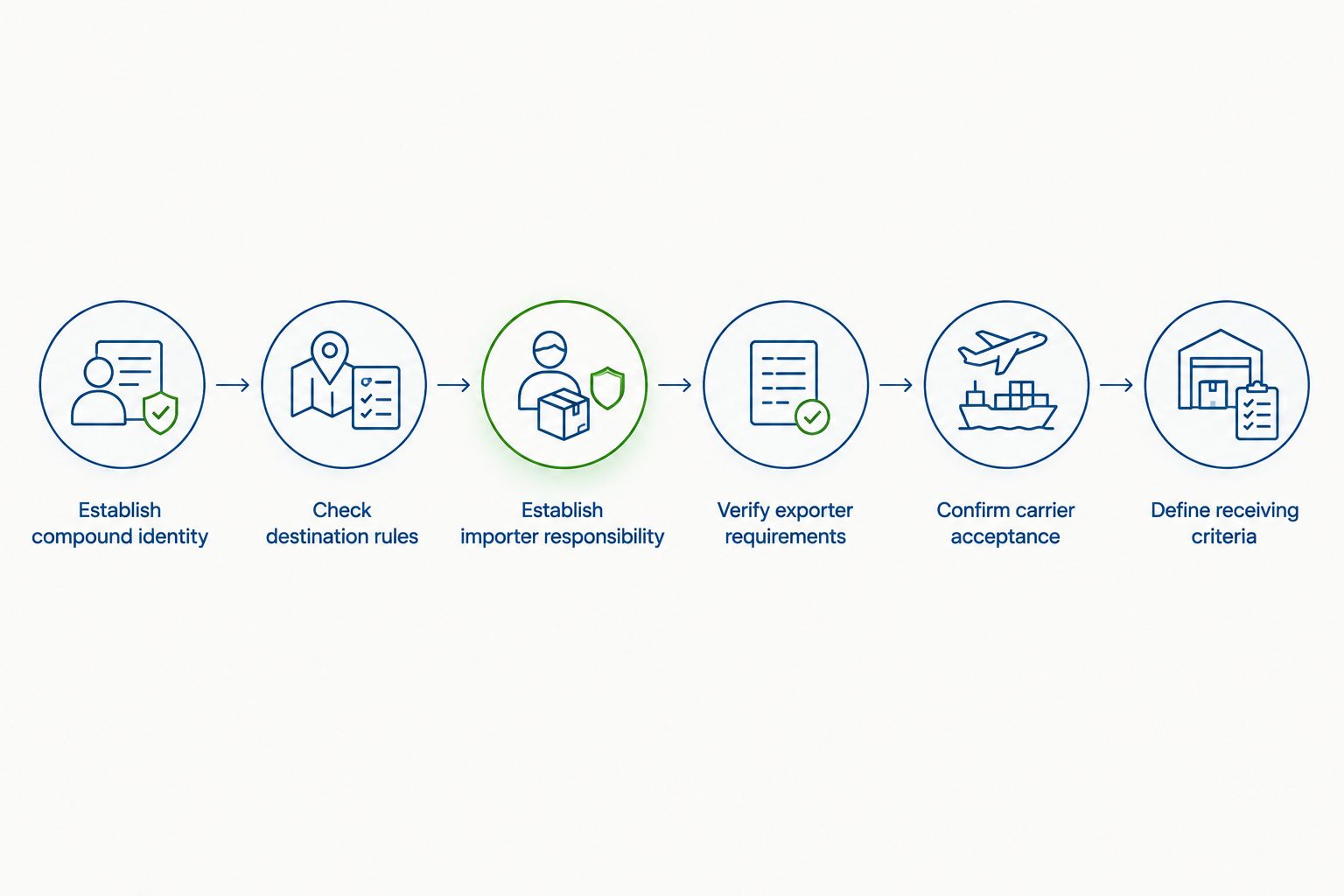
Yes, but approval belongs to the specific shipment—not to research peptides as a category. Establish the compound’s identity, destination, intended use, and importer responsibilities before arranging transport. Use this sequence to build a shipment file that your purchasing team, customs broker, and receiving laboratory can review.
Start with the exact material, not a shorthand product name. Request the peptide sequence or other appropriate identifying information, formulation, physical form, and batch details. Include a chemical identifier where one is assigned and applicable.
These details support classification and distinguish the shipment from similarly named materials. A description such as research supplies is not a substitute for an accurate description of the contents. Do not authorize dispatch while the supplier’s documents and your purchase record describe different materials.
Ask your institution’s compliance team or a qualified customs broker to assess the exact compound and intended laboratory use against the destination’s current requirements. Identify the relevant customs authority and any additional regulator responsible for the material’s classification.
In 2026, use current official requirements rather than an old order confirmation or an account of another laboratory’s delivery. Previous clearance documents are useful records, but they do not establish permission for a different compound, recipient, or intended use.
Identify the importer of record and determine who will provide documentation, respond to customs questions, and obtain any required authorization. Make sure the receiving institution agrees to that role before the shipment leaves the supplier.
A purchasing contact and an importer of record are not automatically interchangeable. Record the responsible organization, authorized contact, and receiving address consistently across the order and shipping documents. Resolve discrepancies before booking transport.
Confirm that the supplier has assessed applicable export requirements in the country of dispatch. Destination-country permission does not answer the exporter’s separate compliance obligations.
Ask for written confirmation that the proposed material and destination are accepted for shipment. Treat that confirmation as a supplier statement about the proposed transaction, not as a substitute for your institution’s import assessment. Each party needs to complete its own responsibilities.
Give the carrier or shipping coordinator an accurate description of the contents, packaging, and any temperature-control materials. Request confirmation that the proposed service accepts the shipment on the intended route.
If the packaging includes dry ice, follow the applicable dangerous-goods requirements and carrier instructions. Do not assume that a carrier accepting a peptide vial also accepts every refrigerant or packaging arrangement used around it.
Specify what your laboratory will inspect at arrival: package integrity, material identity, batch documentation, and any required temperature record. Define the response to an excursion or damaged package before dispatch, rather than during an experiment.
Separate physical receipt from release for use. Your laboratory can receive a parcel and hold its contents pending documentation review. Customs release is not evidence that a peptide retained the properties required for your assay.
International research peptide shipments differ because regulatory classification and transport suitability depend on the actual material and transaction. Use these factors to structure your review instead of asking whether a country accepts peptides in general.
For 2026 orders, reassess these factors whenever the compound, destination, recipient, intended use, or shipping configuration changes. An approved purchasing workflow should preserve the evidence supporting each decision, not simply repeat the outcome of an earlier order.
Physical form affects handling requirements, but it does not determine import permission. Evaluate lyophilized and solution-form peptides against compound-specific stability information and the proposed shipping configuration. Neither format supports a universal refrigeration rule.
| Material format | Best for | Practical advantage | Limitation to resolve |
|---|---|---|---|
| Lyophilized peptide | Laboratories planning preparation under their own validated procedure | Allows reconstitution to be managed at the receiving laboratory | Dry form alone does not prove stability during the proposed journey |
| Peptide in solution | Laboratories whose workflow requires the supplied formulation | Avoids a separate reconstitution step at receipt | Solvent, concentration, formulation, and temperature requirements need review |
Choose the format that fits your documented laboratory workflow. Do not select lyophilized material solely because it appears easier to transport, or solution-form material solely because it appears ready to use.
For either format, request handling guidance tied to the actual material. A general storage statement does not establish an acceptable shipping excursion, and a visually intact vial does not demonstrate retained purity or activity.
Build a shipment file that distinguishes customs documentation from analytical evidence. A certificate of analysis supports material assessment; it does not grant permission to import. Different documents answer different questions, even when they accompany the same vial.
Request an accurate commercial invoice, packing information, material description, quantities, and identification of the parties responsible for the transaction. Have the appropriate person verify classification and any applicable permit requirements.
The declared value must accurately reflect the transaction. Do not describe purchased material as a gift or substitute a vague description to avoid scrutiny. If an authority requests clarification, respond through the responsible importer or authorized representative.
Request the batch-linked certificate of analysis, relevant analytical methods, handling instructions, and safety documentation as applicable. Check that the batch reference on the vial matches the records supplied with the shipment.
A purity percentage is not a complete material specification. Review what the reported result measures and whether the available evidence meets your experiment’s identity, purity, or other acceptance requirements. Do not treat an analytical purity result as evidence of sterility.
Keep purchasing approval, the intended-use description, import correspondence, and receiving decisions together. The COA-to-compliance documentation workflow is a related guide for organizing the analytical side of that file.
For a 2026 shipment record, preserve the dated requirements or written advice used to approve the transaction. Retain the distinction between an official requirement, a broker’s assessment, and a supplier’s statement so the next reviewer can understand the decision.
No. Research-use-only labeling does not override import or export requirements. The contents, classification, intended use, and responsible parties still need to satisfy the applicable rules.
Use research-use-only language to describe a genuine laboratory purpose, not to reclassify material intended for personal or clinical use. These materials are for research use only; this article does not provide instructions for human or veterinary administration.
Only when material-specific handling evidence supports the proposed transport conditions. Lyophilization alone does not establish that a peptide is suitable for an unrefrigerated international journey.
Ask for the applicable stability and handling information, then assess the packaging and route against it. Where temperature monitoring is required by your procedure, define how the receiving laboratory will interpret the record before shipment.
No. Delivery proves receipt, not a complete compliance assessment. Retain the documents supporting lawful entry and separately assess the material against your laboratory’s receiving criteria.
Do not use another buyer’s tracking history as authorization for your order. Your compound, institution, intended use, and destination requirements need their own review.
Celonyx Labs is best for laboratory researchers seeking 99%-pure, third-party-tested research peptides. Those stated quality signals support supplier evaluation, but the shipment decision still requires compound-specific documents and destination review.
The useful distinction is between a supplier’s general quality statement and the evidence attached to your proposed order. Request the relevant batch documentation and confirm that it addresses your laboratory’s acceptance criteria. Then assess shipping eligibility separately.
Celonyx Labs research peptides are intended for laboratory research, not personal use. Before authorizing any international order, confirm the supplier’s current destination acceptance and the documentation available for that transaction. Do not infer international shipping coverage from the existence of an online store.
Can research peptides be shipped internationally in 2026?
Yes, research peptides can be shipped internationally when the specific shipment satisfies applicable export, import, and carrier requirements. Confirm the compound, intended laboratory use, destination, and importer responsibilities before dispatch.
Does a research-use-only label guarantee customs clearance?
No, a research-use-only label does not guarantee customs clearance. The material still needs an accurate declaration and any documentation or authorization required by the destination.
Do I need an import permit for research peptides?
An import permit requirement depends on the compound, destination, intended use, and importer status. Have your institution or a qualified customs broker check the applicable official requirements before shipment.
Is a certificate of analysis enough to import a peptide?
No, a certificate of analysis is not an import authorization. It supports material assessment, while customs documents and any required permits address entry requirements.
Can lyophilized peptides travel internationally without cold packaging?
Lyophilized peptides require a material-specific transport assessment before shipment without cold packaging. Dry form alone does not establish acceptable temperature exposure or retained suitability for research.
Can I use a personal address for an institutional peptide order?
Use the recipient and address approved through your institution’s import and procurement process. Do not substitute a personal address to bypass institutional review or importer requirements.
Does Celonyx Labs guarantee international peptide delivery?
Confirm international destination acceptance directly with Celonyx Labs before authorizing an order. Supplier acceptance and customs clearance are separate decisions, and neither establishes the material’s condition at receipt.
What should my laboratory do if a peptide shipment arrives damaged?
Hold damaged material outside released laboratory inventory and follow your institution’s receiving procedure. Document the condition, preserve the shipment records, and obtain a disposition decision before experimental use.
Plan for customs inspection before dispatch—not after a parcel is held. Decide who will answer questions, where supporting documents are stored, and how your laboratory will handle material whose transport history no longer meets its acceptance criteria.
For your next 2026 international peptide order, create separate sign-offs for import eligibility and laboratory release. This prevents a successful delivery notification from becoming an unsupported decision to use the material.
Is subcutaneous injection safe for research peptides? No—purity does not establish human safety. Learn what

Does 99 percent purity mean a peptide is safe for research? No. Learn what purity

Can research peptides be shipped internationally? Yes, subject to import and export rules. Learn the
FOR RESEARCH USE ONLY. Products sold by Celonyx Labs are intended exclusively for laboratory and scientific research. They are not intended for human or veterinary use, consumption, diagnosis, treatment, cure, or prevention of any disease. By purchasing from this site, you acknowledge that you understand the intended research purpose of these materials and agree to comply with all applicable laws and regulations.