

Purity Ingredients Explained: How to Read a Peptide COA
The advice you'll see most often about peptide quality is to buy 99% purity and

Epitalon does not have a single established time to show effects across research studies: the answer depends on the experimental model, measured endpoint, and sampling schedule. A change detected at a scheduled measurement establishes a result at that time—not when the effect first began, and not a timeline for human benefits.
Use the observation period reported for the exact endpoint and model you are studying. An exposure period, an assay collection time, and a follow-up period describe different parts of an experiment. None is automatically interchangeable with biological onset.
Epitalon, also called Epithalon, is a synthetic tetrapeptide: a peptide containing 4 amino acids. Its identity does not establish how quickly an experimental system will respond. You need the study methods and results together to interpret that question.
For your 2026 literature review, extract the model, exposure conditions, sampling times, controls, and measured outcome before recording a timeline. Also separate material quality from experimental response; this guide to whether 99% purity establishes research safety addresses a related distinction.
| Research question | Evidence needed | What the timing establishes | Main limitation |
|---|---|---|---|
| When was a molecular change detected? | Defined assay, controls, and collection times | A measured difference at a sampled time | Does not establish a later functional benefit |
| When did a cellular phenotype change? | Defined phenotype, viability assessment, and repeated measurements | A response in that cellular model | Does not establish an organism-level response |
| When did an organism-level endpoint change? | Defined model, endpoint, observation schedule, and controls | A result within that study design | Does not establish a human treatment timeline |
| Did a response persist after exposure ended? | Follow-up measurements after a defined stopping point | Persistence over the observed interval | Does not establish persistence beyond follow-up |
These are comparison categories, not promised outcomes of Epitalon exposure. Match the timeline to the claim, rather than combining unlike endpoints into an average.
A timeline without an endpoint is not an actionable research finding. “Show effects” can mean a change in an assay signal, a cellular characteristic, or an organism-level measurement. Those claims require different evidence.
The distinction also protects your experimental budget. If you choose collection times from an unrelated endpoint, a negative result will be difficult to interpret: the material, model, assay, or observation window could each explain the finding.
For a 2026 protocol, write the intended claim before choosing the schedule. “Detect a difference in the prespecified assay” is testable; “see whether it works quickly” is not sufficiently defined.
Best for: testing a defined molecular hypothesis. A molecular assay measures a particular feature of the experimental system. It does not establish every downstream consequence associated with that feature.
When reading an Epitalon paper, identify what the instrument or assay actually measured. Distinguish a direct measurement from the authors’ interpretation, and check whether the reported difference is relative to baseline, an untreated group, or a vehicle control.
The strength of this approach is specificity: a clearly defined readout supports a clearly bounded conclusion. Its limitation is scope. A molecular change alone does not demonstrate improved cell function, longer survival, or a benefit in humans.
Record the collection time exactly as reported. Do not convert a positive final measurement into a claim that the response started immediately after exposure.
Best for: evaluating a defined cellular phenotype. Cellular experiments require you to interpret the outcome alongside the condition of the cells and the suitability of the assay.
Check the cell model, culture conditions, exposure schedule, and relevant controls. If a measurement depends on cell number or metabolic activity, examine how the study accounted for those influences before treating the signal as a specific response.
The advantage is that cellular measurements can connect an experimental exposure to an observable phenotype. The limitation is that culture conditions define the setting; they do not reproduce every feature of an intact organism.
For timing comparisons, ask whether studies used comparable starting conditions. A difference between experiments is not evidence of faster or slower Epitalon activity when the model, handling, or endpoint also changed.
Best for: evaluating a defined endpoint within a specified organism model. Read the observation period alongside the model characteristics, experimental procedures, and endpoint definition.
An organism-level result provides information that an isolated cellular assay cannot. It also introduces additional sources of variation, including differences between subjects and the relationship between exposure and the tissue being assessed.
Do not treat the end of an observation period as the moment an effect began. Likewise, do not turn a result in a nonhuman model into an expected personal response schedule.
For your 2026 evidence summary, state the model in the same sentence as the result. Removing that context makes the timeline sound more general than the experiment supports.
Variation in reported timing must be interpreted through experimental design. Check these factors before deciding that studies disagree:
A timeline belongs to a complete experimental setup, not to the compound name alone. Preserve those conditions whenever you summarize a study or compare findings.
Start with a relevant published protocol and your laboratory’s approved procedures. The sequence below is a planning framework, not an Epitalon exposure or administration protocol.
A useful 2026 protocol explains why each measurement exists. Adding collection points without a defined question creates more data, but does not automatically create a clearer answer.
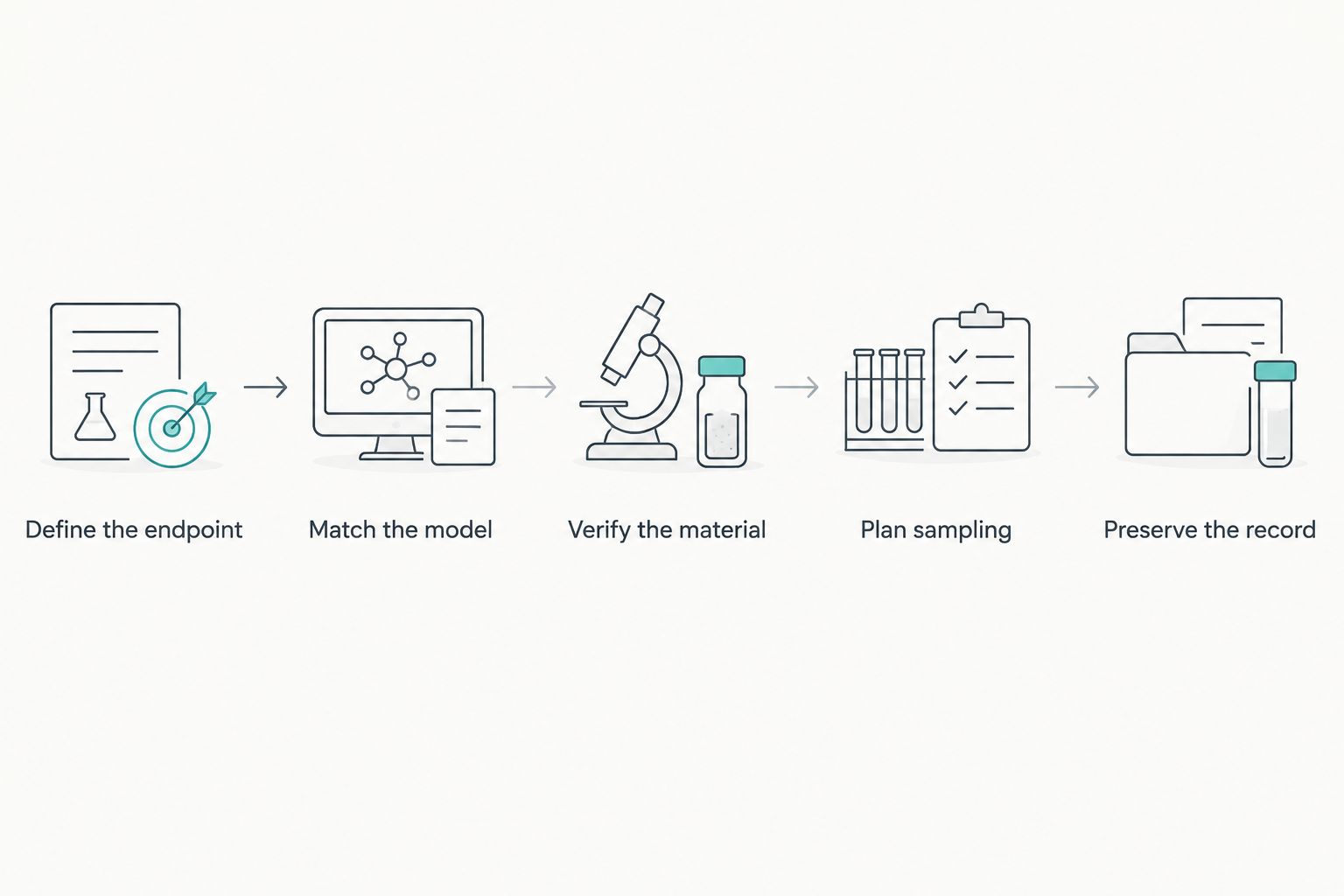
Read beyond the abstract before assigning a time to effect. The methods establish what was done; the results establish what was observed.
Build a study record with the compound name, experimental model, material source, exposure conditions, endpoint, collection schedule, comparator, and reported uncertainty. Include whether the measurement occurred during exposure or after exposure ended.
Pay particular attention to the distinction between a reported difference and a demonstrated progression. A study that measures only a final endpoint cannot describe the full path to that endpoint.
Also inspect whether the authors distinguish exploratory findings from prespecified outcomes. A result selected after reviewing many measurements deserves a different interpretation from an outcome defined before the experiment began.
Use this reporting pattern: in the specified model, the study detected the defined outcome at the reported collection time under the stated conditions. Keep the conclusion within those boundaries.
Material documentation helps you assess what entered the experiment. It does not replace evidence that the material produces your chosen biological response.
Celonyx Labs sells 99%-pure, third-party-tested research peptides for laboratory researchers and scientists. The catalog includes Epithalon 10mg, described as a synthetic tetrapeptide also referred to as Epitalon. The 10 mg designation identifies the listed vial amount; it is not a concentration, exposure schedule, or time-to-effect claim.
Celonyx Labs research peptides are for laboratory researchers and scientists, not for personal treatment. The stated purity and third-party testing are material-quality signals; neither establishes an Epitalon response window in your model.
Before using any research material, assess the available lot documentation against your laboratory’s requirements. Confirm that compound identity, analytical results, and handling information are appropriate for the intended experiment rather than relying on a storefront description alone.
For research use only. This article does not provide human dosing, self-administration instructions, or a treatment schedule.
A first positive measurement establishes detection at that sampled time, not necessarily onset. Without informative earlier measurements, you cannot determine exactly when the response began.
Report the observed time and the sampling limitation together. That wording is more useful than presenting the first positive sample as a precise biological starting point.
No early change means the assay did not detect the specified difference at that collection time under those conditions. It does not, by itself, establish failure of the material or rule out a different result at another justified endpoint.
Check controls, assay performance, model condition, and protocol deviations before interpreting the finding. Do not extend exposure or change the schedule simply to obtain a positive result.
Laboratory timing does not establish when a person will notice benefits. A preclinical measurement and a human clinical outcome are different claims requiring different evidence.
Keep Epitalon research findings separate from testimonials, self-experimentation reports, and treatment promises. Those sources are not interchangeable measures of onset.
How long does epitalon take to show effects in research?
Epitalon has no single established onset time across research models and endpoints. Use the measured interval from a relevant study, and distinguish detection time from the actual start of a biological response.
Are Epitalon and Epithalon the same name?
Epitalon and Epithalon are alternative names used for the compound. Verify identity against the material documentation and study methods before combining results from differently named sources.
Can an Epitalon study tell me when I will feel a difference?
An Epitalon laboratory study does not establish when you will feel a difference. Research endpoints do not provide a personal treatment timeline, and research-use materials are not instructions for self-administration.
Does 99% purity mean Epitalon will work faster?
99% purity does not establish faster biological activity. Purity describes an analytical quality attribute, while response timing requires evidence from the relevant experimental model and assay.
What is the difference between exposure time and observation time?
Exposure time describes how long the experimental system encounters the material; observation time describes when outcomes are assessed. They can overlap, but they answer different questions.
Should I stop an experiment if the first sample shows no change?
Follow the prespecified protocol and applicable laboratory procedures rather than stopping solely because an early sample shows no change. Review controls and assay performance before interpreting a negative measurement.
What information should accompany a reported Epitalon timeline?
A reported Epitalon timeline should include the model, endpoint, exposure conditions, sampling schedule, controls, and material documentation. Without that context, the number does not define a transferable response window.
The first detected effect and the first actual effect are different claims. A more sensitive assay or a different sampling schedule can change detection without demonstrating a change in the underlying biology.
For your 2026 research record, keep separate timestamps for exposure, sample collection, and analysis. Then write conclusions using the collection time—not the day the assay was processed or the result reviewed.
The advice you'll see most often about peptide quality is to buy 99% purity and

Can LL-37 be combined with antimicrobial peptides? Yes, for controlled laboratory research. Learn how to

Can GHK-Cu be combined with BPC-157? Learn how to frame a controlled laboratory study, verify
FOR RESEARCH USE ONLY. Products sold by Celonyx Labs are intended exclusively for laboratory and scientific research. They are not intended for human or veterinary use, consumption, diagnosis, treatment, cure, or prevention of any disease. By purchasing from this site, you acknowledge that you understand the intended research purpose of these materials and agree to comply with all applicable laws and regulations.