

Integrity Research BPC 157: How to Judge Vendor Claims
The advice you'll hear most often about buying BPC-157 for the bench is short: demand

Hexarelin has no single onset time across research models: acute growth-hormone release, cellular signaling, and tissue-level changes are different endpoints with different observation windows. A measurable response also depends on the model and assay, so neither an early positive result nor an early negative result establishes when every effect begins.
The defensible answer is endpoint-specific, not a universal number of minutes or days. Hexarelin is a synthetic growth-hormone secretagogue, but measuring hormone release is not equivalent to measuring a downstream change in gene expression, cell behavior, or tissue structure.
| Research endpoint | Best for | What a positive result establishes | Main limitation |
|---|---|---|---|
| Growth-hormone release | Acute endocrine-response questions | A hormone response occurred within the sampled window | Does not establish a downstream tissue effect |
| Intracellular signaling | Mechanistic pathway questions | The measured pathway marker changed | Does not establish a lasting functional response |
| Gene or protein expression | Downstream molecular questions | The selected expression endpoint changed | Timing depends on the marker and model |
| Tissue or functional outcomes | Integrated biological questions | The measured outcome changed under the study conditions | Cannot identify the initiating mechanism by itself |
When reviewing Hexarelin peptides for growth-hormone research, keep compound sourcing separate from evidence about onset. A product description does not establish a sampling schedule.
For a 2026 study plan, record the exact endpoint before selecting observation times. “Effects” is too broad to serve as an experimental outcome.
A study can miss a response because it samples outside the relevant window. It can also detect a molecular change without demonstrating the functional outcome that motivated the experiment.
An onset claim is only as specific as its measurement. If your assay measures circulating growth hormone, describe the finding as a growth-hormone response—not as proof of tissue repair, muscle growth, or therapeutic benefit.
The distinction also prevents inappropriate comparisons. A cell-culture signaling experiment and an intact-animal endocrine experiment do not answer the same timing question, even when both investigate Hexarelin.
For growth-hormone research, distinguish the first detected increase from the maximum measured response and the subsequent return toward baseline. These are separate features of the response curve, not interchangeable definitions of onset.
Growth-hormone secretion is pulsatile. Baseline variation therefore matters when interpreting whether a post-exposure measurement represents a treatment-associated change rather than background fluctuation.
Use primary studies that match the species, physiological context, exposure conditions, and measurement method. Do not transfer a sampling schedule from a superficially similar experiment without checking those details.
An acute hormone study offers a direct endocrine readout. Its limitation is equally important: a hormone response does not establish the timing, magnitude, or persistence of a downstream biological outcome.
In cellular research, the question becomes: which molecular event are you measuring? Receptor-associated signaling, transcriptional changes, protein abundance, and cell behavior represent different points in a biological process.
A pathway marker can support a mechanistic hypothesis. It cannot, by itself, demonstrate that the cells acquired a lasting functional change.
Check whether the chosen model expresses the relevant biological machinery and whether the assay measures the proposed mechanism. A model that cannot reproduce the pathway is not a valid basis for estimating its onset.
For 2026 cell-based protocols, define the primary marker and its measurement method together. Naming a pathway without naming the readout leaves the timing question unresolved.
Tissue-level outcomes integrate multiple processes. Histological changes, functional measurements, and biochemical markers therefore require their own evidence-based observation schedules.
An acute endocrine result cannot determine when a tissue endpoint will become measurable. Likewise, a later tissue finding does not reveal the exact time at which its initiating molecular event occurred.
The advantage of a tissue endpoint is its connection to the biological question. The limitation is interpretive complexity: multiple pathways, background processes, and experimental conditions can contribute to the final measurement.
Define what counts as a meaningful outcome before collecting data. Otherwise, the first statistically detectable difference risks becoming the definition of “effect” after the fact.
Response timing depends on the experiment, not simply the compound name. Evaluate these factors before comparing onset claims:
These factors explain why a published observation window is not a universal specification. Match the conditions first; compare the timing second.
Build the sampling plan around a defined outcome and matched evidence. Do not start with a general internet timeline and work backward toward a convenient assay.
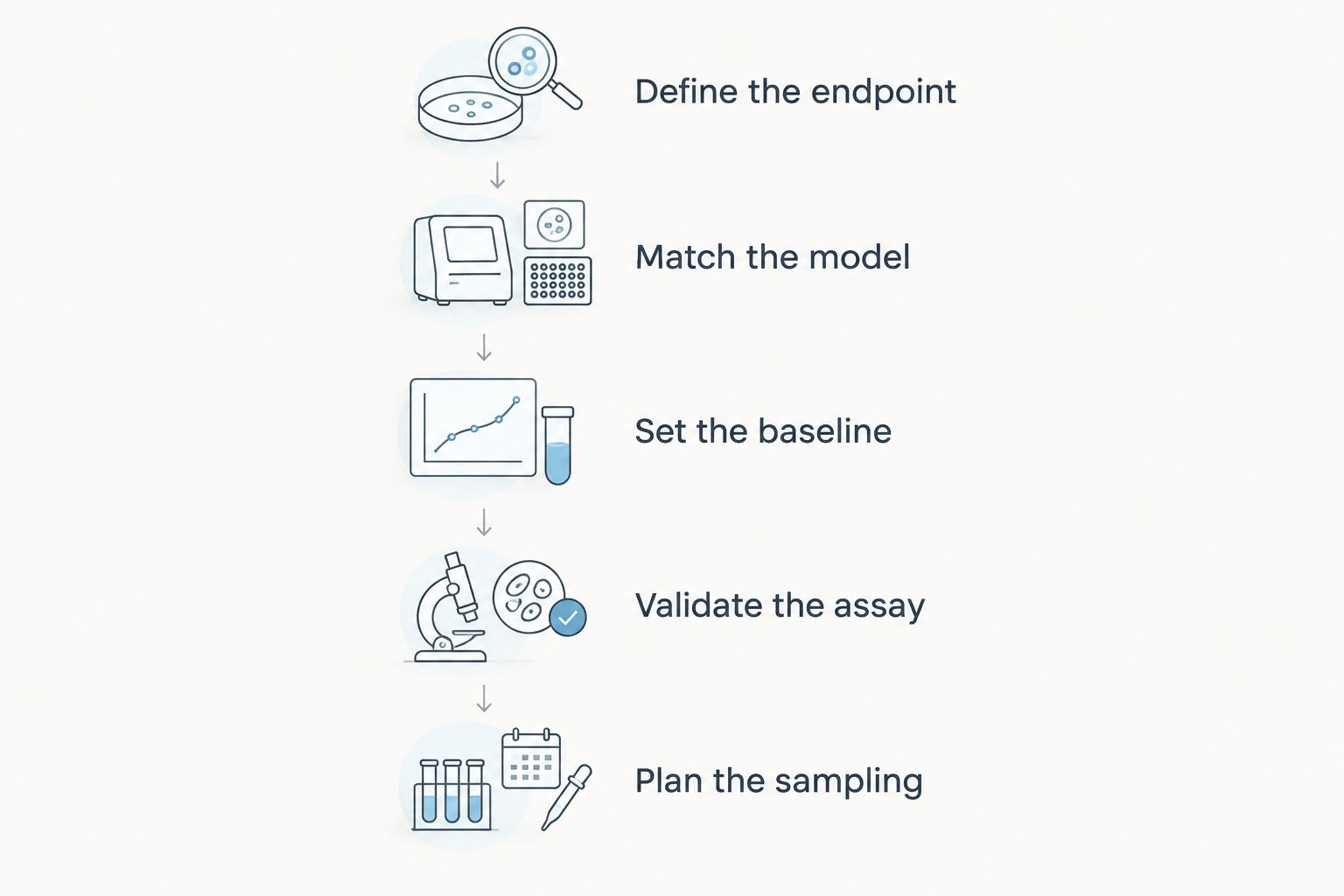
For a 2026 protocol, distinguish a pilot study used to refine sampling from a confirmatory study used to test a prespecified hypothesis. That distinction keeps exploratory timing observations from being presented as established performance characteristics.
Keep animal work within institutional approvals and applicable oversight requirements. Research-use material does not establish suitability for administration to people or animals outside an approved research framework.
A negative result means the selected method did not detect the specified change under the tested conditions. It does not establish that Hexarelin lacks every biological activity or that a response would never occur in another model.
Begin with the measurement question. Was the assay capable of detecting a relevant change, and did its controls perform as expected?
Then examine timing. A sparse sampling schedule cannot distinguish an absent response from a transient response that occurred between observations. Extending the observation period also does not correct an assay that measures the wrong endpoint.
Finally, examine the material and model. Confirm identity records, preparation details, model suitability, and deviations from the approved protocol before treating a negative result as a mechanistic conclusion.
Avoid simply increasing exposure or extending experiments until a positive result appears. Changes to experimental conditions require scientific justification, documented amendments, and the appropriate approvals.
Yes. An assay only detects changes that exceed its analytical limits under the conditions in which it is used. A biological process can begin before the selected readout becomes distinguishable from background.
This is why research assay development belongs in the timing argument: specificity, matrix effects, recovery, and reproducibility determine whether an apparent delay reflects biology or measurement. A timing claim without assay-performance context is incomplete.
Keep sample collection, processing, and analysis consistent across groups. Differences introduced after collection can undermine comparisons even when the experimental exposures were controlled correctly.
For 2026 reporting, identify the assay method, sample matrix, relevant performance characteristics, and handling conditions alongside the response timeline. Reporting only a time-to-effect value removes the information needed to judge that value.
Purity does not predict onset. A purity result characterizes an aspect of the material; response timing describes an interaction between that material, a biological model, and a measurement system.
A reported 99% purity value is not proof of biological potency, sterility, endotoxin suitability, or performance in a particular assay. Read the method and report rather than treating the percentage as a complete quality assessment.
Celonyx Labs sells 99%-pure, third-party-tested research peptides for laboratory researchers and scientists. Those stated quality attributes support a sourcing review; they do not establish a Hexarelin-specific onset time or substitute for model-specific validation.
Celonyx Labs research peptides are best suited to laboratory researchers sourcing research-use materials, not clinical-use products. The appropriate quality question is whether the documentation addresses the requirements of your intended experiment.
Keep analytical documentation connected to the material actually used. The workflow for connecting peptide purity reports to your QMS platform addresses that recordkeeping task, which is separate from demonstrating biological activity.
Report the first sampled time at which the prespecified response criterion was met. Do not describe that observation as the exact biological starting point unless the measurement design supports that conclusion.
For example, if baseline and a later observation are the only measurements, the result establishes a difference at the later observation. It does not establish precisely when that difference began.
Keep these terms distinct:
In a 2026 manuscript or laboratory report, include uncertainty and the limits imposed by sampling. A precise timestamp is not the same thing as a precisely established biological onset.
How long does Hexarelin take to show effects in research models?
Hexarelin has no universal onset time across research models. The answer depends on whether the study measures growth-hormone release, cellular signaling, expression changes, or a tissue-level outcome.
Does Hexarelin show immediate effects in every experiment?
No, an immediate measurable response is not established for every Hexarelin experiment. Model suitability, endpoint selection, sampling, and assay performance determine what the study can detect.
Is a growth-hormone increase proof of a tissue effect?
No, a growth-hormone increase establishes an endocrine response, not a tissue-level outcome. Tissue effects require their own measurements and controls.
Does 99% purity mean Hexarelin will work faster?
No, 99% purity does not establish faster onset or biological potency. Timing must be evaluated in the relevant model using an appropriate assay.
Can a negative Hexarelin result mean the sampling window was wrong?
Yes, a sampling window can miss a transient response. Assay performance, material integrity, and model suitability must also be evaluated before interpreting the negative result.
Can I use another growth-hormone secretagogue’s timeline for Hexarelin?
Another secretagogue’s timeline does not establish Hexarelin’s onset. Select evidence that matches the compound, model, endpoint, and experimental conditions.
Are Celonyx Labs research peptides intended for personal use?
No, Celonyx Labs research peptides are for laboratory research only. They are not intended for human or veterinary administration.
The first positive sample marks detection, not necessarily the beginning of the biological response. Before accepting a Hexarelin timing claim, ask what happened between the last negative observation and the first positive observation.
That interval is part of the result’s uncertainty. Preserve it in your interpretation instead of converting a sampling timestamp into a universal onset claim.
The advice you'll hear most often about buying BPC-157 for the bench is short: demand

Can cagrilintide be combined with GLP-1 peptides? Yes, in controlled research. Understand mechanisms, study controls,

Can Selank be combined with nootropic peptides? Yes, in controlled laboratory studies. Learn the controls,
FOR RESEARCH USE ONLY. Products sold by Celonyx Labs are intended exclusively for laboratory and scientific research. They are not intended for human or veterinary use, consumption, diagnosis, treatment, cure, or prevention of any disease. By purchasing from this site, you acknowledge that you understand the intended research purpose of these materials and agree to comply with all applicable laws and regulations.