
Integrity Research BPC 157: How to Judge Vendor Claims
The advice you'll hear most often about buying BPC-157 for the bench is short: demand
Type epithalon 10 mg into a search bar and most results hand you a schedule: reconstitute the vial, then take a set amount on set days. That advice puts the cart well before the horse. Until you know what the powder is, what else is in the vial with it, and how much of the labelled mass is peptide, a number on a label can't tell you what to do at the bench.
Here's the reframe that makes the rest of the label readable. Ten milligrams is a mass of material. It isn't a dose, a potency, a schedule, or evidence that anything happens in a cell. The same 10 mg becomes a 10 mg/mL solution or a 0.04 mg/mL solution depending on how much solvent you add, and neither is more correct until a study design says so.
Read the vial as a chemist first. A quantity turns into a dose only after identity, purity, peptide content, solvent volume and route are all fixed. Skip those steps and the number measures nothing.
Every useful question about a 10 mg listing is answerable before the first pipette tip leaves the box. That's the whole point of the exercise.
Read a label item by item rather than as a whole, because each line answers one question and leaves the next one open. The front of the vial gives you a mass. The certificate gives you context. The intended-use statement gives you the boundary.
Start with the molar arithmetic, since it's the only conversion that stays valid when you compare studies. Epitalon is a synthetic tetrapeptide with the sequence Ala-Glu-Asp-Gly and a molecular mass of approximately 390.35 g/mol, so a 10 mg quantity corresponds to roughly 25.6 micromoles before counterions, water or formulation excipients are counted, as the indexed epitalon chemistry record sets out.
Peptides ship as salts, usually the acetate, and the lyophilized cake holds residual water. So the peptide itself can weigh less than the number printed on the vial. A peptide-content assay, run alongside identity confirmation and an impurity profile, is what separates the two figures. Without it you're guessing at your own starting mass.
A percentage is the main peak's share of total peak area, on the method the lab names. It says nothing about sterility, endotoxin load, aggregates or biological activity. A nominal purity figure isn't evidence of any of those things, and it certainly isn't evidence of suitability for administration.
The research-use wording is the other boundary marker. It states that the material is supplied for laboratory and scientific research, which is a claim about intended use and not a comment on quality. Then comes the lot number, which only earns its keep if it links to test records for that exact lot. A certificate for a different batch says nothing about your vial.
| Label item | What it tells you | What it does not tell you |
|---|---|---|
| 10 mg | Gross mass of material in the vial | A dose, potency or clinical effect |
| About 25.6 micromoles | Molar amount before counterions and water | Net peptide content by weight |
| 99% purity | Share of the main peak by the stated method | Sterility, endotoxin or biological activity |
| For Research Use Only | Intended use is laboratory research | Approval for human or veterinary use |
| Lot or batch number | Links the vial to its own test records | Quality of any other lot |
Apply the same five-part test to any listing you meet: name the mass, the molar amount, the purity method, the lot link and the intended use. If one of the five is absent, you've found the gap before you've found the problem.
Ten milligrams sounds more official with a concentration attached to it. Federal reviewers examined products described in almost exactly those terms and reached a settled position that the marketing rarely mentions.
In the United States, epithalon has no FDA approval as a drug, and the agency has stated that the available clinical information doesn't support its safety for proposed human use. FDA briefing materials reviewed epitalon free base and epitalon acetate in proposed injectable concentrations of 10 mg/mL and 3,000 mcg/mL, and drew a line the market often erases.
The distinction matters. A concentration is a formulation choice, something a manufacturer or a lab decides. An appropriate dose is a clinical finding backed by data. The agency concluded that it had identified no clinical data supporting the safety of either substance in humans, particularly for the proposed subcutaneous route.
Reviewers also raised product-quality and immunogenicity concerns, including possible risks tied to peptide aggregation and impurities. Those aren't hypothetical marketing objections. They're the same analytical questions a lab should ask about any vial: what else is in here, and what does it do in a biological system.
When reviewers write that a concentration exists but a dose doesn't, they're describing the gap between a catalogue number and a clinical claim.
Nothing in that record establishes purity, sterility, bioavailability or benefit for a product sold as epithalon 10 mg. The number describes an amount of material.
This is why the research-use-only framework matters as a working boundary rather than a disclaimer. Celonyx Labs states that products sold by the company are intended exclusively for laboratory and scientific research, not for human or veterinary use. That language sets the permitted context of use, and a responsible lab record should mirror it: identity, analytical characterization, batch testing, route, concentration and the experimental rationale, all documented next to the vial rather than remembered.
Epithalon, often written epitalon, is a synthetic tetrapeptide: four amino acids, alanine, glutamic acid, aspartic acid and glycine, in that order, abbreviated Ala-Glu-Asp-Gly. Change the order and you get a different molecule with the same mass but different behaviour, so the sequence is the identity check in chemical form.
The 10 mg on a vial states a mass: how much peptide was weighed into the container. It carries no instruction about how that material was meant to be used, and reading it as one is the first mistake to avoid.
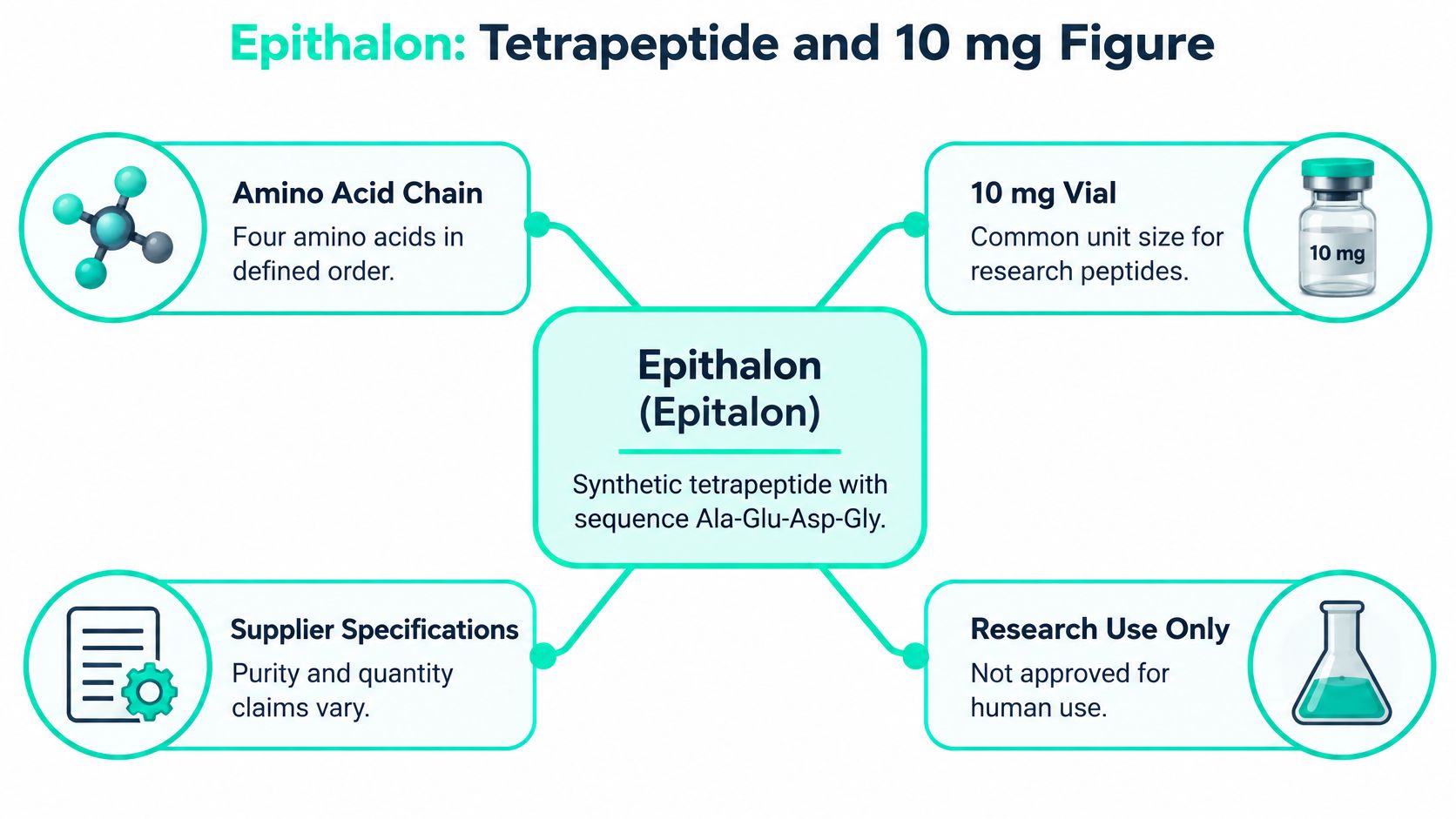
The name itself is a source of confusion, because epithalon, epitalon and epithalone all describe the same compound, while epithalamin is a different material entirely, a polypeptide extract of pineal tissue. Trace the 10 mg figure back far enough and that difference becomes the whole story.
A historical human study summarized in a recent peer-reviewed review of epithalon followed 70 elderly patients with coronary disease and accelerated cardiovascular aging for 12 years. Thirty-six participants received epithalamin and 34 received saline as a control. The reported regimen was five 10 mg intramuscular injections given at 3-day intervals, repeated every 6 months for 3 years.
That study is the origin of the number in circulation. The 10 mg in it was given as epithalamin, not as the epitalon sold today in vials labelled Epithalon 10 mg. Most misreadings of this literature start when the figure travels without the compound, preparation and route attached to it.
The broader human evidence stays modest: small physiological or biomarker studies plus an older controlled study in retinitis pigmentosa. No adequately powered randomized clinical trial has established therapeutic efficacy, and pharmacokinetic, dose-ranging and long-term safety data remain inadequate.
Three-part rule for reading old papers. Identify the compound named, identify the preparation used, and record the route and schedule. Only then decide whether any figure in that paper belongs on a product listing.
A 10 mg vial isn't an established clinical dose, and historical dosing can't validate the safety or effectiveness of a modern research formulation. What the figure gives you is a starting mass, the amount of material in the container before anything else is decided at the bench.
Think of the evidence as a ladder, and note how far the top rung sits from a clinical answer. Each study type below observed something real. None of them produced a human dose.
In the published oocyte-aging experiments, 0.1 mM epitalon was added to culture medium. Treatment reduced reactive oxygen species, spindle defects and abnormal cortical-granule distribution during post-ovulatory aging, while increasing mitochondrial membrane potential and mitochondrial DNA copy number. That concentration works out to roughly 39 micrograms per millilitre of medium, which is a cell-culture condition and nothing more. Aged human lymphocyte cultures have shown chromatin decondensation and higher ribosomal gene activity, a measurable cellular response that doesn't demonstrate benefit.
A small human study cited in an FDA advisory document gave sublingual epitalon to 20 healthy subjects for 20 days and measured urinary 6-sulfatoxymelatonin and clock-gene expression. It didn't evaluate sleep outcomes and didn't report safety data. Small sample, short duration, unclear blinding.
| Study type | What it observed | What it cannot support |
|---|---|---|
| Mouse oocyte culture at 0.1 mM | Less oxidative stress and fewer spindle defects during post-ovulatory aging | Any human dose or clinical outcome |
| Aged human lymphocyte cultures | Chromatin changes and higher ribosomal gene activity | Clinical benefit |
| 20 healthy subjects, sublingual, 20 days | Changes in urinary 6-sulfatoxymelatonin and clock-gene expression | Sleep benefit or safety, since no safety data were reported |
| Randomized trial evidence | None established as adequately powered | Therapeutic efficacy |
The ladder has no rung that converts into an anti-aging, insomnia, fertility or performance claim. A 10 mg vial supports laboratory research unless an applicable regulator has authorized a specific pharmaceutical formulation and use. Anything further is extrapolation dressed as findings.
A 99% purity claim answers one narrow question and leaves the more useful ones untouched. It doesn't tell you whether the remaining material is closely related peptide variants, degradation products, residual solvents, counterions, aggregates or contaminants that matter for your specific assay.
The stakes are practical. A 2025 review of epitalon analysis and stability notes that LC-MS/MS has been used to identify epitalon in products labelled as containing it, which shows why identity confirmation and impurity characterization sit ahead of a single percentage. The same review states that short peptides like epitalon can be unstable and degrade rapidly in vivo, while epitalon-specific stabilization strategies such as acetylation or amidation hadn't yet been evaluated.
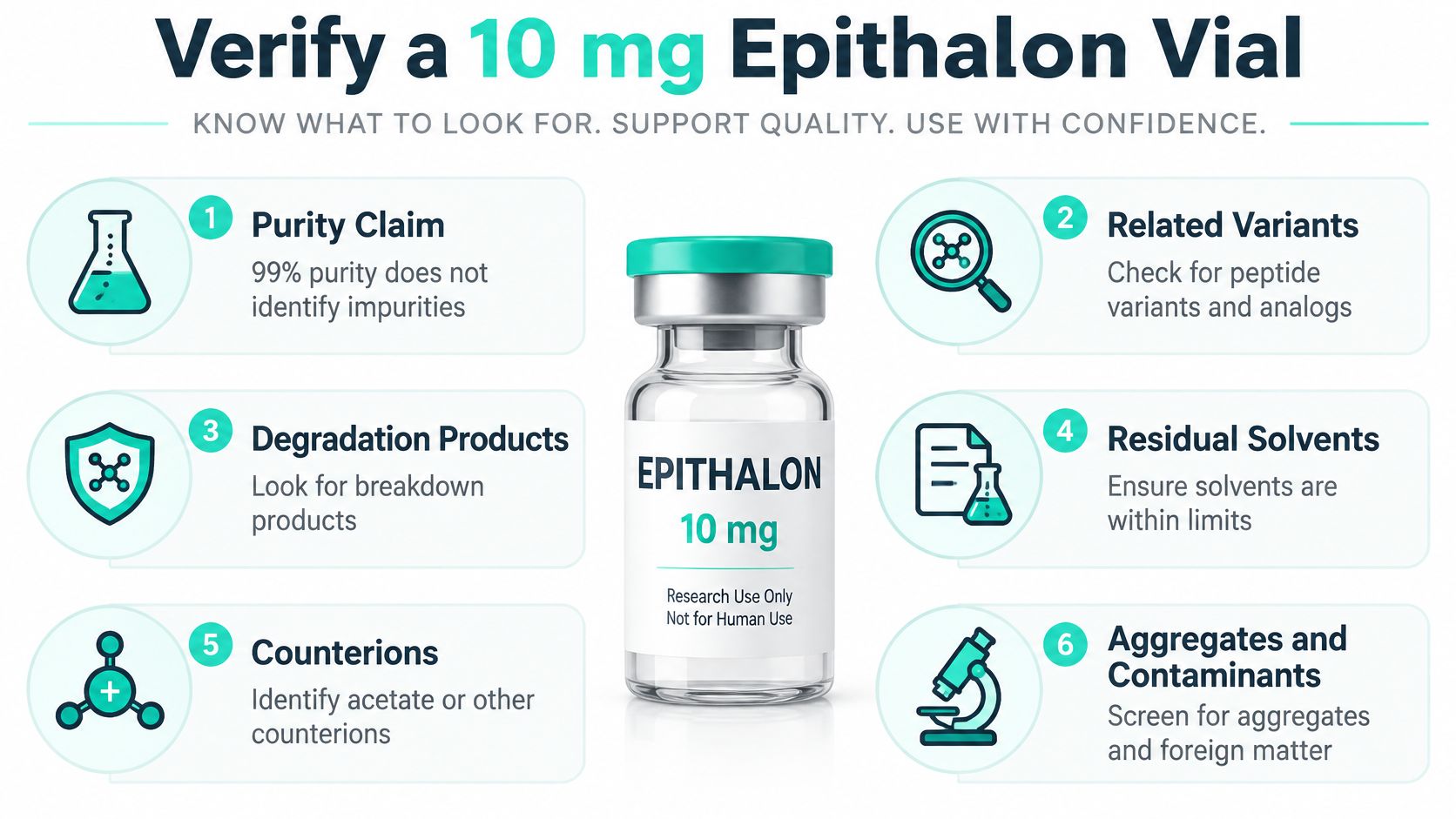
Run these checks in order before you place an order:
Step six carries more weight than it looks. A peptide that degrades quickly in solution turns a good certificate into a bad experiment if the vial sits on a bench for a week. Record the storage temperature from the datasheet on receipt, then note the date the vial is first opened so stability limits run against a real clock.
Practical rule: if the certificate doesn't name the lot, the method and the identity result, treat the vial as unverified regardless of the percentage in the header.
The peptide certificate of analysis guide sets out what a lot-specific document should contain and how to read a chromatogram rather than skim it. That's also where the line between research-use characterization and clinical-grade release becomes visible, a boundary generic high-purity pages rarely draw.
Concentration is the one variable you control completely, and it's where most bench errors start. The mass in the vial is fixed. The volume you add is not. Work through the steps in order and write each one down.
Step one changes your answer by the non-peptide share of the powder. Step four is the one that lets you match a published condition, because a concentration quoted in a paper is almost always molar and a concentration quoted on a forum is almost always mass. Reconciling the two after the fact is guesswork.
| Solvent volume added | Mass concentration | Approximate molar concentration |
|---|---|---|
| 1 mL | 10 mg/mL | about 25.6 mM |
| 2 mL | 5 mg/mL | about 12.8 mM |
| 5 mL | 2 mg/mL | about 5.1 mM |
| 10 mL | 1 mg/mL | about 2.56 mM |
| 256 mL | about 0.039 mg/mL | 0.1 mM |
The figures assume the full labelled mass is peptide, so net peptide content lowers every value in proportion to the non-peptide share. That's arithmetic for laboratory planning, not a dosing guide, and the peptide concentration determination guide walks through the same calculations with the solvent choice spelled out.
Divergent numbers in a shared lab usually trace back to this table. Agree on one standard reconstitution volume, record it identically every time, and the batch-to-batch confusion mostly disappears.
The 10 mg label describes a mass of material, not a dose or a guarantee of usable peptide content. For a lab buyer, the decision turns on whether the supplier's available product information fits the study's requirements.
Celonyx Labs lists Epithalon 10 mg for $24.95. The company states 99% purity and independent third-party testing, and its peptides are labeled “For Research Use Only.” Before ordering, ask the supplier which documentation applies to the specific vial, including whether it identifies the lot and the methods used to assess identity and purity.
A price or purity claim alone cannot answer those questions. Check the product information and supplier response against your lab's requirements, including any storage or stability details needed for your work.
Record the product and lot information available to you, along with the planned molar concentration, in the experiment file before starting. That record helps others understand what material the study used and how it was prepared.
Celonyx Labs sells Epithalon 10 mg for laboratory research. Use the checks above to ask which documentation applies to a given vial before ordering through the Celonyx Labs website.
The advice you'll hear most often about buying BPC-157 for the bench is short: demand

Can cagrilintide be combined with GLP-1 peptides? Yes, in controlled research. Understand mechanisms, study controls,

Can Selank be combined with nootropic peptides? Yes, in controlled laboratory studies. Learn the controls,
FOR RESEARCH USE ONLY. Products sold by Celonyx Labs are intended exclusively for laboratory and scientific research. They are not intended for human or veterinary use, consumption, diagnosis, treatment, cure, or prevention of any disease. By purchasing from this site, you acknowledge that you understand the intended research purpose of these materials and agree to comply with all applicable laws and regulations.