

Is Humanin stable at room temperature for research use?
Is Humanin stable at room temperature? Do not assume stability. Learn how formulation, exposure records,

Humanin should not be assumed stable at room temperature for research use; accept an exposure only when stability evidence covers the specific material, formulation, temperature, and duration. A sealed lyophilized vial and a reconstituted solution require separate assessments, and a purity certificate alone does not establish either material’s room-temperature shelf life.
There is no universal room-temperature holding time you can apply to every Humanin preparation. Your decision must follow the documentation for the exact peptide and formulation, supported by your laboratory’s acceptance criteria.
Humanin is a peptide commonly described as having 24 amino acid residues. That identity does not establish its storage conditions: sequence, formulation, packaging, and the analytical endpoint all matter. General peptide storage temperature benchmarks by type provide context, not authorization to assign a Humanin shelf life.
| Material or evidence | What it helps establish | What it does not establish |
|---|---|---|
| Sealed lyophilized Humanin | The dry material’s identity and documented storage requirements | Stability after dissolution or after an undocumented excursion |
| Reconstituted Humanin | The formulation actually entering your experiment | The same stability profile as the original dry material |
| Certificate of analysis | Results for the tested sample under the reported methods | Stability throughout later handling and storage |
| Matched stability study | Performance under the study’s stated conditions | Performance outside the tested formulation, temperature, or duration |
Read every stability statement with its conditions attached. A statement about shipment does not automatically authorize benchtop storage, and a statement about unopened material does not automatically cover a prepared working solution.
Uncontrolled storage introduces an extra variable into your experiment. If the starting material changes before use, an altered assay response becomes harder to separate from the biological effect you intended to measure.
In a 2026 Humanin protocol, treat storage history as part of sample identity. Link the vial, lot, preparation record, and exposure history so another researcher can reconstruct what entered the assay.
The practical question is not whether the vial still looks acceptable. It is whether the material still meets the chemical and functional requirements of your experiment.
A dry peptide and a peptide in solution are different storage systems. Removing water generally reduces opportunities for some degradation pathways, but lyophilization does not establish unlimited stability or permission to store a vial on the bench.
Best for assessing an unopened dry vial: use documentation that explicitly covers the lyophilized material. Check whether the stated conditions assume intact packaging, protection from moisture, and a particular storage environment. Do not transfer those conditions to an opened or reconstituted vial without supporting evidence.
The advantage of the dry format is separation from the solvent conditions introduced during preparation. Its limitation is that residual moisture, packaging integrity, and subsequent handling remain relevant; the word lyophilized is not a complete stability specification.
If the vial has experienced an excursion, keep its original storage instructions and the excursion assessment together. Returning it to the designated storage location does not demonstrate that any earlier change has been reversed.
After reconstitution, assess the complete formulation rather than the peptide name alone. Solvent, pH, concentration, container, and handling conditions define the material your experiment receives.
Best for assessing a working solution: use stability evidence matching the prepared formulation. A result obtained in a different buffer or at a different concentration is not automatically transferable. Document any difference before deciding whether the evidence applies.
A working solution’s advantage is readiness for the specified assay. Its limitation is that preparation introduces additional variables, including solvent compatibility, contamination control, and interactions with surfaces.
Do not select bacteriostatic water simply because it appears in another peptide protocol. A preservative’s antimicrobial function does not establish Humanin’s chemical stability or compatibility with your assay. Follow a formulation justified for the research method.
Room-temperature stability depends on conditions, not the label alone. Review these factors before accepting an exposure:
For your 2026 laboratory SOP, define these fields before an excursion occurs. A predefined record is more useful than a retrospective description such as left out briefly.
Place the affected material on hold until its exposure has been assessed against applicable evidence. That preserves a clear distinction between material under review and material released for an experiment; it does not mean the peptide is automatically unusable.
Use the following sequence in your laboratory’s deviation process:
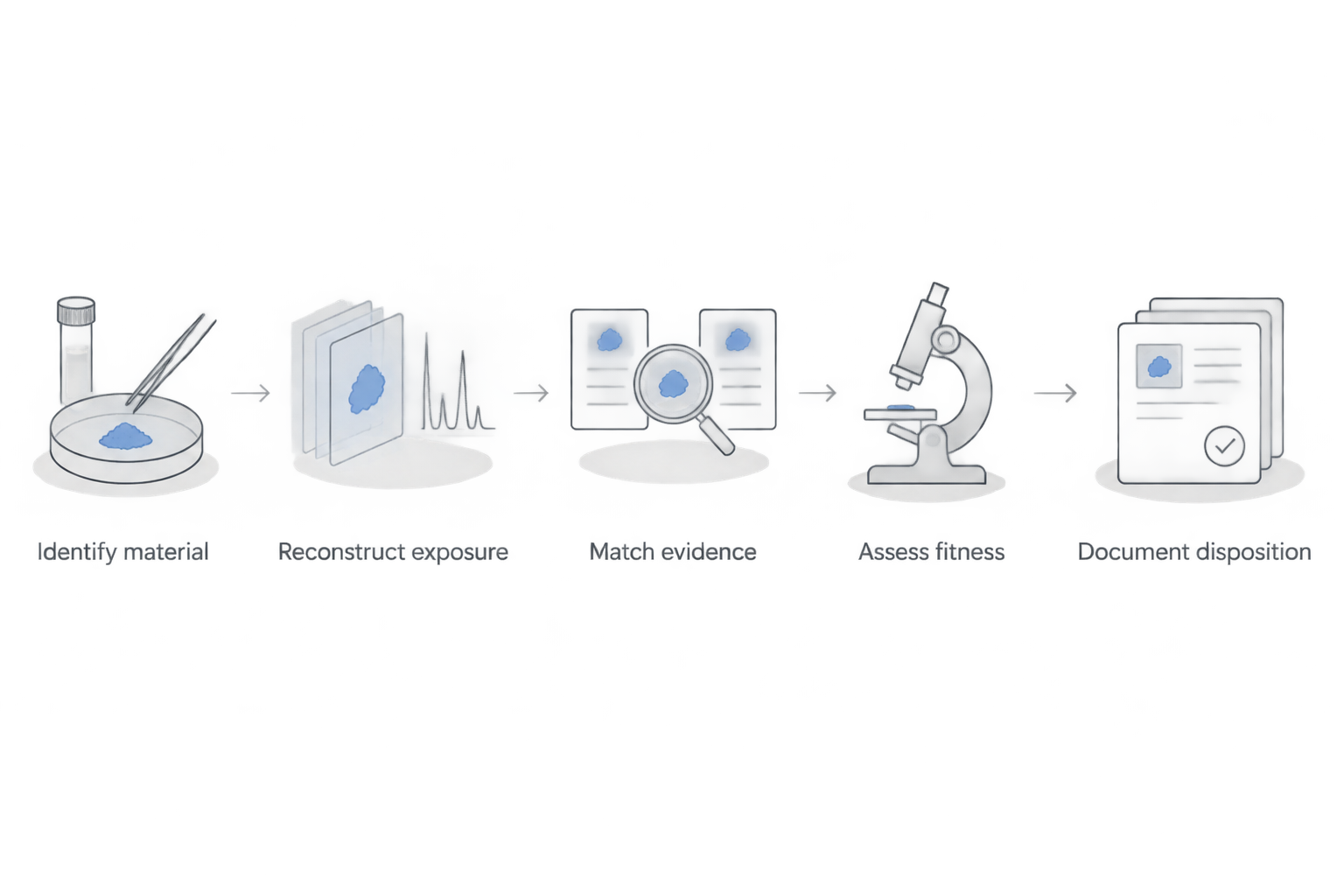
Do not convert missing temperature information into a favorable assumption. If the exposure cannot be reconstructed, the disposition must account for that uncertainty rather than treating it as documented compliance.
A purity report describes the tested sample; it does not independently establish stability after a later exposure. Check when the sample was tested and which methods produced the reported result.
Chromatographic purity, identity, peptide content, and biological activity answer different questions. An HPLC area percentage is not automatically the mass fraction of active peptide in a vial, and an identity result does not establish functional activity in your assay.
Celonyx Labs describes its research peptides as 99%-pure and third-party-tested. Those are sourcing quality signals, not a Humanin-specific room-temperature storage claim. The distinction between 99% purity and suitability for research remains essential when qualifying material.
For a 2026 stability review, connect the analytical result to the exposure being assessed. A release test performed before an excursion cannot, by itself, show what happened afterward.
Ask for the conditions behind the conclusion, not simply a statement that the peptide is stable. A useful assessment identifies the tested material, its formulation, the storage container, the exposure conditions, and the acceptance criteria.
Analytical methods must suit the question. Chromatography can characterize changes in the measured impurity profile; mass spectrometry can support identity assessment. Neither result alone establishes every aspect of biological function.
Where activity matters to your endpoint, use an appropriate functional assessment within the laboratory’s method. Include suitable controls so a change in response is not automatically attributed to storage when the assay itself has varied.
Define acceptance criteria before examining the exposed sample. Choosing criteria after seeing results weakens the decision because the observed outcome starts determining what counts as acceptable.
Your 2026 review record should also distinguish measured findings from assumptions. A documented assumption remains an assumption; recording it does not turn it into a stability result.
Humanin bench exposure is acceptable only within conditions supported by the applicable preparation method or stability assessment. A preparation interval is not an established storage allowance.
Organize equipment and documentation before retrieving the material, and record relevant exposure during the procedure. Do not invent a maximum holding time because another peptide’s protocol contains one.
Reconstituted Humanin cannot be assigned the same stability as lyophilized Humanin without supporting evidence. Dissolution changes the material’s environment and introduces formulation-specific variables.
Assess the dry vial and prepared solution separately. Even when both are acceptable for the experiment, they require their own justified handling conditions.
Humanin should not be automatically accepted or discarded solely because an excursion occurred. Place it on hold, assess the documented exposure, and follow the laboratory’s disposition process.
If the available evidence cannot establish fitness for the intended experiment, do not treat the material as equivalent to a qualified control. Keep any investigation use clearly separate from routine experimental use.
Celonyx Labs research peptides are best suited to laboratory researchers and scientists, not personal use. That research-only scope matches the need for documented material qualification rather than consumer handling advice.
The stated 99% purity and third-party testing provide a starting point for supplier review. Their limitation is scope: they do not establish a particular Humanin formulation, an exposure allowance, or a post-reconstitution shelf life.
When evaluating Celonyx Labs or another supplier, ask the same specific questions about the material you intend to study. Separate supplier-level quality statements from compound-specific evidence and lot-level records.
Is Humanin stable at room temperature overnight?
Do not assume Humanin is stable at room temperature overnight. Accept that exposure only when applicable evidence covers the material, formulation, actual temperature, and duration.
How long can Humanin remain at room temperature after reconstitution?
Humanin has no universal post-reconstitution room-temperature holding time. Use conditions established for the exact formulation and intended research method.
Does Humanin need refrigerated or frozen storage?
Use the storage conditions specified for the exact Humanin material and formulation. Do not choose refrigeration or freezing solely from generic peptide guidance.
Can I tell whether Humanin degraded by looking at the vial?
Visual inspection cannot establish Humanin’s chemical integrity or biological activity. Appearance checks supplement appropriate documentation and testing; they do not replace them.
Does bacteriostatic water keep Humanin stable at room temperature?
Bacteriostatic water does not establish Humanin’s room-temperature stability. Antimicrobial preservation and peptide chemical stability are different properties, and assay compatibility must also be assessed.
Does a high-purity Humanin certificate prove stability?
A high-purity certificate does not prove stability after subsequent storage or handling. It reports results for the tested sample under the stated analytical methods.
Can Humanin analog stability data be used for Humanin?
Humanin analog stability data should not be treated as interchangeable with data for unmodified Humanin. Confirm sequence, modifications, formulation, and test conditions before using the evidence.
The most useful stability record describes what happened to the material, not what the room was called. For your 2026 Humanin workflow, record measured conditions and exposure history alongside the preparation details.
A clear solution, an intact label, and a high-purity certificate answer different questions. None substitutes for evidence that the material remains fit for your experiment. For research use only; not for human or veterinary administration.
Is Humanin stable at room temperature? Do not assume stability. Learn how formulation, exposure records,

How long does follistatin-344 take to show effects? No fixed research timeline applies. Learn how

Is sermorelin legal to buy for research? Not every sale qualifies. Understand U.S. intended-use rules,
FOR RESEARCH USE ONLY. Products sold by Celonyx Labs are intended exclusively for laboratory and scientific research. They are not intended for human or veterinary use, consumption, diagnosis, treatment, cure, or prevention of any disease. By purchasing from this site, you acknowledge that you understand the intended research purpose of these materials and agree to comply with all applicable laws and regulations.