

How much does a vial of research-grade MOTS-C cost?
How much does a vial of MOTS-C cost? Check the current listing, then compare peptide

Sermorelin can be purchased for legitimate nonclinical laboratory research in the United States, but a research-use label does not establish that every sale, shipment, or intended use is lawful. In 2026, your review must distinguish laboratory procurement from human treatment and account for applicable federal law, state requirements, and import rules. This guide explains that distinction and the documentation researchers should check before ordering.
A genuine laboratory purchase is different from a purchase intended for self-administration, prescribing, or clinical treatment. There is no universal research-peptide exemption that makes every transaction lawful simply because a seller prints “for research use only” on the vial.
For U.S. procurement in 2026, separate these activities before evaluating the supplier:
| Intended activity | Appropriate review route | What a research-use label does not establish |
|---|---|---|
| Analytical or in vitro laboratory work | Institutional procurement, material specifications, and applicable purchasing requirements | That the material meets your assay requirements |
| Nonclinical animal research | Applicable animal-research oversight, protocol requirements, and procurement review | That animal administration is authorized by your institution |
| Human clinical investigation | Applicable FDA investigational requirements and human-subject protections | That research-grade material is suitable for human administration |
| Personal treatment or self-administration | Licensed medical care and lawful pharmaceutical channels | That a research purchase is a lawful substitute for medical treatment |
For the broader purchasing context, see whether buying research peptides is legal in the United States. Keep the compound-specific and intended-use questions separate: an answer about laboratory purchasing does not answer a question about administering sermorelin to a person.
Sermorelin corresponds to the first 29 amino acid residues of human growth hormone-releasing hormone. Its biological activity makes the distinction between studying a compound and using it as treatment consequential. Neither a familiar peptide name nor an analytical report resolves that distinction.
Your laboratory needs a defensible reason for acquiring the material, a defined experimental use, and documentation connecting the delivered lot to its specifications. Those records support procurement and scientific traceability. They do not replace regulatory authorization where authorization is required.
Research use describes an intended activity; it is not a universal legal clearance. Treat that distinction as the starting point for your 2026 purchasing review, not as a disclaimer added after checkout.
The Federal Food, Drug, and Cosmetic Act distinguishes products partly by their intended use. FDA's intended-use regulation, 21 CFR 201.128, explains how objective intent is assessed for drugs. Labeling, advertising, and the circumstances surrounding distribution matter; the disclaimer is not the entire record.
That means a laboratory-facing description and a treatment-facing sales pitch raise different regulatory questions. Instructions encouraging human use are not neutralized merely by placing a research disclaimer elsewhere on the same website.
For human investigations, 21 CFR Part 312 governs investigational new drug requirements. Section 312.2 addresses applicability and exemptions. Do not assume an exemption applies because the study is small, investigator-led, or described as research.
These references identify the federal framework relevant to this 2026 guide; they do not determine the outcome of a particular transaction. Your institution's regulatory office or qualified counsel should assess the actual material, protocol, supplier representations, and jurisdiction.
Sermorelin's treatment under controlled-substance law is a separate question from its treatment under drug law. The absence of a controlled-substance restriction does not, by itself, authorize a sale for human use.
Do not use a seller's “not controlled” statement as the complete purchasing rationale. Confirm any applicable scheduling requirements through the relevant authorities, then review drug, pharmacy, import, and institutional requirements separately.
A useful legal review focuses on the transaction rather than the word “peptide.” These factors explain why apparently similar purchases require different decisions:
A supplier's willingness to accept payment answers none of these questions. Neither does successful delivery. Approve the proposed use and procurement route before ordering the material.
Use the following 5 review steps to connect the proposed purchase to a documented research purpose. This is a procurement framework, not a claim that completing a checklist guarantees legal compliance.
The sequence matters: a favorable analytical result cannot repair an inappropriate intended use. Establish the research purpose and purchasing route before deciding whether a particular lot is scientifically suitable.
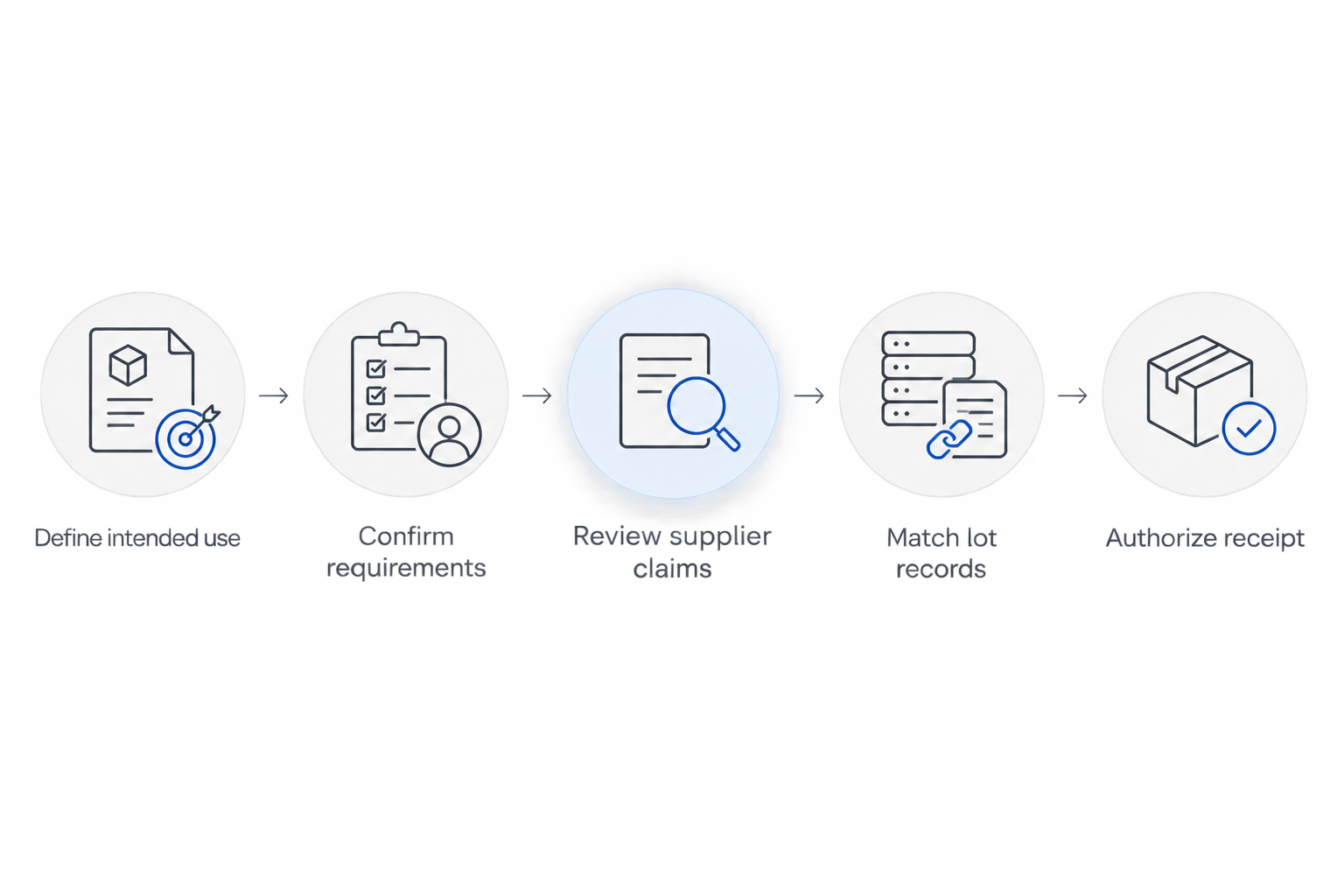
Keep the record readable enough that another researcher can reconstruct the decision without relying on a buyer's memory. The file should explain what was purchased, why it was needed, which review applied, and which documents support its release into laboratory inventory.
Third-party testing does not establish legal authorization or suitability for human administration. It provides evidence about the properties actually measured by the laboratory using the stated methods.
For example, an HPLC purity result concerns the analytical measurement described in the report. It does not automatically establish identity, sterility, endotoxin limits, absolute peptide content, or clinical suitability. Review those attributes separately when your application requires them.
A 99% purity statement also needs context. Ask which method produced the result, whether the report identifies the delivered lot, and whether the method addresses the impurities relevant to your experiment. Do not treat chromatographic purity as a complete description of vial contents.
For a 2026 procurement file, distinguish these questions:
A strong certificate of analysis supports scientific assessment. It is not an FDA approval document, a prescription, or an authorization to conduct human research.
Celonyx Labs is an online store selling 99%-pure, third-party-tested research peptides for laboratory researchers and scientists. Those stated quality attributes are relevant to supplier assessment, but they do not replace a lot-specific review or determine the legality of a proposed use.
Celonyx Labs research peptides are best suited to laboratory researchers and scientists, not people seeking treatment. The practical benefit is a stated laboratory-research focus; the limitation is equally important: a research reagent is not a substitute for an authorized medicine or an appropriate human-study supply.
Evaluate Celonyx Labs using the same procurement criteria you apply to any research supplier. Match documentation to the material, assess suitability against your protocol, and keep research-use restrictions attached to the inventory record.
A laboratory-reagent transaction and a prescription-medicine transaction are different pathways. Do not interpret the absence of a prescription field at checkout as proof that a purchase or intended use is lawful.
For genuine nonclinical procurement, establish the applicable laboratory purchasing requirements. For personal medical use, consult a licensed clinician rather than purchasing research-labeled material as a workaround.
A research-use label does not authorize human administration. Human studies require review of applicable FDA investigational requirements, institutional review board requirements, informed consent, and the suitability of the investigational material.
A study protocol alone does not resolve manufacturing or quality requirements. Before obtaining material, involve the institution's regulatory team and the personnel responsible for investigational-product control.
A research-use label does not guarantee U.S. admissibility. Imported material requires a review of the shipment's actual identity, intended use, documentation, and applicable entry requirements.
For a proposed import in 2026, have your procurement team coordinate with qualified customs and regulatory personnel before shipment. Do not misdescribe the contents, value, or intended use to obtain clearance.
Domestic delivery and international entry are separate questions. A supplier's acceptance of an international order does not establish that the shipment will satisfy U.S. requirements.
Is sermorelin legal to buy for research in the United States?
Sermorelin can be purchased for legitimate nonclinical laboratory research, but legality depends on the transaction, intended use, and applicable requirements. A research-use disclaimer does not make every sale or use lawful.
Does for research use only mean FDA approved?
No. A research-use statement does not establish FDA approval, clinical suitability, or authorization for human administration.
Can I buy research sermorelin for personal use?
Research-labeled sermorelin is not an appropriate substitute for medical treatment. Discuss personal medical questions with a licensed clinician and use lawful pharmaceutical channels.
Does a certificate of analysis prove sermorelin is legal?
No. A certificate of analysis reports specified analytical results; it does not authorize a transaction, approve a study, or establish suitability for human use.
Is 99% purity enough to approve a research peptide?
No. A 99% purity statement does not by itself establish identity, sterility, peptide content, or suitability for your experiment. Review the lot-specific methods and acceptance criteria.
Does calling an experiment research remove human-study requirements?
No. Describing an activity as research does not remove applicable FDA investigational requirements or human-subject protections. Obtain the appropriate institutional and regulatory review before human administration.
Can an overseas seller guarantee that research sermorelin will clear customs?
A seller’s assurance does not establish U.S. admissibility. Review the material, intended use, documentation, and applicable entry requirements before arranging an import.
The most useful procurement question is not “Does the website let you buy it?” Ask: “Can your laboratory document why this material, from this supplier, is appropriate for this approved use?” That question exposes gaps a checkout page cannot address.
Keep legal authorization and scientific suitability as separate approvals. A purchase can require further regulatory review even when the analytical documentation looks satisfactory, and a permissible research purchase can still fail your laboratory's quality criteria. For research use only; not for human consumption. This article provides general U.S. research-procurement information, not legal or medical advice.
How much does a vial of MOTS-C cost? Check the current listing, then compare peptide

Can PEG-MGF be combined with muscle-repair peptides? Study combinations only in controlled research; learn controls,
How much does a vial of AOD-9604 cost? Compare current quotes by peptide mass, testing
FOR RESEARCH USE ONLY. Products sold by Celonyx Labs are intended exclusively for laboratory and scientific research. They are not intended for human or veterinary use, consumption, diagnosis, treatment, cure, or prevention of any disease. By purchasing from this site, you acknowledge that you understand the intended research purpose of these materials and agree to comply with all applicable laws and regulations.