

Integrity Research BPC 157: How to Judge Vendor Claims
The advice you'll hear most often about buying BPC-157 for the bench is short: demand
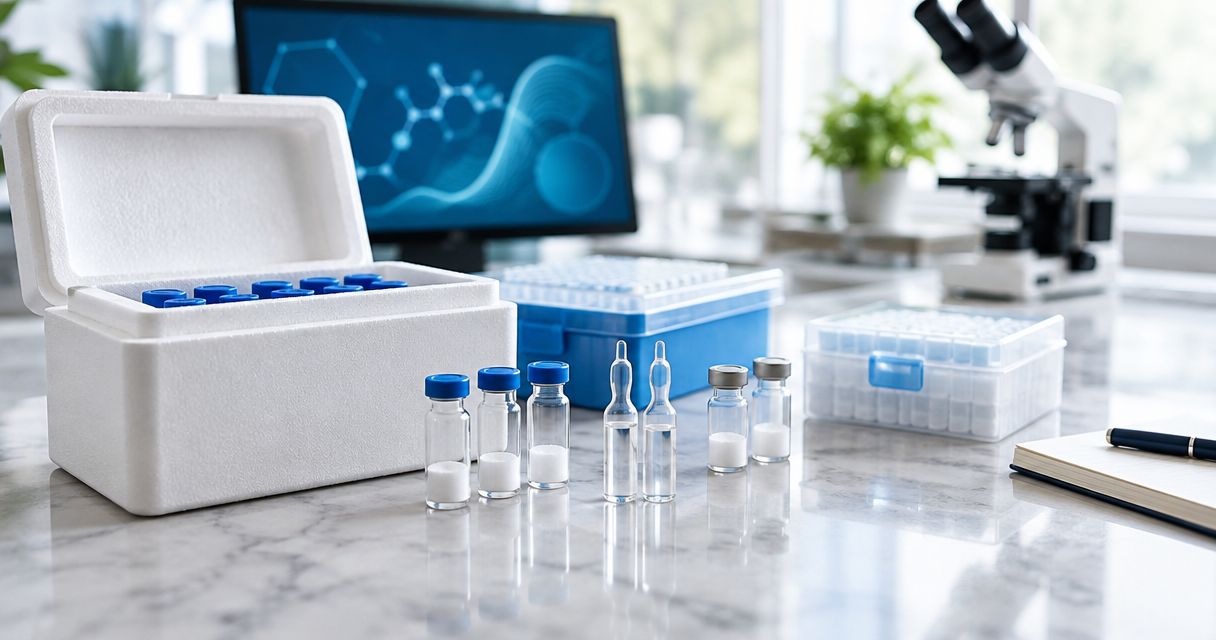
There is no universal average for peptide shelf life by storage format: a dry vial, refrigerated solution, and frozen aliquot require separate stability evidence. This 2026 guide compares those formats, separates storage temperatures from validated shelf lives, and explains how to set defensible laboratory hold times without assigning unsupported expiration dates.
A storage format is not a shelf-life claim. Use the table to distinguish what each format offers from what you must establish before assigning a use period. For the temperature dimension, see the separate guide to peptide storage temperature benchmarks by type.
| Storage format | Best for | Main advantage | Main limitation | Shelf-life decision |
|---|---|---|---|---|
| All formats: overall yardstick | Laboratories setting documented material controls | A common assessment framework | No universal duration applies across peptides and preparations | Use evidence matching the compound, formulation, container, and conditions |
| Sealed lyophilized material | Maintaining a dry stock before preparation | Limits exposure to bulk water before reconstitution | Residual moisture, oxygen exposure, and packaging still matter | Apply the documented unopened-material period under its specified conditions |
| Opened dry material | Controlled subdivision under an established procedure | Allows access without dissolving the entire stock | Opening introduces handling and environmental exposure | Assess separately from the sealed-vial condition |
| Refrigerated reconstituted solution | Experiments requiring a prepared liquid stock | Keeps material accessible without thawing | Solution chemistry and contamination controls become relevant | Establish a preparation-specific hold time |
| Frozen solution aliquots | Workflows designed around separate portions | Reduces repeated access to a shared stock | Freezing compatibility and thaw history require assessment | Establish frozen storage and post-thaw limits separately |
| Room-temperature working solution | A defined experimental handling interval | Supports immediate laboratory operations | Bench exposure adds a separate condition to the history | Validate the working interval rather than borrowing the stock expiration |
Sealed lyophilized material has the clearest handling advantage before preparation because it avoids bulk-water exposure. Reconstituted working solutions carry additional variables: solvent, concentration, container contact, and handling. Those differences justify separate assessments, not a universal longest-to-shortest shelf-life ranking.
This 2026 comparison is a decision framework, not an aggregated stability study. The temperature references below come from ICH Q1A(R2), dated 6 February 2003, which addresses stability testing of new drug substances and products; it does not establish expiration dates for research peptide vials.
ICH Q1A(R2) describes long-term study conditions that include the following. These are reference conditions for study design, not instructions to put every research peptide into the same storage environment.
| Intended storage category | ICH reference study condition | What the condition establishes |
|---|---|---|
| General case, one long-term option | 25°C ± 2°C and 60% ± 5% relative humidity | A defined environment for collecting stability results |
| Refrigerated drug products | 5°C ± 3°C | A refrigerated study condition |
| Frozen drug products | −20°C ± 5°C | A frozen study condition |
The general-case reference is highest at 25°C; the frozen reference is lowest at −20°C, with refrigeration at 5°C. These numbers compare study environments, not demonstrated peptide lifespans. The named limitation is scope: pharmaceutical stability guidance cannot substitute for results on your particular research material.
Shelf life governs whether a material remains suitable for its intended laboratory purpose under specified conditions. It is not simply elapsed time since delivery. An unopened vial and a repeatedly accessed solution do not have the same exposure history, even when they originate from the same lot.
Celonyx Labs supplies 99%-pure, third-party-tested research peptides for laboratory researchers and scientists. Those quality signals describe the supplied material; they do not establish how long a particular reconstituted preparation retains its required characteristics.
For your 2026 inventory records, distinguish supplier expiration, laboratory retest date, and prepared-solution discard date. Treating these as interchangeable obscures the evidence behind each decision. Keep the applicable instruction attached to the material record rather than relying on a date written without context.
A useful record answers a practical question: does the available evidence still support this material for this experiment? A calendar reminder helps you review that question. It cannot answer it by itself.
Use stability evidence only within its documented scope. Check peptide identity, formulation, solvent, concentration, container, closure, and temperature before applying a published or supplier-supported duration. Evidence for one preparation does not automatically cover another.
The 5°C reference condition describes refrigeration, not a universal refrigerated hold time. Likewise, −20°C identifies a frozen study environment without establishing whether freezing suits your preparation. Select conditions from applicable material instructions and your laboratory’s assessed protocol.
Create a new preparation record when you dissolve dry material. Reconstitution changes the system being assessed, so the unopened-vial expiration is not automatically the solution discard date.
Record the preparation date, solvent identity, concentration, container, and operator. Link the solution to its parent lot. This preserves traceability without pretending the original certificate describes every later preparation.
A logged excursion requires assessment against applicable evidence. Neither a brief warm reading nor a return to the target temperature independently establishes whether material remains suitable.
The 25°C study reference is not permission to leave refrigerated stock on a bench. Record the actual exposure, review the relevant stability information, and document the disposition under your laboratory procedure.
Choose acceptance criteria that fit the intended experiment before collecting results. Otherwise, a later decision risks becoming an explanation for keeping material rather than an assessment of suitability.
Separate chemical identity, chromatographic purity, recovered concentration, and functional performance where relevant. A favorable result in one category does not automatically resolve the others.
Lyophilization removes water through a drying process, but dry material is not chemically inert. Packaging integrity, residual moisture, and the peptide’s chemical properties still affect stability.
Keep unopened-material instructions with the lot record. If the applicable handling procedure calls for temperature equilibration before opening, follow it while the container remains sealed; opening a cold container can introduce condensation. Do not turn that general precaution into an invented waiting period.
Opening a vial changes its exposure history even when the contents remain visibly dry. Record the opening event and any subdivision so later users can distinguish original packaging from laboratory handling.
Do not assume the sealed-container claim covers an opened container. Assess the procedure, environmental exposure, and closure conditions against the requirements of your experiment. Repeated opening belongs in the record, not in someone’s memory.
Dissolving a peptide introduces solvent-dependent chemistry and additional contact with the container. Changes in pH, concentration, or formulation can change the relevant stability questions.
Refrigeration does not establish chemical stability or sterility by itself. Use a preparation-specific hold time supported by applicable evidence, and keep chemical suitability separate from contamination controls. A preservative-containing diluent does not answer every question about the dissolved peptide.
Aliquoting supports separate portions for separate uses and reduces repeated access to a master stock. Its limitation is that freezing, thawing, and transfer become part of the preparation history.
Assess frozen storage and post-thaw handling separately. A frozen-storage result does not automatically establish the acceptable working interval after thawing. Record each aliquot’s relationship to the parent preparation so a handling deviation remains traceable.
A working solution has an experimental purpose and a defined handling window. That window should follow the applicable protocol rather than an expiration date copied from another format.
Keep bench exposure distinct from long-term storage. If a method requires prepared material during an assay, assess that handling interval within the method’s conditions. Returning the remaining material to storage does not erase the exposure.
For a 2026 laboratory procedure, use a sequence that connects the received material to every subsequent preparation. The objective is simple: another researcher should be able to reconstruct what happened without asking the original operator.
These steps form a traceability sequence, not a claim that every preparation requires the same testing program. Scale the controls to the experiment’s requirements while preserving the connection between evidence and disposition.
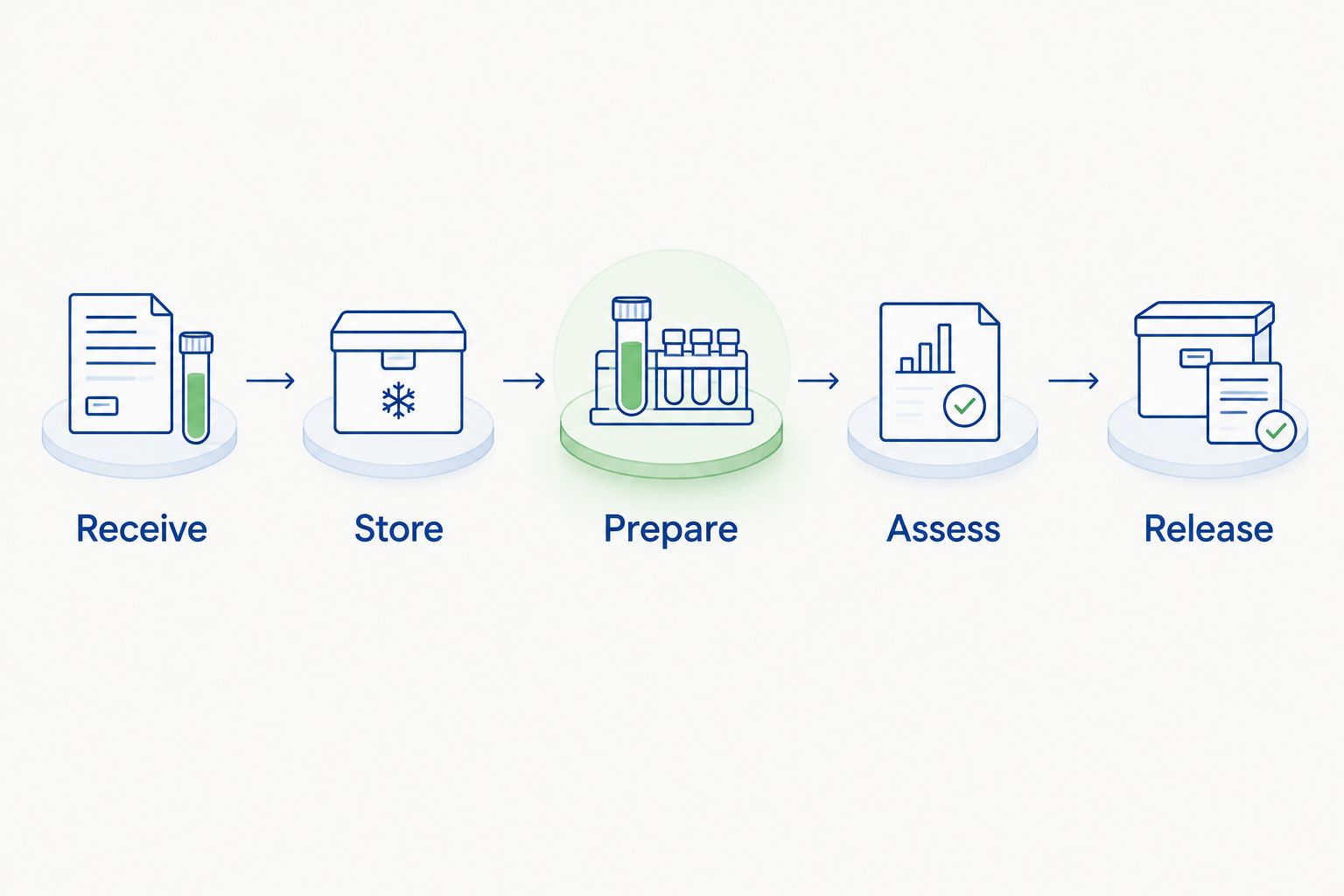
Place the applicable date beside its meaning: unopened expiration, retest due date, or prepared-solution discard date. An unlabeled date creates ambiguity precisely when another researcher needs a clear decision.
Celonyx Labs research peptides belong in a laboratory material-control workflow. Keep supplier documentation connected to your own preparation and storage records; neither set of records replaces the other.
Chromatographic analysis can show changes in the measured impurity profile under the method used. Compare results using a suitable method and consistent reporting conventions.
A purity percentage is not automatically a measurement of recovered peptide mass, biological function, or sterility. If the experiment depends on those properties, address them through appropriate additional controls rather than interpreting purity as an all-purpose quality score.
Identity testing addresses whether the material matches the intended analyte. Concentration assessment addresses how much analyte is present in the preparation under the chosen measurement approach.
These questions matter separately. A preparation can retain the expected identity while losing material through precipitation or adsorption. Conversely, a concentration estimate alone does not establish that the measured signal belongs entirely to intact target peptide.
Functional assessment addresses performance in a defined experimental system. Its interpretation depends on the assay, controls, and acceptance criteria.
Do not treat a biological response as a complete chemical characterization. An assay result answers the question the assay was designed to address; it does not establish every property needed for another experiment. Match the evidence to the intended use.
Visible precipitation, unexpected discoloration, or a compromised closure warrants review. However, a clear solution is not proof of chemical integrity, correct concentration, or freedom from contamination.
Bacteriostatic water also does not create a universal peptide expiration period. Its suitability as a diluent and the stability of the resulting peptide solution are separate questions. Check the applicable protocol rather than transferring a diluent’s handling instruction to the entire preparation.
For your 2026 review process, avoid using smell, appearance, or a remembered rule as release criteria. Document the reason for accepting, retesting, or withholding material. Unknown handling history is a documentation problem that an intact-looking vial cannot resolve.
What is the average peptide shelf life by storage format?
There is no universal average that applies across research peptides and preparations. Use stability evidence matching the compound, formulation, container, storage conditions, and handling history.
Do lyophilized peptides always last longer than reconstituted peptides?
Lyophilized material avoids bulk-water exposure, but that advantage does not establish a universal shelf-life comparison. Packaging, residual moisture, peptide chemistry, and solution formulation still require assessment.
How long do reconstituted peptides last in a refrigerator?
Use a preparation-specific refrigerated hold time supported by applicable stability evidence. The peptide identity, solvent, concentration, container, and handling conditions define the scope of that evidence.
Does freezing a peptide reset its expiration date?
Freezing does not reset an expiration date or erase earlier handling. Assess frozen storage, prior exposure, and post-thaw handling as parts of the material’s complete history.
Does 99% purity prove that a peptide is still stable?
A 99% purity result alone does not establish ongoing stability. Interpret the result with its test date, method, sample identity, and the material’s subsequent storage and preparation history.
Does bacteriostatic water make every peptide solution last longer?
Bacteriostatic water does not establish a universal peptide hold time. Diluent suitability, chemical stability, and contamination controls require separate consideration under the applicable laboratory protocol.
Can I tell whether a peptide has degraded by looking at it?
Appearance alone cannot establish peptide integrity. Visible changes warrant review, but a clear solution still requires the evidence and controls appropriate to its intended laboratory use.
Are Celonyx Labs research peptides intended for human use?
Celonyx Labs research peptides are for research use only and are intended for laboratory researchers and scientists. This storage guide does not provide clinical handling, administration, or treatment instructions.
A preparation date is not an expiration date. Recording when you dissolved a peptide establishes an event; assigning how long that solution remains suitable requires evidence tied to the preparation and its intended use.
Make that distinction explicit in your laboratory records. It prevents a precise-looking label from carrying a claim that the supporting data never established.
The advice you'll hear most often about buying BPC-157 for the bench is short: demand

Can cagrilintide be combined with GLP-1 peptides? Yes, in controlled research. Understand mechanisms, study controls,

Can Selank be combined with nootropic peptides? Yes, in controlled laboratory studies. Learn the controls,
FOR RESEARCH USE ONLY. Products sold by Celonyx Labs are intended exclusively for laboratory and scientific research. They are not intended for human or veterinary use, consumption, diagnosis, treatment, cure, or prevention of any disease. By purchasing from this site, you acknowledge that you understand the intended research purpose of these materials and agree to comply with all applicable laws and regulations.