

How much does a vial of research-grade MOTS-C cost?
How much does a vial of MOTS-C cost? Check the current listing, then compare peptide
The most repeated advice about peptide reconstitution is that you divide the milligrams on the vial label by the milliliters of water you add, then keep the result in the fridge for 28 days. The first half of that sentence is arithmetic. The second half is a guess wearing a number's clothing.
A calculator that returns 2.5 mg/mL and a tidy expiry date has answered one question and skipped the three that decide whether the prep is still usable on Friday. What is the peptide sequence, what is it dissolved in, and can your instrument physically deliver the volume you plan to draw? Treat the output as a preparation record, not a widget result. Everything below is written for laboratory research use only, and none of it is a human or veterinary dose.
A reconstitution calculator has one job: divide labeled peptide mass in milligrams by diluent volume in milliliters, then hand back a concentration in mg/mL. The worked example on the reconstitution calculator at peptidecalcs.com pairs a 5 mg lyophilized peptide vial with 2 mL of bacteriostatic water and returns 2.5 mg/mL, or 2,500 mcg/mL. Five divided by two is 2.5. Nothing harder happened at the arithmetic stage.
The harder part is everything printed around the number. A calculator that outputs "2.5" with no unit has done what a price tag with no currency does: it states an amount and hides the scale.
Feed those three in and a tool can produce a result. Feed them in and stay silent about which unit was printed, and the tool has produced half a result.
One milligram is 1,000 micrograms. Vials are labeled in milligrams while bench records are often kept in micrograms, and that single relationship explains most unit disputes in this field.
The second conversion applies when draws are logged in syringe units. A 1 mL insulin syringe holds 100 units, so each unit is one hundredth of a milliliter, and the last column below shows what one unit carries at each concentration.
| Peptide on label | Diluent added | Concentration | Micrograms per mL | Micrograms per unit |
|---|---|---|---|---|
| 5 mg | 1 mL | 5 mg/mL | 5,000 mcg/mL | 50 mcg |
| 5 mg | 2 mL | 2.5 mg/mL | 2,500 mcg/mL | 25 mcg |
| 10 mg | 2 mL | 5 mg/mL | 5,000 mcg/mL | 50 mcg |
| 2 mg | 2 mL | 1 mg/mL | 1,000 mcg/mL | 10 mcg |
Run the tool first, then pick the row matching your vial and diluent and compare both the concentration and the per-unit figure. Any disagreement means a unit error somewhere, and the tool is the likelier suspect.
What the table can't tell you: a concentration is a starting condition. It says nothing yet about how long the solution holds or whether the transfer can be measured accurately.
A prepared concentration also stays a paper value until someone checks it against the actual solution. The guide to peptide concentration determination covers how that verification works on the analytical side.
Keep the limit of this section in view. 2.5 mg/mL is a prepared research concentration, recorded for laboratory use only, never a dose or a schedule. A correct concentration can still be a bad prep, and the rest of the record is what separates the two.
Work in this order and the arithmetic stays auditable. Skip a step and the number still looks plausible on screen, which is exactly why the order matters.
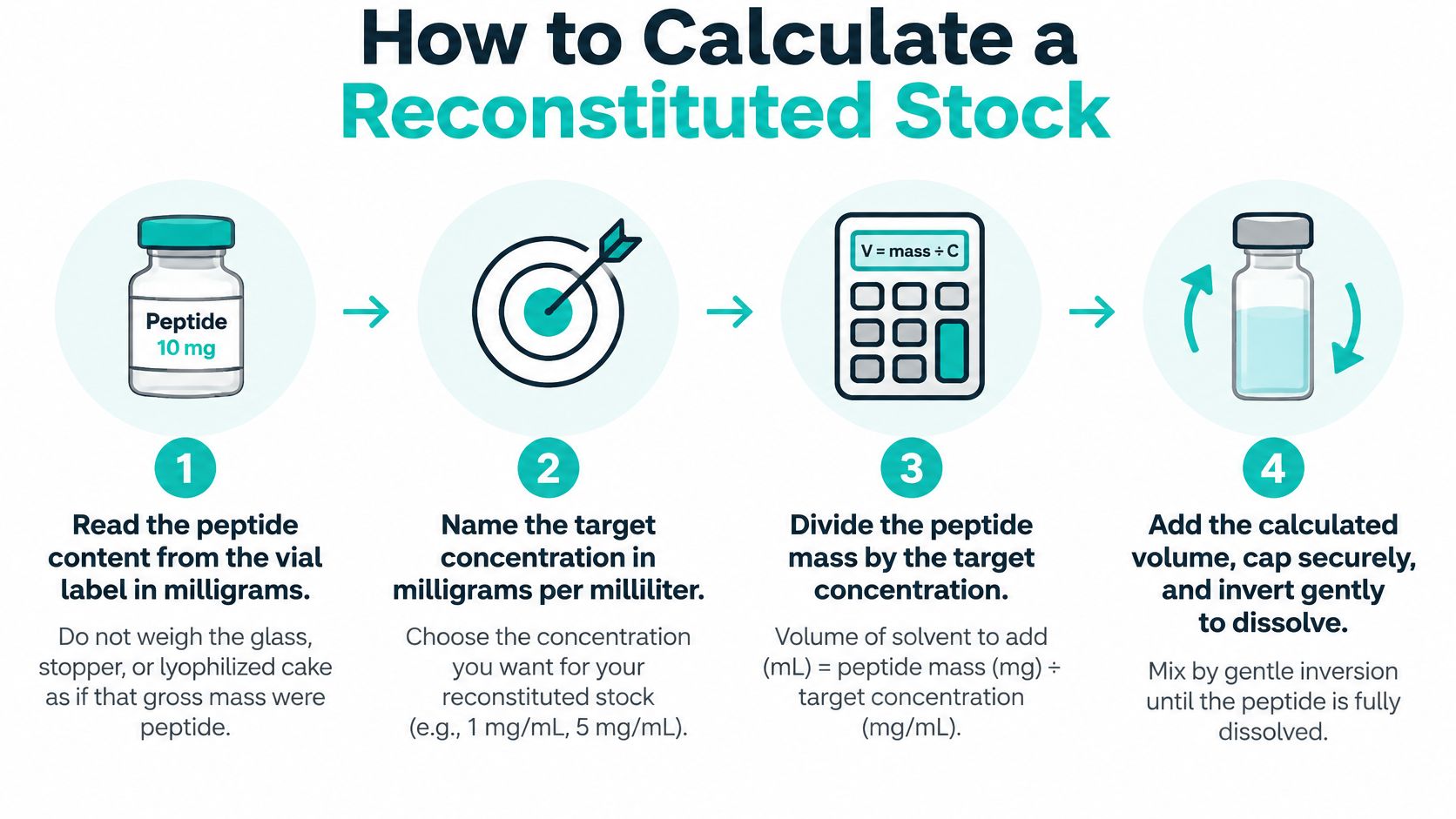
1. Read peptide content from the vial label in milligrams. The label number is the mass of peptide in the vial. Weighing the whole vial tells you about glass and rubber, and the lyophilized cake contributes nothing you can weigh separately on a bench balance.
2. Name the diluent the protocol specifies, then fix the volume. Bacteriostatic water, a stated buffer, whatever the protocol calls for. Choose the volume before the powder is wetted, because the volume decision is reversible and the wetting is not.
3. Divide mass by volume. Five milligrams into 2 mL gives 2.5 mg/mL. Write the division down, even when a tool did it, so the next reader can reproduce it.
4. Multiply by 1,000 to reach micrograms per milliliter. That same stock is 2,500 mcg/mL. Do this once and the milligram and microgram versions of the record stop drifting apart.
5. Convert to syringe units only if your lab record uses them. Peptides Index notes on its reconstitution calculator page that a 1 mL insulin syringe contains 100 units, so each unit represents 0.01 mL. At 2,500 mcg/mL, that unit carries 25 mcg. If your records are kept in microliters, skip this step entirely and stay in volume.
6. Invert the math as a check. Concentration times the volume you added must return the original mass. If you added 2 mL of a 2.5 mg/mL stock and the product isn't 5 mg, you have an arithmetic or unit fault. Compare against the lookup row from the previous table as a second opinion.
7. Write the record on the vial before it leaves the bench. Concentration, diluent, volume added, date, time, and lot. A vial that crosses the lab without those six items will be re-identified by guesswork within a week.
Bench rule: finish the arithmetic before the stopper comes off. The powder should never be wet while somebody is still redoing the division.
Two entry errors scale the result, and both survive a glance at the screen. Typing a microgram figure into a milligram field overstates the mass a thousandfold. Treating the aliquot you intend to draw as the reconstitution volume understates the concentration and leaves you with a far weaker stock than the record claims. Neither mistake produces an error message.
Celonyx Labs publishes a Peptide Reconstitution Calculator for entering these same research inputs, vial strength, diluent volume and desired amount, which is a reasonable place to run the division while you keep the paper record beside it.
Stop at a labeled research stock. These steps describe laboratory preparation only, never human, veterinary, or therapeutic use.
A unit swap doesn't look wrong on a screen. The digits are the same digits, the decimal point sits where it sat, and the concentration that comes out is off by a factor of 1,000. That's why a second person checks the entry before the label is written.
Confirm the field units out loud. The mass field is milligrams and the volume field is milliliters. Enter micrograms as milligrams, or microliters as milliliters, and the concentration moves by 1,000 either way. Saying the unit before typing the number catches this more reliably than rereading it.
Check the diluent name against the protocol. Calculators often carry a default solvent. A default that isn't the solvent your method names has just changed the preparation without anyone deciding to.
Print both units when syringe units appear at all. At 2,500 mcg/mL, one unit of a 100-unit, 1 mL syringe is 0.01 mL and 25 mcg. Show the micrograms per milliliter and the micrograms per unit side by side, because a later reader who mistakes a unit figure for a milligram figure will be out by orders of magnitude.
Run the diluent down the vial wall, then swirl. Aim the stream at the glass, not at the cake. Shaking whips foam into the solution, puts the peptide at an air interface, and leaves material dried on the glass above the liquid line.
The scale of that error class isn't theoretical. The U.S. Food and Drug Administration reported in 2024 that some patients received compounded semaglutide doses 5 to 20 times higher than intended, with confusion among units, milliliters, and milligrams identified as a contributing factor, as summarized in PeptideConvert's calculator notes. That's a clinical population and a different preparation route from a research vial, so read it as a magnitude check rather than a method.
A research calculator should catch the class of error before it prints anything: flag a mass that is implausible for the vial size, refuse to output without a unit selection, and label every result with the unit it used. Ten seconds of flagging beats a mislabeled stock that sits in the fridge for a month, wrong and perfectly legible.
Say a 2,500 mcg/mL stock needs a 10 mcg analytical aliquot. Divide 10 by 2,500 and you get 0.004 mL, or 4 microliters. On paper the calculation is exact. At the bench it is a problem, because 4 microliters sits below one unit of a 100-unit insulin syringe and near the bottom of what a small pipette delivers with any confidence.
The concentration is right. The transfer isn't reproducible. Those are different failures, and a calculator that shows only the first has hidden the second.
Guidance on reconstitution calculator sanity checks makes the point that very small calculated volumes can put ordinary pipettes and syringes outside their usable range, while overly dilute stocks swing the problem the other way by magnifying the relative impact of every measurement error. The fix isn't a steadier hand.
| Instrument | Smallest mark to trust | If the aliquot is smaller |
|---|---|---|
| P10-class micropipette | about 2 µL | Make an intermediate dilution |
| P200 micropipette | about 20 µL | Make an intermediate dilution |
| 1 mL insulin syringe, 100 units | 1 unit, 0.01 mL | Do not read partial units; dilute |
| Serological pipette | about 0.1 mL | Use a smaller instrument or dilute |
Those floors are practical sanity checks, not certified specifications. What matters is that you know yours and that the calculator asks for it.
Move 0.1 mL of the 2,500 mcg/mL stock into 0.9 mL of the same diluent. That transfers 250 mcg into a total of 1 mL, so the working dilution is 250 mcg/mL. Now the 10 mcg aliquot becomes 0.04 mL, or 4 units, which is a volume a person can draw and a second person can check.
You've added one transfer to remove one source of doubt. That's usually a good trade, and it's the reason a validated intermediate dilution beats a careful attempt at a tiny pull.
A concentrated stock can improve stability or reduce solvent load, and it raises percentage error the moment the transfer drops below your instrument's range. More concentrated is not automatically better.
A useful output here estimates absolute and percentage uncertainty for the planned aliquot and offers an alternative reconstitution volume that lands the draw inside range. For academic labs, CROs, and preclinical teams who need the same prep to reproduce next month, that warning is worth more than another decimal place. Matching your syringes and needles to the volumes you draw is part of the same decision, not an afterthought.
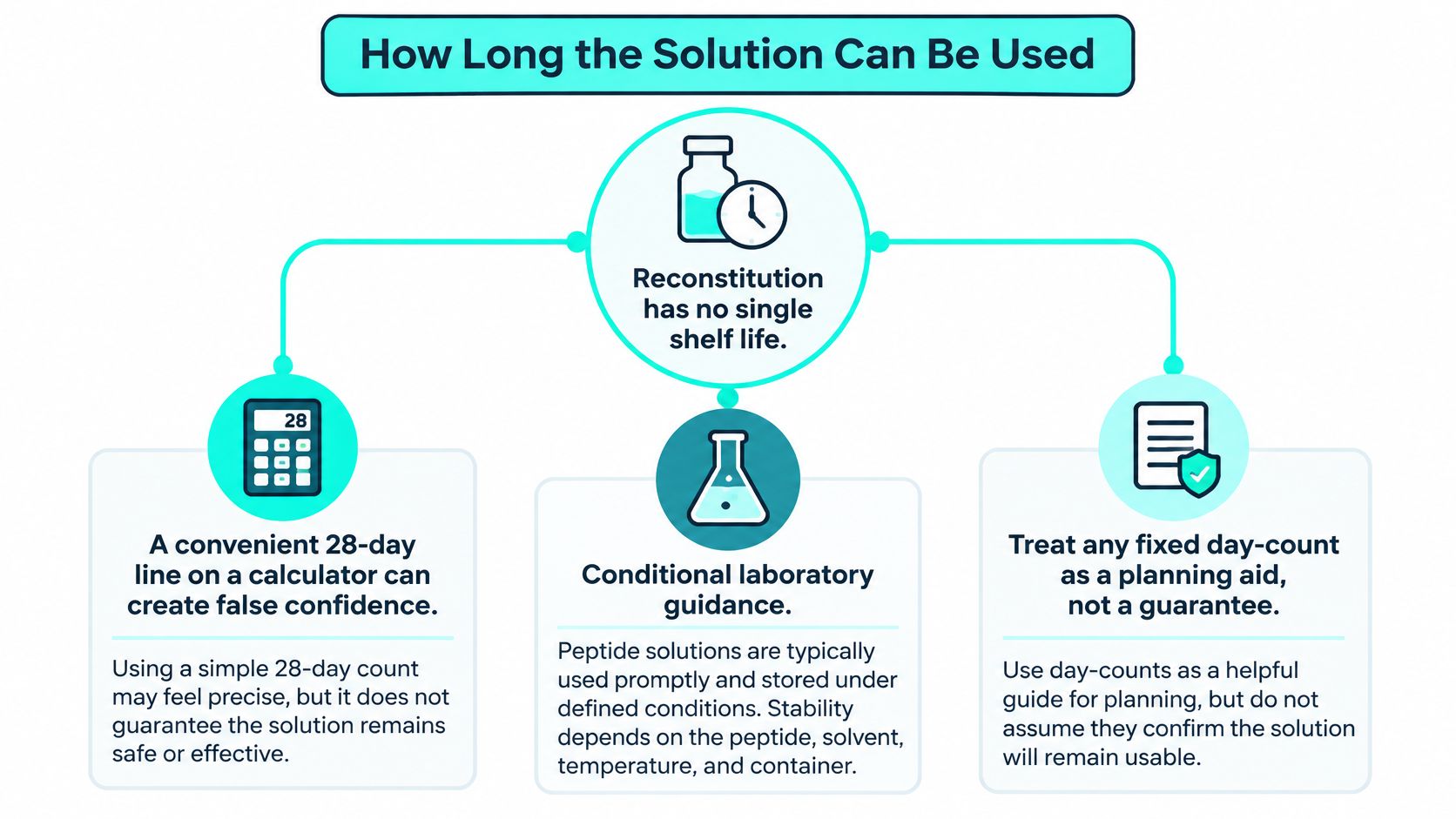
There is no universal shelf life for a reconstituted peptide, and a calculator that prints "28 days" as though it were a property of water is creating confidence it hasn't earned.
Merck's handling and storage guidance for peptide solutions is far more conditional than the calculator circuit. It states that peptide solutions are generally stable for up to one week at 4 °C, with exceptions that depend on sequence, and recommends freezing aliquots when storage will run longer or the peptide is known to be unstable. It also advises against repeated freeze-thaw cycles, asks for pH control, and prefers keeping material lyophilized at −20 °C or −80 °C.
| Condition | What to plan for | Calculator warning |
|---|---|---|
| Lyophilized at −20 °C or −80 °C | Preferred long-term storage | Do not treat as a solution expiry |
| Solution at 4 °C | Generally up to one week, sequence-dependent | Ask for known stability data |
| Storage longer than a week or unstable peptide | Freeze aliquots | Print an aliquot plan |
| Repeated freeze-thaw | Avoid | Count each thaw |
| No stability data for this sequence and diluent | Usable time unknown | Show no validated stability data |
Storage belongs in the input panel, not in a footnote under the result. A tool built for real bench work should ask for the peptide identity or any known stability notes, the diluent and its pH, the storage temperature, the assay date, and how many withdrawals the vial will see. Those five answers decide more about usability than the mass and volume do.
The record it prints should carry concentration, date and time of preparation, aliquot plan, storage condition, and a running freeze-thaw count. When the sequence and diluent have no validated stability data behind them, the record should say so in plain words rather than defaulting to a comfortable day count.
Practical rule: ask for the assay date before you ask for the volume. A prep planned for Friday and a prep planned across three weeks are different preparations, even when the arithmetic is identical.
A 2.5 mg/mL stock made Monday for a Friday assay can reasonably sit at 4 °C if the peptide isn't known to be fragile. The same stock needed across three weeks should be split into single-use frozen aliquots on the day it's made, with each aliquot thawed once. Same numbers. Different handling. Different record.
That's the question the division never answers: how long is this usable? Usable time is an interaction among sequence, solvent, pH, temperature, concentration, and handling. The storage guidance for reconstituted peptides covers the handling side in more detail.
Close on a decision rather than another formula. Four lines, all filled, all legible, and then the stopper comes off.
If any line is blank, rerun the calculator. Do not correct the vial after the powder is wet. A record written from memory the next morning is a different document, and a weaker one.
The output of all this planning is a laboratory solution for research use only. It is not a human dose, a veterinary dose, or a therapeutic schedule, and no amount of precision in the arithmetic changes that. Celonyx Labs labels all of its peptides "For Research Use Only" and designs them for scientific study in laboratories worldwide.
Add lot and date to the four lines, save the record, and only then open the vial.
If you'd rather not rebuild the division by hand every time, Celonyx Labs publishes a Peptide Reconstitution Calculator that takes vial strength, diluent volume, and desired amount and returns concentration alongside the draw volume in both units and milliliters. Pair it with the four-line record above, keep the storage plan on the same page as the number, and the prep you make on Monday will still be identifiable on Friday. Browse the catalog when you're ready to plan the next batch.
How much does a vial of MOTS-C cost? Check the current listing, then compare peptide

Can PEG-MGF be combined with muscle-repair peptides? Study combinations only in controlled research; learn controls,

How much does a vial of AOD-9604 cost? Compare current quotes by peptide mass, testing
FOR RESEARCH USE ONLY. Products sold by Celonyx Labs are intended exclusively for laboratory and scientific research. They are not intended for human or veterinary use, consumption, diagnosis, treatment, cure, or prevention of any disease. By purchasing from this site, you acknowledge that you understand the intended research purpose of these materials and agree to comply with all applicable laws and regulations.