
BPC 157 TB 500 GHK Cu Research Guide 2026
The popular advice to treat BPC-157, TB-500, and GHK-Cu as a ready-made regenerative stack skips
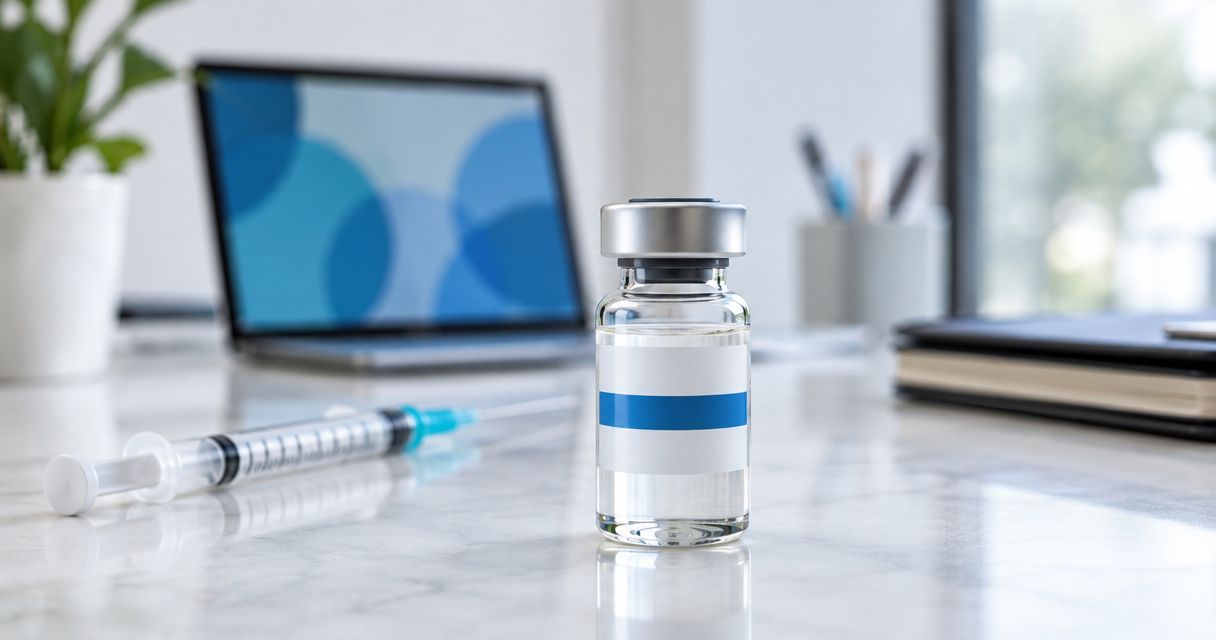
The cost of a research-grade AOD-9604 vial depends on the current supplier quote, stated peptide mass, and supporting quality documentation; a vial label alone does not establish comparable value. For your 2026 laboratory budget, compare equivalent specifications and include procurement, verification, and preparation expenses rather than treating the vial charge as the complete experimental cost.
Compare the material your protocol requires, not the container it arrives in. A vial is a packaging unit, while peptide mass, identity, and analytical specifications determine what you are purchasing for an experiment.
For 2026 procurement, begin with a written specification and request comparable quotations against it. The research peptide buying guide provides a broader sourcing framework; the sections below focus on building an AOD-9604 purchasing decision you can document.
Keep the intended use explicit throughout the process. This guide concerns laboratory research procurement only, not personal use, administration, or treatment.
Use the supplier’s current written quotation for the exact AOD-9604 specification your laboratory intends to purchase. Record the quoted date, labeled mass, lot identifier when assigned, and included documentation before comparing the offer with another supplier.
A meaningful cost comparison needs a shared denominator. Comparing containers without matching their contents leaves the central purchasing question unanswered: how much specified research material does your budget obtain?
| Comparison basis | Best for | Advantage | Limitation |
|---|---|---|---|
| Per vial | Ordering against an exact, matched specification | Simple to reconcile with a purchase order | Misleading when peptide mass or specifications differ |
| Per milligram | Comparing equivalent peptide quantities | Removes differences in labeled vial mass | Does not establish identity, purity, or experimental suitability |
| Total procurement expense | Approving a laboratory purchase | Includes documented purchasing and receipt expenses | Requires checking each quotation’s inclusions |
| Per experimental run | Planning a defined research protocol | Connects purchasing to planned material consumption | Depends on a validated protocol and realistic material accounting |
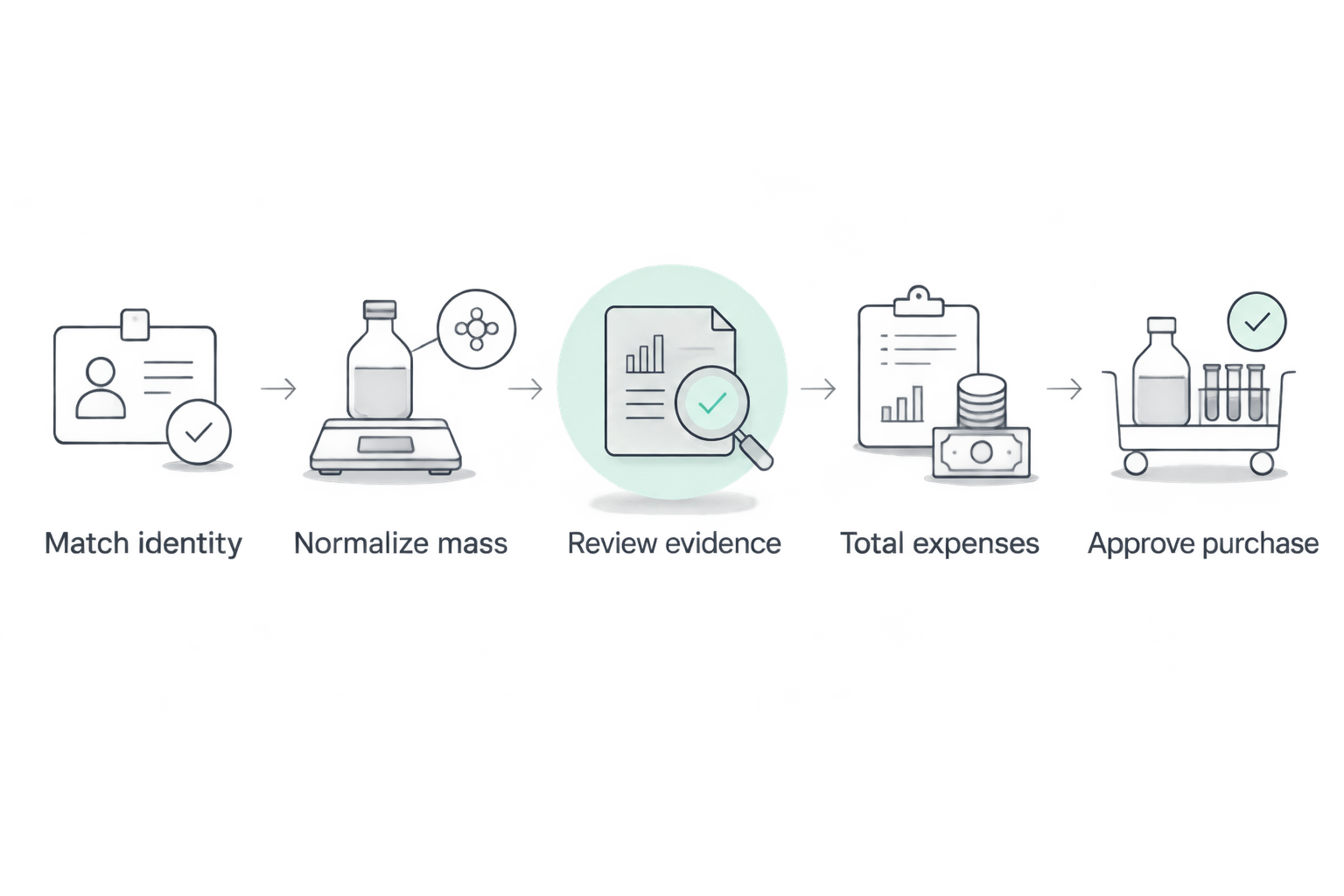
These are complementary views, not competing answers. Use the per-vial figure for ordering, the mass-normalized figure for comparison, and the total procurement figure for approval.
Separate the material charge from any documented transport, handling, independent verification, and laboratory preparation expenses. Include only expenses that apply to your purchase; do not assume every supplier imposes the same charges or provides the same services.
For a 2026 purchase request, attach the quotation rather than copying an undated figure into a reusable spreadsheet. Keep the original specification beside it so your purchasing team can identify substitutions before accepting them.
Start with quantity, then examine quality. A mass-normalized comparison is useful only after you establish that the offers concern the same requested material and acceptable specifications.
Keep the original units visible during conversion. 1 gram equals 1,000 milligrams, and 1 milligram equals 1,000 micrograms. These conversions standardize quantity; they do not correct for water, counterions, or other contributions to the mass of a peptide preparation.
Do not divide a quotation by the volume of the container. Container capacity is not peptide mass, and a reconstitution volume chosen later does not change the amount originally purchased.
If your worksheet includes solution volumes, keep those separate from mass: 1 milliliter equals 1,000 microliters. A concentration calculation needs both a mass and a volume; neither unit alone describes the concentration of a prepared solution.
Ask for enough information to connect the quotation, received vial, and analytical record. Your laboratory should be able to explain what it ordered, what arrived, and why the material met its acceptance criteria.
Record the exact requested identity, stated mass, physical form, and any chemical-form requirements relevant to your protocol. Do not assume that similar names establish equivalent materials.
Specify whether your work requires a particular counterion, peptide-content determination, or other analytical characteristic. Those requirements belong in the purchase specification, not in an informal discussion after delivery.
Request the applicable certificate of analysis and identify which tests support which claims. A purity result, an identity result, and a peptide-content result answer different questions.
For example, chromatographic peak-area purity does not by itself establish the absolute mass of peptide in the vial. Review the reported method and its scope before interpreting a percentage as a complete assessment of material quality.
Obtain the supplier’s applicable handling instructions and check them against your laboratory’s receiving process. Arrange responsibility for receipt, inspection, and storage before placing the order.
Do not transfer storage or preparation instructions from a different peptide merely because the containers look alike. Your approved procedure should govern how the received material enters inventory and becomes eligible for experimental use.
Differences in the purchase specification change what a quotation represents. Use the following factors as comparison fields, not as proof that a particular supplier’s higher charge is justified.
Do not treat a longer certificate as automatically better evidence. Evaluate whether the reported methods answer your acceptance questions and whether the results apply to the material you receive.
A 99% purity statement is a quality attribute to evaluate, not a complete purchasing verdict. Its meaning depends on the analytical method, reporting basis, and connection to the supplied material.
Celonyxlabs describes its research peptides as 99%-pure and third-party-tested. Those are relevant screening signals for laboratory buyers, but they do not replace checking the documentation required for a particular experiment.
Celonyxlabs research peptides are best suited to laboratory researchers seeking 99%-pure, third-party-tested materials. The purchasing limitation remains application-specific: a general purity statement does not establish sterility, endotoxin status, absolute peptide content, or fitness as a certified reference material.
For your 2026 acceptance checklist, separate each required attribute into its own field. The guide to whether 99% purity establishes research safety explains why a purity percentage should not stand in for a broader assessment.
Calculate the quoted material charge divided by the stated peptide mass in milligrams. Use this result only to compare quotations that meet the same identity and specification requirements.
Keep two mass fields if your documentation distinguishes labeled material mass from measured peptide content. Otherwise, a spreadsheet can make unlike quantities appear equivalent simply because both columns use milligrams.
Do not calculate an assumed peptide-content value by multiplying labeled mass by chromatographic purity. Peak-area purity and mass fraction are not interchangeable measurements, so that shortcut does not establish the amount of peptide present.
The lowest per-vial quote is not a sufficient basis for selection. Choose against predefined acceptance criteria first, then compare the total expense of qualifying offers.
A less expensive container fails the comparison if it does not meet your required specification. Conversely, additional analytical documentation has purchasing value only when it supports a requirement your laboratory actually needs.
Reconstitution changes the solution concentration, not the nominal mass originally purchased. Adding solvent therefore does not create additional peptide or make an unmatched quotation equivalent to another offer.
Keep purchasing calculations separate from preparation instructions. Select solvents, handling conditions, and analytical checks through your laboratory’s approved procedures rather than using a procurement worksheet as a preparation protocol.
A purchasing decision should remain understandable after the invoice is filed. Connect the accepted specification and quotation to the received lot, analytical documents, inventory entry, and experimental record.
Use clear status labels such as awaiting inspection, accepted, or rejected within your laboratory’s own system. Receiving a shipment is not the same event as approving its contents for use.
Retain the reasoning behind exceptions. If your laboratory accepts a documented deviation, record who authorized it and which experimental requirements remain satisfied; an unexplained approval becomes difficult to assess later.
For repeat purchasing in 2026, review the new quotation and documentation rather than treating an earlier approval as permanent. The same product name does not remove the need to assess the material assigned to the new order.
How much does a vial of AOD-9604 cost in 2026?
Use a current supplier quotation for the exact AOD-9604 specification you need. Compare stated mass, analytical documentation, and total procurement expense before approving the purchase.
What’s the best way to compare AOD-9604 vial quotes?
Compare quotations against the same identity, mass basis, and acceptance requirements. Then assess both the per-milligram calculation and the documented total procurement expense.
Does 99% purity mean the entire vial contains peptide?
A 99% chromatographic purity result does not establish that the entire vial mass is peptide. Water, counterions, and the analytical reporting basis must be considered separately.
Is third-party testing enough to approve a research peptide?
Third-party testing alone does not establish suitability for every experiment. Check the test scope, lot connection, and results against your laboratory’s acceptance criteria.
Does adding more solvent give me more AOD-9604?
Adding solvent does not increase the amount of AOD-9604 purchased. It changes the concentration of the prepared solution, subject to the material dissolving and the preparation procedure.
Are other research peptides valid substitutes for an AOD-9604 quote?
Other research peptides are not valid substitutes for an AOD-9604 quotation. Their commercial terms do not establish the cost or suitability of the material your protocol specifies.
Who are Celonyxlabs research peptides intended for?
Celonyxlabs research peptides are intended for laboratory researchers and scientists. They are for research use only, not for human or veterinary use.
Write your rejection criteria before reviewing commercial offers. That keeps a purchasing decision tied to the experiment instead of allowing an attractive quotation to redefine what your laboratory considers acceptable.
Place the required identity, mass basis, analytical evidence, and documentation connection at the top of the request. A quote that cannot be assessed against those requirements is not ready for approval, regardless of how simple the vial listing looks.
The popular advice to treat BPC-157, TB-500, and GHK-Cu as a ready-made regenerative stack skips

How much does a vial of MOTS-C cost? Check the current listing, then compare peptide

Can PEG-MGF be combined with muscle-repair peptides? Study combinations only in controlled research; learn controls,
FOR RESEARCH USE ONLY. Products sold by Celonyx Labs are intended exclusively for laboratory and scientific research. They are not intended for human or veterinary use, consumption, diagnosis, treatment, cure, or prevention of any disease. By purchasing from this site, you acknowledge that you understand the intended research purpose of these materials and agree to comply with all applicable laws and regulations.