

Best peptide suppliers ranked by batch consistency 2026
Compare peptide supplier batch consistency by lot records, testing methods, and traceability. Choose documented evidence

Best overall for small, single-use laboratory transfers: a fixed-needle, low-dead-space syringe. Best for interchangeable connections: a matched low-dead-space Luer-lock assembly. Best for instrument-specific analytical work: a fixed-needle glass microsyringe validated for the method. This 2026 guide compares syringe formats, not unverified product models, for research use only.
Dead space is the internal volume that retains liquid after the plunger reaches its intended endpoint. The syringe tip, connection, and needle all contribute; a low-dead-space barrel does not establish the residual volume of an assembled system.
For peptide research, retained solution is only part of the problem. Adsorption to contact surfaces, unsuitable graduations, and inconsistent handling also affect transfer performance. Select the complete liquid-contact pathway, not the label on the barrel.
Use the broader syringes and needles for peptide research guide when your protocol also requires a separate needle-selection decision.
Celonyx Labs supplies 99%-pure, third-party-tested research peptides for laboratory researchers and scientists. Those quality signals concern the research material; they do not validate a syringe, establish sterility, or replace a transfer-method assessment.
Apply these criteria before comparing formats in 2026:
A low-dead-space claim addresses retained liquid. It does not, by itself, demonstrate low protein binding, chemical compatibility, calibrated delivery, or suitability for aseptic work.
| Rank and format | Best for | Standout design feature | Key limitation |
|---|---|---|---|
| 1. Fixed-needle disposable syringe | Small, single-use transfers through one needle | Permanent needle connection removes a detachable hub interface | Needle geometry cannot be changed |
| 2. Matched low-dead-space Luer-lock assembly | Workflows requiring interchangeable attachments | Locking interface permits compatible detachable connections | Residual volume depends on the complete assembly |
| 3. Fixed-needle glass microsyringe | Instrument-specific analytical transfers | Precision syringe formats support defined analytical methods | Cleaning, carryover, and breakage require control |
These are format recommendations, not measured performance rankings. Within each format, select a documented model that satisfies the protocol; neither barrel material nor connection type proves performance independently.
A fixed-needle disposable syringe combines the barrel and needle in a permanent assembly. Removing the detachable hub interface simplifies the liquid pathway, although the needle bore and syringe tip still retain liquid.
This format is the default starting point when your laboratory needs one compatible needle for one defined transfer. Confirm the manufacturer's residual-volume information, working-volume accuracy, and contact materials before approval.
Best for: Small laboratory transfers where the protocol specifies one needle configuration and single-use handling.
Do not select this format solely because the barrel looks small. Read the graduation scheme and documented delivery performance; a visually fine scale is not a substitute for suitability at the intended volume.
Verdict: Buy a documented fixed-needle, low-dead-space model when its needle, materials, and working range match the protocol.
A Luer-lock syringe accepts compatible detachable attachments through a locking connection. Low-dead-space configurations use features intended to reduce liquid retained in the syringe tip or attachment interface.
The important purchasing unit is the assembly. Pairing a low-dead-space syringe with an attachment that has a larger internal cavity does not preserve the syringe's standalone residual-volume specification.
Best for: Laboratory workflows that genuinely require interchangeable attachments or a locking interface.
For a 2026 procurement specification, identify both the syringe and attachment by catalog reference. Record the combination in the method so a replacement connector does not become an undocumented equipment change.
A secure connection and low residual volume answer different questions. Check both, along with chemical compatibility and any application-specific pressure limits stated by the manufacturer.
Verdict: Buy a matched low-dead-space Luer-lock assembly when interchangeable connections are necessary; skip an undocumented combination.
A glass microsyringe is an analytical liquid-handling format used in applications such as instrument sample introduction. A fixed-needle version avoids a detachable needle hub, but its residual volume and delivery characteristics remain model-specific.
Choose this format when the analytical method or instrument calls for it. Do not assume that glass automatically prevents peptide adsorption or that every microsyringe is suitable for aqueous peptide solutions.
Best for: Analytical laboratories using a validated manual or instrument-specific microsyringe method.
The syringe must fit the instrument's requirements, including physical dimensions and operating conditions. A laboratory transfer syringe is not automatically an appropriate substitute for an instrument syringe, even when the nominal capacities match.
Verdict: Buy a fixed-needle glass microsyringe for a defined analytical method; skip it as the automatic default for routine disposable transfers.
A peptide vial's stated mass does not determine the required syringe capacity. The transfer volume depends on the prepared solution and the laboratory method, while the syringe must measure and deliver that volume appropriately.
Keep the volume notation explicit:
These are unit conversions, not recommended transfer volumes. They do not establish which syringe can deliver a particular volume accurately.
Write the intended transfer in mL or µL, then compare it with the manufacturer's working range and accuracy information. If a syringe uses a substance-specific unit scale, do not treat those markings as peptide mass or as a universal concentration scale.
A clearly marked barrel helps prevent reading errors; documented performance establishes whether the device suits the measurement. When the required volume falls outside a syringe's supported range, assess another validated liquid-handling method rather than estimating between markings.
Use this sequence for a new syringe selection or a 2026 equipment change. Complete the assessment before committing research material to the transfer.
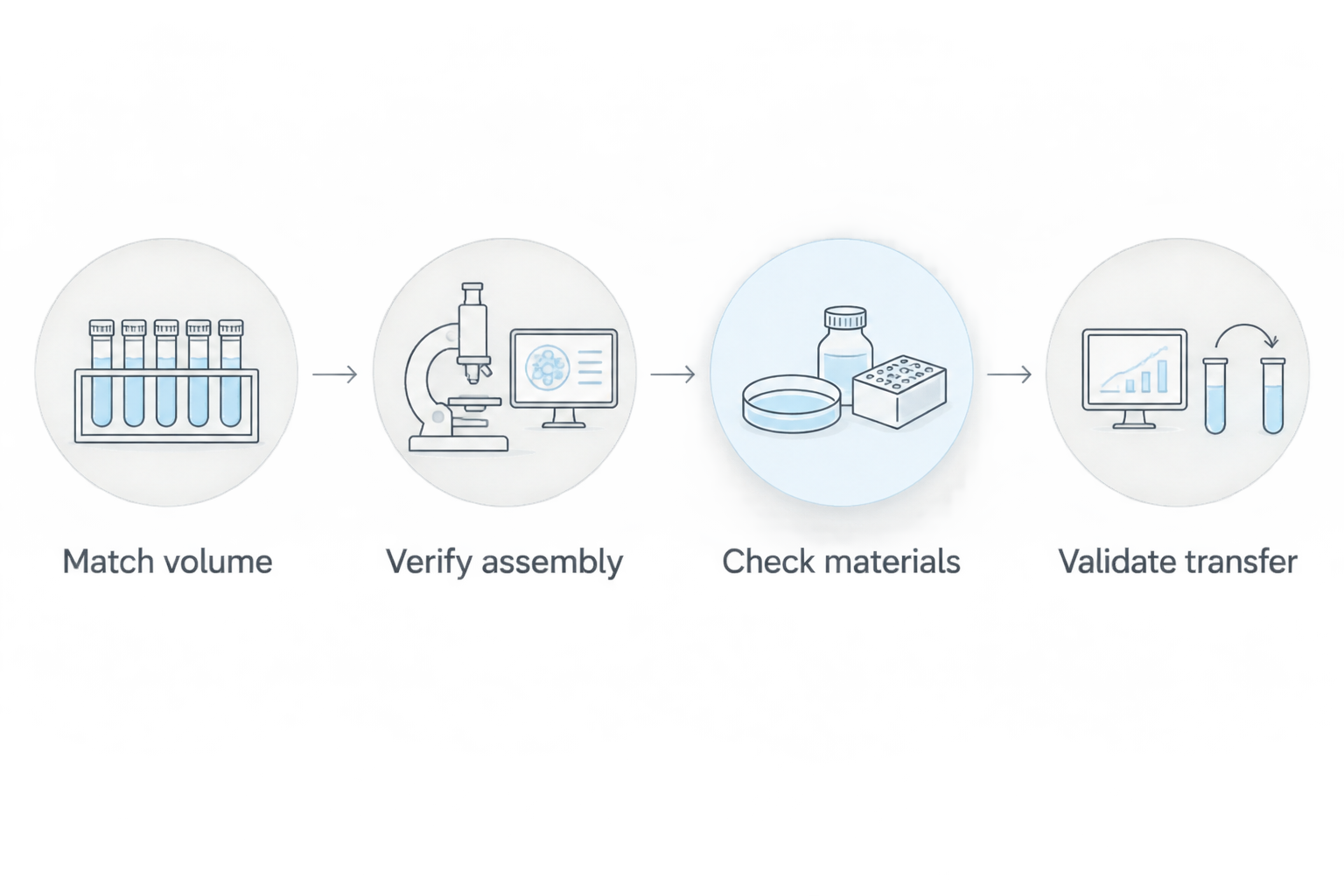
Record the approved configuration and procedure together. If the attachment, solvent, or contact time changes, review whether the existing qualification still applies rather than carrying the approval across automatically.
Residual volume: Liquid remains inside the syringe, needle, or connector after dispensing. Low-dead-space design addresses this retained volume, but the measurement depends on the device and test conditions.
Surface adsorption: Peptide associates with a contact surface rather than remaining entirely in solution. Reducing internal volume does not establish that a surface is low-binding for the peptide under study.
Transfer inconsistency: Bubbles, an unsuitable working range, or inconsistent plunger handling affect the transfer independently of dead space. Standardize the procedure before comparing devices.
Carryover: Reusable equipment can retain material from a previous sample if cleaning is inadequate. Assess cleaning performance separately from the syringe's nominal delivery specification.
Do not add an undocumented extra volume to compensate for assumed losses. That changes the method without establishing what the loss actually is.
The ranking prioritizes a simple, documented liquid pathway for routine single-use transfers, then connection flexibility, then analytical specialization. Each recommendation follows the same criteria: residual volume, working range, materials, connection requirements, and method control.
The 2026 selection rule is straightforward: choose the simplest qualified format that performs the required transfer. Fixed-needle disposable syringes lead only when a permanent needle fits the task; the other formats win when the method requires their specific features.
Start with a fixed-needle disposable syringe for a small, single-use laboratory transfer that does not require interchangeable attachments. Choose the matched Luer-lock assembly when the connection requirement justifies it, and reserve the glass microsyringe for a defined analytical method.
For Celonyx Labs research peptides, syringe selection remains a laboratory-method decision. A purity specification does not establish transfer recovery, solvent compatibility, or suitability for administration. All discussion here concerns research use only, not human or veterinary use.
What’s the best low dead space syringe for peptides in laboratory research?
A documented fixed-needle, low-dead-space disposable syringe is the default choice for small, single-use transfers when its needle, materials, and working range fit the protocol. Use a matched Luer-lock assembly when interchangeable connections are necessary.
Is a fixed-needle syringe always lower in dead space than a Luer-lock syringe?
No; connection type alone does not establish the residual volume of a specific device. Compare manufacturer documentation for the complete syringe-and-attachment configuration under relevant test conditions.
Does low dead space mean a syringe is accurate?
No; low dead space describes retained liquid, not delivery accuracy. Confirm documented performance at the intended working volume and qualify the transfer procedure.
Does a glass syringe prevent peptide adsorption?
No; a glass barrel does not establish the absence of peptide adsorption. Evaluate recovery with the actual peptide, solvent, contact time, and wetted materials when the method requires it.
Can I reuse a disposable syringe for a different peptide vial?
Do not reuse a single-use syringe across peptide vials. Follow the device instructions and laboratory procedures to control contamination and carryover.
Can a syringe scale tell me the mass of peptide transferred?
A syringe measures volume, not peptide mass. The peptide amount depends on the solution concentration and the volume delivered; substance-specific unit markings are not universal peptide measurements.
Does Celonyx Labs peptide purity establish syringe compatibility?
No; peptide purity does not establish syringe compatibility or transfer performance. Qualify the complete liquid-contact pathway separately, and use research peptides only within an approved laboratory protocol.
A nominally low-dead-space syringe can become a different transfer system as soon as you change its attachment. Record the approved syringe-and-needle combination as one configuration, not two interchangeable purchasing choices.
That documentation is more useful than choosing by appearance. Approve the complete pathway once, then control changes to it.
Compare peptide supplier batch consistency by lot records, testing methods, and traceability. Choose documented evidence

Choose a growth hormone secretagogue peptide blend by research fit, not ingredient count. Compare four

Choose a peptide starter kit for research lab work: start with one protocol-matched peptide, verify
FOR RESEARCH USE ONLY. Products sold by Celonyx Labs are intended exclusively for laboratory and scientific research. They are not intended for human or veterinary use, consumption, diagnosis, treatment, cure, or prevention of any disease. By purchasing from this site, you acknowledge that you understand the intended research purpose of these materials and agree to comply with all applicable laws and regulations.