

Best GHK-Cu peptides for skin and wound healing research 2026
Choose the best GHK-Cu peptide format for laboratory skin and wound-healing research. Compare documentation, assay
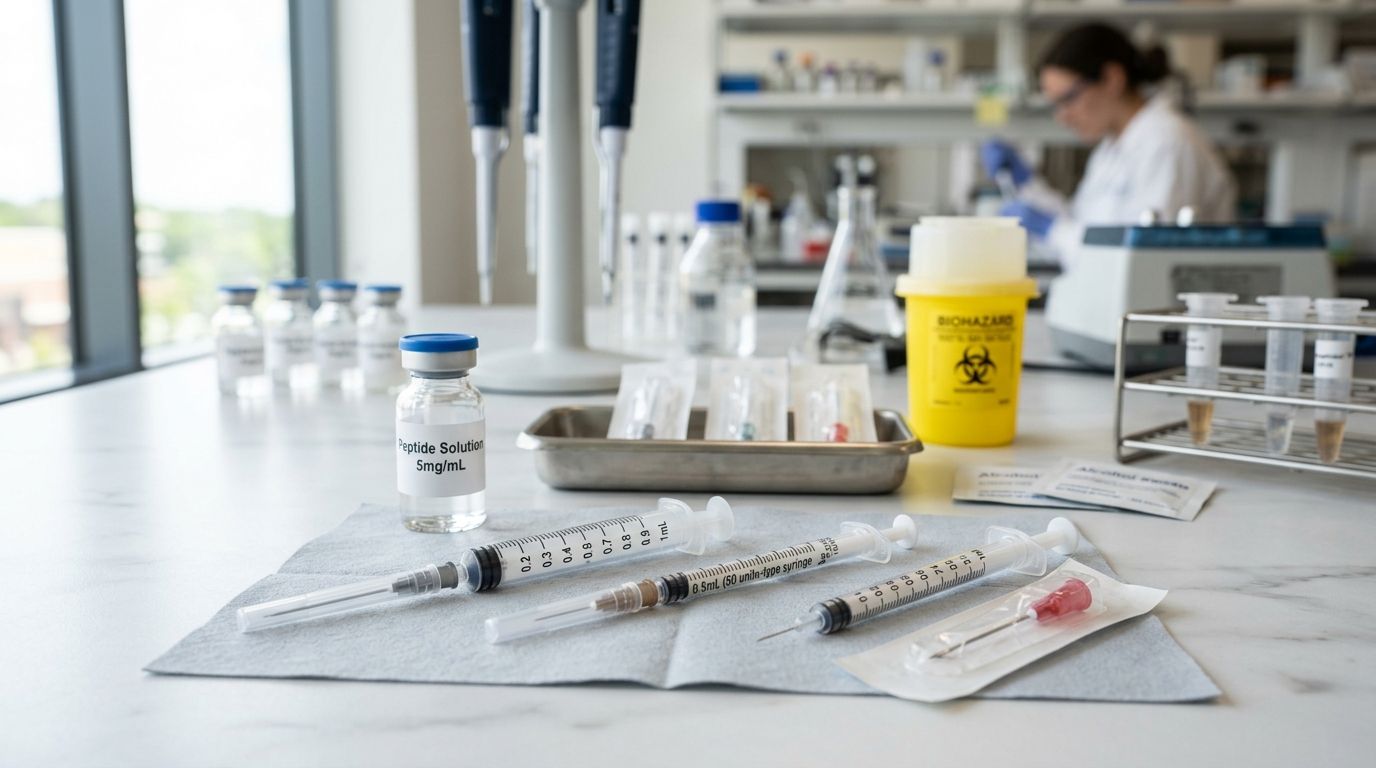
Picking the right syringes and needles determines how cleanly you reconstitute lyophilized material, how accurately you measure a dose, and how much peptide gets wasted in the hub of a needle instead of the vial — this guide ranks the supply types that matter most for research protocols in 2026.
Every reconstitution and measurement step introduces a chance to lose material or skew a dose. A standard syringe hub and needle can trap enough solution that repeated draws from the same vial slowly drift off the intended concentration — a real problem when a protocol depends on consistent dosing across a study.
Gauge, dead-space design, and luer fitting aren't cosmetic details. They determine whether bacteriostatic water mixes cleanly with a lyophilized peptide, whether a filter catches particulate before storage, and whether measurement graduations are fine enough to matter at microliter volumes. All items below are described strictly for laboratory and research use, not for human administration.
If you haven't nailed down the reconstitution step itself, the bacteriostatic water reconstitution guide covers solvent ratios before you even pick up a syringe.
| Item | Best for | Standout feature | Key limitation |
|---|---|---|---|
| BD Ultra-Fine II Insulin Syringe (U-100, 31G) | Precise dose measurement | Fine printed 1-unit graduations | Small barrel limits volume per draw |
| Terumo 3mL Luer-Lock Syringe | Reconstitution and mixing | Secure luer threading for filter attachment | Not built for fine-gauge injection work |
| Exel Comfort Point Insulin Syringe (29G) | High-volume bulk protocols | Lower per-unit cost in bulk packs | Slightly wider gauge than BD 31G |
| BD Blunt Fill / Draw Needle (18G) | Withdrawing through rubber stoppers | Wide bore speeds up vial draws | Too large for actual injection use |
| PES Syringe Filter (0.22 micron, luer lock) | Sterile filtration of stock solution | Removes particulate before storage | Adds a step to every reconstitution cycle |
The BD Ultra-Fine II is a fixed-needle insulin syringe built around a 31G needle and fine 1-unit graduations on a 0.3mL or 0.5mL barrel. It's the standard reference point researchers compare other insulin syringes against because the printed scale stays legible at low volumes where measurement error matters most.
BD Ultra-Fine II pros:
BD Ultra-Fine II cons:
Best for: researchers measuring small, precise volumes from a reconstituted vial. Verdict: Buy.
The Terumo 3mL luer-lock syringe is built for the reconstitution step itself — drawing bacteriostatic water and injecting it into a lyophilized peptide vial. The luer-lock tip threads securely onto a draw needle or filter, which matters when you're moving between multiple attachments during one session.
Terumo 3mL pros:
Terumo 3mL cons:
Best for: mixing bacteriostatic water into lyophilized peptide vials before any dosing step. Verdict: Buy.
Exel Comfort Point syringes use a 29G needle on a standard insulin-syringe body, positioned as the lower-cost alternative to BD's fine-gauge line when a protocol runs through a high volume of syringes across many vials.
Exel Comfort Point pros:
Exel Comfort Point cons:
Best for: labs running through large volumes of syringes where per-unit cost adds up fast. Verdict: Buy for bulk use.
An 18G blunt fill needle exists for one job: pulling solution out of a rubber-stopper vial quickly and cleanly, without using your fine injection needle to do double duty. Using a dedicated draw needle protects the sharper, finer needle from dulling against the septum.
18G draw needle pros:
18G draw needle cons:
Best for: protocols pulling from rubber-stopper vials repeatedly across a session. Verdict: Buy as a companion tool, not a standalone.
A 0.22 micron polyethersulfone (PES) syringe filter threads onto a luer-lock syringe and filters reconstituted peptide solution before it goes back into storage. This pore size is the standard used across microbiology and pharmaceutical prep for removing bacteria-sized particulate from a solution.
PES syringe filter pros:
PES syringe filter cons:
Best for: labs storing reconstituted stock for more than a single session. Verdict: Buy if you store solution between uses.
Each item was scored against the six criteria above — gauge fineness, dead-space design, luer compatibility, graduation precision, material compatibility, and sterile packaging — then matched to the single research step it performs best. No item on this list competes with another for the same job; each owns a distinct stage of the reconstitution-to-measurement workflow.
For most research setups in 2026, start with a BD Ultra-Fine II for measurement and a Terumo 3mL luer-lock for reconstitution — that combination covers the two steps every protocol needs. Add an 18G draw needle if you're pulling from rubber-stopper vials often, and a 0.22 micron PES filter if reconstituted stock sits in storage between sessions. Exel Comfort Point syringes are the right call only when bulk cost outweighs the marginal gauge difference.
Before reconstituting anything, confirm which peptides you're working with are actually verified for purity — the GLP-1 research peptides comparison breaks down third-party tested options relevant to most 2026 protocols.
Browse research peptides for your protocol
Third-party tested, 99% purity peptides ready for reconstitution.
What gauge needle is best for peptide research?
A 29G-31G needle is standard for research reconstitution and measurement work in 2026 because finer gauges reduce septum coring on repeated vial draws. Wider gauges like 18G are reserved for drawing solution through a stopper, not for measurement.
Is a luer lock or slip tip syringe better for peptide reconstitution?
Luer lock is better for reconstitution because it threads securely onto draw needles and syringe filters without popping loose mid-transfer. Slip tip syringes work fine for simple draws but offer no attachment security.
Do I need a syringe filter for peptide research?
A 0.22 micron syringe filter is worth adding if reconstituted stock will sit in storage between sessions, since it removes particulate before the solution goes back into a vial. For immediate single-session use, filtration is optional.
What’s the difference between BD and Exel insulin syringes?
BD Ultra-Fine II syringes use a 31G needle with sharper graduation printing, while Exel Comfort Point uses a slightly wider 29G needle at a lower bulk cost. Both are standard U-100 insulin syringes suitable for low-volume research draws.
Can I reuse a syringe for multiple peptide vials?
Single-use, sterile syringes are the standard practice for research protocols to avoid cross-contamination between vials. A separate draw needle for withdrawing solution helps keep the measurement needle undulled across a session.
What is dead space in a syringe and why does it matter?
Dead space is the residual volume trapped in the needle hub after a draw, and low dead-space syringes leave measurably less solution behind than standard designs. This matters most when peptide supply is limited and every microliter affects consistency across a protocol.
How much bacteriostatic water do I need per syringe draw?
The volume depends on the reconstitution ratio for the specific peptide, not the syringe itself — a 3mL luer-lock syringe simply needs to be large enough to hold the full draw in one pull. Check the reconstitution guide for solvent-to-peptide ratios before drawing.
Are these syringes and needles approved for human use?
No — every item on this list is intended strictly for laboratory and research use, not for human administration. Research peptides and the supplies used to handle them are sold for research use only.
Low dead-space syringes leave measurably less solution trapped in the hub and needle than standard designs — a detail that matters more than barrel size once you're tracking consistency across a multi-vial protocol in 2026. If your reconstituted peptides need to last beyond a single session, pair your syringe choice with proper cold storage; the lyophilized peptide storage guide covers how long reconstituted versus lyophilized material actually holds up.
Choose the best GHK-Cu peptide format for laboratory skin and wound-healing research. Compare documentation, assay

Choose lot-verified melanotan 1 peptide for pigmentation research. Compare material specifications, purity evidence, and documentation

Native oxytocin peptide is the default for behavioral research. Compare reference standards, labeled materials, and
FOR RESEARCH USE ONLY. Products sold by Celonyx Labs are intended exclusively for laboratory and scientific research. They are not intended for human or veterinary use, consumption, diagnosis, treatment, cure, or prevention of any disease. By purchasing from this site, you acknowledge that you understand the intended research purpose of these materials and agree to comply with all applicable laws and regulations.