
Best peptide suppliers ranked by batch consistency 2026
Compare peptide supplier batch consistency by lot records, testing methods, and traceability. Choose documented evidence

Best default for a growth hormone secretagogue peptide blend study: separately characterized ipamorelin and a precisely identified GHRH analog, rather than an undocumented premix. This 2026 guide ranks research designs by interpretability and documentation—not clinical performance—and explains what laboratory researchers should verify before sourcing from Celonyxlabs or another supplier.
A growth hormone secretagogue peptide blend combines compounds intended to investigate growth hormone release through related signaling pathways. The experimental question matters more than the number of ingredients: a mixture without component controls cannot show which compound produced an observed response.
A defensible ranking separates research suitability from biological potency. The options below occupy different experimental roles; their order is not evidence that one produces a larger growth hormone response or a better health outcome.
This guide concerns laboratory research only. It does not recommend human or veterinary administration, dosing, injection schedules, or therapeutic use.
Use these criteria for your 2026 shortlist before comparing compound names:
Celonyxlabs describes its research peptides as 99%-pure and third-party-tested. Those are relevant sourcing signals, but they do not replace batch-specific review or establish that a particular mixture meets your laboratory's acceptance criteria.
These are candidate combinations for study design, not claims that a supplier sells or has validated a finished blend. The default assumes your question requires both GHRH-receptor and growth hormone secretagogue receptor signaling.
| Rank and option | Best for | Standout feature | Key limitation |
|---|---|---|---|
| 1. Ipamorelin plus modified GRF | Component-controlled dual-pathway studies | Distinct GHRH and secretagogue receptor targets | Informal no-DAC naming requires identity checks |
| 2. Sermorelin plus ipamorelin | Defined GHRH-fragment comparisons | A specified GHRH fragment paired with a secretagogue | Still requires separate-component controls |
| 3. GHRH plus GHRP-2 | Secretagogue substitution studies | Changes the secretagogue while retaining a GHRH comparator | Results cannot be transferred from an ipamorelin experiment |
| 4. GHRH plus GHRP-6 | Parallel GHRP comparator studies | Adds a distinct secretagogue comparator | Requires its own characterization and assay assessment |
No option earns a universal biological winner label. Choose the combination whose composition and controls let you answer your stated question.
Ipamorelin is a pentapeptide containing 5 amino acids and acts at the growth hormone secretagogue receptor. Modified GRF is a GHRH analog, so this pairing lets researchers examine signaling through 2 receptor classes rather than simply adding another compound with the same intended target.
Best for: Laboratory studies comparing individual and combined stimulation of these pathways.
The strongest starting design keeps the compounds separately characterized. You can then compare vehicle, ipamorelin alone, the GHRH analog alone, and the combination without relying on a fixed commercial ratio.
Do not treat modified GRF and CJC-1295 terminology as interchangeable without checking the underlying sequence and modifications. In particular, the presence or absence of a drug affinity complex is a material specification—not a minor naming detail.
Celonyxlabs lists Ipamorelin 5mg as a research peptide. That identifies a single-component product, not evidence of a finished ipamorelin–GHRH blend or its compatibility.
Verdict: Hold any premix until identity, composition, and mixture suitability are documented; prioritize separate components for initial characterization.
Sermorelin is the amidated 29-amino-acid N-terminal fragment of GHRH. Pairing sermorelin with ipamorelin provides a defined GHRH-fragment option for studies that need to compare the GHRH side of the experiment.
Best for: Protocols asking whether the selected GHRH ligand changes the measured response while the secretagogue remains constant.
This option is not a substitute for the first design merely because both involve a GHRH-related compound. Ligand identity remains an experimental variable, and the comparison needs matching assay conditions and explicit controls.
Request the chemical form and analytical documentation for both components. Record whether reported quantities refer to peptide content or another mass basis; otherwise, nominally matching preparations can be difficult to compare.
Verdict: Hold until the protocol specifically requires a sermorelin comparator and the component documentation meets acceptance criteria.
GHRP-2 is a growth hormone-releasing peptide that acts at the growth hormone secretagogue receptor. Pairing GHRP-2 with a specified GHRH ligand lets you change the secretagogue component while retaining a defined comparator on the GHRH side.
Best for: Studies comparing secretagogue identity under a common experimental framework.
Write the full identity of the GHRH ligand into the protocol. A label that says only GHRH plus GHRP-2 leaves too much ambiguity for a reproducible comparison.
Choose endpoints that distinguish your primary question from secondary observations. A stronger response on one readout is not automatically a better research reagent, particularly when specificity is central to the hypothesis.
Verdict: Hold unless secretagogue substitution is an explicit study objective; skip it as an unexplained extra ingredient.
GHRP-6 is another peptide agonist of the growth hormone secretagogue receptor. A specified GHRH ligand plus GHRP-6 belongs in a comparator panel when the research question concerns differences among secretagogue candidates.
Best for: Parallel studies that already include a defined GHRP comparison plan.
Keep the GHRH component and measurement framework consistent where the scientific question permits. Otherwise, changing both ingredients at once makes attribution harder.
Do not rank GHRP-6 above another candidate solely because a mixture contains more peptide mass. Mass, molecular amount, receptor activity, and measured assay response are different quantities.
Verdict: Hold for a planned comparator study; skip inclusion based only on ingredient count.
For a 2026 procurement review, use a sequence that separates identity from suitability. A purchasing decision should follow the analytical evidence, not precede it.
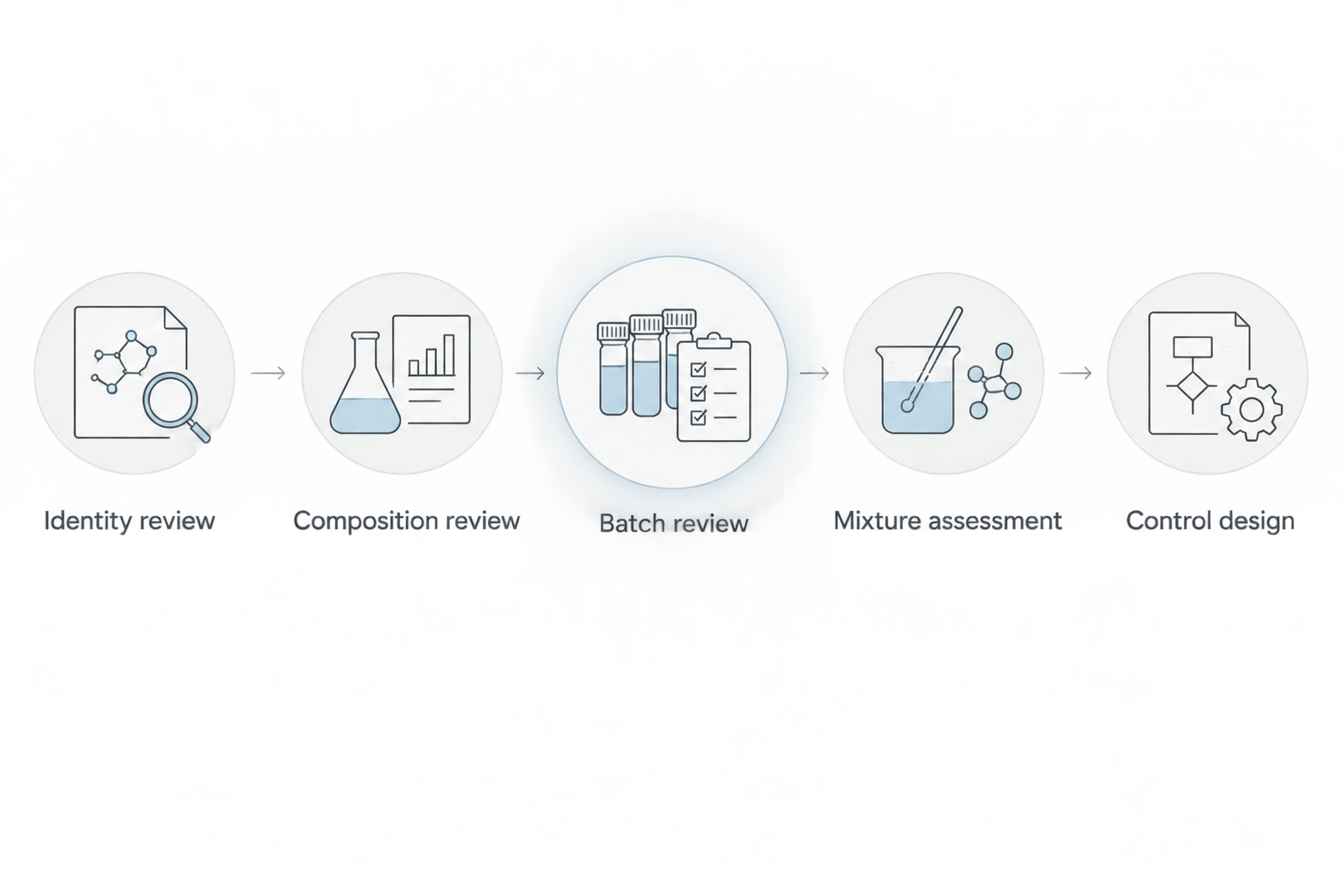
Do not equate an HPLC purity result with confirmed composition. Chromatographic purity describes a method-dependent measurement; identity and component quantity require appropriate supporting evidence. A reported purity percentage also does not establish sterility or endotoxin status.
For mixtures, ask whether the analytical method distinguishes the ingredients and relevant impurities. An unresolved peak or a total-area summary cannot, by itself, establish that every component is present at the intended amount.
This 2026 ranking prioritizes exact identity, distinct experimental roles, component-level controls, and traceable documentation. It does not claim head-to-head testing, comparative potency, clinical benefit, or supplier-specific blend validation.
The first option is the default only for a study that needs both receptor pathways and independent component control. A sermorelin-focused hypothesis moves the second option first; a GHRP comparison question moves the relevant comparator first.
Start with the simplest design that answers your hypothesis. If your question concerns ipamorelin alone, adding a GHRH analog creates another variable rather than improving the experiment automatically.
Celonyxlabs is a research peptide sourcing option for laboratories evaluating single-component ipamorelin. For blend research, assess the actual component and mixture records rather than extending a general quality statement to an unverified combination.
If you need dual-pathway investigation, begin with separately characterized ipamorelin and a precisely identified GHRH analog. Consider a fixed premix only when its composition, suitability, and limitations match the protocol.
What’s the best growth hormone secretagogue peptide blend for research in 2026?
There is no universal best blend. For component-controlled dual-pathway research, separately characterized ipamorelin and a precisely identified GHRH analog are a defensible starting design, subject to model suitability and documentation.
Is ipamorelin alone a growth hormone secretagogue peptide blend?
No. Ipamorelin is a single peptide; a blend contains multiple components, each requiring an identified role and appropriate characterization.
Is CJC-1295 no DAC the same as modified GRF?
Do not assume the labels establish identical material. Informal naming varies, so verify the amino acid sequence, modifications, and chemical form before treating preparations as equivalent.
Does 99% purity prove a peptide blend is suitable for my assay?
No. A purity result does not establish component identity, blend composition, stability, sterility, or compatibility with your assay.
Are separate peptide vials better than a premixed blend?
Separate vials provide more control when your experiment requires independent component adjustment. A premix has a fixed composition and needs evidence that the mixture remains suitable under the intended conditions.
Can a stronger combined response prove peptide synergy?
No. Demonstrating an interaction requires an appropriate experimental design and analysis, including individual-component comparisons; a larger combined response alone is insufficient.
Can these research blends be used for bodybuilding or treatment?
This guide does not support human use. Research-use-only peptides are laboratory materials, and a research label or purity claim does not establish suitability for bodybuilding, self-administration, or treatment.
A blend can meet a total purity specification and still leave its component ratio unresolved. Before approving a 2026 research purchase, ask whether the evidence establishes what each ingredient is, how much is present, and whether the mixture remains suitable for the experiment.
Compare peptide supplier batch consistency by lot records, testing methods, and traceability. Choose documented evidence

Choose a growth hormone secretagogue peptide blend by research fit, not ingredient count. Compare four

Choose a peptide starter kit for research lab work: start with one protocol-matched peptide, verify
FOR RESEARCH USE ONLY. Products sold by Celonyx Labs are intended exclusively for laboratory and scientific research. They are not intended for human or veterinary use, consumption, diagnosis, treatment, cure, or prevention of any disease. By purchasing from this site, you acknowledge that you understand the intended research purpose of these materials and agree to comply with all applicable laws and regulations.