
Best BPC-157 vials ranked by purity grade 2026
Compare BPC-157 purity grade claims across 5 mg and 10 mg research vials. Prioritize lot-matched

Best overall for ipamorelin cjc 1295 no dac research: separately documented reagents when you need independent concentration control. Best for fixed-ratio experiments: a fully characterized premixed blend; best for protocol-specific composition: a documented custom blend. This 2026 guide ranks research formats by identity, analytical documentation, and experimental fit—not by unsupported supplier claims.
The phrase “CJC-1295 no DAC” is not a sufficient material specification. Supplier terminology can obscure whether a listing describes the exact peptide structure your protocol requires. Treat the name as the start of verification, not the conclusion.
Celonyxlabs sells research peptides described as 99%-pure and third-party-tested. Those quality statements do not establish the composition, component ratio, or analytical suitability of a particular combination. Celonyxlabs research peptides fit laboratory sourcing reviews, not assumptions about unlisted blend specifications.
For your 2026 procurement review, separate three questions: Is the material correctly identified? Does the analytical evidence support its stated composition? Does that composition match your experimental design? A positive answer to one does not answer the others.
For research use only. Not for human or veterinary administration. This guide addresses laboratory sourcing and experimental documentation, not treatment, personal use, or administration instructions.
Use these criteria before comparing listings or requesting a quotation:
Read the guide to peptide purity testing for contract research organizations when defining your analytical acceptance criteria. A procurement specification should name the evidence you need before you review a supplier’s quality claims.
| Rank and format | Best for | Standout feature | Key limitation |
|---|---|---|---|
| 1. Separately documented reagents | Independent concentration studies | Each component remains independently adjustable | Requires separate qualification and preparation records |
| 2. Characterized premixed blend | Repeated fixed-ratio experiments | A defined combination supports a standardized preparation workflow | You cannot independently change the components within that preparation |
| 3. Documented custom blend | Protocol-specific composition | Composition can be specified before manufacture | Requires agreement on analytical acceptance and change control |
These are sourcing-format recommendations, not endorsements of unidentified products. The ranking prioritizes experimental flexibility first, followed by suitability for a locked composition and then a custom specification.
Separately sourced ipamorelin and the precisely identified no-DAC comparator give you independent control over each reagent’s experimental concentration. This format fits studies that compare individual components with a combination or examine more than one composition.
Celonyxlabs lists Ipamorelin 5mg as a synthetic pentapeptide for laboratory research involving growth hormone signaling pathways. That listing identifies a single-component research reagent; it does not establish a paired reagent, a combined formulation, or combination performance.
Best for: Exploratory studies, concentration matrices, and experiments requiring single-agent controls.
For a 2026 study with an unsettled combination ratio, choose separate reagents before committing to a premix. Lock the experimental design first; standardize a combined preparation only after its composition serves that design.
Verdict: Buy separately documented reagents when independent control is essential; hold procurement until both component specifications are verified.
A premixed blend combines both components in a stated composition before your laboratory prepares the experimental solution. It fits a protocol that already requires that composition and does not need independent adjustment within the same preparation.
The strongest purchasing specification identifies both peptides, states each component’s quantity, and defines how the composition was established. A total vial mass and a single purity percentage do not supply all that information.
Best for: Repeated experiments using an established, fixed composition.
For illustration only, a hypothetical vial containing 5 mg of each component contains 10 mg total peptide and has a 1:1 mass ratio. This is a calculation example, not a product specification or an experimental recommendation. Equal masses do not establish equal molar amounts when molecular weights differ.
Your 2026 purchasing worksheet should record the ratio basis explicitly. “Equal blend” is not precise enough for a reproducible method.
Verdict: Buy a premixed blend only when component identity, quantity, and ratio basis match a locked protocol; otherwise hold.
A custom blend starts with your laboratory’s written material specification rather than a catalog composition. It fits a study whose required combination cannot be adequately described by a standard premix.
Specify the exact components, the basis of the ratio, the required analytical evidence, and the release criteria before approving manufacture. A custom label is not evidence that the resulting material meets those requirements.
Best for: Established protocols requiring a particular composition and formal material acceptance.
In your 2026 specification, include a process for reviewing changes to either component or the analytical method. Otherwise, a repeated product name can conceal a change that matters to interpretation.
Verdict: Hold until the written specification and release criteria are agreed; buy only after the resulting lot meets them.
Start with the exact chemical identity of each component. Ask for the peptide sequence, relevant modifications, and the identity method used. Reconcile the documentation with your protocol rather than assuming similar names describe interchangeable materials.
For the CJC component, require explicit structural clarification of “no DAC.” Do not substitute a DAC-containing material or accept a different peptide solely because the listing uses familiar shorthand.
Next, separate identity from purity. Chromatographic purity describes the result of a particular analytical separation; it does not independently establish every attribute needed for your experiment. Identity testing, content determination, and relevant contamination assessments have different roles.
Finally, connect the analytical record to the vial you receive. A report is useful only when its sample and lot identifiers support that connection. Keep the original document alongside the receiving record and your laboratory’s acceptance decision.
Use the following review order before releasing material into experimental inventory:
A failure at identity review stops the process. There is no reason to debate handling convenience when the material itself has not been adequately identified.
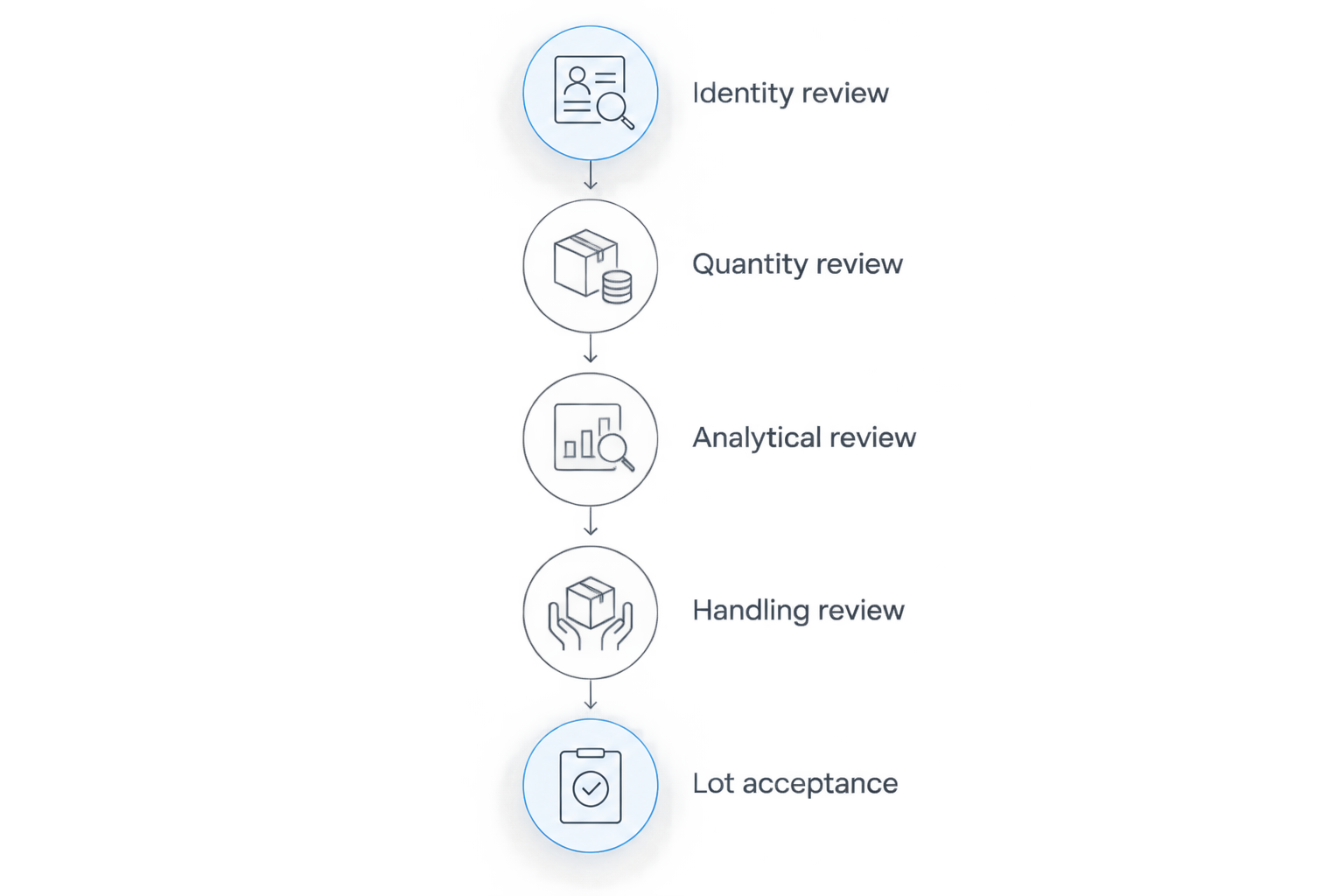
Keep this sequence in your laboratory’s receiving procedure. Consistent review makes it easier to compare lots without allowing an attractive product description to replace the material specification.
The ranking follows the criteria above: identity, component quantities, traceability, analytical scope, experimental control, and handling evidence. It does not assign scores to suppliers or claim comparative laboratory testing.
Separate reagents rank first because they preserve independent concentration control and support component-specific controls. A characterized premix ranks next for a fixed protocol, while a custom blend fits a narrower situation that requires specification before preparation.
Documentation remains a condition for every option. A poorly characterized separate reagent does not outrank a well-characterized blend simply because it comes in its own vial.
Choose separately documented reagents unless your approved protocol already requires a fixed combination. That default preserves experimental choices without treating a supplier’s preferred composition as your study design.
Choose a characterized premix when the ratio is settled and its documentation supports your acceptance criteria. Choose a custom blend when your protocol requires a composition that needs to be specified directly.
Celonyxlabs research peptides include the listed single-component Ipamorelin 5mg. Evaluate that reagent on its own documentation rather than treating it as evidence for a combined formulation.
What is the best ipamorelin CJC-1295 no DAC option for research?
Separately documented reagents are the best default when your study requires independent concentration control. A characterized premix fits an established fixed-ratio protocol, while a custom blend fits a written protocol-specific composition.
Does Celonyxlabs list an ipamorelin CJC-1295 no DAC blend here?
The product identified here is Ipamorelin 5mg, a single-component research reagent. Do not treat that listing as a specification for a combined formulation.
Is CJC-1295 no DAC a precise enough name for purchasing?
No, the name alone is not a complete material specification. Require the peptide sequence, relevant modifications, and analytical identification, and reconcile them with your protocol.
Is a 1:1 blend equal in mass or equal in molecules?
A 1:1 ratio is ambiguous unless its basis is stated. Equal masses do not establish equal molar amounts when the components have different molecular weights.
Does 99% purity prove that a peptide blend is suitable?
No, a 99% purity statement does not independently establish identity, component quantities, sterility, or suitability for your assay. Review the analytical method, lot traceability, and application-specific acceptance criteria.
Can a premixed blend replace single-agent controls?
No, a premixed blend does not provide separate component controls. Source and qualify separate reagents when your experimental design requires those comparisons.
Can the same reconstitution instructions be used for every blend?
No, do not assume that instructions for one peptide apply to another material or combination. Follow material-specific documentation and your laboratory’s validated procedure.
Are these research peptides intended for personal use?
No, these materials are for laboratory research use only, not human or veterinary administration. This guide provides no treatment, personal-use, or administration instructions.
A blend ratio without a defined basis is an unresolved specification. Before approving a purchase, add a required field for “mass ratio or molar ratio” to your material review form. That small documentation decision prevents two laboratories from using the same ratio label for different compositions.
Compare BPC-157 purity grade claims across 5 mg and 10 mg research vials. Prioritize lot-matched

Compare glp 3 rt peptide formats for research. Start with 10mg for moderate requirements, then

Compare ipamorelin cjc 1295 no dac research formats. Separate reagents win for concentration control; verify
FOR RESEARCH USE ONLY. Products sold by Celonyx Labs are intended exclusively for laboratory and scientific research. They are not intended for human or veterinary use, consumption, diagnosis, treatment, cure, or prevention of any disease. By purchasing from this site, you acknowledge that you understand the intended research purpose of these materials and agree to comply with all applicable laws and regulations.