

Is bacteriostatic water the same as sterile water? No 2026
Is bacteriostatic water the same as sterile water? No. Compare preservatives, vial handling and peptide

You have a vial in front of you, a study deadline behind you, and a deceptively simple question on your bench notes. What's the right MOTS-c dose? Most protocol writeups answer that question badly. They give a flat number, strip away context, and ignore the part that determines whether your data will mean anything at all: dose design is a systems problem, not a single-value problem.
A usable MOTS-c dosage protocol starts with the experimental objective, then works outward through peptide verification, stock preparation, route selection, injection schedule, controls, and safety constraints. That matters even more here because the human evidence base for native MOTS-c is thin, protocol variation is wide, and many published dosing discussions blur together metabolic studies, fat oxidation goals, and performance-oriented timing.
If you're trying to build a protocol that another lab could reproduce without guessing what you meant, the right move isn't to ask for “the standard dose.” The right move is to define what biological question you're asking, then make every dosing choice serve that question.
A strong MOTS-c dosage protocol begins before reconstitution. The first real decision is whether your experiment is trying to detect a chronic metabolic effect, an acute exercise-linked effect, or a body-composition effect that depends on dose frequency as much as dose size. Labs often lose reproducibility because they treat those as interchangeable.
The planning document should answer five questions in plain language:
Practical rule: If the research question is vague, the dosing schedule will become arbitrary.
A common mistake is to choose the peptide dose first and invent the rest of the study around it. That produces noisy data because the total weekly exposure, injection cadence, and timing relative to tissue collection all influence what signal you'll see. For metabolic work, repeated exposure may matter more than a large single administration. For exercise studies, timing relative to training may dominate.
Another planning error is failing to define which variables are fixed and which are exploratory. If you want to test schedule effects, hold the total intended weekly exposure constant and vary only frequency. If you want to test dose magnitude, don't also change route, feeding condition, and sampling window.
Write the protocol like a lab handoff document. The person executing it shouldn't have to infer anything. If they need to guess, your design is still incomplete.
A study can fail before the first dose is ever administered. The usual cause is not the nominal dose on paper. It is a preventable bench error such as wrong concentration, poor labeling, repeated warm-up cycles, or unverified material.
This stage sets the ceiling for the rest of the protocol. If the peptide identity is uncertain or the stock concentration is wrong, later adjustments to schedule and route will not repair the dataset.
Check the vial before any solvent touches it. Confirm the label, lot number, peptide name, and supplied mass against the batch paperwork. The Certificate of Analysis should be batch-specific and should match the vial in hand. If identity, purity, or mass documentation is incomplete, stop the run and resolve it with the supplier. Tight execution cannot compensate for questionable starting material.
Then make one practical decision early. Will the vial be used as a single refrigerated working stock over a short handling window, or will it be aliquoted to limit repeated access? That choice affects solvent volume, final concentration, container selection, and the number of opportunities for concentration drift.
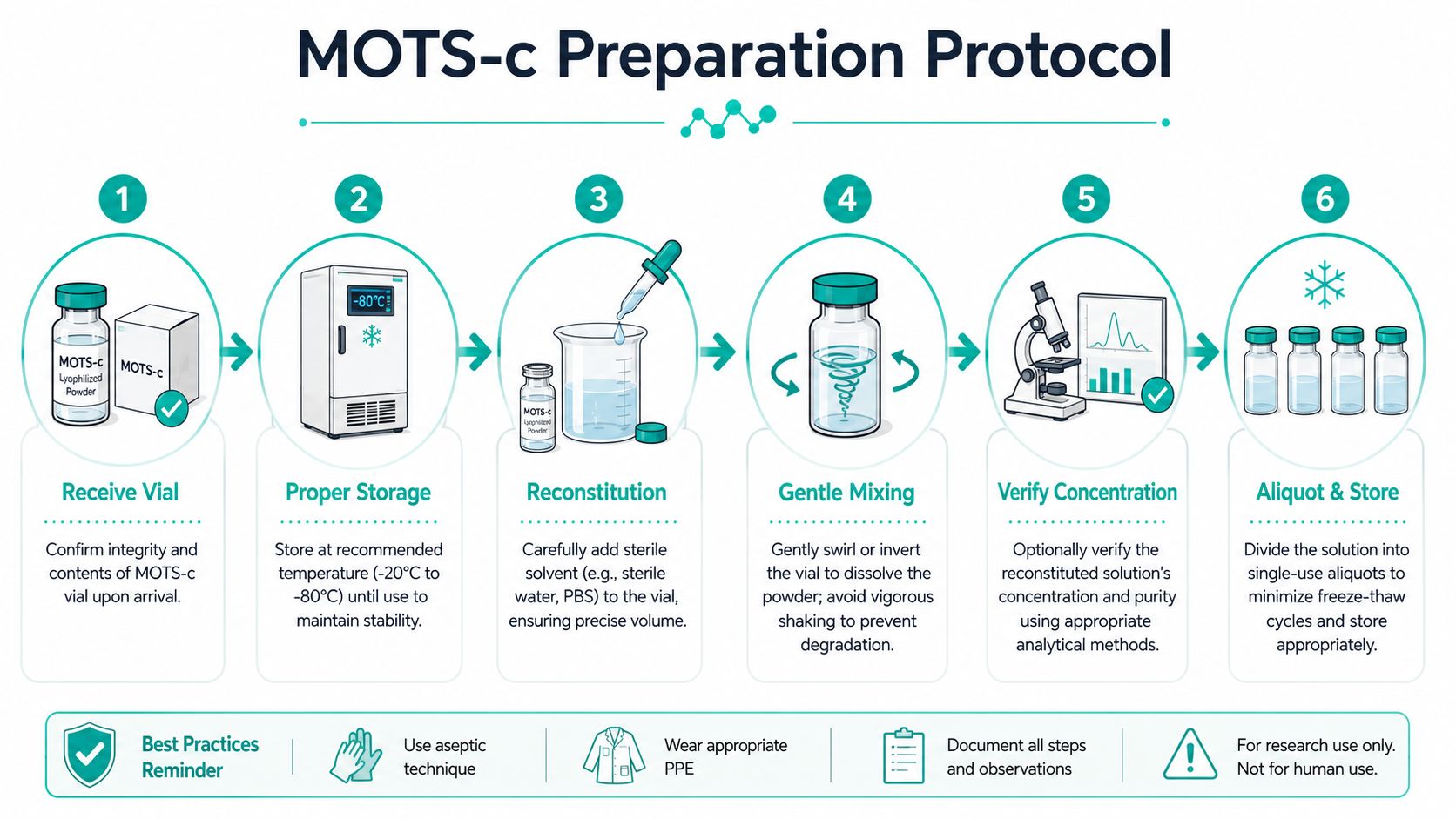
A preparation record should capture, at minimum:
Labs that want standardized handling across staff should use a written peptide reconstitution workflow and labeling guide rather than relying on memory or local habit.
Reconstitution is a concentration-control step. Choose the solvent volume based on the dosing volumes your model can tolerate and the precision your pipettes or syringes can realistically deliver.
That trade-off matters. A dilute stock may force large injection volumes that complicate administration in small animals. An overly concentrated stock makes small measuring errors proportionally larger. In practice, the best concentration is the one that keeps administration volume practical while preserving measurement accuracy at the bench.
Use a controlled technique:
The prepared solution should be visually uniform and clearly labeled. If staff are guessing whether the vial is mixed, the handling method was not controlled tightly enough.
Once reconstituted, label the vial immediately with concentration, solvent, reconstitution date, and discard date. Do it at the bench. Shared cold storage creates easy opportunities for mix-ups, especially when multiple studies use similar tube sizes or shorthand labels.
For longer studies, staged preparation is usually safer than stretching one batch through repeated handling cycles. Small working aliquots reduce open-close events and lower the chance of contamination or concentration shift from routine bench use. That approach also supports the larger goal of this protocol guide. Dose and schedule are not isolated math problems. They depend on whether the stock can be prepared, stored, and delivered consistently for your specific model and endpoint.
The FDA has explicitly prohibited MOTS-c from compounding medications, which reinforces its status as a research-use material rather than an approved therapeutic product. Treat every vial accordingly, with full documentation and controlled laboratory handling.
A dosing error usually starts before the syringe is filled. A team picks a number from a human-oriented protocol, converts it loosely to mg/kg, and only later realizes the study question was about chronic metabolic adaptation while the schedule they borrowed was built around acute pre-exercise timing. The result is not just underpowered data. It is a protocol that tested the wrong exposure pattern.
Dose selection starts with the endpoint, species, and study duration. MOTS-c protocols discussed in human-oriented research sources vary by objective, not just by amount. One reference describes 5 mg three times weekly for metabolic health, 10 mg daily in weight-loss oriented use, and 5 to 10 mg given 30 to 60 minutes before training on training days for performance-focused protocols, with maintenance schedules and periodic biomarker review also differing by goal (goal-specific MOTS-c dosage protocol details).
That distinction matters in preclinical design. A study targeting insulin sensitivity or fasting glucose should usually prioritize repeated, evenly spaced exposure and tightly fixed sampling windows. A fat oxidation study may justify comparing the same weekly exposure delivered as split doses versus larger intermittent doses, because frequency can change peak-trough behavior. A training study should define dose timing relative to exercise as part of the intervention, not as a minor handling detail.
I treat schedule as a biological variable. Total weekly exposure is only one part of the design.
For preclinical work, copy the logic of the protocol, not the human calendar. Start by writing the study objective in one line, then define what exposure pattern best tests that objective. After that, calculate the per-animal dose, concentration, and injection volume.
A practical planning framework:
If two groups receive the same total weekly milligrams but one gets daily dosing and the other gets three injections per week, those are different protocols. They should be analyzed that way.
A dose worksheet should list body weight, target mg/kg, stock concentration, injection volume, administration frequency, total weekly exposure, and timing relative to feeding, fasting, or training. For arithmetic checks before preparation, many labs use a peptide dosing calculator for accurate volume and concentration planning.
The correct peptide can look inactive if the exposure pattern is wrong for the model.
Allometric scaling helps translate a human-equivalent dose into a species-adjusted estimate. It does not establish that the translated dose is biologically appropriate for your endpoint. MOTS-c is exactly the kind of compound where that distinction matters, because timing, repetition, and metabolic context can change the apparent response.
The standard body-surface-area method uses Km factors:
| Conversion step | Expression |
|---|---|
| Animal dose from human-equivalent dose | Animal mg/kg = Human mg/kg × (Human Km / Animal Km) |
Use numeric Km values from a citable public reference, then record that reference in the protocol file. The FDA guidance Estimating the Maximum Safe Starting Dose in Initial Clinical Trials for Therapeutics in Adult Healthy Volunteers includes the standard body surface area conversion table used widely for cross-species dose estimation (FDA allometric scaling guidance).
| Species | Body Weight (kg) | Km Factor (Body Weight / BSA) |
|---|---|---|
| Human | use FDA table | use FDA table |
| Mouse | use FDA table | use FDA table |
| Rat | use FDA table | use FDA table |
That keeps the calculation reproducible and auditable. It also avoids a common lab failure mode, where one technician remembers an old conversion factor, another uses a different one, and the discrepancy is discovered after dosing has started.
Run worked calculations in the study worksheet. Then have a second person verify the math before the first administration. In peptide studies, simple calculation drift can create larger variance than the biological effect you are trying to measure.
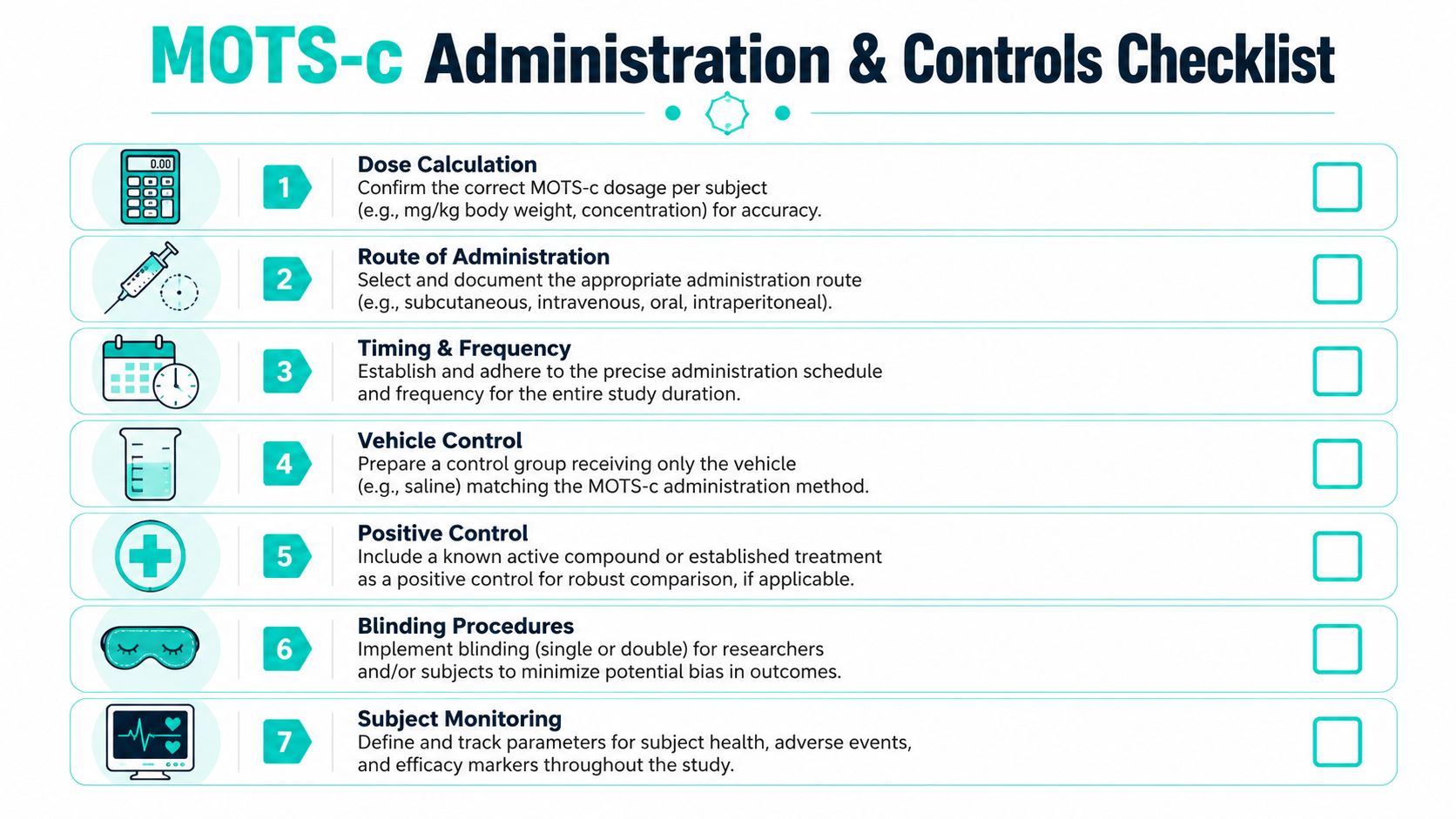
Administration is where well-planned dose calculations either hold up or fall apart. Two MOTS-c studies can use the same mg/kg number and still produce different results because route, schedule, injection burden, and sampling windows were set up differently. For this part of the protocol, the right question is not "what is the standard dose?" It is "what exposure pattern fits this model and endpoint?"
Use one administration route unless route itself is an experimental variable. Mixing subcutaneous and intraperitoneal dosing in the same study usually creates an exposure interpretation problem, not a better design.
Subcutaneous dosing is often the cleaner choice for repeated administration studies because it supports a consistent chronic schedule and tends to fit metabolic endpoints where gradual, repeatable exposure matters. Intraperitoneal dosing is common in rodent workflows and may be easier operationally during dense study weeks, but it changes how exposure compares with subcutaneous designs. If the study goal is metabolic health over time, subcutaneous delivery often gives a more defensible chronic-dosing framework. If the study goal is a shorter mechanistic screen where handling efficiency matters, intraperitoneal delivery may be acceptable if it is declared up front and held constant.
Repeated injections into the same area add noise. Local irritation, altered absorption, and differences in restraint time can all shift readouts. For subcutaneous work, define site rotation before day 1 and train staff to follow the same map. For any route, set a maximum injection volume per animal and put that limit in the worksheet, not in someone's memory.
Material quality affects this phase more than many groups expect. Before the first administration, confirm that lot identity, storage history, and reconstitution records are complete, especially if the peptide came through a GMP-adjacent research peptide sourcing workflow. A dosing plan is only as reproducible as the material entering the syringe.
| Route | Best fit | Main risk to control |
|---|---|---|
| Subcutaneous | Chronic metabolic studies, repeated exposure designs | Site effects, volume drift, inconsistent rotation |
| Intraperitoneal | High-throughput preclinical dosing, short mechanistic studies | Reduced comparability to subcutaneous exposure patterns |
Schedule drives interpretation. A chronic daily or near-daily pattern tests sustained exposure. A training-linked schedule tests whether timing around exertion changes the response. A split-frequency design helps answer a different question altogether, whether the same weekly amount behaves differently when concentrated or distributed.
That distinction matters for MOTS-c work. If the endpoint is fasting glucose, insulin sensitivity, or body-composition change over weeks, choose a schedule that minimizes day-to-day exposure swings. If the endpoint is exercise tolerance, substrate use, or acute signaling after exertion, anchor dosing to the training event and keep that interval fixed across animals. If the endpoint is fat oxidation, frequency itself may need to become a study factor rather than a hidden convenience choice.
Three scheduling frameworks are usually worth considering:
Choose one framework and write down why. That short justification often prevents a mid-study schedule change that makes the final dataset harder to defend.
A vehicle-only group is the minimum control set for an injectable peptide study. Match route, injection volume, dosing times, handling duration, and sampling burden. Otherwise, the control group does not control the procedure.
The next layer of control is operational. Blind outcome assessment when feasible. Predefine what counts as an injection-site reaction, a missed dose, or an out-of-window sample. Lock blood and tissue collection to a fixed interval after the final administration. In metabolic studies, inconsistent sampling time can easily obscure a real signal or create a false one.
Use a dosing calendar with actual timestamps.
That log should capture who dosed, when the dose was given, which site was used, whether the full volume was delivered, and any deviation observed during restraint or recovery. In my experience, these records explain more unexpected variance than post hoc statistical cleanup ever will.
Positive controls can be useful if the assay needs a performance check, but they do not replace a clean vehicle arm. The vehicle group is the reference that separates peptide activity from handling, injection stress, and solvent effects.
Safety is not a boilerplate footer in a MOTS-c protocol. It's part of the scientific validity of the work.

The most important compliance point is straightforward. Human clinical evidence for native MOTS-c is nearly nonexistent, and the FDA has explicitly prohibited MOTS-c from compounding medications because of “potential significant safety risks”. The same source also flags a safety gap when MOTS-c is used alongside metformin, since both affect the AMPK pathway, which could contribute to unexpected hypoglycemia (regulatory and safety discussion for MOTS-c).
That should shape how you write and label your study materials. A preclinical research protocol should stay preclinical. Don't let informal language drift into therapeutic language, and don't let procurement or storage practices imply human-use intent where none is justified.
A separate evidence review goes further. It states that human evidence for native MOTS-c remains extremely limited, identifies only one small human trial using CB4211, a MOTS-c analog, in 20 subjects over 4 weeks, notes that no human safety data exists beyond 4 weeks, and reports that one clinical trial suspension occurred due to persistent injection site reactions, while also stating the peptide lacks human safety validation above 10 mg per injection (analysis of MOTS-c evidence and safety limits).
Those facts don't tell you how to run a mouse study minute by minute. They do tell you not to overstate certainty.
Your safety file should distinguish between lyophilized storage and reconstituted handling. Once you move from powder to solution, chain-of-custody and time-in-storage matter more because contamination risk and degradation risk both become operational concerns.
Interaction risk deserves explicit mention in the protocol, especially if the model involves agents that overlap metabolically. The AMPK overlap issue with metformin is a good example. Even in preclinical work, if another intervention touches the same pathway, you need that documented as a possible confounder and safety concern.
This walkthrough may help staff think more clearly about dose discipline and lab handling before a study starts:
Compliance failures usually happen long before anyone notices them. They begin when a lab doesn't define who signs off on calculations, where lot paperwork is stored, how deviations are logged, or when reconstituted stock must be discarded.
For procurement and documentation workflows, many groups use a sourcing checklist that emphasizes vendor paperwork, purity documentation, and operational consistency. A practical reference point is this guide to sourcing GMP-adjacent research peptides, which is useful for building a cleaner intake process even when your work remains strictly research-focused.
If you want defensible data, treat compliance like a core assay condition. Because it is.
A reproducible MOTS-c dosage protocol doesn't come from picking a popular milligram figure. It comes from making a chain of decisions that all point at the same biological question.
Start with the material. Verify identity and batch documentation before you touch solvent. Prepare the stock with a concentration that supports accurate administration, not just convenient arithmetic. Label everything immediately and control refrigerated handling tightly.
Then focus on dose design. Metabolic health, fat oxidation, and exercise performance are not the same study, so they shouldn't share a thoughtless schedule. Frequency, total intended exposure, route, and timing relative to sampling all shape the result. If you want interpretable data, those variables must be chosen deliberately and recorded precisely.
Good peptide studies rarely fail because the concept was weak. They fail because the protocol left too much room for drift.
Finally, keep the safety and compliance picture in frame. Native MOTS-c has a narrow human evidence base, regulatory concerns are real, and interaction risk with overlapping metabolic agents isn't something to hand-wave away. For preclinical work, disciplined handling and honest framing are part of the science.
If another lab can read your protocol and run it without making assumptions, you've done the hard part correctly.
Celonyx Labs supports laboratories and investigators with research peptide sourcing, documented quality practices, and an ecommerce workflow built for lab procurement. If you need a dependable supplier for peptide research materials, visit Celonyx Labs.
Is bacteriostatic water the same as sterile water? No. Compare preservatives, vial handling and peptide

How do you know if a peptide vial has gone bad? Quarantine changes, check storage

Can too much bacteriostatic water ruin a peptide vial? Yes, if it overfills the vial
FOR RESEARCH USE ONLY. Products sold by Celonyx Labs are intended exclusively for laboratory and scientific research. They are not intended for human or veterinary use, consumption, diagnosis, treatment, cure, or prevention of any disease. By purchasing from this site, you acknowledge that you understand the intended research purpose of these materials and agree to comply with all applicable laws and regulations.