
1500 Mg Glutathione: What That Strength Really Means
You're comparing two bottles on a supplement shelf. One says 500 mg glutathione. The other
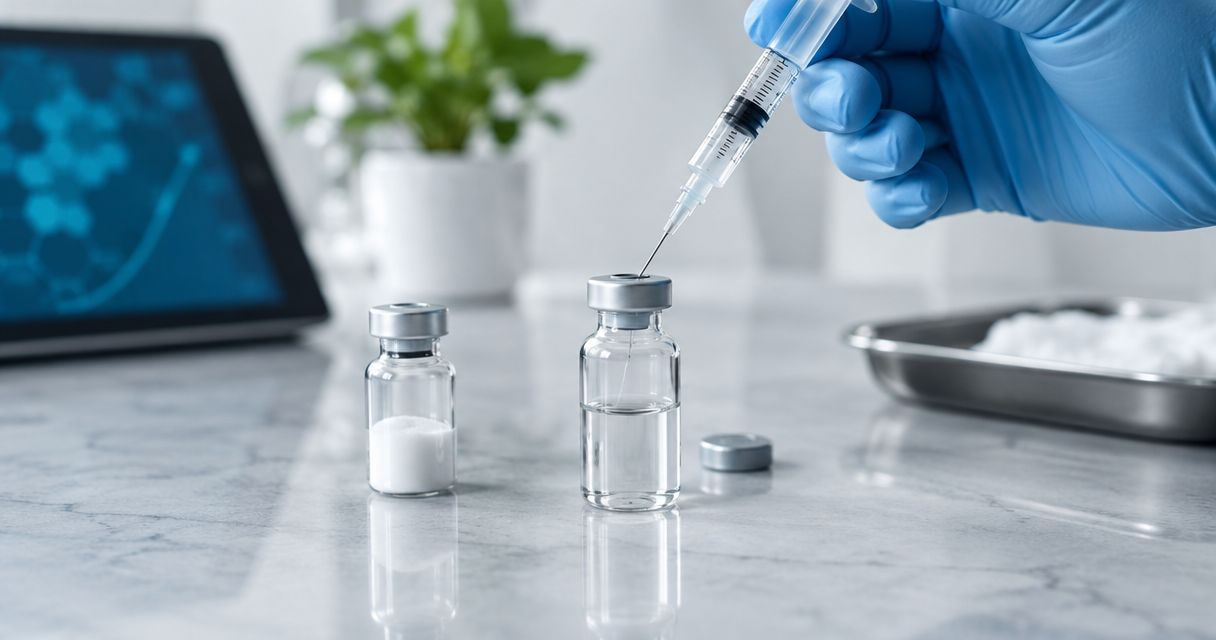
Yes. Too much bacteriostatic water can make a research peptide vial unusable if the liquid exceeds the vial’s capacity or if the resulting concentration no longer fits the experiment. Extra water does not, by itself, prove that the peptide has degraded. Check the final volume, calculated concentration, solvent compatibility and vial condition before deciding whether to use it for laboratory research.
Too much water usually creates a concentration problem before it establishes a degradation problem. If you know the peptide mass and the actual final volume, you can calculate the new concentration. If liquid escaped, the vial overflowed or you cannot establish the amount added, the preparation no longer has a reliable concentration record. The bacteriostatic water dilution ratios by peptide type guide provides context for planning; your peptide’s documentation and laboratory protocol determine the appropriate solvent and target concentration.
| What happened | What it means | Best for | Limitation |
|---|---|---|---|
| More compatible diluent was added, with no spill | Calculate concentration using the actual final volume | A research assay that accepts the lower concentration and the verified solvent | Dilution cannot be undone by using the original calculation |
| The vial was overfilled or liquid escaped | The amount of peptide remaining is uncertain | No quantitative assay until the remaining mass is established | A new volume measurement does not establish how much peptide was lost |
| The added volume is unknown | The concentration is unknown | Qualitative work only if the protocol permits it | Do not assign a concentration by guessing |
| The solvent or vial condition is uncertain | Compatibility or sample integrity has not been established | No experiment requiring a verified preparation | A clear-looking solution does not resolve either uncertainty |
In 2026, the useful question for a lab record is not whether a vial looks diluted. It is whether you can document what entered the vial, what remains in it and whether that mixture meets the assay’s requirements. Keep a verifiable diluted preparation; replace one whose composition you cannot establish.
A lyophilized peptide starts as a known mass only when its identity, contents and documentation support that value. Reconstitution turns that mass into a concentration. If the final volume changes, every later calculation that assumes the planned volume changes with it.
That distinction protects your 2026 research record from two different errors: discarding a usable sample merely because it is dilute, and treating an uncertain sample as though its concentration were known. Neither appearance nor the original plan substitutes for the actual preparation record. Research peptides are for research use only, not human or animal administration.
For a preparation in which the peptide has dissolved and none has been lost, concentration equals peptide mass divided by final solution volume. Use the measured final volume in the units your assay requires. Do not use the amount you planned to add after a different amount has entered the vial.
As a mathematical illustration, a vial assumed to contain 5 mg of peptide at a final volume of 1 mL has a calculated concentration of 5 mg/mL. If the same 5 mg remains in a final volume of 2 mL, the calculated concentration is 2.5 mg/mL. The second preparation is more dilute; the calculation alone says nothing about peptide degradation, solvent suitability or sterility. These figures illustrate arithmetic, not a recommended reconstitution volume.
The calculation assumes that the relevant peptide mass remains in the vial and that the solution is suitable for the assay. A spill breaks the first assumption. Poor dissolution or an incompatible solvent can break the second. In either case, arithmetic cannot repair the missing evidence.
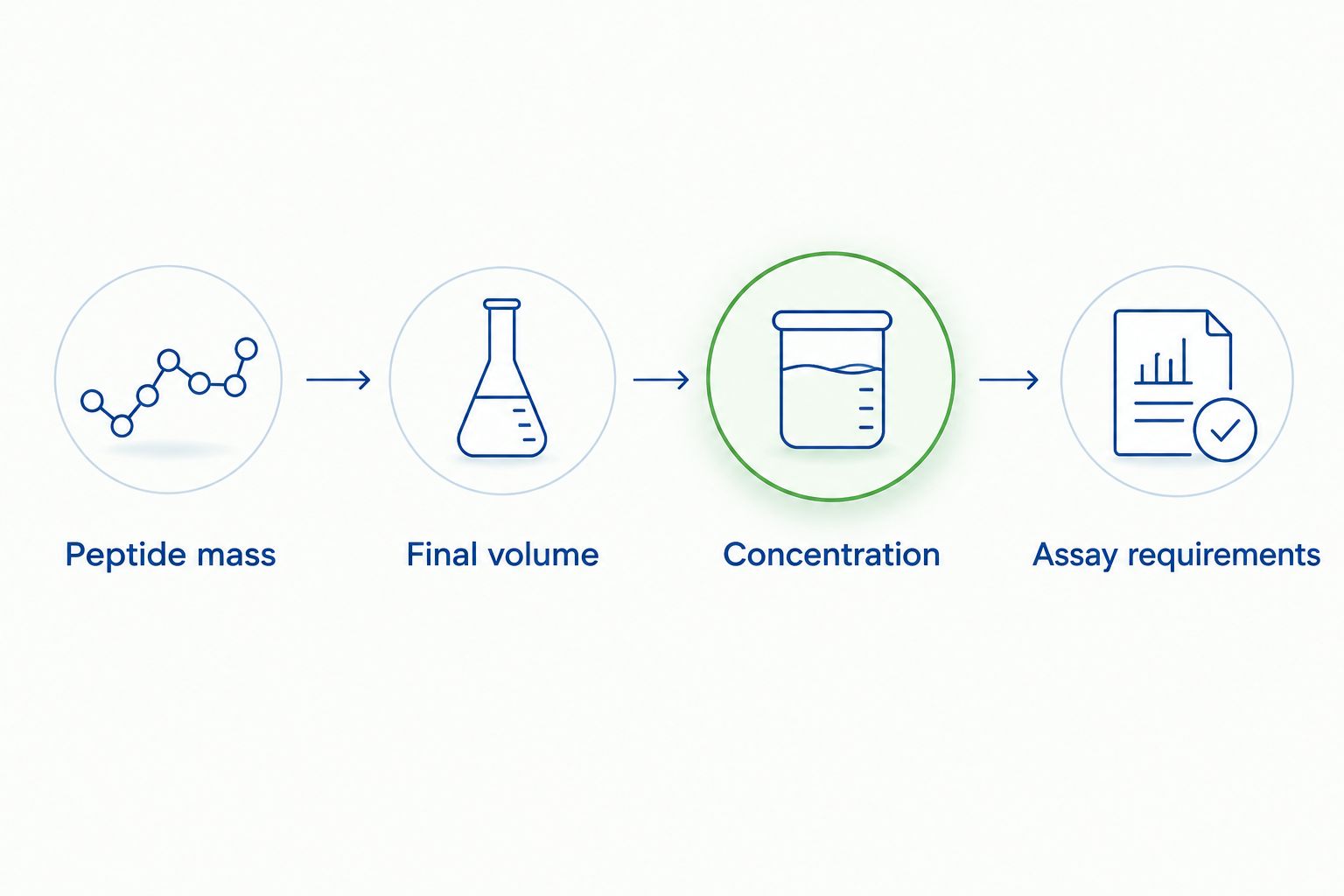
The answer changes with the preparation, not with a universal excess-water threshold. Review these factors in a 2026 laboratory assessment:
These factors explain why a visibly intact vial can still be unsuitable for quantitative work. They also explain why a lower-than-planned concentration can remain usable when its composition and handling are documented and the assay accepts it.
Keep the diluted vial only when its actual composition is known and the research protocol accepts it. Preparing a fresh sample is the clearer choice when volume, remaining peptide mass, compatibility or handling cannot be verified. Neither choice establishes that the peptide has degraded; it establishes whether the sample meets the experiment’s requirements.
| Option | Best for | Advantage | Drawback |
|---|---|---|---|
| Use the verified diluted preparation | Assays that accept its calculated concentration and documented solvent | Preserves a preparation whose composition is known | The lower concentration can fall outside the method’s requirements |
| Prepare a fresh research sample | Work requiring a known concentration after an uncertain addition or spill | Restores a defined preparation record | Uses another vial and requires a new preparation |
Before you choose, check the assay’s required concentration range and the peptide-specific reconstitution instructions. A sample that is too dilute for one method is not automatically unsuitable for every method. Conversely, a calculation that produces a usable concentration does not establish that an incompatible solvent is acceptable.
The peptide reconstitution guide for biotech startup labs covers preparation workflow considerations. Celonyx Labs sells research peptides described as 99%-pure and third-party-tested; that sourcing information does not establish the condition of a particular vial after reconstitution. Celonyx Labs research peptides are best for laboratories that prioritize stated purity and third-party testing, but each lab must verify its own preparation.
Removing liquid does not reliably restore the planned concentration. If the solution is mixed, the removed liquid contains peptide as well as solvent; you have reduced both the volume and the amount of peptide in the vial. The original mass can no longer be used as the amount remaining without further evidence.
Nor does transferring liquid to another container reverse an undocumented spill. A transfer introduces another handling step and another place where material can be lost. For 2026 quantitative work, record what happened and assess the resulting sample against the protocol instead of treating a smaller volume as a corrected preparation.
Dilution alone does not establish instability. Peptide stability depends on the specific sequence, solvent, concentration, handling and storage conditions. The fact that the liquid is bacteriostatic water does not establish compatibility with a particular peptide or method.
Separate the questions in your notes: Is the concentration known? Is the solvent appropriate? Is the preparation suitable for the assay? A clear solution answers none of them on its own. Follow the peptide-specific documentation and your laboratory’s acceptance criteria rather than assigning a universal stability period to every reconstituted vial.
Bacteriostatic water does not make an uncertain handling event acceptable. Its preservative function is not proof that a particular vial remains sterile after transfer, repeated access or a compromised closure. Treat sample integrity as a separate decision from concentration.
If the vial’s closure was damaged, the transfer was uncontrolled or the handling record is incomplete, do not clear the sample for work requiring a verified preparation solely because bacteriostatic water was used. The same rule applies in 2026 whether the planned volume was met or exceeded.
Record the event while the details are available. A useful 2026 entry separates observed facts from calculations:
Do not fill an unknown-volume field with the intended volume. Do not calculate a new concentration from the original peptide mass after material has escaped. Those shortcuts turn an identifiable preparation error into an untraceable assay error. For Celonyx Labs research peptides, retain the relevant third-party testing documentation alongside, not in place of, the reconstitution record.
Can too much bacteriostatic water ruin a peptide vial?
Yes, if it overfills the vial or leaves the preparation unsuitable for its research assay. Extra water alone does not prove peptide degradation; check the actual concentration and sample condition.
Does adding more bacteriostatic water destroy a peptide?
Adding more water does not, by itself, establish that a peptide was destroyed. Confirm solvent compatibility and the peptide-specific handling requirements before using the preparation.
Can I use a peptide vial after adding too much water?
Use it for laboratory research only if the actual composition is known and the protocol accepts the resulting concentration and solvent. Prepare a new sample when the amount added or remaining cannot be verified.
How do I calculate concentration after adding extra water?
Divide the documented peptide mass remaining by the actual final solution volume. The calculation is unreliable if liquid escaped or the remaining peptide mass is unknown.
Can I draw out the extra water to fix the concentration?
No, drawing out a mixed solution removes peptide along with water. It does not restore the original peptide mass or planned concentration.
Does bacteriostatic water make a reconstituted peptide sterile?
No, its use does not verify the sterility of a particular preparation. Assess the vial closure, transfer and handling record against your laboratory’s requirements.
Is a cloudy peptide vial ruined after adding water?
Cloudiness is a reason to stop and check the peptide-specific instructions and assay requirements. Appearance alone cannot identify the cause or establish whether the preparation is usable.
The most consequential error is not adding more water than planned. It is continuing to label the vial with the concentration you planned instead of the one you can support. In 2026, treat an unknown final volume or an undocumented loss as an unknown concentration; a new preparation is preferable to an unsupported number.
You're comparing two bottles on a supplement shelf. One says 500 mg glutathione. The other
Is bacteriostatic water the same as sterile water? No. Compare preservatives, vial handling and peptide
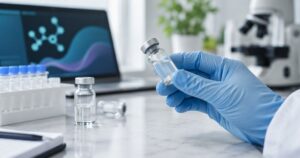
How do you know if a peptide vial has gone bad? Quarantine changes, check storage
FOR RESEARCH USE ONLY. Products sold by Celonyx Labs are intended exclusively for laboratory and scientific research. They are not intended for human or veterinary use, consumption, diagnosis, treatment, cure, or prevention of any disease. By purchasing from this site, you acknowledge that you understand the intended research purpose of these materials and agree to comply with all applicable laws and regulations.