6 Acetic Acid: What It Means and Where It Fits in Research
What does “6 acetic acid” tell you about the bottle on your bench? Not much,
You're standing at the bench with a lipolysis assay ready to run, and the core question is simple: which peptide gives you a clean way to study fat mobilization without dragging full hormone effects into the readout? That's the niche HGH fragment 176-191 occupies in research discussions. It's a compact, domain-based tool, and the confusion starts fast because people often blur it with the modified analog AOD-9604, even though those two aren't interchangeable in evidence or interpretation.
A metabolic researcher can have a clean plate, a calibrated reader, and a decent assay design, then still stall at the first sourcing decision because the peptide question is not only “what binds?” It is also “what biology am I buying into?” HGH fragment 176-191 entered research through domain-mapping work from the 1990s, including studies associated with Monash University, where investigators showed that a truncated growth hormone region could keep fat-related activity without the broader growth-promoting effects of intact hormone Peptides Institute.
That origin matters because full human growth hormone is a 191-amino-acid hormone, while this fragment is only a 16-amino-acid segment corresponding to residues 176 through 191, so you are looking at about 8.4% of the full sequence length Peptides Institute. In lab terms, the difference is like removing one calibrated module from a larger instrument. The fragment is described as research-use only and not FDA-approved for human use, so it belongs in investigational work rather than routine therapy Peptides Institute.
For researchers, that creates a narrow but useful set of questions. Does the fragment support lipolysis in your model, how do you verify identity and purity, and how do you avoid reading a result that belongs to the modified analog AOD-9604? A general primer on research peptides helps frame that distinction, especially when you are sorting a compound's role in a broader experimental workflow, as outlined in this research-peptide overview.
Practical rule: treat this peptide as a domain-specific research tool, not a shorthand for all growth hormone biology.
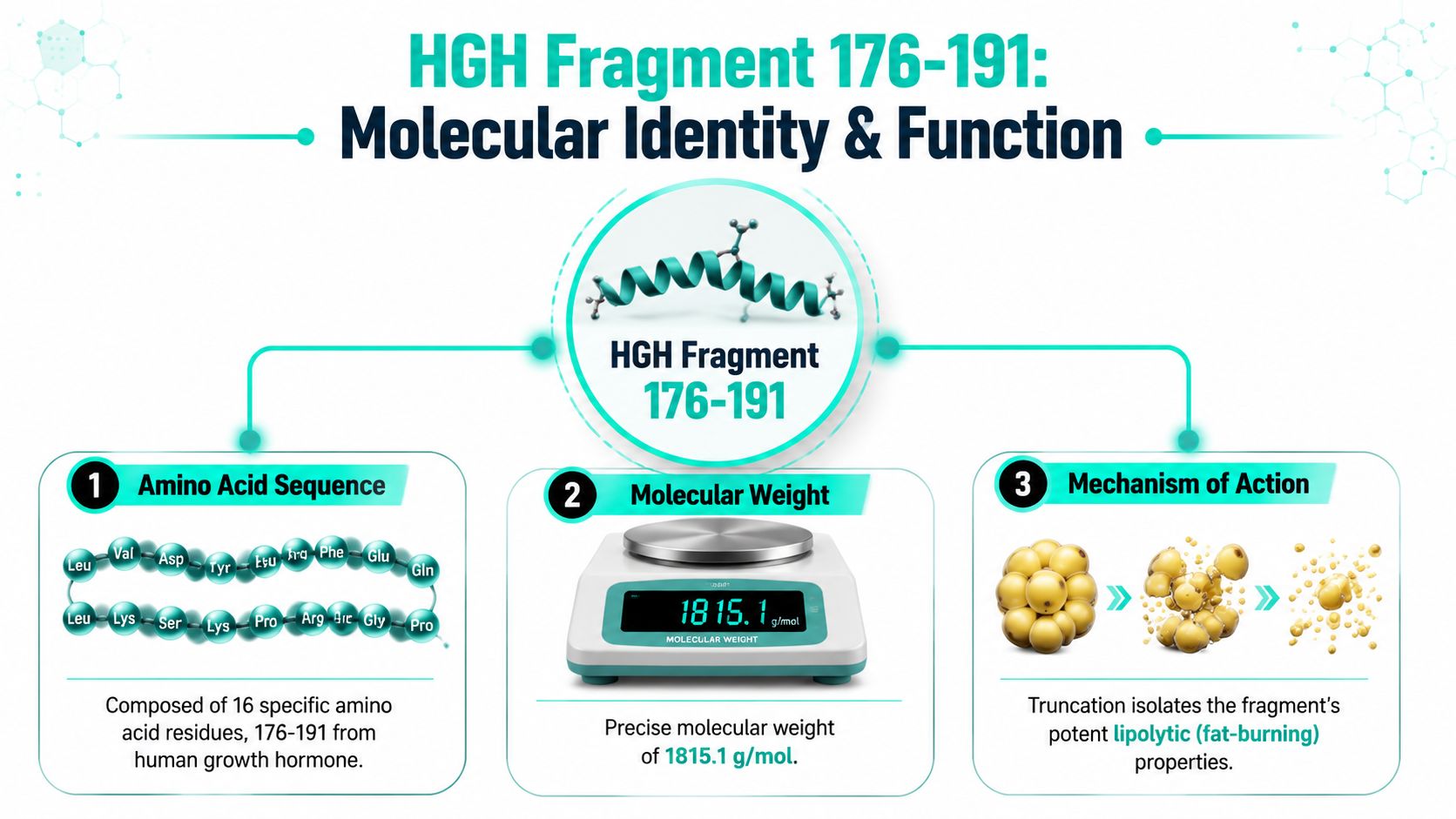
A lab team that hears what is HGH fragment 176-191 for the first time can easily mistake it for “mini HGH.” A better starting point is to treat it as a named functional slice of the parent hormone. It is a 16-amino-acid C-terminal peptide made up of residues 176 through 191, and one technical catalog lists a molecular weight of about 1815.1 g/mol Technical Data Sheet. That size helps explain why researchers examine it separately from full-length growth hormone, since it can preserve a metabolic signal without carrying the full hormone's broader systemic behavior.
Full-length growth hormone is the whole key, and the fragment is one cut that fits a specific lock in the lipolytic domain. That is why researchers use it to probe adipose and metabolic biology rather than general endocrine signaling. Truncation isolates the region associated with fat mobilization, which is why the peptide appears in experimental discussions of adipocyte metabolism.
The mechanism is usually described as selective lipolysis with limited endocrine spillover. A technical data sheet says this region controls the fat-reducing action and does not appear to drive some undesirable HGH-associated effects such as increased insulin resistance, while a peer-reviewed paper notes that a C-terminal hGH 176-191 variant has been reported to enhance lipid breakdown and fat utilization in mice Technical Data Sheet. The cleaner interpretation is straightforward. The peptide is studied as a domain with lipolytic behavior, not as a simplified stand-in for all growth hormone biology.
That same framing matters for assay work. If your readout is lipid breakdown, you still need to ask where the signal came from, the fragment itself, a degradation product, or a mislabeled analog. Identity confirmation and chain integrity matter as much as the biological model, especially when a lab is trying to separate real mechanism from a convenient label.
A lab team comparing HGH fragment 176-191 with its modified analog can run into a simple but common problem, the studies do not line up cleanly. Preclinical reports keep the native fragment in the metabolic discussion because animal work has described 12 to 23% fat reduction and other changes consistent with lower lipid stores. Other summaries note lower blood sugar without a rise in IGF-1 or a shift in insulin sensitivity, which is why researchers often treat the fragment as a distinct peptide domain rather than a generic growth hormone stand-in HealthRX.
The human evidence base is thinner, and that gap matters more than promotional language does. The strongest clinical signal in the sources belongs to AOD-9604, the modified analog, where one review describes a Phase IIb study using 1 mg/day for 12 weeks and reporting about 2.1 kg more fat loss than placebo HealthRX. That result can be useful as a reference point, but it should not be treated as proof for the native sequence.
The native HGH fragment 176-191 itself does not have a human randomized controlled trial in the cited material. A separate summary says the closest human evidence for this biology belongs to AOD-9604, and that the analog later failed its decisive weight-loss trial HealthRX. For researchers, that is the key distinction. A related molecule showing a signal in one setting does not validate the original fragment in another.
The comparison becomes clearer once you separate the molecules at the sequence level. The native fragment 176-191 sequence differs from modified analog AOD-9604, so folding one compound's results into the other can distort study design and interpretation Core Peptides. A practical way to frame it is this. The analog is a cousin with a different experimental history, while the native fragment remains the peptide you are trying to characterize.
| Study Type | Dose/Model | Fat Reduction Outcome |
|---|---|---|
| Animal studies | Preclinical models | 12 to 23% fat reduction HealthRX |
| Human study of AOD-9604 | 1 mg/day for 12 weeks | About 2.1 kg more fat loss than placebo HealthRX |
| Native HGH fragment 176-191 | Human randomized controlled trial | No randomized human data HealthRX |
The conservative takeaway is the one most researchers trust. Animal data are more supportive than human data, and the human signal most often cited belongs to a modified analog rather than the native fragment itself.
If you're handling HGH fragment 176-191 in a lab, the first priority is to protect the material from avoidable degradation and then prove you still have the right molecule. A common workflow starts with gentle reconstitution, then aliquoting into single-use portions so you don't keep reopening the same vial. A practical peptide-reconstitution guide can be useful when you're building your own SOP, especially if your lab rotates between different peptide classes, as described in this reconstitution resource.
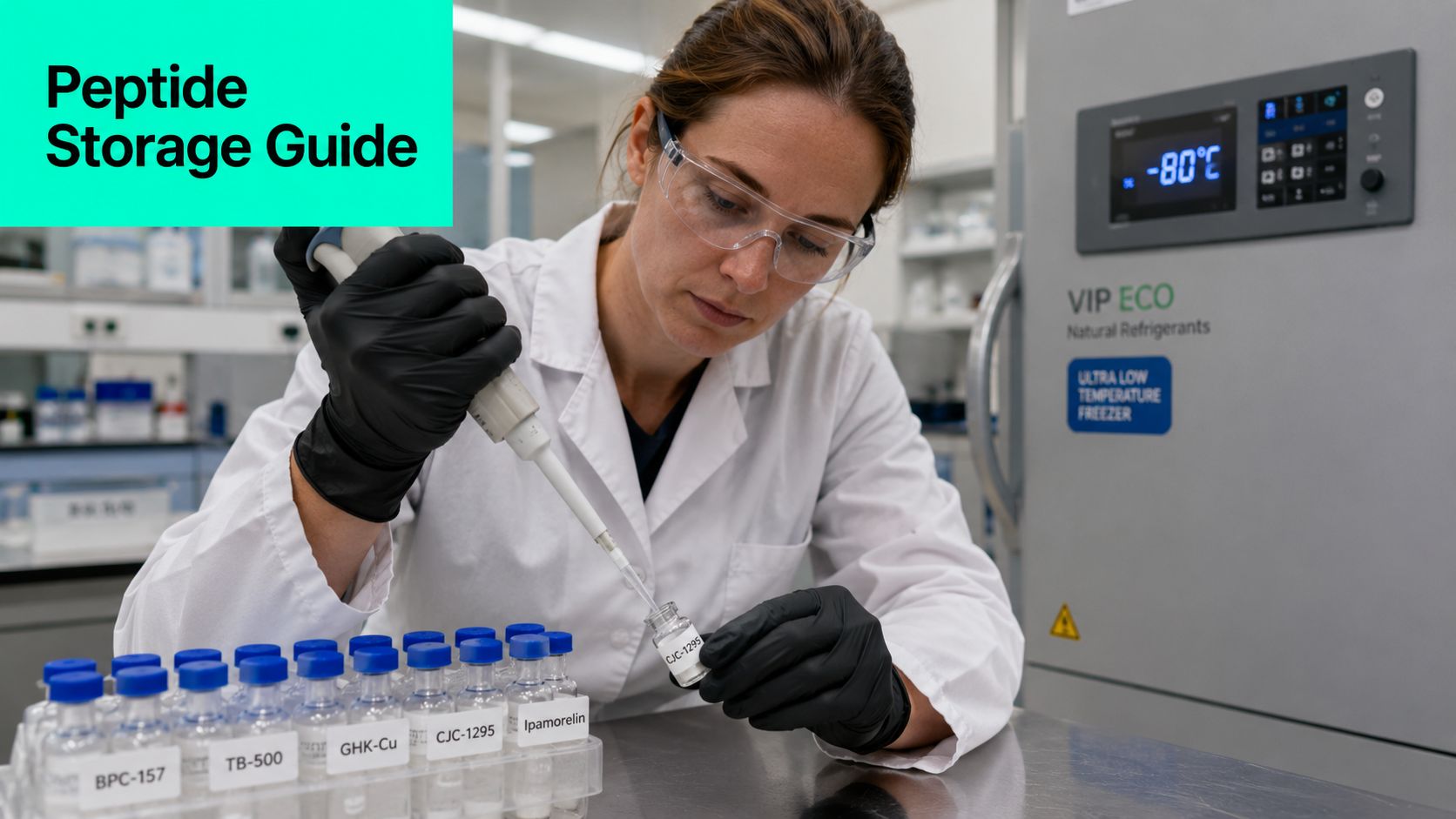
Start with a solvent choice that matches your downstream assay, then mix by gentle inversion rather than aggressive shaking. If the peptide behaves poorly in solution, don't force it into a one-size-fits-all buffer, adjust conditions carefully and document what changed.
For potency and identity, LC-MS is especially useful because it helps separate the intended sequence from close lookalikes or breakdown products. If your readout depends on lipolysis, you want molecular verification before you trust any biological signal. That's the difference between a valid assay and an attractive artifact.
A peptide can look clean on a product page and still fail the first questions a researcher should ask before it reaches the bench. Sourcing should begin with vendor vetting, then move to documentation and independent confirmation. A clear checklist infographic helps make that process easier to follow, especially when more than one person in the lab has to review batch records.
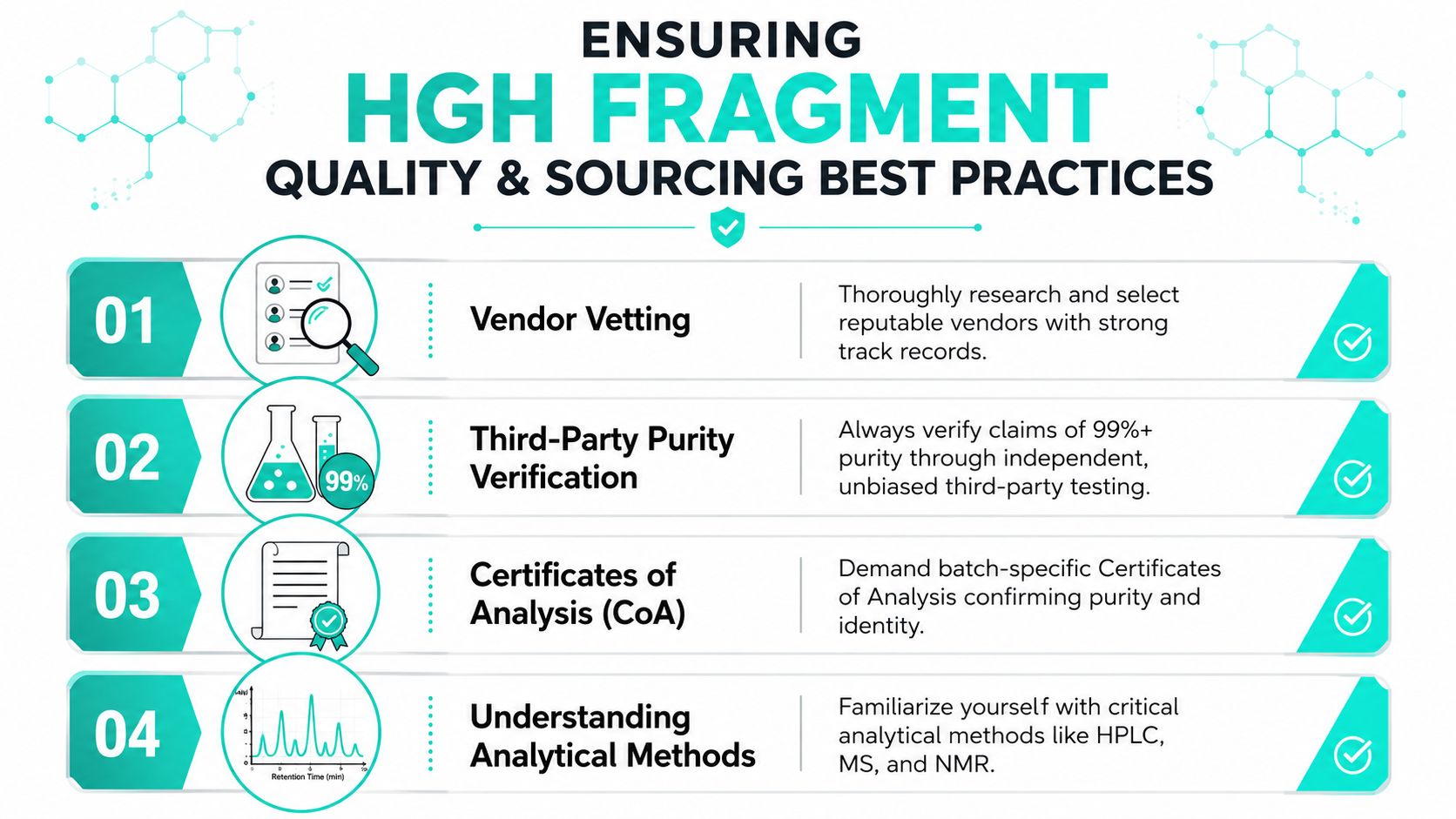
Start with a batch-specific Certificate of Analysis, not a generic template that could apply to several products. The CoA should match the lot you are buying, and it should be backed by analytical methods that researchers can evaluate directly, such as HPLC, MS, and qNMR.
The distinction between the native sequence and AOD-9604 matters because mixing them up can distort study design and make later interpretation harder. It is similar to labeling two related assay reagents as if they were identical, the names sound close, but the evidence base and research context are not the same. A sourcing file should make that difference obvious before any work begins, and that is where documented third-party verification becomes useful. For a clear example of how that kind of review is presented, see this third-party testing overview.
A research peptide can look straightforward on paper and still carry a complicated regulatory profile in the lab. HGH fragment 176-191 is described as research-use only and not FDA-approved for human administration, so it belongs in controlled laboratory work, not casual use. That label matters because a peptide's research identity does not create a clinical use pathway.
Treat the material as an accountable investigational reagent. Labeling should stay clear, storage access should be limited to authorized personnel, and any in vitro or in vivo work should sit inside the institution's normal review and oversight framework. In a preclinical setting, the governing standard is not promotional wording, it is the protocol, the records, and the compliance process your institution already requires.
The distinction between the native fragment and AOD-9604 also matters here, because safety and regulatory discussions can become muddled when related names are used as if they describe the same material. They do not. For researchers, that is similar to handling two assay reagents with overlapping labels but different validation histories. The safer course is to keep the identity of the exact peptide fixed in the batch file, then apply the appropriate oversight for that specific material.
The fragment may be biologically interesting, but its use case is still research. That means the burden of diligence, documentation, and oversight stays with the lab.
A practical reading list helps most when it points to the next lab decision, not just another citation. Start with the native-fragment description for sequence context and the regulatory framing already noted earlier, then compare it with the evidence summary that separates animal findings from the limited human record. For identity work, use the molecular specification reference that reports the 16-amino-acid sequence and 1815.1 g/mol weight.
A strong lab workflow usually includes three next steps:
That distinction matters because the native fragment and the modified analog may share a related naming pattern, yet they should not be treated as interchangeable reagents. A researcher reading one vendor's summary and another vendor's method note can easily assume the same biological story is being told twice, when the validation history may differ. The more careful approach is to keep the exact peptide identity fixed in the batch file, then read the assay data against that identity rather than against a marketing label.
For teams that need a purchasing and documentation path aligned with research use, start with a vendor that publishes testing language, inventory details, and support contacts, then keep your own records tighter than the product sheet. If your lab is ready to source with that standard in mind, review the catalog and documentation approach at Celonyx Labs and map your next batch against your assay plan.
What does “6 acetic acid” tell you about the bottle on your bench? Not much,

Best sterility testing kits for 2026 peptide labs: Endosafe nexgen-PTS wins on speed, Steritest for

Compare the best peptide reference standards for analytical research in 2026, ranked by purity, COA
FOR RESEARCH USE ONLY. Products sold by Celonyx Labs are intended exclusively for laboratory and scientific research. They are not intended for human or veterinary use, consumption, diagnosis, treatment, cure, or prevention of any disease. By purchasing from this site, you acknowledge that you understand the intended research purpose of these materials and agree to comply with all applicable laws and regulations.