
Kisspeptin 10 for Sale Research Guide for Labs
A researcher searching “kisspeptin 10 for sale” may expect a straightforward catalog result. Instead, the

You've got a lyophilized peptide on the bench, a protocol open on one screen, and a limited window to choose a diluent. The vial of aqua science bacteriostatic water may look interchangeable with sterile water for injection or normal saline, but that assumption can affect every later decision, from repeated withdrawals to assay compatibility and contamination control.
The important question isn't whether the water is sterile. You need to know what's in the formulation, how the vial is intended to be used, and whether the preservative fits your experiment. A diluent selected casually can create problems after the peptide has already been dissolved, when changing the solvent is no longer practical.
A peptide reconstitution workflow begins before the syringe enters either vial. First, identify the intended use of the preparation. A single-use assay, a multi-session research workflow, and a preparation intended for injection may require different decisions about preservatives, osmolarity, container format, and handling.
The product label establishes a narrow formal use case. FDA-linked labeling describes bacteriostatic water as a diluent for dissolving or diluting drugs intended for intravenous, intramuscular, or subcutaneous injection, not as a universal laboratory solvent. That distinction matters even when your work is strictly preclinical or analytical, because the formulation carries a defined preservative load.
Practical rule: Choose the diluent before you calculate the final concentration. The solvent is part of the experiment, not an invisible background ingredient.
Before opening a vial, check four points:
Bacteriostatic water, sterile water for injection, and normal saline can all appear as simple aqueous diluents on a purchasing list. They don't behave the same way after opening, and they don't impose the same experimental constraints. The safest habit is to review the formulation and protocol together, then document why the selected diluent was appropriate.
Bacteriostatic Water for Injection, USP is a sterile, nonpyrogenic water-for-injection preparation containing 0.9% benzyl alcohol, equivalent to 9 mg/mL, as a bacteriostatic preservative, according to FDA-linked DailyMed labeling. The base is sterile injectable water, but the added benzyl alcohol changes how the vial is intended to function.
The preservative is there to suppress microbial growth during appropriate multi-dose handling. It doesn't make the vial immune to contamination, and it doesn't turn the product into an indefinite storage system. Sterility still depends on the container, stopper, access technique, storage conditions, and compliance with the product label and laboratory procedures.
A researcher should read the label as a specification, not as a marketing description. The relevant questions are straightforward:
That formulation can support workflows requiring controlled, repeated access, but it introduces a substance that may interfere with sensitive experiments. The preservative also creates an important safety restriction. FDA-labeled information warns against use in neonates because benzyl alcohol has been associated with toxicity, as described in DailyMed product information.
For research teams, the lesson is simple: bacteriostatic does not mean universally compatible. It means the formulation includes a preservative intended to inhibit microbial growth during multi-dose use. Whether that advantage outweighs the risk of assay interference depends on the peptide, the experimental system, and the planned handling schedule.
The right comparison isn't “which liquid looks cleanest?” It's which formulation matches the workflow. Sterile water for injection has no benzyl alcohol preservative. Normal saline contains sodium chloride and is selected when an isotonic solution is appropriate. Bacteriostatic water adds benzyl alcohol to a sterile water-for-injection base.
| Attribute | Bacteriostatic Water | Sterile Water for Injection | Normal Saline, 0.9% NaCl |
|---|---|---|---|
| Preservative | Contains benzyl alcohol | No preservative | Typically no benzyl alcohol preservative |
| Container purpose | Multi-dose diluent | Single-dose preparation | Commonly supplied for single-use preparation |
| Repeated access | May support controlled multi-dose handling | Not the intended advantage | Not the intended advantage |
| Main compatibility concern | Benzyl alcohol carryover or toxicity context | Lack of preservative | Sodium chloride and osmotic effects |
| Appropriate selection | Repeated withdrawals when compatible | Single-use or preservative-sensitive work | Workflows requiring saline conditions |
Use bacteriostatic water when repeated access is needed and the target peptide, assay, and approved protocol are compatible with benzyl alcohol. The preservative can be useful in a controlled multi-dose workflow, but it shouldn't be selected merely because a vial may be used more than once.
Choose sterile water for injection when the preparation must be preservative-free or when the protocol calls for a single-use diluent. Normal saline may be more appropriate where osmotic balance is a defined part of the preparation. Neither alternative should be treated as a universal substitute, because the peptide and assay may respond differently to the final solution environment.
The age-related warning is especially important. FDA-linked labeling identifies benzyl alcohol-related pediatric risk, including the warning that benzyl alcohol-containing preparations aren't intended for neonates. In research, that warning also reinforces a broader principle: the absence or presence of a preservative must be deliberate.
A defensible reconstitution workflow starts with identity and documentation, not with agitation. Confirm the peptide name, lot, stated mass, target concentration, and approved solvent before puncturing the stopper. If the peptide's protocol doesn't address benzyl alcohol compatibility, pause and obtain a qualified technical or scientific review rather than assuming the preservative is harmless.
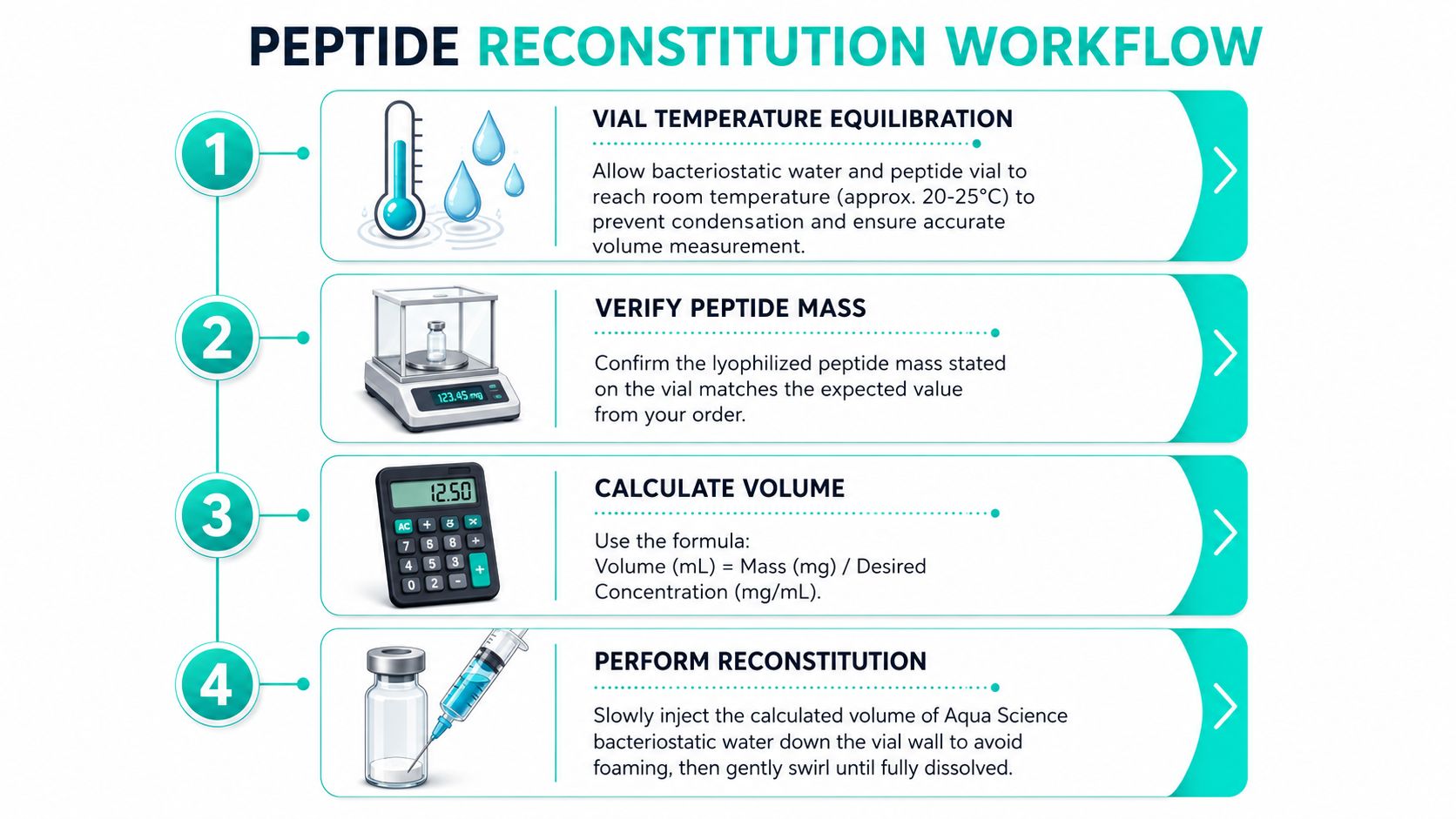
Use the intended final concentration to determine the required volume:
Volume in mL = peptide mass in mg ÷ desired concentration in mg/mL
Check the units before drawing anything. A mismatch between milligrams and micrograms can produce a serious preparation error, so have a second person verify the calculation when your SOP requires an independent check.
Allow the peptide vial and diluent to equilibrate according to your laboratory's handling procedure. Inspect both containers for compromised seals, visible particles, or unexpected appearance. Don't proceed with a vial that fails an incoming-material or visual-inspection requirement.
Disinfect the stopper using the method specified by your SOP and use a new sterile syringe and needle. Direct the stream of bacteriostatic water down the inside wall of the peptide vial rather than onto the lyophilized cake. A slow addition reduces foaming and limits mechanical stress on the material.
Avoid vigorous vortexing unless the peptide's validated protocol specifically permits it. Gentle swirling or controlled rotation is generally easier to defend because it reduces unnecessary agitation while allowing the cake to dissolve. Don't force dissolution by adding unapproved solvents or changing the planned volume without recording the deviation.
For a more detailed discussion of technique and calculation checks, review this peptide reconstitution guide.
If the experiment requires multiple withdrawals, define the access plan before reconstitution. If it doesn't, aliquoting into suitable containers may reduce repeated stopper punctures, but the containers, labeling, and storage conditions must be covered by your SOP.
Record the peptide lot, diluent lot, volume added, calculated concentration, operator, date, and any observations during dissolution. This traceability becomes especially important if an assay later shows unexpected interference or if procurement identifies a formulation difference between lots.
A short demonstration can supplement written training, but it can't replace the approved protocol, risk assessment, or qualified supervision.
Opening the flip-off cap isn't the same as puncturing the stopper. The practical contamination-control clock begins when the vial is entered, because each access creates an opportunity for microorganisms or particles to enter. Benzyl alcohol can suppress microbial growth, but it doesn't compensate for poor aseptic technique or a damaged container.
Use the manufacturer's labeled in-use period and your institution's policy as the controlling standard. The commonly referenced multi-dose handling window is 28 days, but that figure must be tied to an appropriate source and product-specific procedure, not treated as permission to keep every vial indefinitely. The FDA-linked product information also documents serious consequences associated with compromised sterility, including invasive bacterial infection, bacterial meningitis, septicemia, fever, chills, malaise, and cutaneous abscess.
Keep the vial in the storage environment specified by the product label and your laboratory SOP. Protect it from avoidable heat, light, and handling damage, and don't transfer it to an unapproved container. Refrigeration shouldn't be introduced casually if the label or protocol specifies another condition, because temperature changes can affect handling and condensation.
At each access:
Labeling matters because a clear solution can still fail a time or handling requirement. For related peptide storage practices, consult this guide to storing reconstituted peptides, then reconcile its advice with your own validated SOP.
“Sterile” and “bacteriostatic” describe important quality attributes, but they don't tell you everything a research team may need to know. A front label doesn't replace lot-level documentation, especially when the material will enter a sensitive cell-based assay or preclinical workflow.
Start with the Certificate of Analysis, or CoA, for the exact lot you'll receive. A useful document should allow your quality team to connect the vial to testing results rather than relying only on a brand-level statement.
Check whether the documentation addresses:
The preservative concentration is particularly relevant because current DailyMed entries show that products may be labeled with either 0.9% or 1.1% benzyl alcohol, as reflected in the FDA-linked product entry. Don't assume that every bacteriostatic water product has an identical formulation merely because the product name is similar.
For cell-based work, endotoxin can become a confounding variable. For in-vivo work, the material must meet the relevant study and institutional requirements. A lab's incoming-material SOP should specify who reviews the CoA, what discrepancies trigger quarantine, and how long the records remain available.
If your team uses external analytical services, document the scope before sending a sample. This third-party testing resource can help frame the questions to ask, but it shouldn't replace your own acceptance criteria or the manufacturer's lot documentation.
A procurement plan that assumes bacteriostatic water is always available can fail at the point of order. The American Society of Health-System Pharmacists has documented a U.S. shortage of bacteriostatic water for injection associated with manufacturing delays and limited supply, as shown in its drug shortage detail. That makes lead-time review part of experimental planning, particularly when a study depends on a specific vial format.
Availability isn't the only variable. Recent DailyMed entries show formulations labeled with 0.9% or 1.1% benzyl alcohol, so a buyer shouldn't assume that every product carries the same preservative concentration. A small formulation difference may matter when a protocol, assay, or risk assessment assumes a fixed preservative load.
Before checkout, ask for the exact product and lot documentation where possible. A brand name alone isn't enough for a reproducible input.
Don't substitute a different product solely because its label says “bacteriostatic water.” Compare the concentration, container format, documentation, and intended use. A replacement that looks equivalent may introduce a preservative or packaging difference your validation work didn't cover.
A useful procurement record includes supplier, product name, formulation, lot, receipt date, CoA status, storage location, and disposition. That record gives the lab a defensible trail if a shipment is delayed, a lot changes, or an assay result requires investigation.
The central decision is straightforward: bacteriostatic water is a preserved multi-dose diluent, not a generic solvent. Its sterile water base and benzyl alcohol preservative support a particular handling pattern, but that pattern only works when the peptide, assay, storage plan, and safety context are compatible.
Use the following decision sequence at the bench:
The procurement lesson is just as important as the bench technique. Shortages can disrupt schedules, while formulation variability can undermine assumptions about preservative exposure. Keep an approved purchasing record and don't wait until the day of reconstitution to discover that the required lot, documentation, or formulation isn't available.
For most compatible, repeated-withdrawal research workflows, bacteriostatic water is a reasonable default. For single-use or preservative-sensitive applications, sterile water may be the more defensible choice. When osmotic conditions matter, normal saline may fit better. Write the decision into the lab notebook with the diluent lot, opening date, storage conditions, peptide lot, added volume, and final concentration.
Celonyx Labs supplies research peptides through an online catalog and provides product and testing information for laboratory buyers evaluating peptide materials and related preparation workflows. Visit Celonyx Labs to review available research products and contact the team about procurement documentation for your lab.
A researcher searching “kisspeptin 10 for sale” may expect a straightforward catalog result. Instead, the

Ranked guide to the best tirzepatide peptides for research in 2026: lyophilized vials, reference standards,

The best cagrilintide peptides for research in 2026, ranked by purity, COA availability, and format
FOR RESEARCH USE ONLY. Products sold by Celonyx Labs are intended exclusively for laboratory and scientific research. They are not intended for human or veterinary use, consumption, diagnosis, treatment, cure, or prevention of any disease. By purchasing from this site, you acknowledge that you understand the intended research purpose of these materials and agree to comply with all applicable laws and regulations.