

Bacterial Water Treatment: Mechanisms, Technologies
In the United States, typhoid fever fell from about 100 cases per 100,000 people in

In the United States, typhoid fever fell from about 100 cases per 100,000 people in 1900 to 33.8 per 100,000 by 1920, then to 0.1 per 100,000 in 2006, or 353 cases in total, according to a historical review of water treatment and public health (PLOS Water historical review). That decline wasn't caused by one piece of equipment. It reflected the combined effect of filtration, disinfection, engineered biological processes, monitoring, and operational discipline.
Bacterial water treatment now sits at the intersection of microbiology and process control. Some bacteria are the workforce that removes organic pollution and nutrients. Others are the organisms operators must reduce before treated water can be discharged or reused. The central engineering challenge is to encourage the right microbial community, suppress harmful or disruptive populations, and then prove to regulators that the treatment train provides reliable pathogen control.
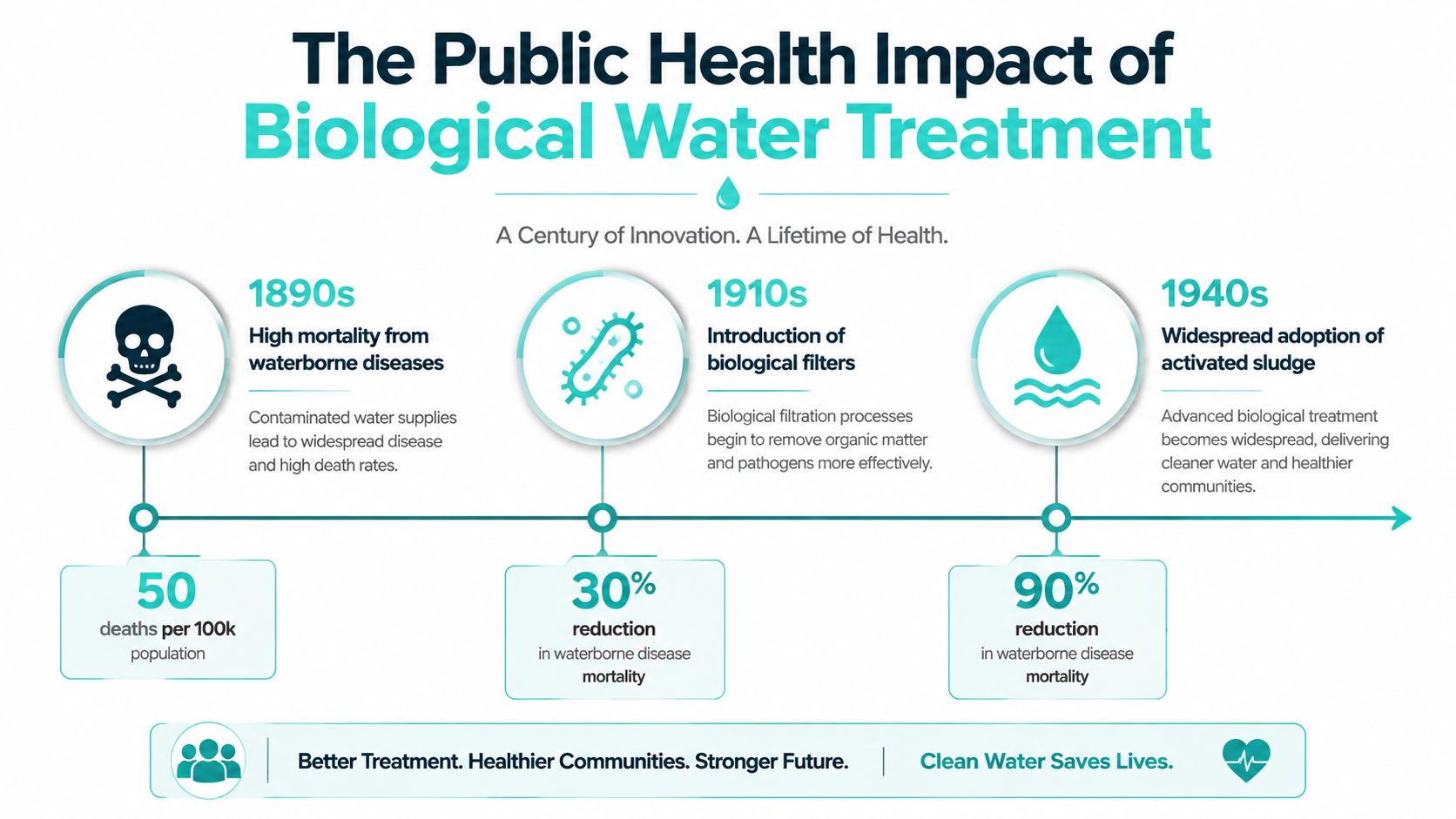
Bacterial water treatment shapes both municipal wastewater costs and the safety of reused water supplies. In a wastewater plant, active microbial communities consume biodegradable organic matter, transform nitrogen compounds, and produce solids that can be separated from the liquid stream. In drinking-water and reuse systems, the treatment train must also reduce bacterial pathogens and other microorganisms that threaten public health.
Chemical disinfection became a widely used control because it can be applied at scale, monitored operationally, and integrated into municipal treatment trains. Its role is not only to “kill bacteria.” Operators must demonstrate that a defined barrier performs reliably under changing flow, water quality, and operating conditions.
In biological wastewater treatment, bacteria are valuable process agents. Heterotrophic organisms break down carbon-rich compounds, while nitrifying and denitrifying communities transform nitrogen. Their metabolism converts dissolved pollution into new biomass, gases, and more stable chemical forms that operators can remove through settling or downstream polishing.
The same broad microbial world also contains organisms that treatment must control. Pathogenic bacteria can enter raw water through sewage, animal waste, stormwater, industrial activity, or distribution-system failures. A plant therefore maintains a dense, active microbial community inside the reactor while limiting the release of reactor solids and incoming pathogens into finished water.
A healthy-looking aeration basin does not by itself demonstrate compliance. Operators need suitable solids retention time, dissolved oxygen, loading conditions, hydraulic contact, separation performance, and disinfection barrier. Organic-matter removal can remain strong even when microbial protection is weak, particularly if solids escape, short-circuiting occurs, or the final barrier lacks adequate validation.
Operational principle: Biological treatment reduces pollution and may contribute to pathogen control, but reuse approval depends on the complete treatment train and the evidence supporting credit for each barrier.
Regulatory reuse frameworks award bacterial removal credit according to validated performance, monitoring, and response procedures, rather than microbial activity alone. A biological reactor may achieve meaningful reduction in routine operation, yet receive limited formal credit if performance data are incomplete or failure responses are undefined. This is also where emerging phage-based strategies may offer an advantage over conventional disinfection: targeted phages can attack selected bacterial hosts while leaving more of the surrounding microbial community intact. Their practical value still depends on host range, resistance management, persistence, and regulator-accepted validation.
Engineering teams should therefore design for two outcomes at once: actual treatment performance and defensible regulatory credit.
A treatment reactor works like a microbial workforce, but the workforce only performs well when the plant supplies the right working conditions. Different organisms handle different tasks, and their roles overlap rather than operating as isolated steps.
Heterotrophic bacteria are the general laborers. They consume biodegradable organic carbon, using it for energy and cell growth. Their activity lowers measures such as biochemical oxygen demand and chemical oxygen demand, while the resulting cells become part of biological flocs or biofilms.
Nitrifiers are specialized technicians. Organisms associated with Nitrosomonas oxidize ammonia to nitrite, while Nitrobacter and related organisms oxidize nitrite to nitrate. These bacteria grow more slowly than many carbon-consuming organisms, so an operator who wastes too much sludge can remove nitrifiers from the system even when the rest of the biomass remains active.
Denitrifiers work under anoxic conditions. They use nitrate as an electron acceptor and convert nitrogen compounds toward nitrogen gas when a suitable carbon source is available. The plant must create the right sequence of aerobic and anoxic environments, rather than adding more air everywhere.
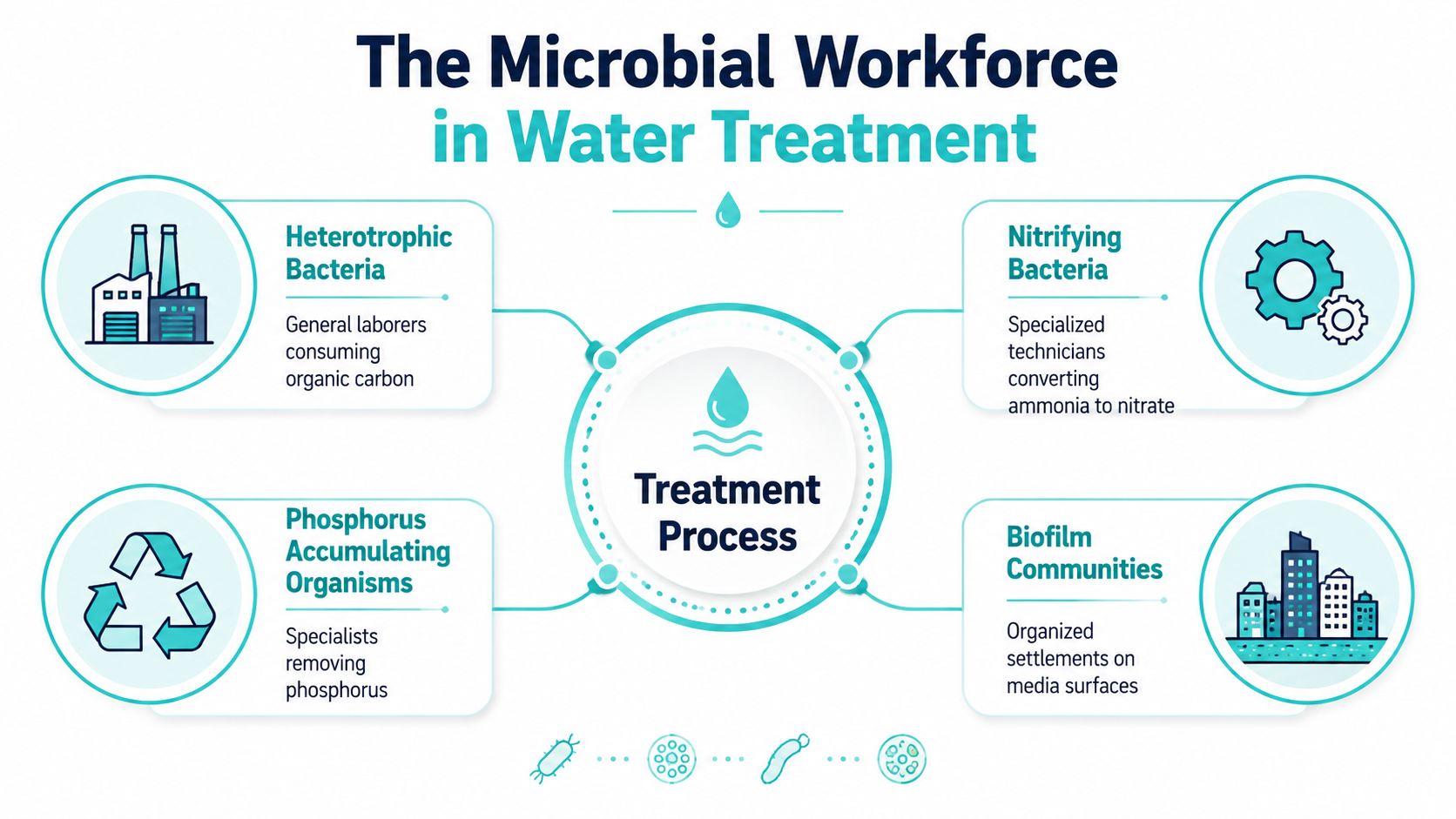
Attached-growth systems support bacteria on media surfaces, where extracellular polymeric substances, or EPS, help cells adhere and form a protective matrix. EPS also contributes to floc structure in suspended-growth systems. The matrix holds cells close together, traps particles, and creates diffusion gradients.
Those gradients produce metabolic handoffs. Oxygen may be plentiful near the outer surface of a biofilm but limited deeper inside it. One population consumes a compound and releases a product that another population can use. This structure allows aerobic, anoxic, and sometimes anaerobic activity to occur across a very small distance.
Suspended-growth systems keep biomass in the liquid as flocs. Attached-growth systems retain organisms on fixed or moving surfaces. The choice affects surface area, washout risk, oxygen transfer, and which organisms can compete successfully. A deeper biofilm can protect slow-growing specialists from being removed, but it can also create diffusion limitations and uneven activity.
Protozoa graze on bacterial cells and help regulate floc ecology. Bacteriophages, viruses that infect bacteria, can also shape population balance by selectively attacking particular hosts. That relationship is relevant to emerging treatment strategies, especially where operators need to suppress a problem organism without broadly damaging the bacteria that perform pollutant removal.
For teams working with phosphate-containing laboratory solutions, the chemistry and microbial context should be separated carefully. A useful background reference is what PBS solution means in laboratory practice, but phosphate chemistry in a laboratory buffer isn't the same as biological phosphorus removal in a wastewater reactor.
No biological process is universally superior. Selection depends on influent strength, flow variation, available land, energy access, operator capability, solids handling, and the required level of pathogen or nutrient control. The table uses representative BOD-removal ranges as orientation, not guaranteed plant performance. Actual results change with loading, temperature, configuration, and operating targets.
| Technology | Representative BOD Removal | Footprint | Energy Use | Complexity | Best Application |
|---|---|---|---|---|---|
| Activated sludge | 85–95% | Moderate | High, mainly for aeration | High | Municipal plants with established operators and reliable controls |
| Sequencing batch reactor | Approximately 80–95%, design-dependent | Moderate | Moderate to high | Moderate to high | Smaller or variable-flow facilities needing batch flexibility |
| Moving bed biofilm reactor | Approximately 80–95%, design-dependent | Compact to moderate | Moderate | Moderate | Facilities needing resilient biomass retention and retrofit capacity |
| Trickling filter | Approximately 70–90%, media and loading-dependent | Moderate | Lower than intensively aerated systems | Moderate | Municipal treatment where energy simplicity matters |
| Constructed wetland | Approximately 60–90%, climate and configuration-dependent | Large | Low | Low to moderate | Decentralized treatment with available land |
| Bioaugmentation | Site-specific | Usually added to an existing process | Site-specific | Moderate to high | Recalcitrant compounds or recovery of a targeted biological function |
The 85–95% BOD removal range for activated sludge comes from the supplied engineering brief and describes the conventional category. Ranges for the other processes are representative planning values, not regulatory credits or guarantees. A fair comparison also needs to separate carbon removal from pathogen control. Biological treatment can reduce bacterial indicators through predation, retention, and unfavorable conditions, yet reuse frameworks generally award removal credit only for a validated treatment barrier with defined monitoring and performance requirements.
Activated sludge provides strong carbon removal and broad municipal experience. Its performance depends on aeration, sludge wasting, return activated sludge control, and secondary clarification. Poor selector conditions or an imbalanced microbial population can produce filamentous bulking, causing solids to settle poorly and escape with the effluent. The process therefore offers a familiar platform, but it requires active control of both biology and solids separation.
SBRs run through timed fill, react, settle, decant, and idle phases. This arrangement handles variable flows without a continuous clarifier, although cycle timing and decant control must protect settling and reaction capacity during peak loads. A short or poorly timed cycle can reduce treatment contact even when the reactor volume appears adequate.
MBBRs combine suspended biomass with organisms attached to mobile carriers. Retained biofilm can buffer loading changes, while media movement, aeration distribution, screens, and hydraulic mixing determine whether that capacity is available. Media clogging or weak circulation reduces effective surface area.
Trickling filters distribute wastewater over fixed media. They generally need less aeration than fully mixed suspended-growth systems, but high-strength industrial wastewater can exceed available biological capacity and cause clogging or odors. Constructed wetlands combine plants, media, attached biofilms, sedimentation, and natural gradients. They suit decentralized treatment where land is available, though seasonal conditions can reduce biological activity.
Bioaugmentation adds selected microorganisms to an existing process. A pilot-scale sequencing batch reactor study reported targeted heterotrophic-aerobic nitrogen-removal bacteria with average effluent values of COD 20.6 mg/L, NH4+-N 0.69 mg/L, TN 14.1 mg/L, and TP 0.40 mg/L at a COD/N ratio of 8, meeting first-class discharge limits (pilot-scale bioaugmentation study). The result supports targeted inoculation for a defined biological gap, not automatic success without diagnosis, retention, and verification.
Emerging phage-based strategies may offer narrower control than conventional disinfection. Bacteriophages can target selected bacterial hosts, potentially suppressing a problem organism while preserving organisms responsible for pollutant removal. Their regulatory value remains separate from established disinfection credit, because host range, persistence, regrowth, and validation must be demonstrated for the specific reuse train.
Membrane filtration can function as a downstream microbial barrier rather than a biological reactor. A membrane-filtration resource helps distinguish biological conversion from physical pathogen separation when teams evaluate treatment trains and removal credit.
Biology responds to operating conditions, not design labels. A plant called an activated-sludge system can perform very differently from another activated-sludge plant if its retention times, oxygen profile, loading, and solids inventory differ.
Hydraulic retention time, or HRT, describes how long water remains in the biological process. A short HRT can reduce treatment opportunity and increase the effect of peak loads. A longer HRT can improve contact, but it may require more tank volume and can alter oxygen demand and biomass behavior.
Solids retention time, or SRT, determines how long organisms remain in the system. Slow-growing nitrifiers need special protection. At 20°C, nitrifiers may require an SRT above 10 days to remain established, according to the supplied engineering brief. Temperature changes the growth rate, so a winter operating plan that works in warm weather can become unstable as nitrification slows.
Dissolved oxygen, or DO, must support aerobic metabolism without turning every basin into an energy-intensive high-oxygen zone. The supplied operating guidance identifies 1.5–2.5 mg/L as a typical DO range for activated-sludge control. Increasing aeration may improve ammonia oxidation, but excess air can waste energy, disturb anoxic nitrogen removal, and change floc structure.
Organic loading and the food-to-microorganism ratio shape competition. Too much readily biodegradable carbon can favor fast-growing heterotrophs and crowd out slower specialists. Too little food can produce low-energy biomass, pin floc, or poor settling. Operators should interpret F/M alongside sludge age, oxygen, temperature, and clarifier performance rather than treating it as an isolated target.
| Parameter | Activated Sludge Range | MBBR Range | Operational Impact |
|---|---|---|---|
| HRT | Site-specific | Site-specific | Controls contact time, tank volume, and response to peak flow |
| SRT | Often managed explicitly through wasting and return sludge | Biomass is retained partly on carriers | Determines washout risk and specialist retention |
| DO | 1.5–2.5 mg/L typical guidance | Set by biofilm oxygen demand and mixing | Balances oxidation, energy use, and anoxic conditions |
| SRT for nitrification | Above 10 days at 20°C may be required | Biofilm retention can support slow growers | Protects ammonia-oxidizing populations |
| F/M | Controlled through loading and biomass inventory | Depends on suspended and attached biomass | Influences floc quality, bulking, and substrate competition |
A sudden increase in aeration may lower ammonia, yet the resulting oxygen transfer can change alkalinity demand, carbon availability, and denitrification conditions. Increasing wasting may improve solids age control, but excessive wasting can remove nitrifiers faster than they reproduce. Raising recycle rates may improve contact with the biological population while increasing hydraulic loading on clarifiers.
Operators should review trends rather than isolated readings. Useful checks include ammonia and nitrate profiles, DO by basin zone, sludge settleability, suspended-solids inventory, return-sludge concentration, temperature, influent carbon, and clarifier blanket behavior. MBBR operators also need to verify carrier movement and screen condition, because a biological design advantage disappears if media isn't circulating or retained.
A treatment process can perform well biologically and still receive limited pathogen-removal credit. Regulators don't award reuse credit because bacteria are present in a reactor, or because a laboratory test shows reduction under favorable conditions. They evaluate the reliability of the barrier, the evidence behind the claimed reduction, monitoring requirements, redundancy, and the consequences of failure.
A 2025 EPA update identifies a specific problem in current reuse frameworks. Existing approaches can under-credit reverse osmosis and other advanced processes for pathogen reduction, even when evidence shows that those processes reduce pathogens. The update calls for risk-based treatment-target frameworks for potable and non-potable reuse (EPA Water Reuse Action Plan quarterly update).
Biological reactors may reduce bacterial indicators through settling, predation, adsorption to flocs, unfavorable conditions, and retention of microbial populations in biofilms. However, regulators may treat secondary biological treatment primarily as pretreatment for a validated disinfection or membrane barrier. That conservative position reflects variability in influent organisms, solids carryover, temperature, hydraulic short-circuiting, and process upsets.
Indicator organisms also complicate interpretation. E. coli, total coliforms, and coliphages can provide useful information, but their behavior doesn't perfectly represent every pathogen. A low indicator count doesn't automatically prove equivalent removal of every organism of concern, especially when sampling frequency and process variability leave gaps between observations.
A plant's actual log reduction and its credited log reduction answer different questions. The first describes observed or validated performance. The second describes what the regulator is willing to rely on for a defined reuse risk assessment.
For laboratory teams supporting environmental monitoring, the distinction resembles the difference between detecting contamination and demonstrating a controlled, validated process. Resources on sterility testing concepts can clarify that validation and sampling design matter as much as the treatment mechanism itself.
A 2025 systematic review found that membrane filtration processes, including MF, UF, and RO, averaged an LRV of 4.5, with a 95% confidence interval of 3.9–5.1, for bacterial removal. Dissolved air flotation, lime softening, and soil aquifer treatment averaged 2.7, 2.6, and 2.4 LRVs, respectively (systematic review of bacterial removal technologies). These values don't establish universal performance for every plant, but they show why regulators often place greater confidence in defined membrane barriers than in variable biological removal.
Bioaugmentation earns its place in a treatment train only when operators can identify the biological constraint it is meant to correct. A pilot-scale sequencing batch reactor study, cited earlier, matched heterotrophic aerobic nitrogen-removal bacteria to the reactor's chemistry and loading, then evaluated performance at a defined COD/N ratio. The treated water met first-class discharge limits, illustrating how a selected microbial population can help a secondary process deliver tertiary-level results (pilot-scale bioaugmentation study).
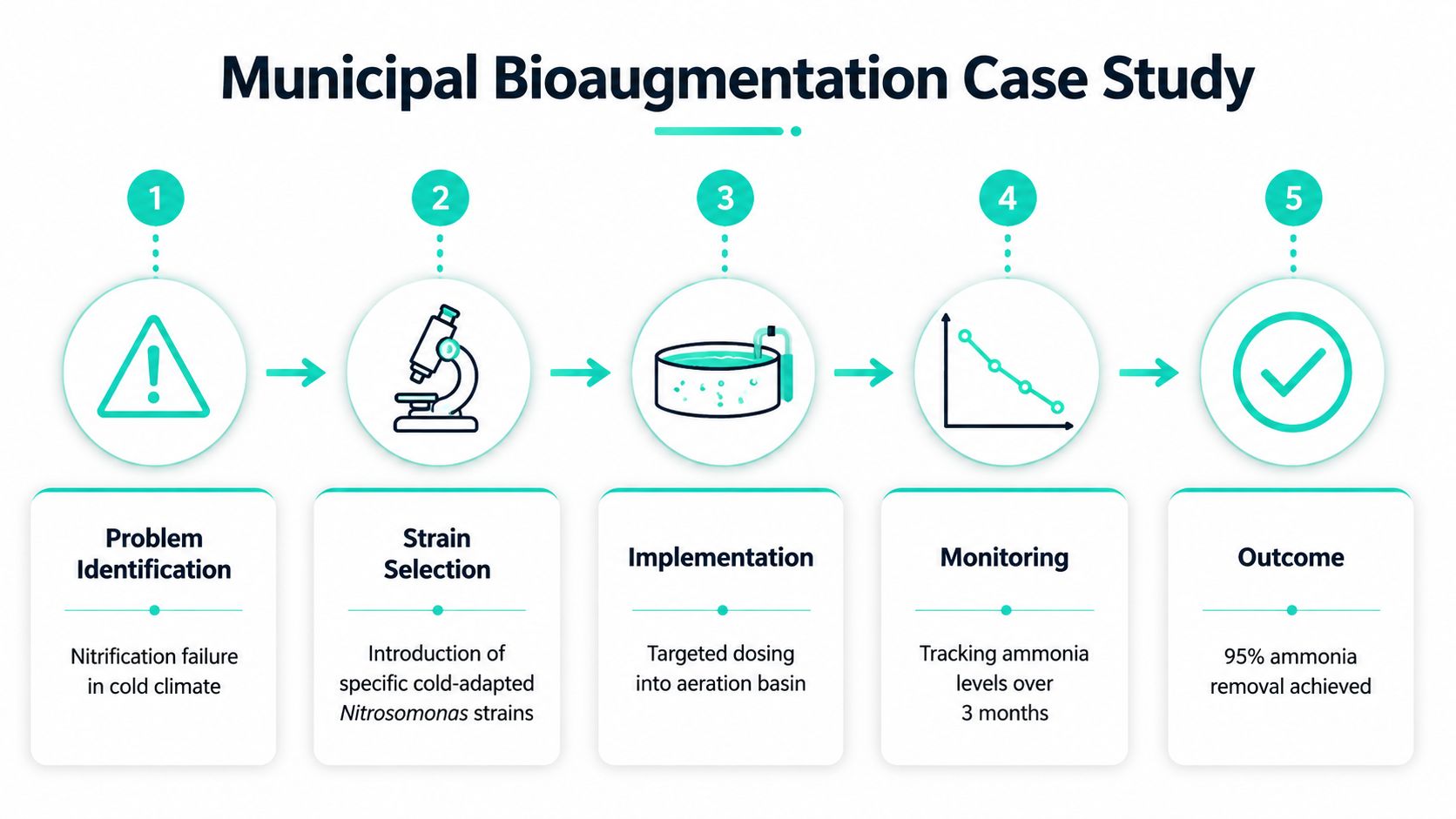
The operating lesson is straightforward: characterize the reactor before dosing. Confirm temperature, ammonia loading, alkalinity, DO, SRT, inhibitory compounds, and solids separation. An introduced strain may fail to establish when the resident community outcompetes it, the chemistry does not support its metabolism, or wasting removes the inoculated biomass. In practice, bioaugmentation is closer to adding a specialist to an existing workforce than replacing the whole microbial community.
Bacteriophages use a narrower control mechanism. They infect selected bacterial hosts, allowing a well-matched phage to suppress a target population while disturbing fewer pollutant-degrading organisms than a broad antimicrobial treatment might. A review in Accounts of Chemical Research examines phage-based control of biofilm, bulking, and antibiotic-resistant bacteria, as well as microbiome-aware approaches such as quorum quenching (Accounts of Chemical Research review on phage-based biocontrol).
Selectivity is the potential advantage, not a performance guarantee. Teams must test host range, resistance development, persistence, movement through solids, and regulatory acceptance. Conventional disinfection remains easier to specify and validate in many treatment trains. Phages may offer greater value when a particular organism drives the problem and broad oxidation or chlorination would be inefficient or would impose unwanted effects on the wider microbial community.
Evidence comparisons are also becoming more structured, with newer reference databases compiling bacterial log-reduction results across chemical and physical technologies. Those compilations can help teams compare intervention classes, but they do not replace site-specific validation. Regulatory credit still depends on a defined, monitorable barrier, reliable operating limits, and documented responses to failure.
Machine-learning tools may help operators anticipate microbial shifts from influent changes, temperature, oxygen demand, and solids trends. Their output should guide, not replace, field measurements and biological interpretation. A prediction has operational value only when it triggers a defined response, such as adjusting aeration, protecting SRT, changing recycle, or increasing confirmatory sampling.
Bacterial water treatment works because engineers create conditions in which different microbial populations can perform complementary tasks. HRT, SRT, DO, organic loading, temperature, and solids separation determine whether that workforce remains stable. Technology selection must match the influent, site constraints, operator capability, and the regulatory endpoint, whether that endpoint is discharge, non-potable reuse, or potable reuse.
The most important regulatory lesson is that observed removal isn't automatically credited removal. Biological reactors can contribute meaningful pathogen reduction, but reuse frameworks often demand validated, monitorable barriers with clearly defined failure responses. Membranes, disinfection, and biological processes should therefore be evaluated as parts of a treatment train, not as interchangeable technologies.
Future work will likely focus on phage-based biocontrol, microbiome-aware process management, predictive models for aeration and solids control, bioelectrochemical systems, advanced sensors, and modular treatment architectures. These approaches could make treatment more selective and responsive, but each will need evidence that connects microbial mechanisms to reliable plant performance and regulator-approved risk reduction.
Teams can start by mapping their treatment objectives to measurable biological and regulatory outcomes. Celonyx Labs supplies laboratory research materials, including Bacteriostatic Water 10mL, for approved laboratory workflows where sterile, non-pyrogenic water with bacterial-growth inhibition after opening is appropriate. Visit Celonyx Labs to review its research catalog and contact options.
In the United States, typhoid fever fell from about 100 cases per 100,000 people in

You've found a listing for SLU-PP-332, the page calls it a peptide, and the vendor
The most popular advice about third party testing labs is also the least useful: look
FOR RESEARCH USE ONLY. Products sold by Celonyx Labs are intended exclusively for laboratory and scientific research. They are not intended for human or veterinary use, consumption, diagnosis, treatment, cure, or prevention of any disease. By purchasing from this site, you acknowledge that you understand the intended research purpose of these materials and agree to comply with all applicable laws and regulations.