

Is bacteriostatic water the same as sterile water? No 2026
Is bacteriostatic water the same as sterile water? No. Compare preservatives, vial handling and peptide
Most advice on bacteriostatic water and syringes blurs the most important line in the whole workflow. Bacteriostatic water does not make a reconstituted peptide automatically stable for 28 days, it only helps suppress microbial growth in the vial after opening. If you treat those as the same problem, you can end up with a vial that is microbiologically protected but chemically compromised, which is a silent lab error I see new researchers make all the time.
The practical question is simpler than the jargon makes it sound. You need to know what the diluent protects, what the syringe hardware changes, and where the peptide itself still sets the limit. Once you separate those jobs, your choices around storage, labeling, needle handling, and discard timing get much easier to defend at the bench.
The cleanest way to think about bacteriostatic water and syringes is to split the job into two tracks. One track is microbial protection of the vial, and the other is chemical stability of the reconstituted peptide. Benzyl alcohol only addresses the first track, so a vial can be less prone to bacterial growth without the dissolved material being chemically unchanged.
That distinction matters because a lot of bench-side confusion starts with a shortcut. People hear “bacteriostatic” and assume the entire vial is protected for the same window. It isn't. The diluent can help keep an opened multi-dose vial more usable from a contamination standpoint, but the peptide may degrade sooner because of its own structure, the storage temperature, or the way the vial was handled.
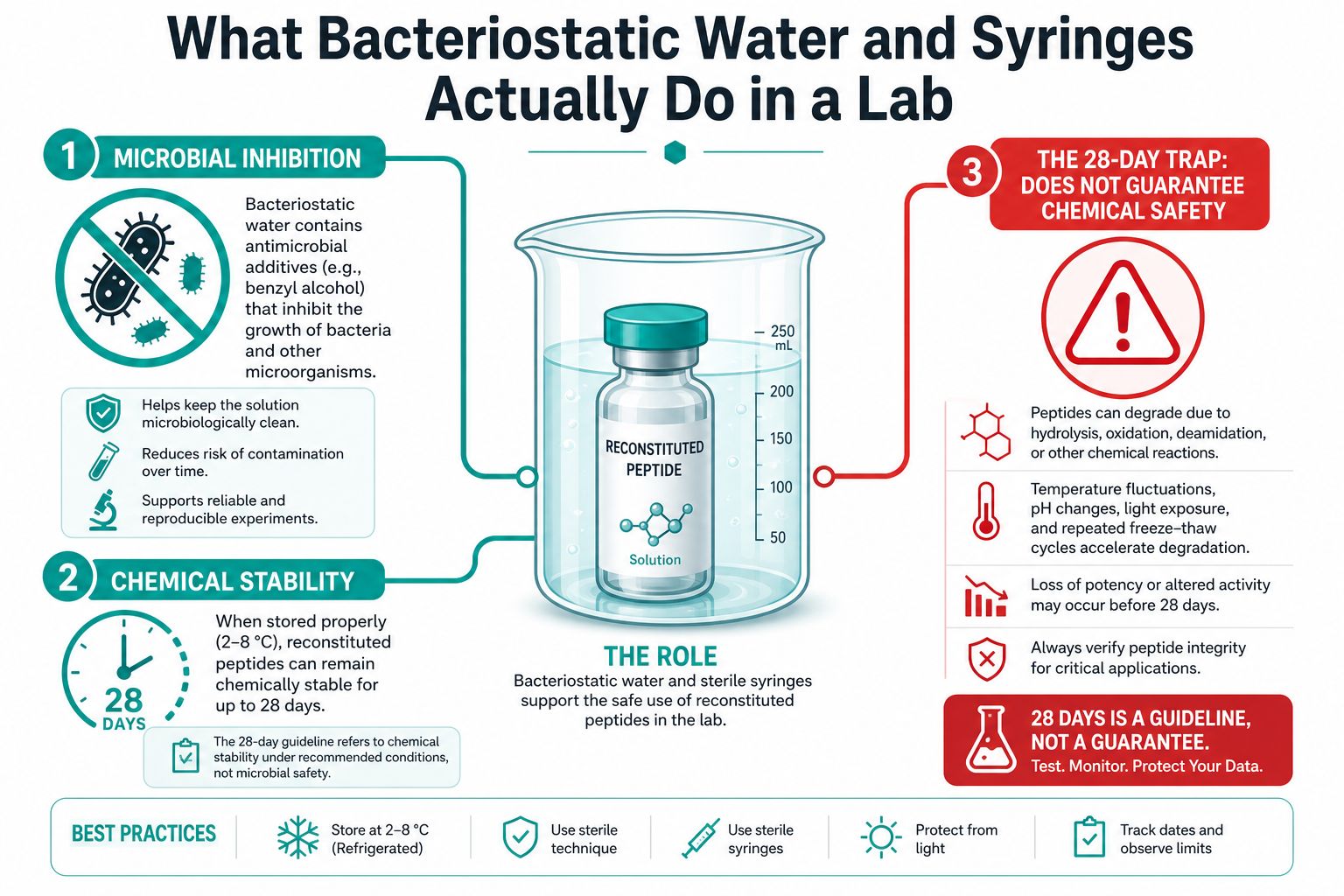
A useful bench rule is to ask two different questions every time you prepare a vial. First, is the vial protected from avoidable contamination after first puncture. Second, is the reconstituted peptide still chemically suitable for the use window you care about. Those questions overlap, but they are not interchangeable.
Practical rule: If a protocol only talks about the diluent, it is incomplete. The peptide's own stability always has the final say.
That is why syringes matter too. A syringe is not just a transfer tool. It is the device that controls whether each puncture is clean, whether the stopper is damaged, and whether the withdrawal stays consistent enough for repeat access. The rest of this guide keeps those two layers separate on purpose, because that's what prevents avoidable error when the protocol moves from a product sheet to an actual bench.
Bacteriostatic water is not a vague “special water” label. The USP-listed formulation is sterile water for injection with 0.9% benzyl alcohol, and the cited pH range is 4.5 to 7.0 (DailyMed). That formulation exists because the preservative, not the water itself, is what gives the opened vial its multi-dose character.
Benzyl alcohol was recognized in the 1940s as a preservative that could inhibit bacterial growth in multi-dose injectable solutions, and bacteriostatic water became a formal pharmaceutical standard in the 1950s. The concentration still repeated across references is 0.9% benzyl alcohol, or 9 mg/mL, which is why many lab teams treat that number as the benchmark for opened-vial handling (Real Peptides history overview).
The preservative changes the microbial environment inside the vial after puncture. It does not make the peptide resistant to oxidation, hydrolysis, aggregation, or poor handling. It also does not neutralize contamination that was already present in the powder vial, and it does not rewrite the storage instructions that belong to the dissolved compound.
That distinction matters because researchers often collapse two separate questions into one. A preserved diluent can slow microbial growth after access, but the reconstituted peptide still follows its own chemistry. If the molecule is prone to unfolding, surface adsorption, or other degradation pathways, the vial can remain microbiologically more controlled while the compound itself loses suitability earlier.
A useful bench habit is to separate “clean enough to keep using” from “chemically fit for the intended assay or dose.” Those are different thresholds. The first is about contamination pressure after puncture, the second is about the molecule's behavior in solution and under storage conditions.
For a quick product-oriented overview, this bacteriostatic water explanation shows how the diluent is described in practice without treating it like a substitute for the compound's own stability profile.
Bench insight: The preservative buys time against contamination, not permission to ignore the peptide's storage limits.
Labs usually choose among three liquids, and the right answer depends on what the formulation can tolerate. Bacteriostatic water is the multi-dose option because it includes benzyl alcohol. Sterile water for injection is the more conservative single-use choice because it has no preservative. Normal saline brings sodium chloride into the picture, which matters when ionic conditions are part of the protocol.
| Criterion | Bacteriostatic Water | Sterile Water for Injection | Normal Saline (0.9% NaCl) |
|---|---|---|---|
| Preservative present | Yes, benzyl alcohol | No | No |
| Intended use pattern | Multi-dose access | Single-use handling | Protocol-dependent |
| Typical role in reconstitution | Repeated withdrawal from preserved vial | Conservative reconstitution choice | Used when ionic balance matters |
| Key limitation | Benzyl alcohol is not appropriate for every use case | Less suited to repeated puncture | Adds salt, which not every compound wants |
| Best fit when | You need repeated aseptic access | You want the simplest diluent | The protocol calls for isotonicity |
The comparison that matters most is not “which one is stronger.” It is which one matches the protocol without adding an unnecessary variable. Bacteriostatic water gives you repeated access, but that same benzyl alcohol can be a problem if the product, the assay, or the intended handling conditions don't tolerate it. Sterile water avoids the preservative question altogether, but that leaves you with the tighter discipline of single-use handling. Saline is a different category entirely, because now you're changing the ionic environment, not just the sterility profile.
A lot of bench errors happen because someone reaches for what is already open in the fridge. That habit is efficient and sometimes wrong. If the compound is sensitive to salts, saline is the wrong starting point. If the compound will be accessed again and again, sterile water may force a handling pattern that doesn't match the workflow.
Decision point: Start with the compound's constraints, then pick the diluent. Don't pick the diluent first and hope the chemistry cooperates.
That logic is easier to defend in a lab meeting than “we used what was available.” It also keeps the team from confusing convenience with compatibility.
The syringe is part of the sterility system, not just the delivery system. The modern syringe evolved from much older injection tools, and the historical move toward the Luer fitting helped standardize aseptic handling and repeated puncture reliability (PubMed historical review). That history matters because multi-dose handling depends on the hardware being predictable every time a stopper is pierced.
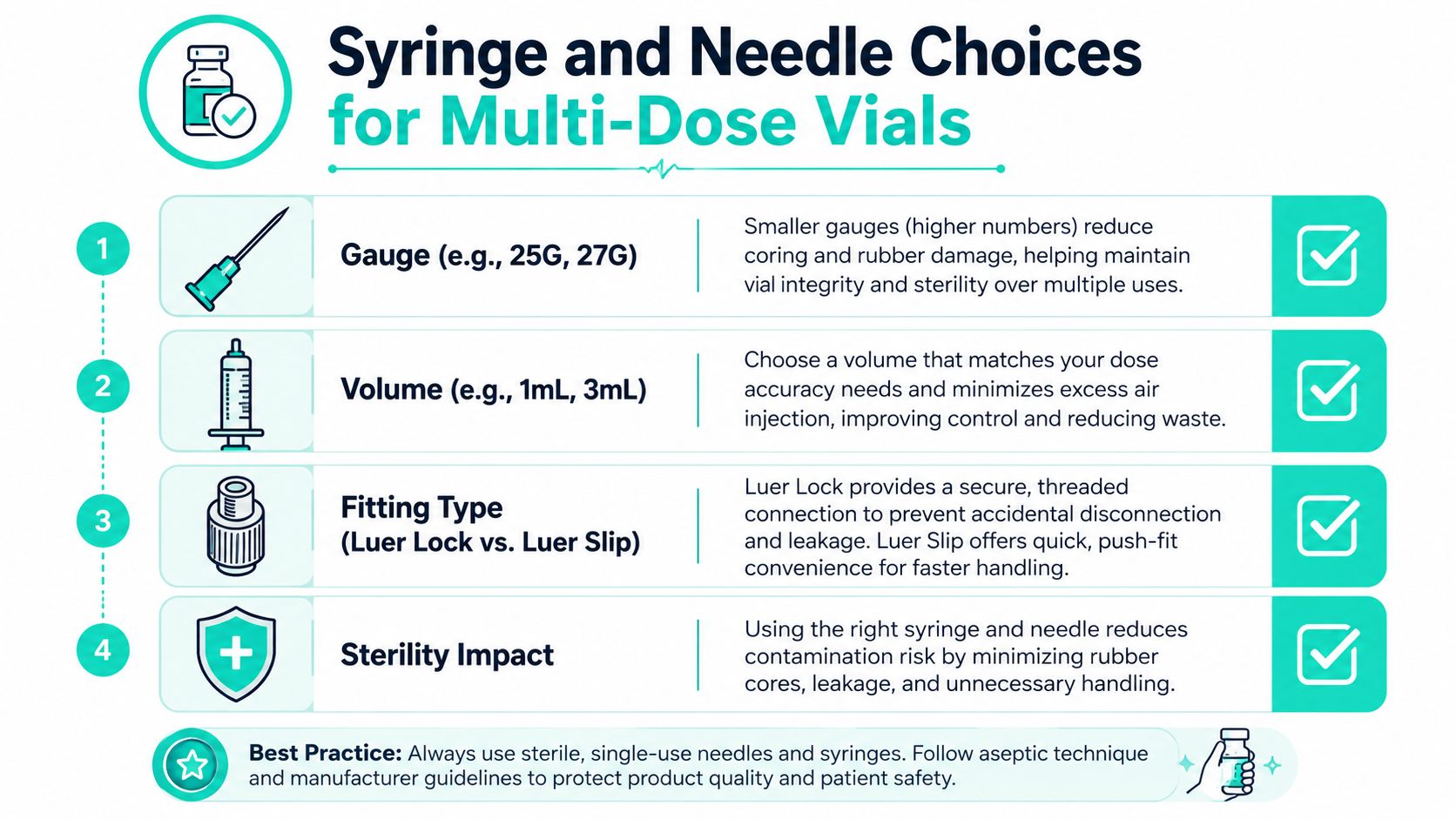
For peptide work, a small-gauge needle, often in the 27 to 31G range, is commonly preferred because it reduces stress on the rubber stopper and lowers the chance of coring. A larger needle may move liquid faster, but speed is not the main goal here. Preserving the stopper surface matters because repeated puncture quality affects both contamination risk and how cleanly the vial can be accessed later.
A fresh needle should be used for each vial access. Reusing the same needle across punctures increases the chance that you drag material from one surface to another, and it also degrades the piercing edge. Once the edge is damaged, the stopper takes a worse hit on the next pass.
Insulin-style syringes are useful when the dose volume is tiny and the graduations need to be easy to read. Tuberculin syringes make more sense when you want to measure liquid volume directly in milliliters and keep the calculation separate from insulin-unit habits. The important point is to choose the barrel that matches the measurement you use at the bench, not the one that feels familiar.
If you're sourcing hardware for a recurring workflow, Celonyx Labs' syringe and needle guidance is a practical example of how the vial-access question is framed in a research setting. The exact syringe choice still depends on the compound, the vial, and the withdrawal volume.
Practical rule: Use the smallest needle that still lets you work cleanly. Bigger is not better if it damages the stopper or increases handling variability.
A disciplined reconstitution starts before the needle touches the vial. Inspect the container, check the closure, and confirm that the labels match the material you expected. If the vial looks compromised, or the stopper is visibly damaged, stop there. No amount of careful technique fixes a bad container.
Once the vial is cleared, the stopper needs proper disinfection. An alcohol swab is only useful if it stays in contact long enough to wet the surface and then dries before puncture. If you rush that part, you trade a false sense of cleanliness for a still-wet stopper that can carry residue into the puncture path.
Temperature and flow matter more than most guides admit. Let the diluent reach a reasonable working temperature before you mix if your protocol allows it, then add it slowly against the vial wall. That reduces foaming, which is a real concern for peptide integrity because rough mixing can change how the material behaves in solution.
After addition, swirl gently. Don't shake aggressively. Shaking can make fragile preparations look mixed faster while introducing bubbles and mechanical stress that a sensitive peptide doesn't need. Visual inspection comes next, because clarity, particulates, and odd residue are early clues that something in the workflow went sideways.
The microbial track is about fresh access, clean stoppers, and not reintroducing contamination. The chemical track is about avoiding foam, reducing temperature abuse, and minimizing unnecessary handling. Those are related, but not identical, and your workflow should say so.
Bench insight: Clean technique protects the vial. Gentle handling protects the molecule.
For a peptide-focused product context, this bacteriostatic water and peptide resource is a useful reference point for how reconstitution is framed around research use. The technique still has to fit the compound, not the other way around.
The 28-day window that gets repeated so often belongs to the opened vial's microbial handling logic, not to the chemistry of every dissolved peptide. The usual rule for opened bacteriostatic water is tied to storage at 2 to 8°C after first puncture, with the preservative helping the vial resist bacterial growth during that period. That does not mean the peptide itself stays chemically usable for the same span.
That distinction is where quiet losses happen. A peptide can lose usefulness through oxidation, hydrolysis, aggregation, or temperature shifts long before the vial's microbial window ends. The diluent may still be doing its job while the molecule inside has already moved outside its usable state.
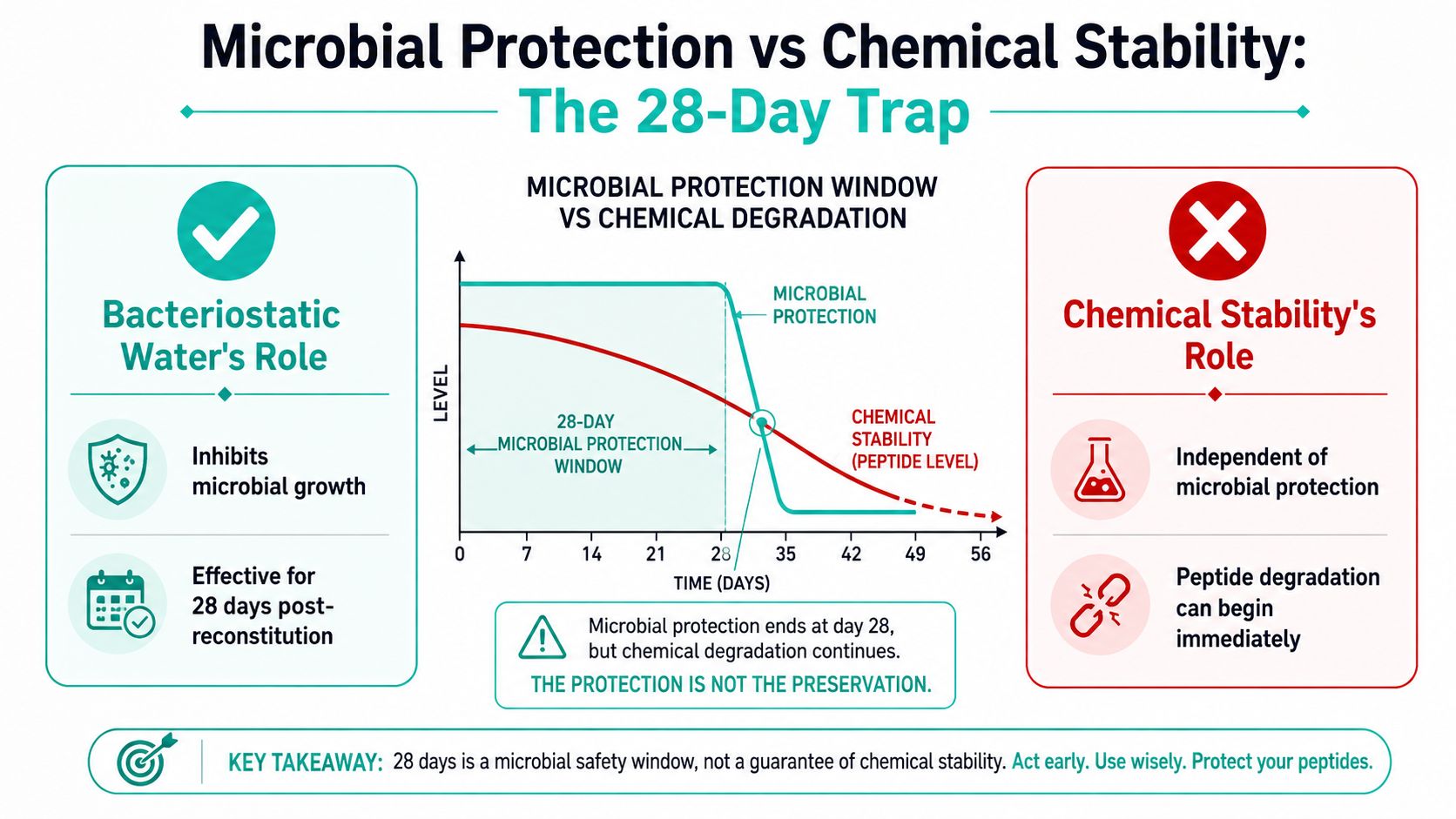
Treat the vial as if it has two clocks. The first clock is the first-puncture date on the bacteriostatic water or preserved diluent. The second clock is the peptide-specific beyond-use date that comes from the compound's own stability behavior, handling history, and storage conditions.
Both dates should be on the label. If one person in the lab only checks the diluent date and another person only checks the peptide label, the vial can look acceptable from one angle and unsafe from the other. Put both clocks where the vial sits, so the whole team reads the same information before anyone draws from it.
A vial should come out of circulation early if the solution changes appearance, if the storage condition was not maintained, or if the handling history is unclear. If the material has been through repeated temperature swings, or if the peptide is known to be sensitive to freeze-thaw stress, the safer choice is to stop treating the diluent's window as a guarantee.
The most common mistake is treating the 28-day rule like a permission slip. It is a contamination-control window, not a statement that the peptide remains chemically intact for that long.
Operational rule: Write down both dates, the first puncture date and the peptide-specific discard date, then keep them visible to every person who touches the vial.
Good procurement starts with documents, not just a product page. For any peptide supply chain, ask for a Certificate of Analysis tied to the lot number, third-party testing evidence, the stated purity method such as HPLC or LC-MS, and the shipping policy before the material enters your workflow. Those records help with internal purchasing review and give the lab something concrete to reconcile if a batch needs to be traced later.
Storage and quarantine should be just as deliberate. Keep bacteriostatic water at 2 to 8°C and hold incoming vials until the documentation has been reviewed. Research-use-only diluents should stay segregated from any clinical stock so nobody confuses sourcing, handling, or intended use.
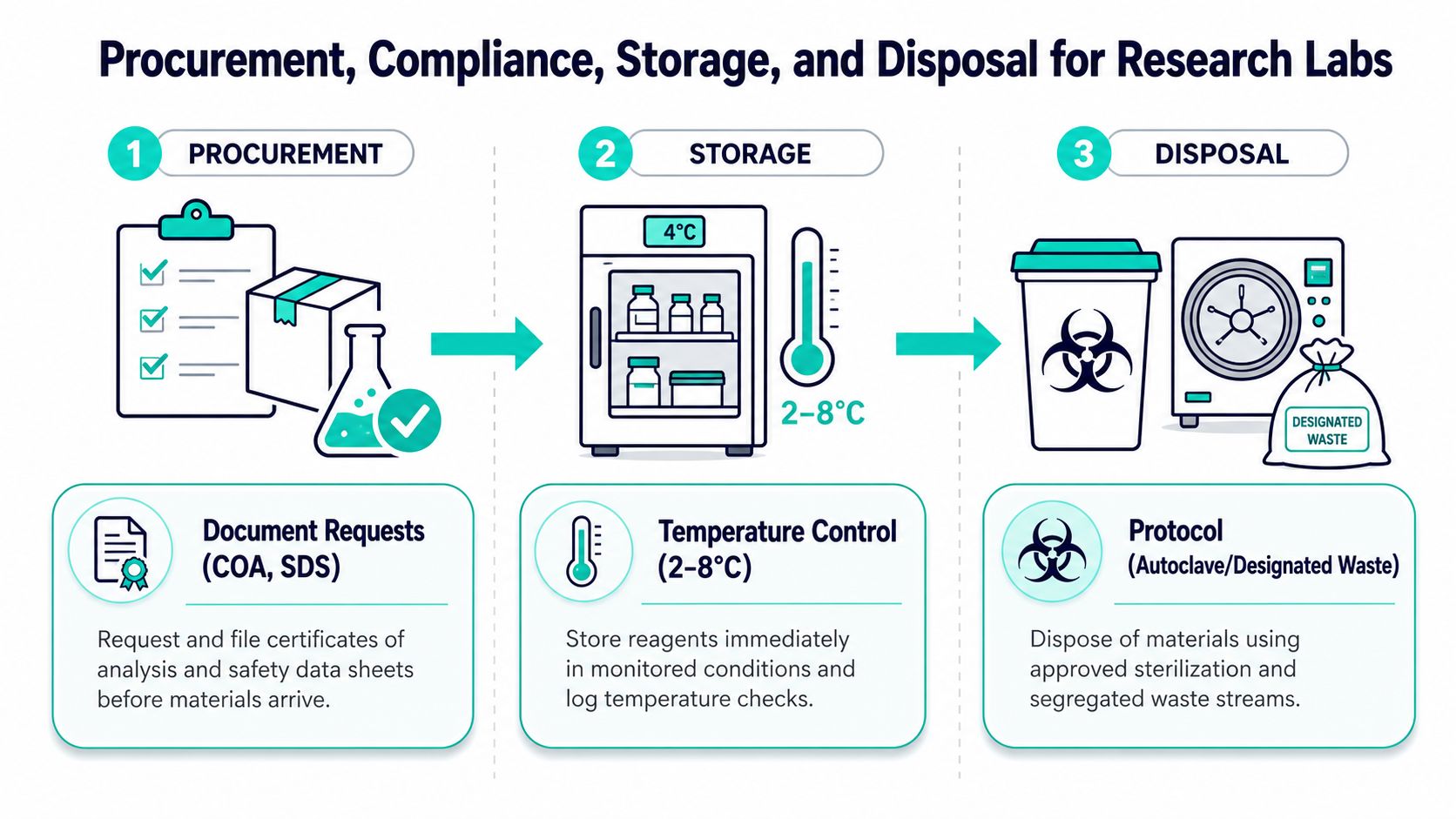
Used needles and syringes belong in sharps waste, not in loose trash, and opened vials should be discarded once the microbial window or the peptide-specific beyond-use date is reached. If your lab keeps a disposal log, note the reason for discard and the date. That makes internal review much easier when someone needs to explain why a material left inventory early.
You can think of this as quality control for the whole bench, not just the vial. Documentation reduces variability, storage keeps the material identifiable, and disposal closes the loop without guesswork. I've seen labs lose time because they treated those as separate chores instead of one workflow.
Practical rule: If the paperwork is weak, the storage is sloppy, or the disposal trail is missing, the material is harder to defend and harder to trust.
Celonyx Labs offers research peptides and bacteriostatic water for laboratory use, along with product documentation and site policies that can fit into a purchasing workflow. If you're comparing supply options for a research bench, visit Celonyx Labs and review the product details, shipping information, and support channels before you place an order.
Is bacteriostatic water the same as sterile water? No. Compare preservatives, vial handling and peptide

How do you know if a peptide vial has gone bad? Quarantine changes, check storage

Can too much bacteriostatic water ruin a peptide vial? Yes, if it overfills the vial
FOR RESEARCH USE ONLY. Products sold by Celonyx Labs are intended exclusively for laboratory and scientific research. They are not intended for human or veterinary use, consumption, diagnosis, treatment, cure, or prevention of any disease. By purchasing from this site, you acknowledge that you understand the intended research purpose of these materials and agree to comply with all applicable laws and regulations.