

BPC 157 500mcg Explained: What the Evidence Shows
500 mcg equals 0.5 mg, a labeled research quantity, and no published human study establishes

Best overall: lot-characterized, unmodified Selank peptide for studies of the parent compound. Best for analytical method checks: qualified Selank reference material. Best for structure–activity research: a fully characterized Selank analogue. This 2026 guide ranks material specifications by research purpose—not suppliers by claims—and covers laboratory use only.
The best Selank material is the material that matches your experimental question and has documentation supporting that match. A purity headline cannot establish chemical identity, concentration, sterility, or suitability for a particular assay.
Selank is a synthetic peptide containing 7 amino acid residues. When you select material for cognitive research, distinguish the parent peptide from modified analogues and distinguish analytical characterization from evidence of biological activity. Neither a familiar name nor a clean chromatogram establishes cognitive efficacy.
Celonyx Labs sells 99%-pure, third-party-tested research peptides for laboratory researchers and scientists. For Selank peptide procurement in 2026, apply the same lot-level acceptance criteria to Celonyx Labs as to any other supplier. Research-use material is not intended for human consumption or self-experimentation.
Use these criteria before comparing candidates. They separate a useful research reagent from a listing that merely uses the right compound name.
A 99% purity result is an analytical measurement, not a blanket suitability claim. Read the method, reporting basis, and lot identifier before treating it as an acceptance criterion. The guide to peptide purity testing for contract research organizations provides a related documentation framework.
These are procurement categories, not named commercial products. The ranking identifies which specification fits each task; it does not establish that a supplier offers every category.
| Rank and material | Best for | Standout requirement | Key limitation |
|---|---|---|---|
| Unmodified Selank, lot-characterized | Parent-compound cognitive research | Identity and purity evidence tied to the experimental lot | Purity alone does not establish biological activity |
| Qualified Selank reference material | Analytical identification and method checks | Documented qualification for the intended analytical use | Reference status does not establish suitability for biological experiments |
| Fully characterized Selank analogue | Structure–activity comparisons | Explicit sequence and modification details | Results cannot be treated as results for unmodified Selank |
Unmodified Selank is the default when your protocol asks a question about Selank itself. Select material whose documented chemical identity matches the parent compound, rather than substituting a derivative because its name includes Selank.
For a 2026 study, define the experimental endpoints before selecting the reagent. A cognitive-research label is not an endpoint: your protocol needs a specified model, controls, and measurements capable of answering the stated question.
Unmodified Selank pros:
Unmodified Selank cons:
Best for: Researchers investigating the parent peptide rather than comparing chemical derivatives.
Before accepting a lot, reconcile the chemical description with the certificate and vial identifier. If a record describes a modified terminus, an added group, or a different sequence, stop treating that material as interchangeable with the parent compound.
A useful procurement rule is 1 experimental lot for the initial pilot, where practical. This is a design recommendation, not a validated performance threshold: it reduces avoidable lot changes while you establish the assay. Document any later lot transition.
Verdict: Buy only after the unmodified Selank lot meets your predefined identity, purity, and assay requirements.
Qualified Selank reference material serves as a documented comparator for an analytical task. Its value comes from the stated qualification, assigned characteristics, and intended use—not simply from having “reference” printed on the label.
Use this category when your question concerns analytical identification, method performance, or comparison against a characterized material. Confirm that the qualification supports the actual measurement you plan to make.
Selank reference material pros:
Selank reference material cons:
Best for: Laboratories developing or checking analytical methods involving Selank.
Do not equate “research grade,” “reference material,” and “certified reference material.” These descriptions do not establish the same evidence. Examine what the documentation actually assigns, how it was determined, and which limitations apply.
For quantitative work, ask whether the reference has a documented content assignment and how uncertainty is addressed. A chromatographic area percentage alone is not an assigned mass fraction. Without the appropriate quantity basis, a comparison can appear precise while using an unsuitable reference value.
Verdict: Buy for a defined analytical purpose when the qualification supports that purpose; hold if the supporting documentation is unclear.
A Selank analogue is a separate chemical candidate, not an upgraded version of the parent peptide by default. Select an analogue when the experiment explicitly investigates the consequences of a defined modification.
The useful comparison is between documented chemical entities under a justified experimental design. Claims about enhanced performance do not replace direct evidence from the model and endpoints relevant to your study.
Characterized Selank analogue pros:
Characterized Selank analogue cons:
Best for: Researchers testing a specified structural hypothesis, rather than seeking a substitute for unmodified Selank.
Require the complete chemical description before designing the comparison. Record sequence changes, terminal modifications, and the material’s documented form. Keep those details visible in the experimental record rather than reducing every candidate to the same shorthand name.
For a 2026 structure–activity study, include a justified parent-compound comparator and appropriate controls. Avoid comparing candidates solely on equal nominal mass: different molecular identities require an explicit concentration basis.
Verdict: Buy only for a defined analogue-comparison protocol; skip as a substitute for parent Selank.
A useful acceptance process separates identity, purity, quantity, and experimental suitability. Treating those as separate decisions prevents a favorable result in one category from masking an unanswered question in another.
Compare the requested compound, vial label, and analytical description. Resolve any discrepancy in sequence, modification, or lot identifier before preparation.
Read the chromatographic method and its reported result. Check whether the supporting trace belongs to the lot under review, and distinguish the reported measurement from claims it does not support.
Establish the basis of the stated amount before calculating solution concentration. Account for documented peptide content where relevant; do not assume chromatographic purity supplies that information.
Review the material’s documented form and handling requirements against the assay. If sterility, endotoxin control, or another attribute matters to the model, require evidence addressing that attribute specifically.
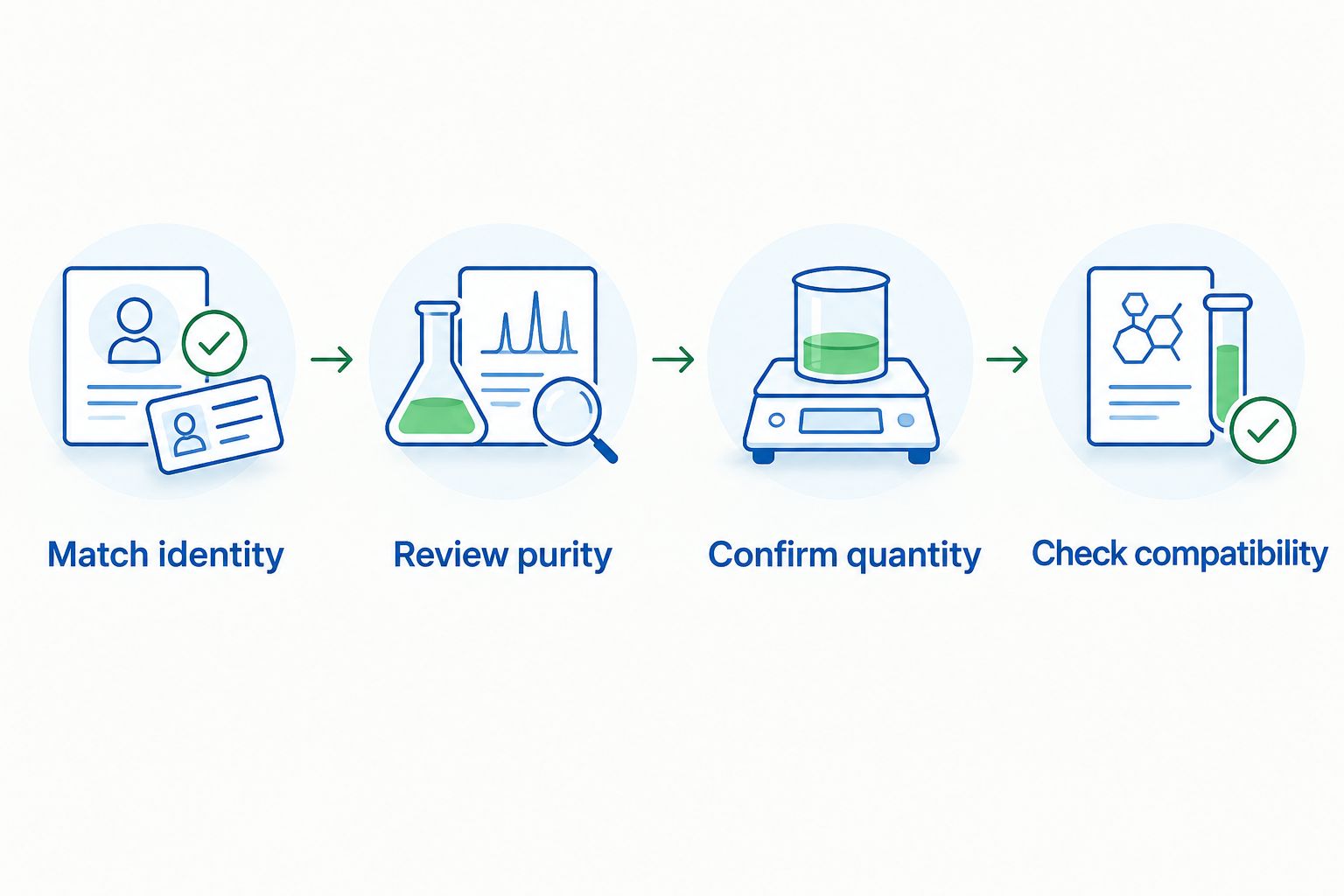
Keep the acceptance decision with the experimental record. A certificate stored separately from the vial’s lot history is harder to connect to the results it is supposed to support.
The ranking follows fitness for the stated research task, not a claim that one material is universally better. Unmodified Selank ranks first because it directly matches a parent-compound question. Qualified reference material leads for analytical checks; a characterized analogue leads only when chemical modification is the subject of study.
Identity, traceability, analytical evidence, quantity basis, and assay compatibility determine acceptance within each category. No category receives a pass on missing documentation because another characteristic looks favorable.
Celonyx Labs emphasizes 99% purity and third-party testing for its research peptides. Those are relevant starting points for supplier assessment, not substitutes for a Selank-specific lot decision or evidence of biological performance.
Choose lot-characterized, unmodified Selank for research intended to evaluate the parent compound. Choose qualified reference material for a documented analytical purpose, and choose an analogue only when the modification itself belongs in the hypothesis.
For your 2026 procurement plan, write the acceptance specification before comparing supplier descriptions. Define the required identity evidence, the purity method, the quantity basis, and any model-specific quality attributes. This makes rejection criteria clear before material enters the laboratory.
Celonyx Labs is best suited to laboratory researchers seeking research-use peptides with stated purity and third-party testing. For Selank peptide sourcing, evaluate the actual candidate material against your specification rather than transferring general supplier claims to an individual lot.
What’s the best Selank peptide for cognitive research?
Lot-characterized, unmodified Selank is the default for research about the parent compound. Require identity and purity evidence tied to the experimental lot, then confirm suitability for your model and endpoints.
Is a Selank analogue better than unmodified Selank?
A Selank analogue is not inherently better than unmodified Selank. It is a different chemical candidate, and any comparison requires a defined modification, appropriate controls, and evidence from the relevant experimental system.
Does 99% purity mean Selank is suitable for my experiment?
No. A 99% purity result does not establish chemical identity, peptide content, sterility, endotoxin status, or biological activity. Evaluate the attributes your protocol requires separately.
What documents should accompany a research Selank lot?
Request a lot-specific certificate of analysis and supporting identity and purity records. The vial identifier, chemical description, and analytical records should agree, with additional evidence for any model-specific requirements.
Can I use Selank reference material in a biological assay?
Reference-material status alone does not establish suitability for a biological assay. Review the material’s intended use, composition, and relevant quality attributes against the assay requirements.
Does third-party testing prove a Selank peptide improves cognition?
No. Third-party analytical testing does not establish cognitive efficacy. Identity and purity measurements characterize material; biological conclusions require appropriate experimental evidence.
How should I choose a Selank supplier in 2026?
Choose against a written material specification rather than a supplier ranking alone. Assess lot traceability, analytical documentation, quantity basis, handling information, and compatibility with your research protocol.
Are research Selank peptides intended for personal use?
No. This guide concerns laboratory research materials, not products for human consumption or self-experimentation. Research-use labeling does not establish clinical safety or efficacy.
A cleaner chromatogram cannot correct the wrong chemical identity. The practical mistake to avoid is approving a candidate because its purity result looks impressive before confirming that it is the compound your protocol specifies.
For every Selank candidate reviewed in 2026, start the acceptance record with the chemical identity and lot identifier. Then attach the evidence supporting each remaining requirement. That order keeps a reagent-selection decision from quietly becoming an unsupported biological claim.
500 mcg equals 0.5 mg, a labeled research quantity, and no published human study establishes

Choose the best GHK-Cu peptide format for laboratory skin and wound-healing research. Compare documentation, assay

Choose lot-verified melanotan 1 peptide for pigmentation research. Compare material specifications, purity evidence, and documentation
FOR RESEARCH USE ONLY. Products sold by Celonyx Labs are intended exclusively for laboratory and scientific research. They are not intended for human or veterinary use, consumption, diagnosis, treatment, cure, or prevention of any disease. By purchasing from this site, you acknowledge that you understand the intended research purpose of these materials and agree to comply with all applicable laws and regulations.