

How to Get Tesamorelin for Research Safely and Legally
A common shortcut says that you can find tesamorelin by searching online and choosing a
The most popular advice about BPC-157 capsules is usually the least useful: choose a convenient oral form, match its labeled milligrams to an injectable protocol, and assume that a high-purity claim predicts biological performance. A laboratory can't make those assumptions. A capsule is a formulation, a delivery system, and a potential source of experimental variability, not merely a smaller vial.
BPC-157 remains an investigational, non-approved substance. The available human record doesn't establish oral efficacy, a validated dose, oral bioavailability, or long-term safety. For laboratories, the practical question isn't whether online claims sound persuasive. It's whether the material's identity, formulation, storage history, and delivered exposure are documented well enough to support a defensible experiment.
BPC-157 has attracted substantial preclinical interest, particularly through animal and non-oral research. That interest matters for hypothesis generation, but it doesn't establish that a capsule is safe or effective in humans. A 2025 narrative review indexed by the NIH identified only three published pilot studies in humans, involving intra-articular treatment for knee pain, interstitial cystitis, and intravenous safety or pharmacokinetic investigation. Those small studies don't support clinical recommendations for oral capsules.
The boundary is straightforward:
BPC-157 capsules don't currently cross that boundary. Much of the frequently cited literature involves animals or administration routes other than oral capsules, so researchers shouldn't transfer those findings directly to a commercial capsule. Claims about healing, gastrointestinal benefits, or enhanced recovery also lack a validated clinical dosage standard.
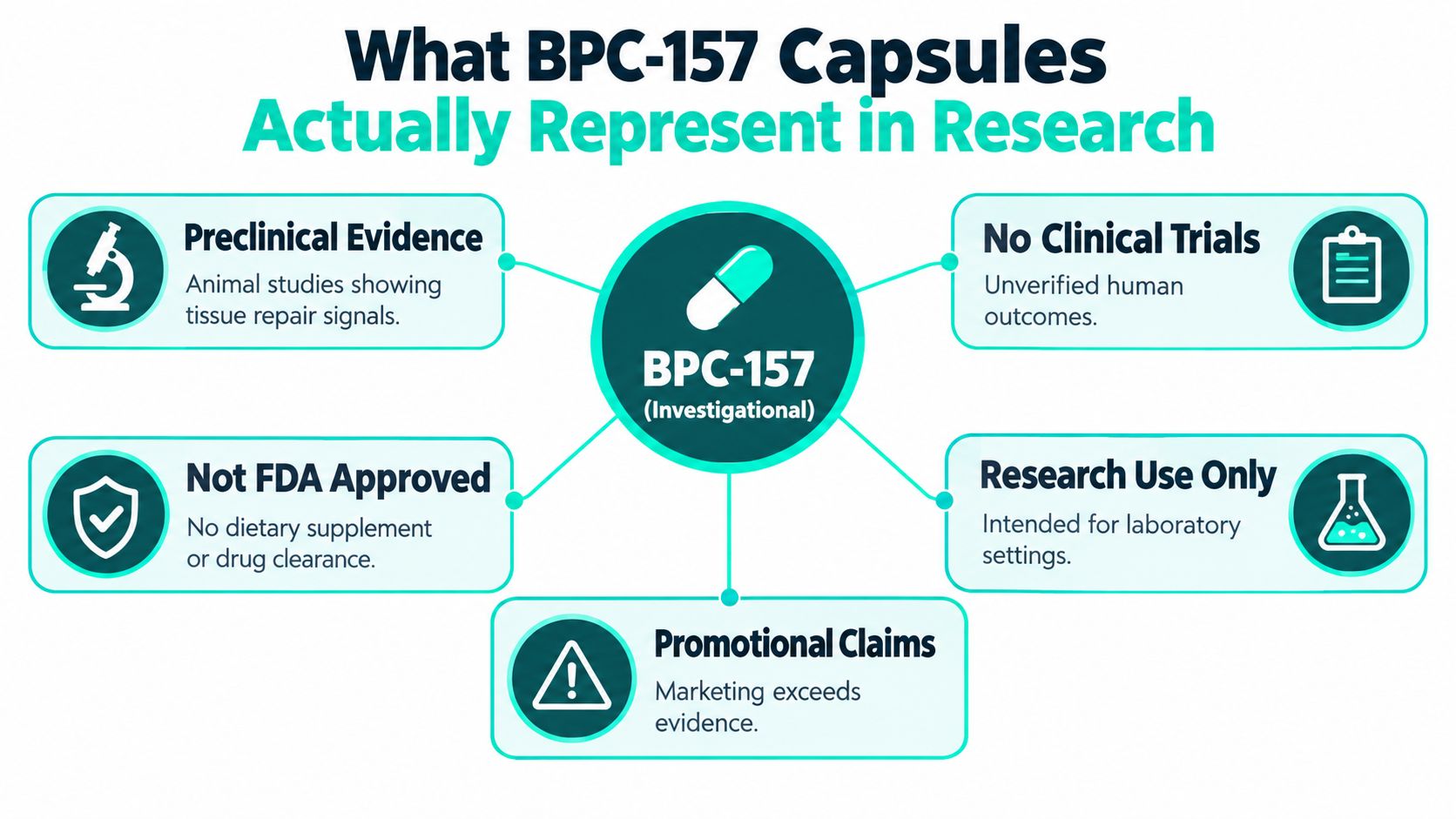
The World Anti-Doping Agency's prohibited-substance framework places BPC-157 in category S0, the class for non-approved substances, prohibited both in and out of competition. A 2023 FDA action also identified concerns about bulk BPC-157 substances used in compounding. That action is a safety and regulatory concern, not authorization for capsules or other human products.
For a laboratory, “research use only” should describe the material's intended context, not imply therapeutic legitimacy. A product page may be useful for locating a supplier, but it isn't evidence of clinical validation. Before procurement, record the exact product description, batch documentation, analytical method, intended model, and institutional requirements.
Practical rule: Treat every capsule as an experimental formulation whose performance must be demonstrated, not presumed from injection literature.
A useful starting point for product-specific terminology and research context is BPC-157 peptide information, but supplier material should complement, never replace, primary evidence and laboratory controls.
A certificate of analysis, or COA, is the minimum documentation for a research peptide. It isn't a guarantee that the experiment will work. It establishes whether the supplier has tied a tested material to a defined batch and disclosed enough information for a laboratory to assess what it received.
A generic statement such as “high purity” is weak evidence. Even a headline purity value doesn't answer several questions:
The analytical certificate characterizes the supplied material. It doesn't establish human efficacy, pharmacokinetics, long-term toxicity, regulatory approval, or capsule performance. A purity assay also can't prove that the labeled amount survives digestion or reaches a target compartment.
For capsule procurement, request the COA before ordering rather than after a shipment arrives. Compare the document with the product label, invoice, and internal purchase record. If the supplier provides a certificate that applies only to a representative batch, ask whether the tested lot is the one being supplied.
| COA element | Why it matters |
|---|---|
| Lot number and product identifier | Connects the report to the physical material |
| Assay and purity method | Defines what the reported result actually measures |
| Identity confirmation | Reduces the risk of substituted or misidentified material |
| Impurity and contaminant scope | Shows what the laboratory has and hasn't evaluated |
| Testing laboratory and date | Supports traceability and audit review |
| Storage or handling notes | Helps interpret whether the result remains relevant after shipment |
Laboratories should also apply the same documentation discipline used for other controlled inputs. A concise GMP operating discipline guide can help teams formalize responsibilities, records, deviation handling, and supplier oversight without treating a COA as a substitute for a quality system.
For additional batch-level documentation, review the supplier's peptide test results. The useful question isn't “Does this product claim purity?” It's “Can we connect this precise lot to an appropriate test, a defined method, and a documented chain of custody?”
A sound COA can describe material at release, but poor handling can change the material before the experiment begins. Capsules add complexity because the active peptide is combined with a shell, excipients, and a formulation intended to pass through a particular environment. The laboratory should therefore preserve the product in the condition specified by the supplier and record any departure from that condition.
Don't invent a storage range when the supplier hasn't validated one. The purchase record should capture the stated temperature, light protection, humidity requirements, shipping conditions, and shelf-life information. If those details are missing, ask the vendor before accepting the material into a study.
At receipt, inspect the outer packaging and container, then document:
Reconstitution introduces a separate stability question. A capsule isn't automatically equivalent to a lyophilized vial, and a solution prepared from capsule contents may behave differently from a formulation designed for solution use. Don't infer solution stability from dry-material stability. Establish the vehicle, concentration, mixing procedure, light exposure, storage interval, and analytical checks in the protocol before beginning.
Keep procurement records, storage records, and study records connected. A result is difficult to interpret when the laboratory can't reconstruct which lot was used or how it was handled.
Shipping also deserves technical attention. Temperature excursions, customs delays, and packaging failures can affect the material or invalidate a planned run. Teams that order internationally may benefit from guidance on managing pharmaceutical shipping rules, while still confirming the requirements that apply to their own jurisdiction and institution.
Supplier selection should begin with evidence, not a product catalog. A professional vendor can explain what was tested, which lot the result applies to, how the material is packaged, what shipping conditions are used, and whom the laboratory can contact when documentation doesn't match the shipment.
A supplier that only offers a purity headline creates work for the buyer. A supplier that provides traceable records allows the laboratory to evaluate risk before committing samples, animals, assay time, or personnel.
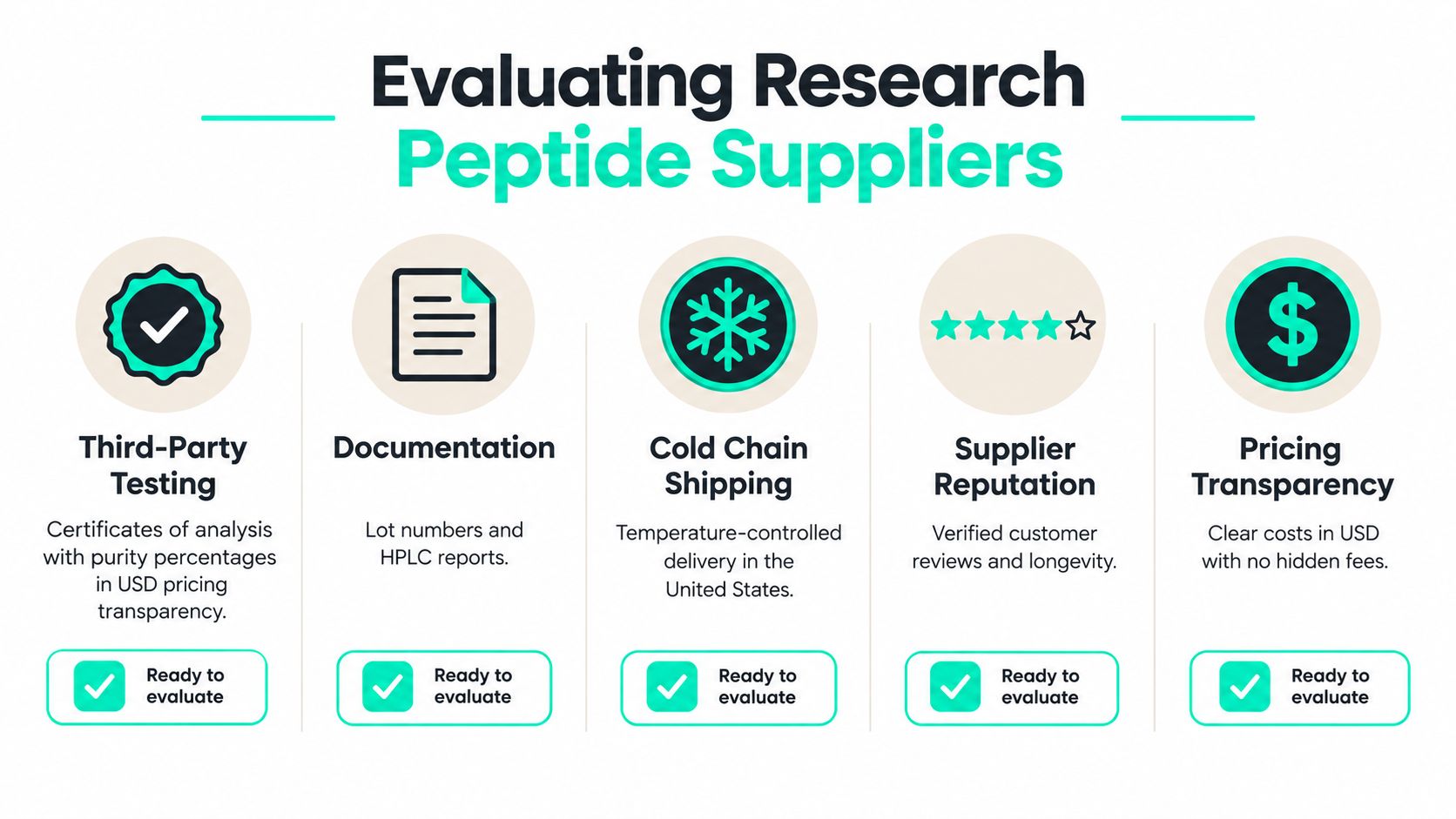
Use a short qualification form and send identical questions to each supplier. Responsiveness isn't proof of product quality, but vague answers about testing or lot traceability are meaningful procurement signals.
| Evaluation Criterion | Minimum Standard | Best Practice Indicator |
|---|---|---|
| COA availability | A document is supplied for the ordered material | The COA identifies the lot and includes methods, identity, and contaminant scope |
| Batch traceability | Product, shipment, and report can be matched | The supplier maintains records that support an audit trail |
| Testing methodology | The supplier names the analytical approach | Reports include enough method detail for scientific review |
| Identity confirmation | Identity is addressed separately from purity | Mass spectrometry or an equivalent fit-for-purpose method is documented |
| Shipping controls | Packaging and delivery conditions are described | The supplier explains excursion handling and receipt procedures |
| Customer support | A named contact responds to technical questions | Staff can answer documentation and batch-specific questions directly |
| Policies and records | Terms, returns, and shipping information are available | Public policies align with institutional purchasing and recordkeeping |
Ask whether the supplied capsule is an enteric-coated or uncoated preparation, what peptide form is present, which excipients are used, and whether the vendor has stability data for the finished formulation. Ask separately whether the laboratory can obtain intact-peptide measurements. These questions distinguish a capsule as a defined research formulation from a labeled mass inside a consumer-style container.
Don't use online reviews as a substitute for analytical records. Reputation can indicate operational consistency, but it can't confirm sequence identity or absorption. Content teams and suppliers sometimes publish polished educational material, so laboratories should also understand how promotional claims are communicated. Guidance on SEO playbooks for pharmacy sites is relevant here because visibility and scientific validation are separate issues.
Before placing an order, document the decision rationale, approved supplier, expected records, and acceptance criteria. A practical guide to buying peptides can help organize the purchasing workflow, but the principal investigator or responsible scientist should approve the final specification.
A capsule can contain the correct nominal mass and still fail to deliver the expected experimental exposure. The compound must remain intact, move through the relevant gastrointestinal environment, cross a biological barrier if systemic activity is hypothesized, and reach the intended compartment in a measurable form. Each stage is a separate experimental variable.
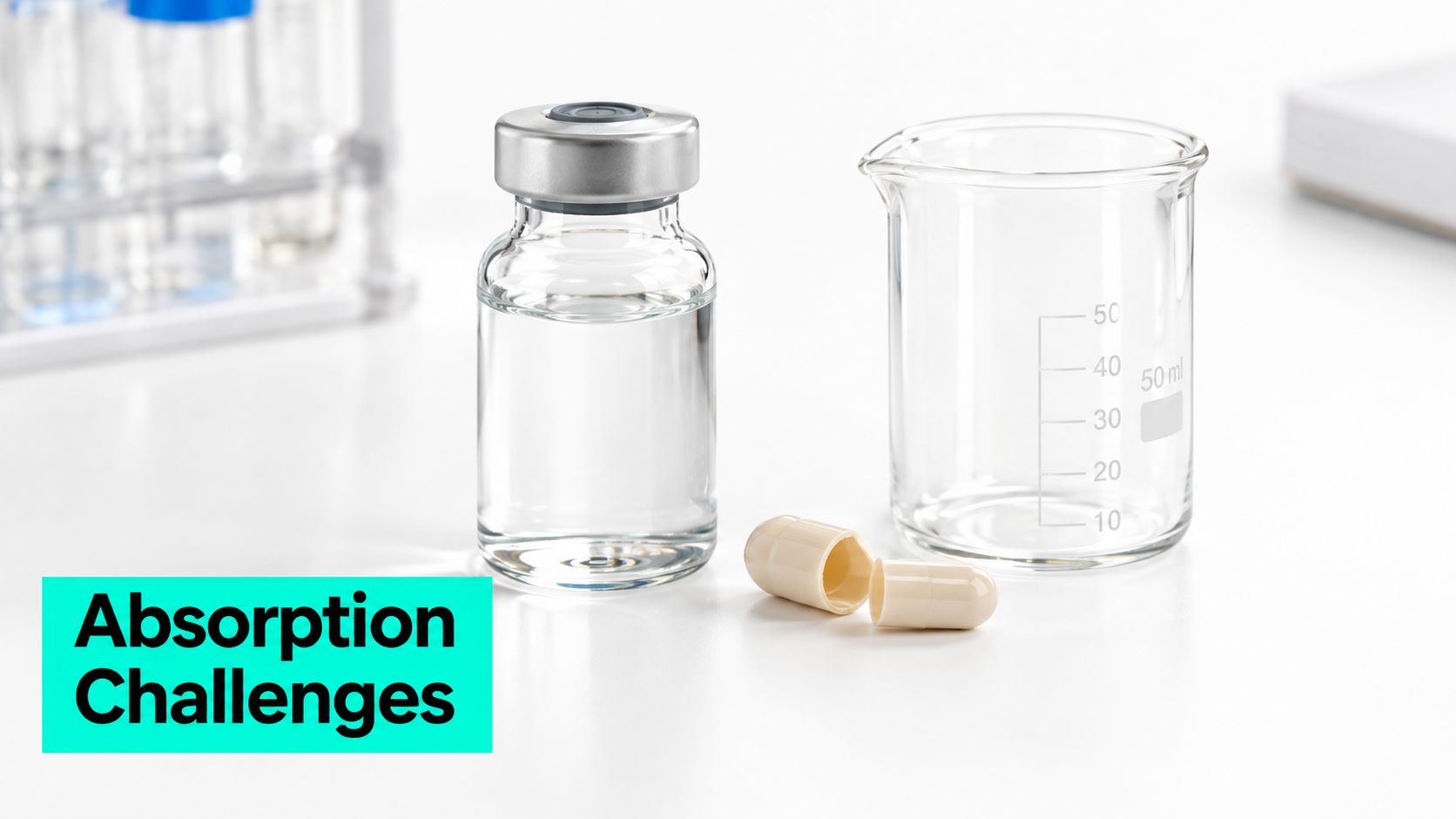
The oral evidence gap is unusually important. An NIH-indexed review reports that published studies haven't characterized BPC-157 stability in simulated intestinal fluid, permeability using Caco-2 or PAMPA models, or hepatic extraction. It therefore concludes that conventional uncoated oral preparations are unlikely to produce clinically relevant systemic exposure without specialized absorption-enhancing or locally acting formulations. That conclusion doesn't prove that every capsule fails. It shows that the formulation question remains unresolved.
Consider two hypothetical experiments. Laboratory A compares an oral capsule with an injection and interprets an absent systemic signal as biological inactivity. Laboratory B first characterizes intact peptide under relevant digestive conditions, measures plasma exposure, and distinguishes local gastrointestinal effects from systemic exposure. The second design can tell whether a negative result reflects the molecule, the formulation, the analytical method, or the route.
Researchers should specify:
Animal exposure data also require species-specific caution. A FDA review of BPC-157 reported substantially different intramuscular bioavailability ranges between rats and dogs, illustrating why one species' exposure estimate can't be treated as a universal conversion factor. The same logic applies to capsules. Administered milligrams don't establish absorbed milligrams.
A certificate of analysis may confirm identity and purity of the supplied material, but it won't answer whether intact BPC-157 survives digestion. If systemic activity is part of the hypothesis, use validated bioanalytical measurement rather than relying only on the label.
A reliable procurement process treats BPC-157 capsules like any other critical reagent with unresolved performance characteristics. Start with a written specification that identifies the peptide form, capsule type, excipients, required COA fields, identity method, impurity scope, shipping conditions, and acceptance criteria.
At receipt, reconcile the lot number against the order and COA, inspect the packaging, record the shipment condition, and quarantine discrepancies. Store the material according to documented supplier instructions, maintain an access and opening record, and link every experimental result to the exact lot.
Before the first study, define the controls and analytical endpoints. If the hypothesis involves systemic activity, plan for exposure measurement. If the hypothesis concerns a local gastrointestinal effect, state that explicitly and avoid using injection-based assumptions as the comparator. Record formulation changes as experimental changes, not administrative details.
Procurement principle: The supplier's label tells you what was intended to be delivered. Your analytical plan must determine what was actually delivered and exposed to the model.
Finally, keep supplier communication, deviations, storage records, test results, and disposition decisions in one controlled file. This discipline won't turn an investigational capsule into an approved medicine, but it will prevent an undocumented formulation from becoming the explanation for an irreproducible result.
Celonyx Labs supplies research peptides to laboratories and investigators through an online catalog, with product documentation, independent third-party testing claims, shipping information, and customer support for procurement questions. Review the available materials and contact Celonyx Labs to evaluate whether its sourcing and documentation process fits your laboratory's requirements.
A common shortcut says that you can find tesamorelin by searching online and choosing a

Choose the best KPV peptide by research model. Compare identity, purity, endotoxin documentation, and vehicle

Choose full-length thymosin beta-4 peptide for native-molecule research. Compare fragments and reference standards, then check
FOR RESEARCH USE ONLY. Products sold by Celonyx Labs are intended exclusively for laboratory and scientific research. They are not intended for human or veterinary use, consumption, diagnosis, treatment, cure, or prevention of any disease. By purchasing from this site, you acknowledge that you understand the intended research purpose of these materials and agree to comply with all applicable laws and regulations.