
BPC 157 Powder: A 2026 Research Guide
A 2025 review of BPC-157 identified 36 relevant studies, 35 preclinical and only 1 clinical.
A 2025 review of BPC-157 identified 36 relevant studies, 35 preclinical and only 1 clinical. That imbalance is the starting point for understanding BPC 157 powder: a material can attract substantial laboratory interest without becoming an established medicine.
For investigators, the practical question isn't whether a vial looks professional or carries an impressive purity claim. It's whether the material's identity, analytical documentation, handling history, and permitted use support the experiment you're planning.
Three human studies. Thirty participants. That is the human evidence base described in a systematic review of human BPC-157 studies, which rated the evidence very low certainty because of bias, indirectness, and imprecision.
BPC-157 is a synthetic peptide investigated primarily in preclinical models. That research history explains scientific interest, while leaving treatment protocols for people unestablished. A purchasing decision should preserve that distinction rather than turn a supplier's description into a clinical conclusion.
The literature includes tendon, muscle, gastrointestinal, nerve, and wound-healing models. These are different experimental settings, and a positive signal in one does not automatically transfer to another. Investigators still need to ask what researchers measured, in which species, under which conditions, before deciding whether a finding helps justify another experiment.
A useful evidence review separates biological findings from material characterization and regulatory status. Each answers a different question.
What current evidence allows a lab to conclude
| Evidence | What was reported | Fair conclusion |
|---|---|---|
| 2025 literature review | Mostly animal and other preclinical work, with little human data | Experimental material, not a validated therapy |
| Human study set in a systematic review | Small studies rated very low certainty | No adequate basis for an efficacy or safety claim |
| Animal pharmacokinetics | Results differ by route, species, and timing | Route, species, and timing aren't interchangeable |
| U.S. regulatory status | Research peptide descriptions sit outside approved-drug and compendial frameworks | A purity percentage is composition data, not approval |
Bias means the way participants were selected, treated, or assessed could influence the apparent result. Indirectness means the evidence does not closely answer the intended clinical question. Imprecision means the available observations leave substantial uncertainty about the actual effect.
A report without treatment-related adverse events is therefore not equivalent to a reliable safety demonstration. Researchers need enough observation, appropriate comparators, and methods designed to detect harm before drawing reassuring conclusions.
Evidence boundary: A favorable result in an experimental model supports a research question. It does not supply a human treatment recommendation.
Wound-healing language is easy to overread. Tissue repair involves local conditions, the underlying injury, circulation, and other factors that a single experimental endpoint cannot fully represent.
For clinical context, Vein and Wound Institute's resource on improving tissue oxygenation for wound healing helps distinguish a real wound-care consideration from claims about an experimental peptide. Treat it as context for perfusion and wound care, separate from any inference that BPC-157 corrects impaired perfusion or improves human wound outcomes.
An animal tendon experiment carries the same limits. The injury model, administration route, exposure, and outcome measures all affect what an investigator can reasonably infer. Converting an animal regimen into personal-use instructions would skip the work needed to establish human pharmacology and safety.
For procurement, keep these questions separate:
A BPC-157 peptide overview can help orient a reader to terminology, while a product page still leaves critical appraisal and method completion to the laboratory.
The defensible conclusion is deliberately narrow: BPC-157 powder is an experimental research material whose identity, assay limits, storage sensitivity, and lot documents must support the exact experiment being proposed.
A researcher receives a vial labeled BPC-157 and plans to prepare a working solution. Before selecting a solvent or calculating concentration, the researcher needs to establish what the vial contains.
BPC-157 has the sequence Gly-Glu-Pro-Pro-Pro-Gly-Lys-Pro-Ala-Asp-Asp-Ala-Gly-Leu-Val, a chain of 15 amino acids. It's described as a synthetic fragment associated with a larger gastric peptide, not as a finished biological preparation.
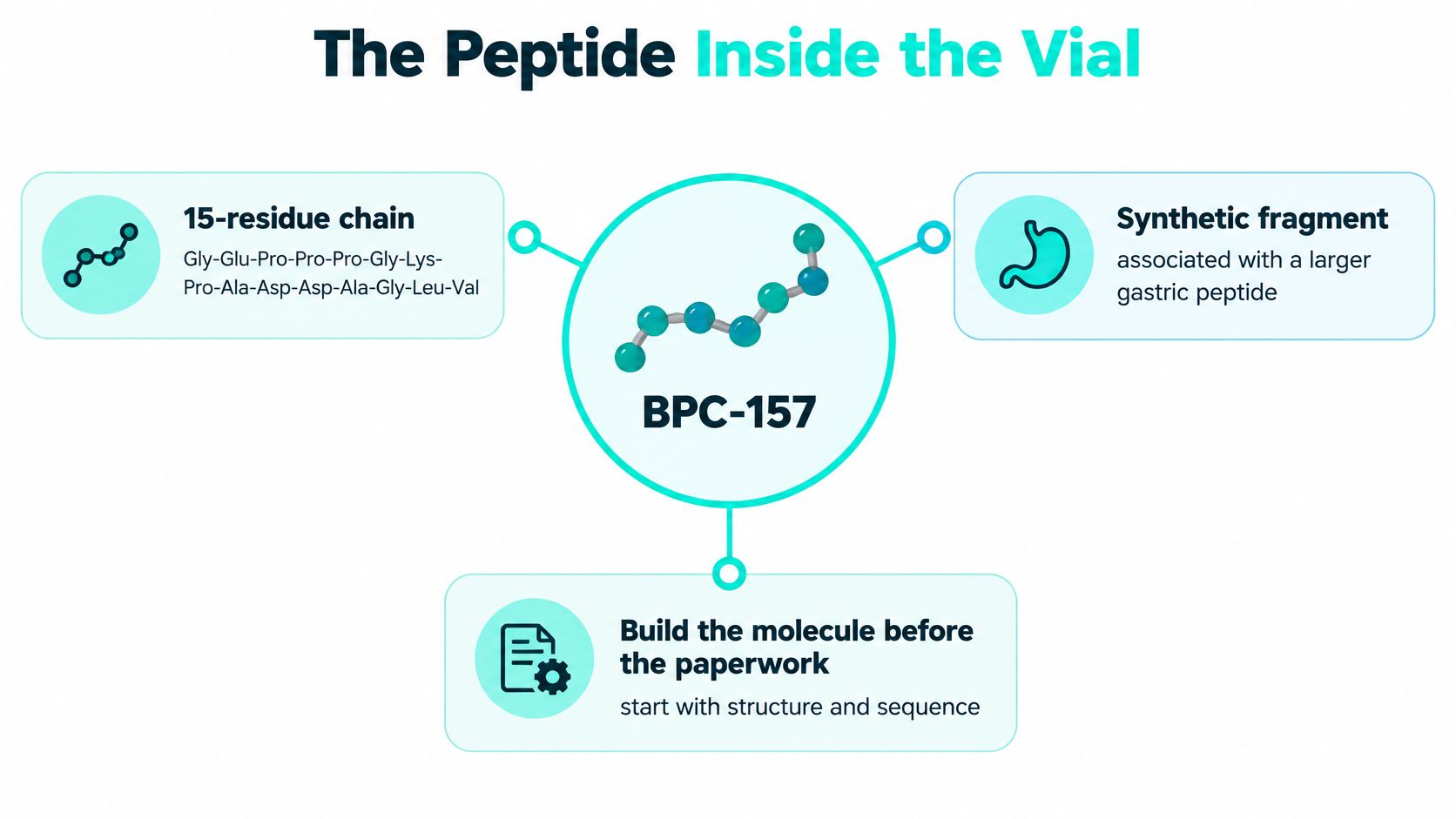
Think of the powder as measured ingredients rather than a finished dish. The experimental method must still define the solvent, working concentration, container, model, and conditions under which the preparation will be evaluated.
Free base and acetate are distinct material descriptions. A certificate for one shouldn't be assumed to characterize the other. The purchase specification, vial label, and analytical report should identify the same form.
Gross powder mass also isn't automatically peptide content. Water, counterions, and residual solvents can contribute to the weighed material, so a calculation based only on the label may not establish the concentration needed for quantitative work.
That distinction matters when an investigator compares exposures between experiments. A preparation can have an apparently acceptable chromatogram while still requiring a separate content measurement.
In the animal pharmacokinetic study of prototype BPC-157, elimination half-life was less than 30 minutes in rats and beagle dogs, while intramuscular absolute bioavailability was approximately 14–19% in rats versus 45–51% in beagles; investigators used reverse-phase HPLC coupled to electrospray tandem mass spectrometry with a validated calibration range of 4–4,000 ng/mL.
Those findings describe a defined analytical and experimental system. They aren't properties that can be assigned to any vial with the same name.
For a laboratory developing a comparable method, the immediate tasks are concrete:
Matching an expected molecular mass supports identity, but doesn't independently establish the complete sequence or exclude every structural impurity. Chromatography and mass analysis provide complementary information.
The relevant question isn't merely whether the powder is BPC-157. It's whether the laboratory has enough characterization to know what it is introducing into its model.
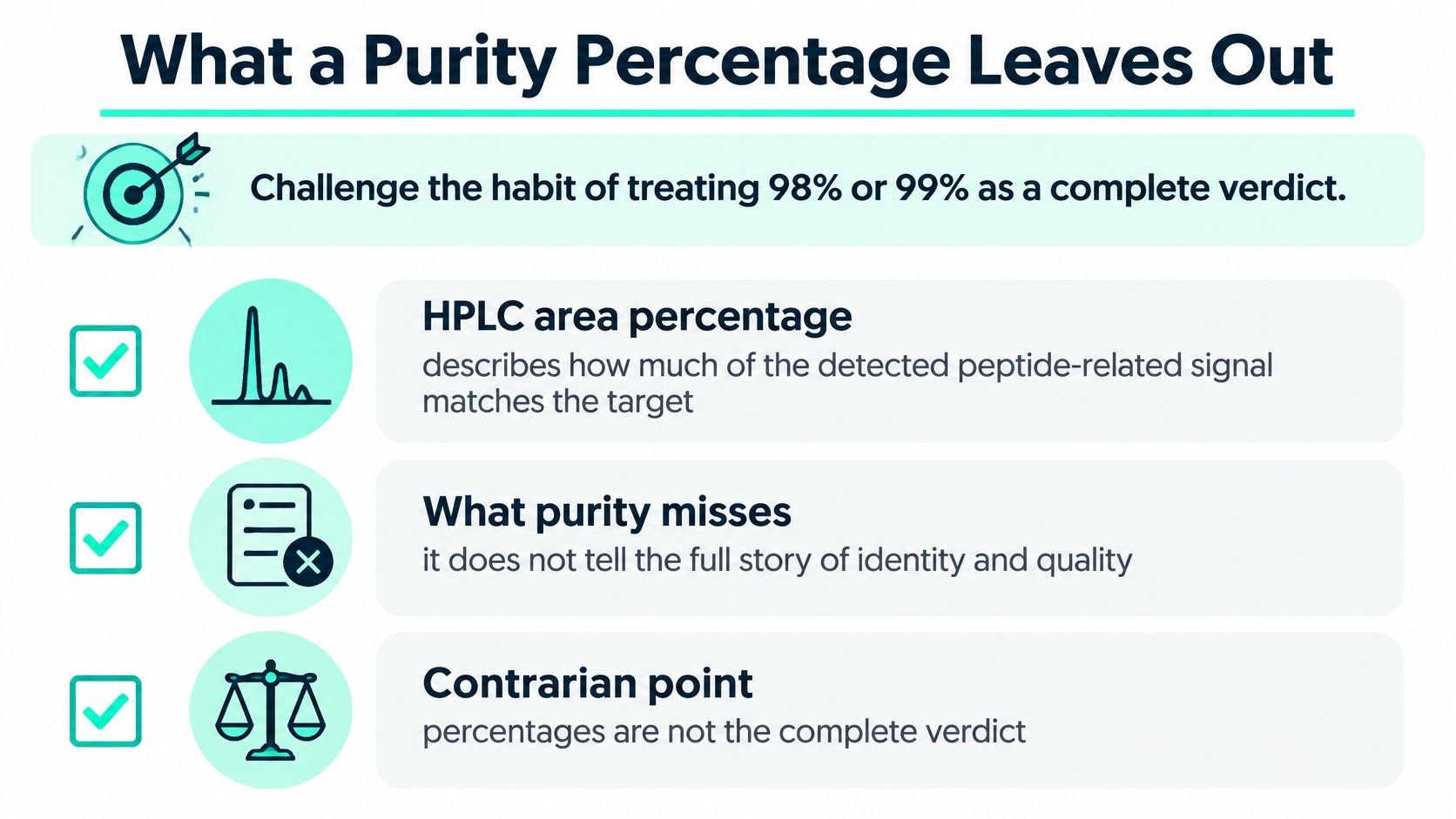
A high HPLC purity percentage isn't a complete quality verdict. An area percentage can describe the main peak's share of the signals measured under a particular chromatographic method while leaving other material attributes unanswered.
The FDA briefing document on BPC-157 describes the complexity of peptide-related impurities and active-ingredient characterization, alongside insufficient clinical safety information. That makes a single headline result a starting point for review, not a release decision.
A certificate of analysis, or CoA, is most useful when every result answers a defined question. Don't assume an unlisted test was performed.
Certificate lines and what each one shows
| Document line | Question it answers | What it does not prove |
|---|---|---|
| HPLC or UPLC purity | Share of the main peak among measured peptide-related signals | Sterility, endotoxin status, or human safety |
| Mass spectrometry or LC-MS | Whether the measured mass matches the expected peptide | Chromatographic purity or potency in a model |
| Related impurities | Which peptide-related and degradation peaks were screened | That unlisted impurity classes were absent |
| Water and residual solvents | How much measured non-peptide material contributes to mass | Biological equivalence after reconstitution |
| Microbial or endotoxin tests | Whether the specified contamination tests were run and passed | That an untested lot is suitable for cell or animal work |
| Lot number, date, lab, and method | Whether the result can be traced to the supplied lot | That a generic product-page claim applies to this vial |
Retention time alone isn't a strong identity check. A peak appearing where expected doesn't offer the same information as a complementary mass measurement.
For purity, examine the method name, chromatogram, reporting basis, and acceptance criteria. Ask whether the reported value is a chromatographic area result or an actual content assay, because those aren't interchangeable measurements.
Related impurities deserve their own review. A method that detects peptide-related degradation products doesn't necessarily assess residual manufacturing solvents, water, microbial contamination, or aggregation.
Similarly, microbial testing, sterility testing, and endotoxin testing answer different contamination questions. The protocol should specify which are required, especially when material will contact cells or animals.
A blank contamination field means the status hasn't been established. It doesn't mean the sample is clean.
For a general explanation of external testing, Peak Performance's guide to understanding independent product testing provides useful terminology. For research procurement, however, the decisive evidence remains the actual laboratory report, its method, and its connection to the supplied sample.
Third-party tested becomes meaningful when the testing laboratory, sample identity, lot number, test date, and acceptance criteria are disclosed. Independence doesn't repair an unidentified sample or an unsuitable assay.
Consider a certificate with a convincing chromatogram but no matching lot identifier. The analyst may have performed valid work, yet the buyer can't establish that it characterizes the powder being delivered. Treat that document as insufficient for release.
Keep the original report with the purchase record and record the method, date, and lot beside any result used in a study. If the certificate can't be tied to the label, hold the material rather than filling the gap with a supplier's purity slogan.
A vial can look unchanged after unsuitable handling. Like photographic film left in a hot car, its appearance doesn't establish that the contents retain their original properties.
The review discussing BPC-157 formulation and storage describes a white-to-off-white powder, water-soluble at 5 mg/mL, and storage in sealed, desiccated containers at approximately 2–8°C or below −18°C, according to the material specification. It also identifies aggregation and degradation as concerns arising from formulation, processing, and environmental conditions.
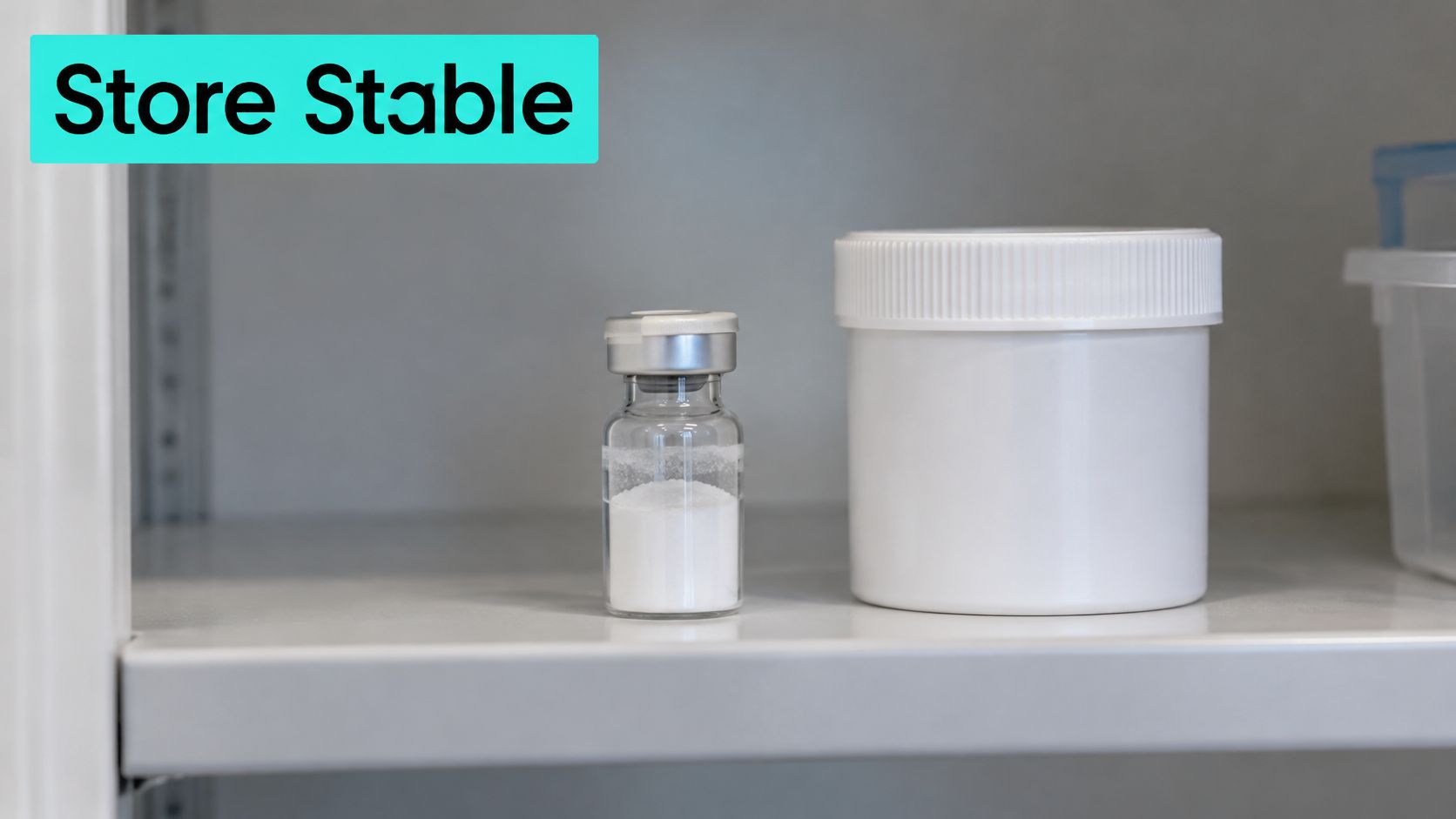
Start with the shipping record and package condition. Record when the parcel arrived, whether the container was intact, and whether any available temperature information supports the specified shipping conditions.
Don't infer a temperature excursion from appearance alone, and don't infer stability because the powder still looks normal. If the shipping history conflicts with the specification, segregate the vial while the discrepancy is evaluated.
The receiving record should distinguish an observation from an assumption. “Seal intact” is an observation; “material remained stable throughout transit” requires supporting evidence.
For a practical handling framework, a lyophilized peptide storage guide can help laboratories organize their procedures. The lot's documented requirements and validated stability information remain the controlling references.
Plan aliquoting around the experiment instead of repeatedly warming the full stock. Use low-humidity handling conditions, suitable containers, and a labeling system that preserves the parent lot's identity.
Follow the laboratory's validated procedure for temperature equilibration before opening a cold container. This helps limit condensation-related exposure rather than introducing moisture during an otherwise careful transfer.
Secondary packaging can help organize and protect supplies. Material Handling USA's reclosable UV protection for laboratory supplies illustrates an available packaging option, but a bag doesn't establish peptide stability or replace a sealed primary container, desiccation, or temperature control.
A useful notebook entry captures the complete preparation history:
Record when powder becomes solution. Don't assign a solution an expiry by copying the powder's storage instructions.
Handling limit: Careful technique reduces uncontrolled variability. It doesn't create stability data.
If an experiment produces an unexpected response, these records help the team distinguish a biological finding from a preparation or handling difference. Without them, repeating the nominal concentration may not reproduce the actual exposure.
Storage planning also belongs before institutional release of an experiment. The team should know who receives the material, who prepares it, which acceptance criteria apply, and what triggers quarantine. A freezer location alone isn't a stability program.
A supplier photograph, a gym discussion, and an animal paper can be combined into a confident claim about healing. A responsible investigator keeps the underlying questions separate.
Biological promise, demonstrated human benefit, and permission for human use are different judgments. None can be established by the appearance of a research vial.
For fitness readers, Sport Integrity Australia's BPC-157 guidance identifies it as a non-approved substance prohibited at all times under the World Anti-Doping Code framework. A research-use label doesn't make a vial a compliant training product.
Researchers importing material should verify the applicable local requirements rather than assuming an overseas catalog establishes permission. A customs decision, purchasing approval, or successful delivery also doesn't authorize a clinical application.
Our BPC-157 research peptide is not intended for human consumption, medical use, veterinary use, or therapeutic applications. That restriction should remain clear in purchasing records, internal labeling, and staff instructions.
For academic laboratories, contract research organizations, and startups, a responsible purchase supports a defined protocol. The organization should establish chain of custody, identify the person authorized to release the lot, and complete biosafety and ethics review where required.
A laboratory animal experiment and veterinary treatment aren't the same activity. Experimental animal work requires its own approved protocol and oversight; a research catalog doesn't provide those approvals.
Research-use language should describe how the organization actually handles the material, not merely what appears on the package.
Keep research stock out of personal possession and prohibit self-administration. If a proposed purchase is really intended for personal recovery, performance, or symptom management, it doesn't become laboratory research because the buyer requests a certificate.
Packaging matters when it supports traceability and communicates those boundaries. It can't carry an efficacy claim, a safety assurance, or permission that the evidence and governing requirements don't provide.
The procurement decision should be based on a matched set of records, not the most attractive result on a product tile. A laboratory needs to know what will ship, which evidence characterizes it, and whether the receiving team can handle it appropriately.
Celonyx Labs is one catalog option for investigators. Our BPC-157 is a white lyophilized powder with purity of at least 98%, verified by HPLC, and every batch undergoes HPLC analysis, mass spectrometry verification, and batch-consistency testing.
Those statements still need to be checked against the paperwork for the lot being shipped. Use a peptide certificate of analysis guide to organize that review, then retain the actual lot documents in the institutional purchasing record.
Before authorizing the order, confirm the following:
If an item is unresolved, hold the order. Don't substitute a generic certificate, an unlabeled chromatogram, or a verbal assurance for the missing record.
Use the published catalog, support contacts, and shipping and return policies when assembling an institutional purchase file. Resolve documentation questions before delivery, especially if receiving staff and investigators work in different departments.
Assign someone to inspect the parcel and route the material to its designated storage location. Fast receipt won't help if the package then sits unattended or enters stock without its supporting documents.
The final authorization should be a practical decision: the material is sufficiently characterized for the proposed study, the laboratory can control its handling, and the intended use remains within research boundaries. Anything less leaves an avoidable uncertainty inside the experiment.
Celonyx Labs offers research peptides and batch analytical verification for investigators evaluating materials such as BPC-157 powder. Visit Celonyx Labs to review the research catalog, then confirm lot documentation and storage requirements before placing an institutional order.
A 2025 review of BPC-157 identified 36 relevant studies, 35 preclinical and only 1 clinical.

There's no nationwide rule that insulin syringes are prescription-free: your order depends on the destination

Buy the highest purity number you can find and you're covered. That's the most popular
FOR RESEARCH USE ONLY. Products sold by Celonyx Labs are intended exclusively for laboratory and scientific research. They are not intended for human or veterinary use, consumption, diagnosis, treatment, cure, or prevention of any disease. By purchasing from this site, you acknowledge that you understand the intended research purpose of these materials and agree to comply with all applicable laws and regulations.