

Is Tesofensine a Peptide? the Lab Answer
Tesofensine is not a peptide: it is a synthetic small molecule with the formula C17H23Cl2NO

Choose Celonyx Labs if you need research peptides for laboratory experiments; choose Vitality Medical if you need medical supplies or care equipment. This 2026 comparison separates those purchasing needs, then explains the quality documentation and procurement checks that matter before you order.
A supplier comparison starts with the material your protocol requires, not the strongest-sounding quality statement. A laboratory reagent and a medical supply serve different purposes, even when both appear in scientific or healthcare purchasing searches.
Celonyx Labs is the better fit for researchers sourcing research peptides. Vitality Medical is the relevant choice for buyers sourcing medical supplies and care equipment. Neither category makes the other redundant.
For your 2026 purchasing plan, separate experimental materials from care-related supplies before comparing vendors. That prevents a category mismatch from becoming a procurement decision.
| Dimension | Celonyx Labs | Vitality Medical |
|---|---|---|
| Best for | Laboratory researchers sourcing research peptides | Buyers sourcing medical supplies and care equipment |
| Product fit | Peptide-focused experimental requirements | Medical-supply and equipment requirements |
| Standout feature | Stated 99% purity and third-party testing for research peptides | Medical-supply and care-equipment focus |
| Quality evidence | Evaluate batch identity, purity methods, and supporting reports | Evaluate the exact product’s specifications and supporting documents |
| Workflow fit | Experimental-material selection and laboratory acceptance | Medical-supply selection against a care or equipment requirement |
| Documentation | Match evidence to the research application | Match evidence to the intended medical-supply application |
| Pricing model | Product-based purchasing; compare a defined research requirement | Product-based purchasing; compare a defined supply requirement |
| Intended use | For research use only | Follow each product’s stated intended use |
Best for: laboratory researchers with a defined peptide requirement. The research store’s stated offering is 99%-pure, third-party-tested research peptides. That aligns with a buyer who starts with a compound identity, an experimental objective, and laboratory acceptance criteria.
The catalog includes GHK-Cu 100mg, GHK-Cu 50mg, BPC-157 10mg, and other named research materials. These entries establish a peptide-focused selection; they do not establish that every listed material meets every analytical or biological application.
Vitality Medical wins the corresponding medical-supply scenario. A buyer seeking care equipment should start with an equipment supplier rather than treating a research-peptide catalog as a general medical purchasing destination.
The limitation runs both ways: a peptide focus does not establish medical-device suitability, and a medical-supply focus does not establish peptide identity or analytical quality. Choose the supplier category before comparing individual items.
For experimental purchasing, product identity comes before vial size. A familiar abbreviation alone does not establish sequence, chemical form, counterion, or suitability for your assay.
Use the listed formats to define your material requirement, not to infer performance. GHK-Cu 100mg and GHK-Cu 50mg identify different labeled quantities. Neither quantity establishes biological activity, concentration after preparation, or the amount your protocol should use.
For a medical-supply purchase, begin with the equipment or consumable specification instead. Fit, dimensions, material compatibility, and the manufacturer’s intended use are relevant where applicable; peptide purity is not a substitute for those criteria.
In 2026, keep these as separate purchase specifications even when the same institution buys both categories. That preserves clear acceptance criteria for each order.
The research store’s stated quality signals are 99% purity and third-party testing. These are relevant starting points for a researcher, but the underlying report determines what the claim actually measures.
Chromatographic purity describes a sample under a particular analytical method. It does not, by itself, establish peptide identity, net peptide content, sterility, endotoxin status, or biological activity. Those are separate questions requiring appropriate evidence.
The research supplier wins on relevance of its stated peptide-quality signals, not on an unsupported claim of better quality than Vitality Medical. A medical-supply product needs evidence suited to its own intended use rather than a borrowed peptide benchmark.
Before accepting a research batch, ask:
For a laboratory purchasing team, the guide to peptide purity testing for contract research organizations provides a relevant next reading topic. Keep the acceptance decision tied to your experiment rather than a headline percentage.
Quality verification is a tie in principle: both purchases require evidence matched to the item. A supplier’s category helps you find the right product, but it cannot replace the product specification.
For research peptides, evaluate identity, analytical purity, labeled quantity, and handling documentation against your protocol. For medical supplies, evaluate the applicable manufacturer specifications, compatibility information, and intended-use statements.
Do not compare unlike documents as if they measure the same thing. A peptide chromatogram and an equipment specification sheet answer different questions. Neither automatically proves that the purchased item is suitable for your particular workflow.
Use this purchasing framework:
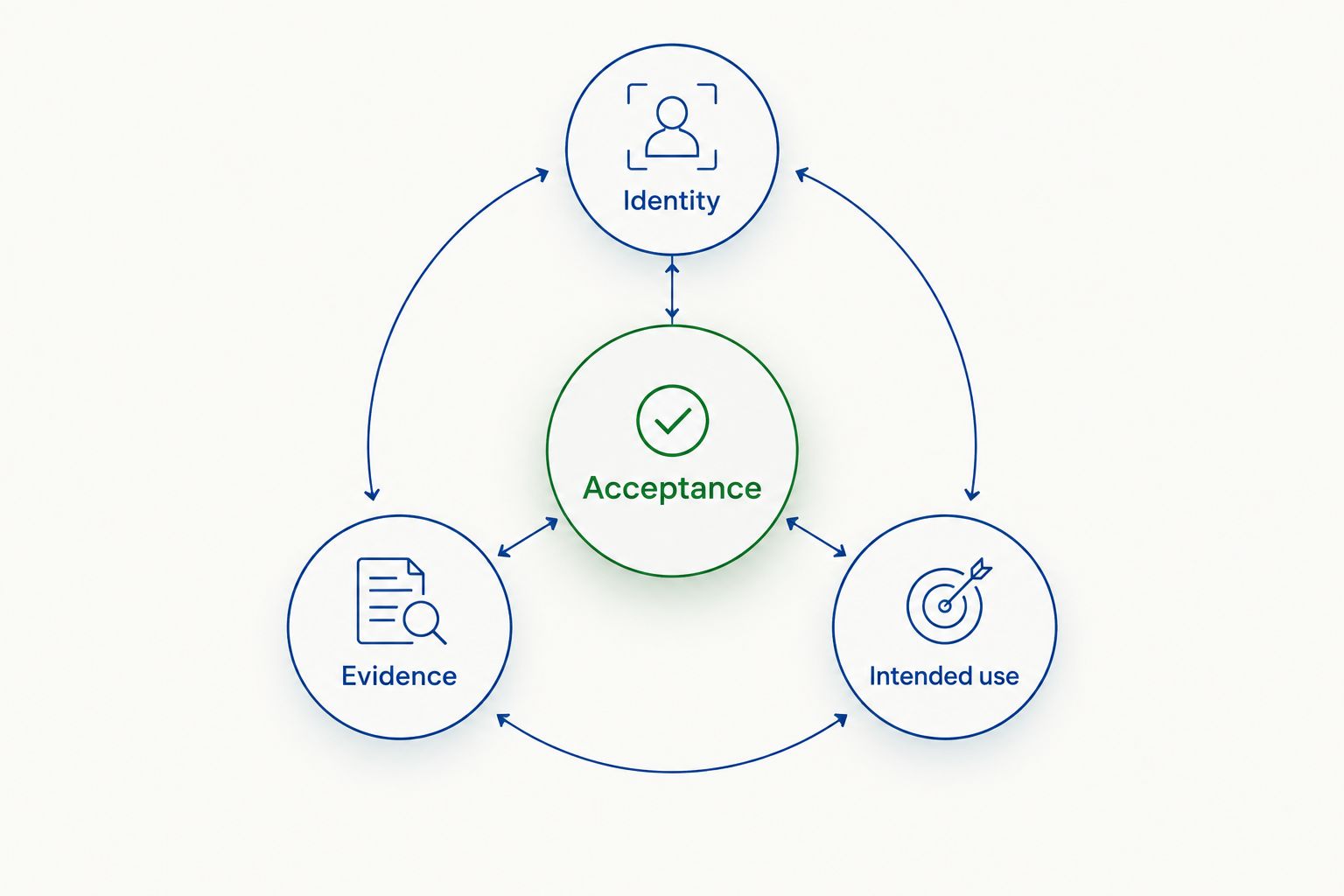
Keep the same framework across suppliers, but change the evidence required for each product category. A consistent process does not mean identical tests.
Best for: a purchasing lead sourcing medical supplies or care equipment. Vitality Medical is the relevant starting point when the purchasing requirement concerns a medical-supply product rather than a research peptide.
Start with the exact item and its intended use. Then check applicable compatibility, manufacturer instructions, and organizational purchasing requirements. Do not assume that a retailer’s broad category establishes the suitability of every item for every setting.
The research-peptide store fits a different workflow: define the experimental material, evaluate supporting analytical evidence, and document acceptance before use. Its peptide focus is an advantage for that task and a limitation for unrelated equipment purchasing.
A useful 2026 procurement practice is to separate the requisitions. Specify the research compound on one request and the care-related supply on another, with independent approval criteria. That makes the reason for choosing each supplier explicit.
Neither supplier earns a documentation win from its name alone. The useful document is the one that answers your application’s acceptance question.
For a research peptide, retain the lot identifier, relevant analytical reports, and preparation records required by your laboratory. A report that cannot be connected to the received material does not complete traceability.
For a medical-supply purchase, retain the exact product identifier and applicable manufacturer documentation. Where compatibility matters, document the match rather than relying on a category label or product photograph.
Keep these distinctions clear:
The advantage of this approach is consistency. Its limitation is that document review takes a defined internal process; no retailer name removes that responsibility.
Both comparisons belong at the product-purchase level. For research materials, define the compound, labeled quantity, and acceptance requirements; for medical supplies, define the exact item and applicable specifications.
There is no meaningful cheapest-supplier verdict across unrelated categories. A research peptide and a care-equipment item do not deliver the same purchasing outcome. Compare equivalent requirements within the relevant category instead.
For example, the catalog names Bacteriostatic Water 10mL alongside research peptides. Its 10 mL labeled volume does not establish that it is the correct solvent for every compound or assay. The approved preparation method determines suitability.
For your 2026 budget, distinguish a predictable specification from flexible item selection. Fixing the required material and acceptance criteria makes quotations comparable; changing formats or specifications requires a fresh comparison. This is a purchasing tradeoff, not evidence that either retailer offers particular contract terms.
Check current purchasing terms directly before approval. Do not infer subscriptions, institutional billing, shipping conditions, or return rights from a product-based retail model.
Research peptides are for research use only. The stated purity and third-party-testing signals do not convert them into medicines or establish suitability for human administration.
Medical supplies likewise require product-specific intended-use checks. A retailer’s medical focus does not make every item suitable for every clinical, laboratory, or home-care task.
This distinction is especially important when a compound name resembles a familiar therapeutic term. Similar naming does not establish identical formulation, regulatory status, or approved use. Keep experimental procurement separate from treatment decisions.
For both supplier categories, stop the purchase when the intended use and proposed application do not align. No comparison-table winner overrides that boundary.
Winner for research-peptide sourcing. Choose this supplier category when your requisition names a research peptide and your laboratory can evaluate its supporting documentation against a defined protocol.
Its stated strengths are peptide focus, 99% purity, and third-party testing. Its limitation is equally important: those statements do not establish sterility, biological activity, certified reference-material status, or suitability for human use.
Winner for medical-supply and care-equipment sourcing. Choose Vitality Medical when the purchasing task concerns that category, then assess the exact product against its intended use and your organization’s requirements.
The strength is category alignment. The limitation is that medical-supply retailing does not establish suitability as a research-peptide source or prove an individual item meets your specification.
| Dimension | Winner |
|---|---|
| Research-peptide purchasing | Research-peptide specialist |
| Medical-supply purchasing | Vitality Medical |
| Stated peptide-quality signals | Research-peptide specialist for relevance |
| Product-level quality verification | Tie: application-specific evidence required |
| Care-equipment workflow | Vitality Medical |
| Documentation review | Tie: match documents to the application |
| Pricing comparison | No cross-category winner |
| Intended-use compliance | Mandatory for both |
Is Celonyx Labs better than Vitality Medical for research peptides?
Celonyx Labs is the better category fit for research-peptide sourcing because its stated offering is 99%-pure, third-party-tested research peptides. Accept individual batches only after reviewing evidence against your laboratory protocol.
Which supplier should I choose for medical supplies?
Choose Vitality Medical when your requirement is medical supplies or care equipment. Verify the exact product’s intended use, specifications, and applicable compatibility before purchasing.
Does 99% peptide purity mean a vial is sterile?
No. Peptide purity and sterility are different properties, and a purity percentage does not establish sterility, endotoxin status, or biological activity.
Can research peptides be used for personal treatment?
Research-use-only peptides are not for personal treatment or human administration. Purity claims and third-party testing do not change that intended-use restriction.
How do I compare the cost of these suppliers?
Compare equivalent purchasing requirements within the relevant product category. Research peptides and care equipment are different purchases, so a single cross-category cheapest-supplier verdict is not useful.
What should a laboratory check before accepting a peptide batch?
Check compound identity, lot traceability, the analytical method behind the purity claim, and any additional evidence required by the protocol. Connect the supporting documents to the material actually received.
Does a larger peptide vial mean a stronger solution?
No. Labeled mass and solution concentration are different quantities; concentration also depends on the final solution volume. Follow your approved laboratory preparation method rather than inferring concentration from vial size.
A high-purity research peptide is not automatically a reference standard. Reference-standard suitability requires characterization appropriate to the analytical task; a purity headline alone does not establish it.
Before your next 2026 purchase, write the acceptance requirement before selecting the supplier. That single ordering decision keeps the comparison focused on evidence rather than reputation.
Tesofensine is not a peptide: it is a synthetic small molecule with the formula C17H23Cl2NO

Choose research peptides for oncology research by identity, batch evidence, and assay fit. Learn quality

Celonyx Labs vs Vitality Medical: choose research peptides or medical supplies. Compare intended use, quality
FOR RESEARCH USE ONLY. Products sold by Celonyx Labs are intended exclusively for laboratory and scientific research. They are not intended for human or veterinary use, consumption, diagnosis, treatment, cure, or prevention of any disease. By purchasing from this site, you acknowledge that you understand the intended research purpose of these materials and agree to comply with all applicable laws and regulations.