
Is Tesofensine a Peptide? the Lab Answer
Tesofensine is not a peptide: it is a synthetic small molecule with the formula C17H23Cl2NO
Tesofensine is not a peptide: it is a synthetic small molecule with the formula C17H23Cl2NO and an average molecular weight of about 328.28 g/mol. Its placement beside research peptides in a catalog doesn't change its chemistry.
That distinction matters before a laboratory opens the vial. A catalog label can help someone find a product, but it can't establish molecular identity, justify a formulation, or determine which analytical methods belong in a study file. For tesofensine, treating the product category as a chemical classification can send the workup in the wrong direction.
No, tesofensine isn't a peptide. It's a synthetic small-molecule drug candidate, with a chemical structure rather than an amino-acid sequence.
PubChem's tesofensine record identifies the compound with the molecular formula C17H23Cl2NO and an average molecular weight of approximately 328.28 g/mol. Its dichlorinated, tropane-derived structure has no peptide-bond backbone.
Tesofensine versus a typical research peptide
| Feature | Tesofensine | Typical research peptide |
|---|---|---|
| Chemical class | Synthetic small molecule | Amino-acid polymer |
| Backbone | No peptide-bond backbone; dichlorinated, tropane-derived structure | Peptide bonds linking amino acids |
| Size | Compact molecular structure with a defined molecular formula | An amino-acid chain, generally much larger in a GLP-1 analogue |
| Primary identity methods | LC-MS, HPLC, NMR, and chiral or optical-rotation analysis where appropriate | Sequence confirmation and peptide mapping |
| Usual research route | Generally studied through oral exposure | Often injection, with peptide-specific stability and delivery constraints |
| Pharmacology | Triple monoamine reuptake inhibitor | For a GLP-1 analogue, hormone-like receptor agonism |
The peptide column describes a useful comparator, not every peptide ever studied. Peptides differ in length, biological function, and delivery method, so neither injection nor hormone-like activity defines the entire class. The amino-acid chain is the defining structural distinction.
A peptide consists of amino acids joined through peptide bonds. A laboratory can ask which residues are present, what order they occupy, and whether the chain matches the intended sequence. Those questions make sense for a peptide, but tesofensine has no sequence for a peptide identity assay to confirm.
For a broader introduction to that terminology, a guide to research peptides helps separate amino-acid compounds from other research materials. For clinical context, ProMD Health Columbia explains peptide treatments, a different subject from identifying the contents of a research vial.
Classification rule: A vendor's research-peptide category describes where it files a product, not what that product is.
The practical consequence is straightforward: specify tesofensine as a small-molecule research compound. Don't accept peptide sequence confirmation as its primary identity evidence, and don't assume that a familiar-looking certificate answers the right chemical questions.
A useful analytical package must address molecular identity, related substances, and stereochemical composition where relevant. A chromatographic peak can look clean without proving that the material has the intended structure. That's why classification belongs at the beginning of procurement and method selection, not merely in the wording of a product description.
Say a laboratory receives a vial whose label names tesofensine, but whose intake form asks for an amino-acid sequence. The problem isn't missing paperwork. The form asks a question that doesn't apply to the material.
Read the molecular formula as a parts list, not a sequence. The letters identify the constituent elements, and their subscripts indicate composition; they don't describe residues arranged along a peptide backbone. Tesofensine's scaffold is a compact, bridged-ring structure containing nitrogen, rather than a string that a peptide sequencer could read.
The molecular diagram below provides a visual reference for that distinction.
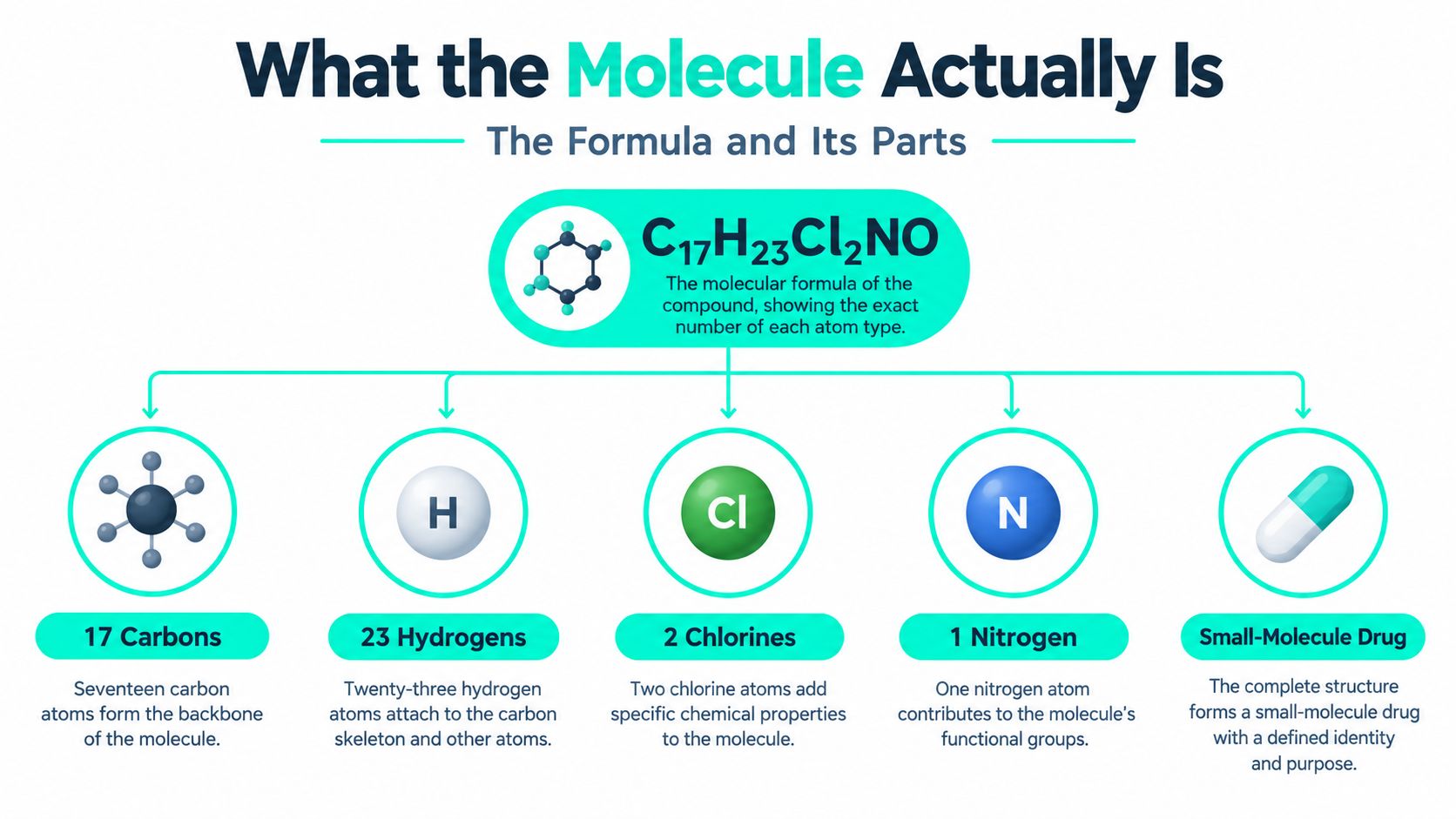
A peptide is like a necklace whose beads are clipped together by peptide bonds. Tesofensine is more like a machined part: its identity comes from the whole connected structure, including its spatial arrangement, rather than from a readable chain of residues.
That distinction helps explain why a formula alone isn't enough. Compounds can share elemental composition while differing in how their atoms connect or how their structures occupy space. A laboratory needs evidence that matches the intended compound, not merely evidence that the vial contains the expected elements.
The chlorine-containing structure also gives an analyst something useful to examine in mass spectrometry. Chlorine isotope patterns can support interpretation of a candidate molecular signal, although a recognizable pattern doesn't replace a full identity assessment.
A high chromatographic purity result answers a narrower question than many readers assume. It describes the material under the conditions of that assay; it doesn't automatically establish the intended stereoisomer or exclude substances the method doesn't resolve.
For the same reason, importing peptide-handling habits isn't a substitute for compound-specific information. Protease degradation, chain aggregation, and familiar reconstitution routines shouldn't define the stability assessment just because the vial arrived from a peptide catalog.
A defensible identity package combines mass evidence, chromatographic comparison with an authenticated reference standard, and structural or stereochemical checks where needed. Each component answers a different question. Together, they make the identification more useful than a formula or purity result standing alone.
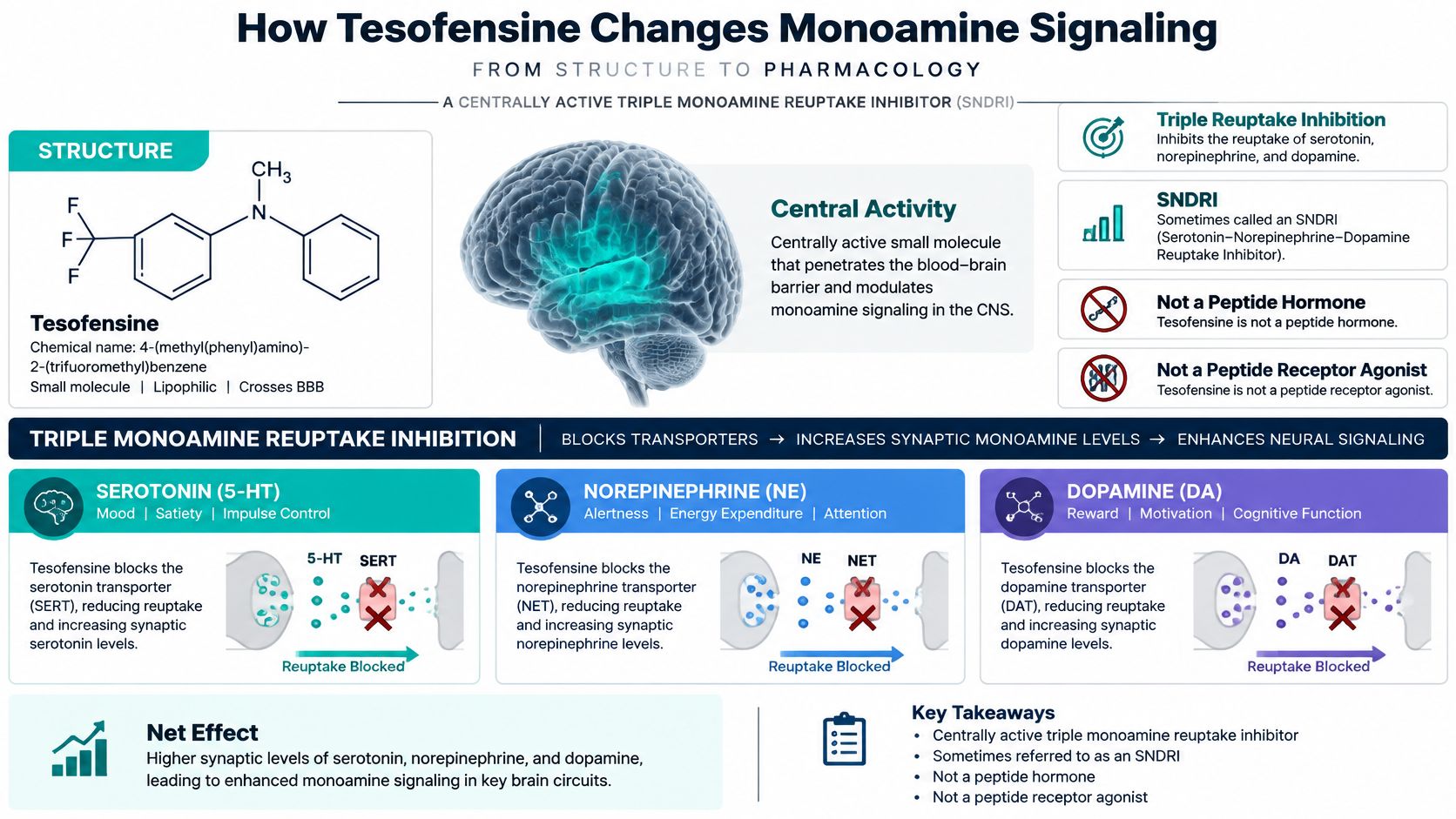
A peptide receptor agonist can be compared to a messenger knocking on a receptor's door. Tesofensine acts differently: it slows the transport systems that normally clear certain neurotransmitters from the space between nerve cells.
Those neurotransmitters are serotonin, norepinephrine, and dopamine. Tesofensine is described as a centrally active triple monoamine reuptake inhibitor, sometimes shortened to SNDRI, rather than a peptide hormone or peptide receptor agonist.
The illustration below separates the affected signaling systems from the compound's chemical classification.
The published pharmacology discussion available through PubMed Central describes positron-emission-tomography findings in which repeated oral doses from 0.125 to 1 mg produced dose-dependent dopamine-transporter blockade, with estimated maximum occupancy of about 80%. The account places the approximately half-maximal effect near 0.25 mg, at a plasma concentration around 4 ng/mL.
Those are exposure and target-engagement observations. They support the conclusion that the compound reaches and affects a central transporter system, but they don't establish an appropriate self-treatment dose or a complete safety profile.
The same published account describes a controlled study in 32 overweight or moderately obese men, reporting 1.8 kg greater weight loss than placebo after two weeks, together with increased satiety and fat oxidation. That short observation period and narrowly defined study group don't establish regulatory approval, durable benefit, or long-term safety.
A measurable biological effect establishes activity. It doesn't, by itself, establish an acceptable treatment.
Increasing neurotransmitter availability can influence hunger and satiety. Dopaminergic and noradrenergic activity can also affect reward and energy-regulation circuits, which helps explain why appetite researchers examine more than food intake alone.
It would be misleading, however, to translate that into a simple story in which each transmitter produces a single isolated benefit. These are interconnected central signaling systems, so the experimental plan must account for effects beyond the desired endpoint.
For another visual explanation of the mechanism, the following video offers additional context.
For a preclinical team, the useful variables include systemic exposure, transporter occupancy, cardiovascular responses, and monoamine-related adverse effects. A reduction in food intake shouldn't be treated as a stand-alone confirmation of the intended mechanism.
Choose readouts that can distinguish target engagement from a nonspecific behavioral change. A feeding endpoint can be valuable, but interpreting it requires the surrounding pharmacology, not a peptide-receptor assay selected because of a catalog category.
A fat-loss menu groups products by the outcome shoppers are interested in, not necessarily by molecular structure. That's how an oral small molecule can appear beside peptide candidates without becoming chemically related to them.
The mismatch becomes clear when a laboratory compares its experimental requirements with those of a GLP-1 analogue. PubChem's chemical entry for tesofensine provides a molecular identity anchor; the surrounding shop menu provides no equivalent scientific basis for treating neighboring products alike.
Suppose a team selects oral tesofensine and injectable semaglutide for an appetite study. It copies the peptide's administration schedule into the tesofensine arm because both products appeared under weight research.
That design hasn't matched exposure, justified timing, or accounted for the different targets. Even if both groups eat less, the team can't infer that the compounds produced equivalent pharmacology.
The category can hide several separate decisions:
Researchers browsing an amino-1-MQ compound guide should apply the same discipline: assess the named compound, not the category surrounding it. A page's position in a catalog isn't a substitute for its molecular specification.
A better study could use the same species, comparable observation conditions, documented material identity, and prespecified outcomes. Each compound would still need its own justified exposure strategy and mechanism-relevant controls.
Researchers could then compare appetite-related outcomes while preserving the distinction between transporter effects and peptide receptor activity. That's a valid comparison of biological responses, not a claim that the compounds are interchangeable.
Shared marketing doesn't justify shared formulation, stability, or analytical assumptions.
Consumer-facing treatment information requires a separate distinction. For readers considering clinical care rather than laboratory design, prescription treatment guidance from XO offers a treatment-oriented context, but it shouldn't be used to establish the identity or suitability of a research chemical.
The answer to “Is tesofensine a peptide?” therefore changes more than terminology. It determines which questions the laboratory must ask before making a comparison. A shared interest in body weight can justify studying compounds alongside each other, but it cannot justify treating their methods, handling, or safety boundaries as equivalent.
The 24-week phase II obesity study involving 203 adults, described in the Compound Codex tesofensine review, reported substantial dose-related weight reduction. The same review describes cardiovascular, sleep, and psychiatric findings that prevent a weight-only interpretation.
These observations belong beside the efficacy result, not in a footnote. The table collects the reported findings and the corresponding planning decisions.
Tesofensine findings that limit a weight-only reading
| Finding | What was reported | Planning implication |
|---|---|---|
| 24-week phase II size | 203 adults with dose-related weight reduction | A short-term signal, not an approval package |
| Heart rate at 0.5 mg | About 7 beats per minute higher | Treat pulse as a measured variable |
| Common adverse effects | Dry mouth, nausea, constipation, diarrhea, hard stools, and insomnia | Expect dose-related tolerability concerns, not a clean profile |
| Sleep in hypothalamic obesity | Sleep disturbance in 50% with tesomet versus 13% with placebo | Score sleep rather than treating it as incidental |
| Psychiatric serious event | A treatment-related serious adverse event involving worsening pre-existing anxiety | Plan exclusions and monitoring around anxiety history |
| Regulatory status | Maximum clinical-trial phase reported as II in the cited account | Don't present the compound as an approved obesity drug |
The cardiovascular and sleep figures are reported in that review: approximately 7 beats per minute higher heart rate at 0.5 mg, and sleep disturbance in 50% of tesomet-treated participants versus 13% with placebo in a separate hypothalamic-obesity study. The populations and treatment descriptions matter, particularly because the tesomet finding shouldn't be presented as a tesofensine-alone result.
Weight reduction answers whether an intervention affected body weight under the study conditions. It doesn't establish that the intervention offers an acceptable long-term balance of benefits and harms.
That distinction becomes especially important when cardiovascular disease, anxiety, insomnia, or concomitant psychoactive medicines are already present. A favorable change on the scale can coexist with clinically important problems elsewhere.
For readers entering ordinary clinical weight management, Lola's discussion of why clinicians check blood markers before weight loss treatment offers relevant screening context. Blood testing alone, however, can't substitute for reviewing cardiovascular history, psychiatric history, medicines, and symptoms.
A research plan needs explicit eligibility criteria and a defined approach to pulse, sleep, and psychiatric monitoring. It should also specify how investigators record withdrawals and adverse events, so tolerability problems don't disappear from the interpretation.
Durability after discontinuation remains a different question from response during exposure. Researchers should avoid treating an on-treatment weight change as proof that the effect persists after the compound is stopped.
The practical conclusion isn't that an efficacy signal has no value. It's that efficacy does not settle safety, and investigational exposure is not equivalent to regulated clinical therapy. Tesofensine should not be described as an established approved obesity treatment.
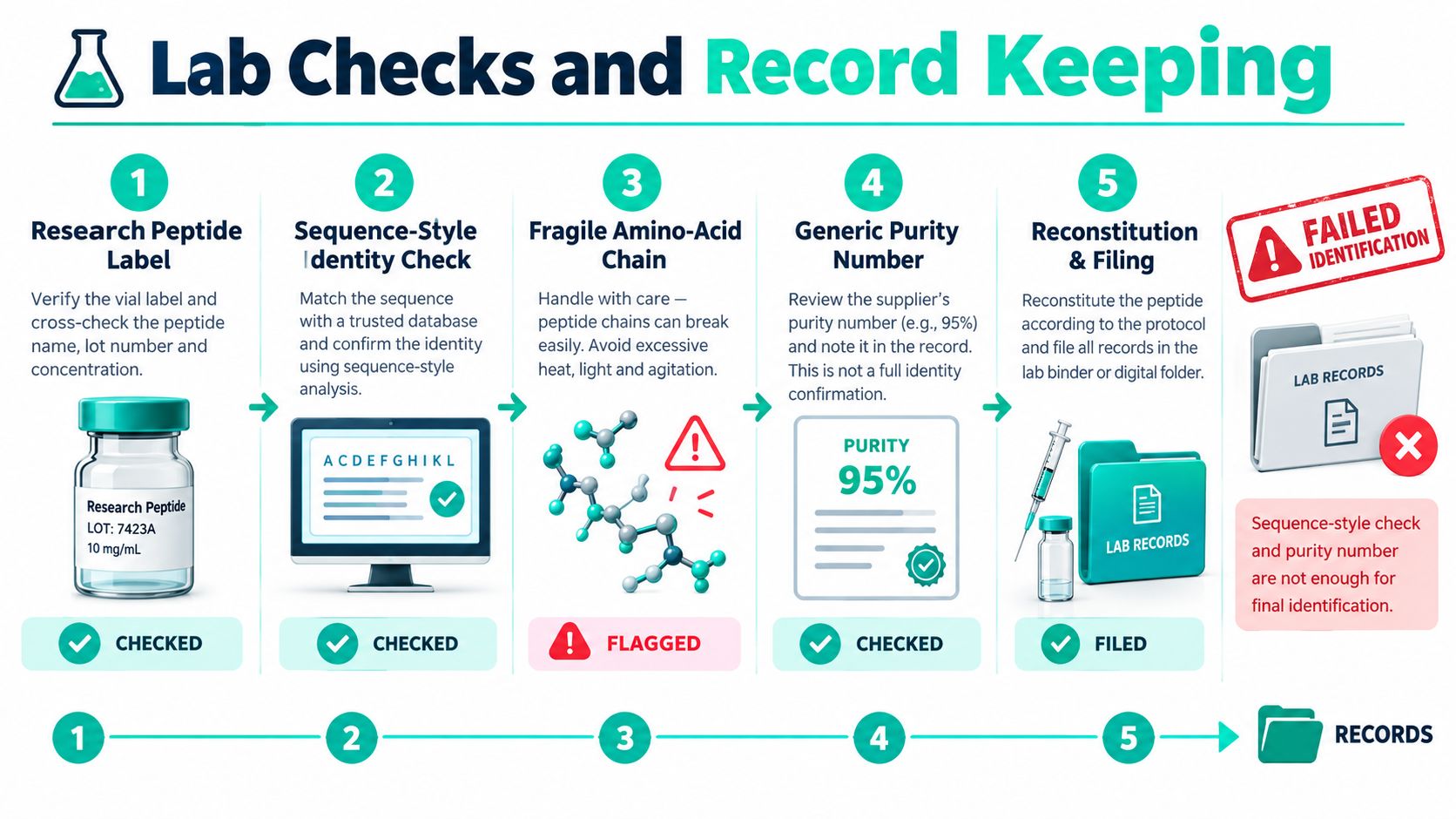
A receiving technician logs a vial as a research peptide because that wording appears on the order. The laboratory requests sequence-style identity evidence, applies a familiar peptide reconstitution routine, and files a purity result without checking whether the method can identify tesofensine.
The paperwork looks complete, but the identification isn't defensible. A generic purity number doesn't establish what the main peak is, whether the assay resolves relevant impurities, or whether the result belongs to the received lot.
The flowchart below illustrates the misclassification pathway that an intake review should catch.
Peptide-style workup versus small-molecule identity package
| Check | Peptide-style workup | Small-molecule identity package |
|---|---|---|
| Identity | Sequence or peptide mapping applied to the wrong material | LC-MS against an authenticated reference standard |
| Purity | Generic purity number with no method | HPLC related-substances assessment tied to the lot |
| Stereochemistry | Not checked | Chiral or optical-rotation assessment, with NMR for relevant structural questions |
| Handling | Automatic peptide reconstitution routine | Solubility and storage based on compound-specific information |
| Documentation | Lot unclear, method absent | Lot number, test date, method, and result tied to the lot |
The failed approach doesn't show that peptide methods are poor methods. It shows that a method can be appropriate for one chemical class and inappropriate for another.
Start by matching the vial's lot identifier to the certificate and receiving record. If the identifiers disagree, quarantine the material while the discrepancy is resolved; don't repair the trail by assuming the supplier meant a different batch.
Next, evaluate LC-MS identity evidence against an authenticated reference standard. Review the expected analyte signal, the reported ion assignment, and chromatographic behavior under the stated conditions. An unexplained peak assignment shouldn't become accepted identity merely because its retention time looks plausible.
Use HPLC to assess related substances with a method suitable for the sample. Keep the identity question separate from the purity question, even when the laboratory uses related instrumentation to answer both.
Where stereochemical composition matters, request an appropriate chiral assessment or optical-rotation comparison. NMR can help resolve structural questions, but routine NMR alone shouldn't be treated as automatic proof of enantiomeric composition.
A laboratory buying genuine research peptides still needs peptide-appropriate specifications, sequence evidence, and suitable independent analytical documentation. A guide to peptide certificates of analysis can help readers inspect those files, but a peptide certificate template should never determine tesofensine's identity requirements.
Write small-molecule research compound in the chemical-class field on orders, inventory entries, notebooks, and protocols. Include the molecular formula in the master specification, and correct any record that substitutes a merchandising category for the chemical class.
Material release should require lot-specific identity evidence and a documented reference-standard comparison. Separately, the study plan should identify the pharmacological and tolerability variables investigators will monitor; analytical acceptance does not authorize human use or establish clinical safety.
Release decision: Approve the material against the intended specification, not against the supplier's category name.
Before accepting a lot, ask whether another analyst could reconstruct the identification from the records without contacting the original operator. If the answer is no, obtain the missing evidence before the material enters the experiment.
Catalog neighborhood does not change the compound, and the record should say small molecule.
Celonyx Labs offers research peptides through an online catalog, with independent third-party testing information and customer support for product questions. Visit Celonyx Labs to review research-peptide options and request the documentation your laboratory needs, while keeping each compound's chemical identity and assay requirements separate from its catalog category.
Tesofensine is not a peptide: it is a synthetic small molecule with the formula C17H23Cl2NO

Choose research peptides for oncology research by identity, batch evidence, and assay fit. Learn quality

Celonyx Labs vs Vitality Medical: choose research peptides or medical supplies. Compare intended use, quality
FOR RESEARCH USE ONLY. Products sold by Celonyx Labs are intended exclusively for laboratory and scientific research. They are not intended for human or veterinary use, consumption, diagnosis, treatment, cure, or prevention of any disease. By purchasing from this site, you acknowledge that you understand the intended research purpose of these materials and agree to comply with all applicable laws and regulations.