
Epitalon Hair Growth: What the Research Actually Shows
No controlled human study has measured hair count or follicle density after Epitalon exposure, and
No controlled human study has measured hair count or follicle density after Epitalon exposure, and the reported 33% telomere-length increase comes from lymphocyte research, not scalp regrowth. Any proposed benefit for Epitalon hair growth therefore remains a mechanistic hypothesis rather than clinical proof.
That distinction challenges the most popular advice on this topic. A plausible cellular mechanism, a positive anecdote, or a product marketed for longevity cannot substitute for follicle-specific measurements. If a study doesn't show what happened to hair density, shaft diameter, or the growth phase of follicles, it hasn't established a hair-growth effect.
For a lab team, the useful question isn't just whether Epitalon “works.” It's whether the available research is relevant to follicle biology, whether the material is characterized well enough to reproduce the experiment, and whether the study design can separate a real signal from batch noise or uncontrolled variables.
The current human evidence is defined more by what hasn't been measured than by what has. No controlled human study has measured hair count, follicle density, anagen-phase length, or hair-shaft diameter after Epitalon exposure. The same evidence review reports no direct clinical evidence that Epitalon promotes scalp regrowth in humans and no peer-reviewed human alopecia trial demonstrating follicle regeneration (review of Epitalon and hair-growth research).
That gap matters because hair research needs objective endpoints. A participant saying that shedding feels lower may be relevant for generating a hypothesis, but it doesn't reveal whether follicles became denser, whether miniaturized shafts thickened, or whether the anagen phase changed. Those distinctions matter particularly when researchers are trying to separate androgenetic alopecia, telogen effluvium, age-related changes, and normal variation.

Cell culture can show that a compound affects a pathway associated with cellular aging. It can't, by itself, establish that a human scalp produces more terminal hairs. That is the central boundary between mechanistic relevance and clinical efficacy.
Researchers entering this area may also benefit from reviewing what research peptides are before treating a commercial preparation as equivalent to a validated therapeutic product. The distinction helps keep laboratory material, investigational compounds, and approved hair-loss treatments in separate categories.
For broader context on how peptide claims are commonly framed in hair discussions, researchers can find the right peptides for hair, while still checking whether each proposed ingredient has hair-specific endpoint data rather than relying on a shared anti-aging narrative.
Practical rule: If a claim doesn't specify the hair endpoint, the control group, and the observation period, treat it as a hypothesis, not a result.
Epitalon attracts interest because researchers have studied it in relation to telomerase, telomeres, cellular aging, chromatin, and neuroendocrine pathways. Telomeres can be understood as protective tips at the ends of chromosomes. Like the plastic tips on shoelaces, they help preserve the underlying structure, and their attrition is associated with cellular senescence.
The proposed hair connection is indirect. Dermal papilla fibroblasts help regulate follicle behavior, and cellular aging in the follicular environment is a reasonable subject for investigation. If a compound changes telomerase-linked activity in relevant follicular cells, researchers might ask whether that alters cell resilience or signaling during the hair cycle. That question is scientifically legitimate, but it still requires a follicle model and follicle-specific outcomes.
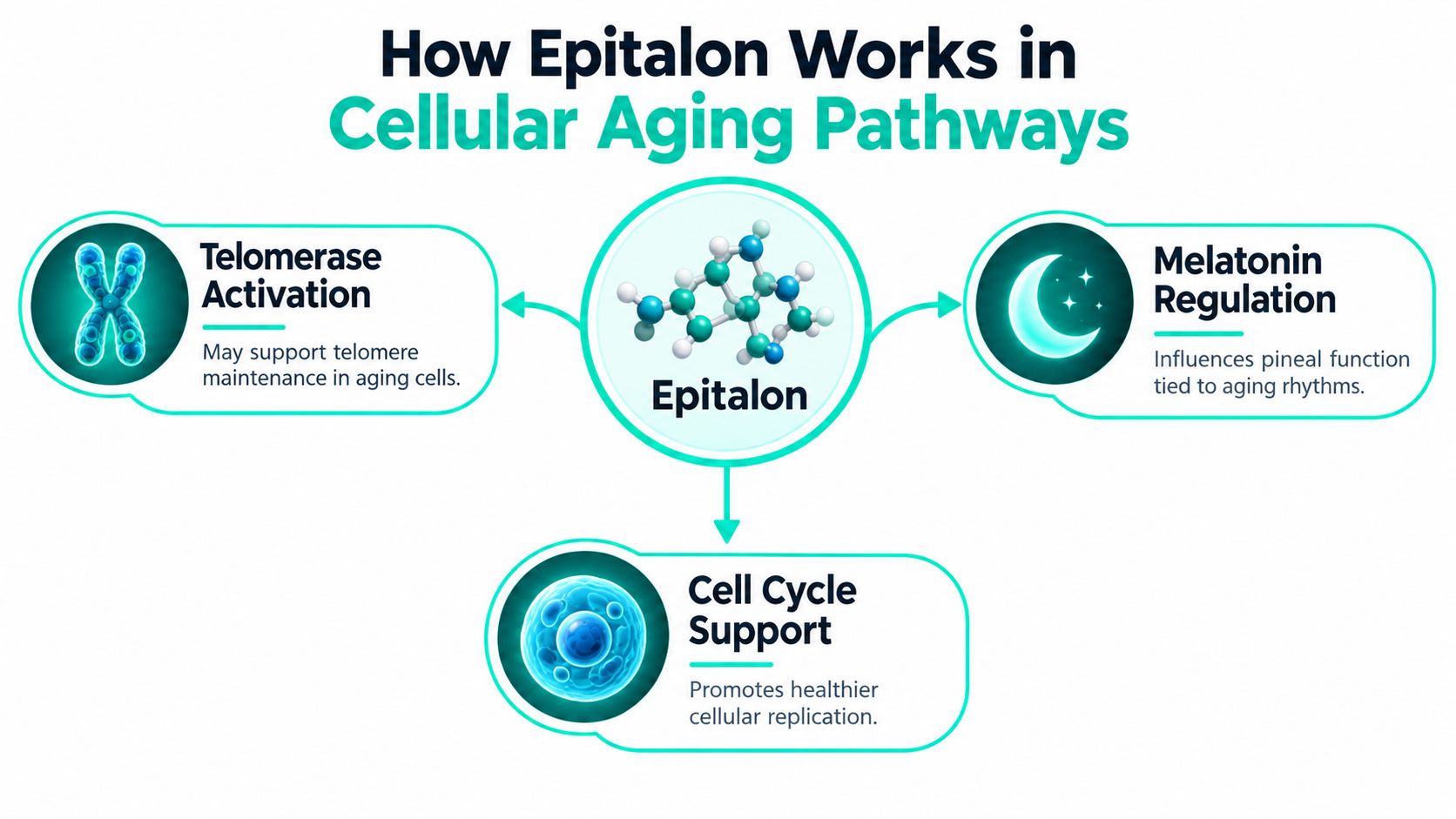
Independent summaries describe telomere-length increases of about 33% in lymphocytes, along with additional cell divisions beyond the Hayflick limit, and later reports of telomere elongation in normal human fibroblasts and mammary epithelial cells after repeated exposure (technical summary of peptide research and telomere-related activity). Those observations are important as cellular signals, but they aren't measurements of scalp density or human regrowth.
The model also has limits. Lymphocytes, fibroblasts, and follicular dermal papilla cells don't behave identically, and an effect in one cell type cannot be assumed to occur in another. Researchers need to establish the relevant concentration, exposure schedule, cell state, and downstream readouts before claiming that the pathway has practical value for follicles.
A second proposed connection involves pineal and melatonin-related biology. That may help explain why Epitalon appears in aging and circadian-rhythm discussions, but it doesn't supply a direct causal bridge to androgenetic alopecia or other common hair-loss disorders.
The video below provides a visual supplement for teams reviewing the broader cellular-aging concept.
The responsible interpretation is narrow: Epitalon may be relevant to research on cellular aging in follicle-associated cells, but the pathway remains a rationale for testing, not evidence that hair will grow.
The research record becomes clearer when separated by evidence layer. At the cellular level, the strongest technical signal concerns telomere dynamics and cell-division behavior. Those findings can justify experiments in dermal papilla cells, follicular keratinocytes, or a three-dimensional follicle model, but they don't answer whether a treated scalp gains visible hair.
The available summaries describe Epitalon research as concentrated on telomerase, aging, chromatin, and neuroendocrine pathways, rather than validated hair-growth endpoints. That distribution of research topics tells a lab how to calibrate its claims. A paper about cellular aging may support pathway selection, but it shouldn't be presented as a hair-regrowth trial.
In vitro work can help answer focused questions:
These are valuable experiments because they narrow the biological question. They also expose where extrapolation becomes unsafe. A telomere measurement is not a hair count, and a change in cell proliferation is not proof of a longer anagen phase.
No controlled human evidence demonstrates that Epitalon increases scalp hair count, follicle density, anagen duration, or hair-shaft diameter. There is also no solid human evidence showing reversal of androgenetic alopecia after Epitalon exposure. The absence of those outcomes means clinical researchers can't compare Epitalon with validated hair therapies using the same efficacy framework.
A cell-culture signal can tell you where to look next. It can't tell you what a patient will see in the mirror.
Animal work, where relevant, would sit between cell culture and human trials, but it would still need a hair-specific design. Researchers would need to document species, hair-cycle stage, dosing route, exposure duration, blinded assessment, and a predefined method for measuring density or shaft characteristics. Without that structure, even an apparent change remains difficult to interpret.
The practical conclusion is straightforward. Epitalon research supports continued investigation into cellular aging pathways, but it doesn't support marketing the compound as a demonstrated alopecia treatment.
A defensible Epitalon hair study must be designed around measurable outcomes from the beginning. Starting with testimonials or a vague “hair quality” endpoint creates room for observer bias, inconsistent photography, and selective reporting. Starting with a protocol makes the result interpretable even if the compound fails to produce a benefit.
A laboratory or clinical team should define the intervention before recruitment or cell exposure. That includes the material identity, concentration, route, dosing schedule, treatment duration, control condition, and criteria for stopping or excluding a sample. A placebo-controlled human study would need random assignment and blinding, while a cell study would need vehicle controls, replicate wells, and a prespecified analysis plan.
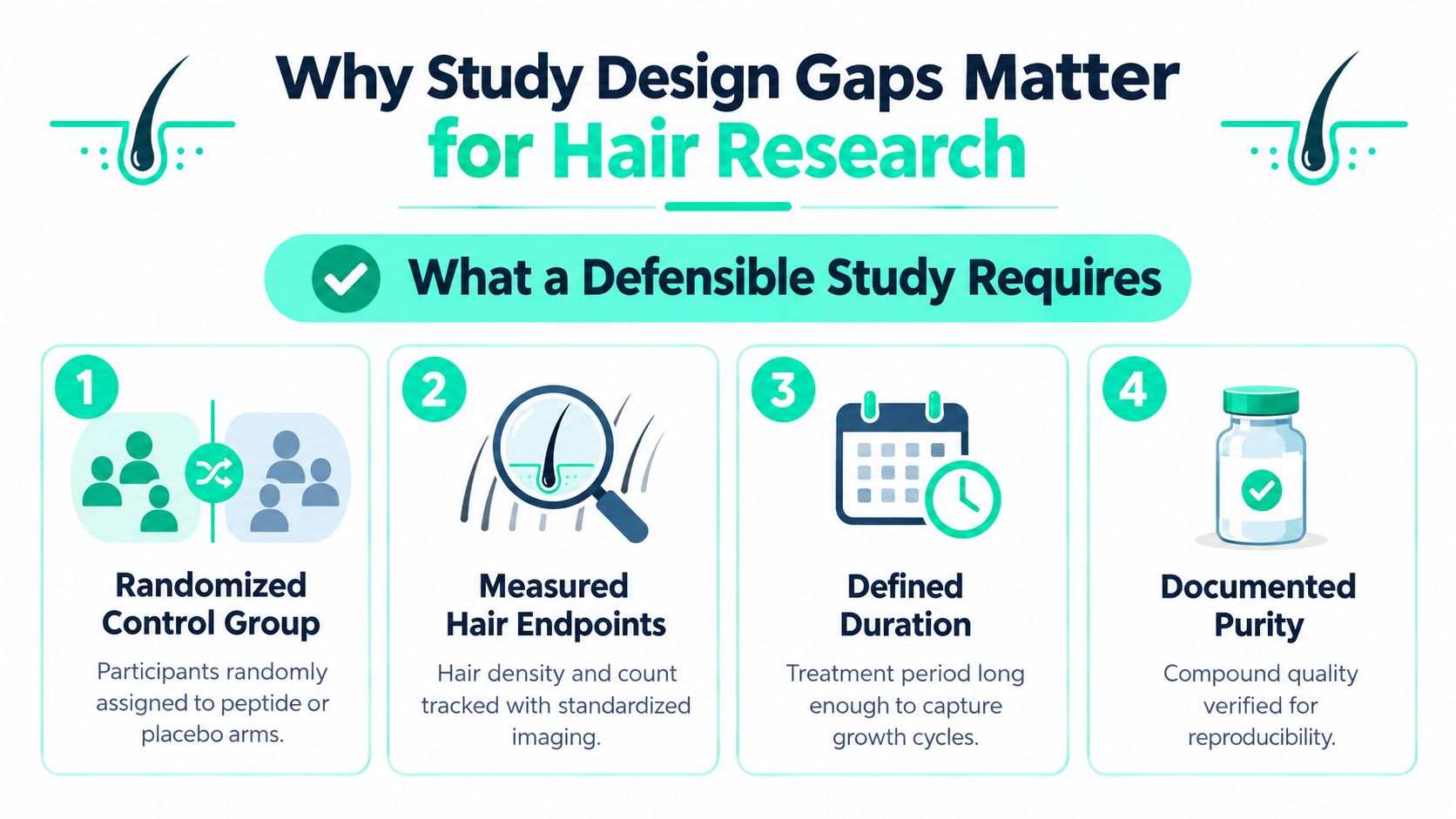
Different claims require different measurements:
| Research claim | More appropriate endpoint |
|---|---|
| More visible hair | Standardized hair count and scalp imaging |
| Larger or less miniaturized follicles | Shaft diameter and follicle-size assessment |
| Longer active growth | Anagen-phase measurement |
| Better follicular cell resilience | Viability, senescence, and pathway markers |
| Reproducible compound activity | Lot-linked assay results and analytical identity data |
The endpoints should be collected at defined time points using the same imaging conditions and assessment rules. Hair changes are slow and variable, so a short observation period may miss the biological effect or mistake temporary shedding for treatment failure.
In vitro data answers whether a mechanism can be observed under controlled conditions. An animal model can add tissue-level context, but it still may not reproduce human alopecia. A controlled human trial is the layer needed to establish whether the intervention changes clinically meaningful hair outcomes.
That hierarchy prevents a common error, treating every positive result as interchangeable. A telomere signal may justify a follicle experiment. It doesn't justify a consumer claim about regrowth.
Design standard: The study should be able to produce a negative result that researchers trust. If it can't, the protocol is too vague.
The current literature leaves a practical research opportunity. Rather than asking only whether Epitalon might help, investigators can define what a credible answer would require and build the missing evidence one endpoint at a time.
Purity is an experimental variable, not a cosmetic detail on a label. If two laboratories use material with different impurity profiles, different residual solvents, or inconsistent peptide identity, their biological results may diverge even when the nominal Epitalon concentration is the same.
That problem becomes more serious in low-signal systems. A weak or variable follicle response can be obscured by degradation products, synthesis by-products, aggregation, contamination, or inaccurate concentration. Researchers may then blame the cell model or biological hypothesis when the actual problem began during procurement.
At minimum, a research team should request documentation tied to the exact lot used in the experiment. Useful records include:
A purity figure without the analytical method is incomplete. HPLC purity can show the proportion of detected peaks under a particular method, while mass spectrometry helps confirm identity. Neither replaces sterility testing where the experimental route requires it, and neither proves biological activity.

Use one characterized lot for a defined experiment whenever possible. If a project spans multiple lots, treat the lot as a recorded factor and include a bridging assay before pooling results. Keep the vehicle, concentration calculations, exposure time, and sample-processing steps consistent.
Procurement principle: A reproducible experiment starts with material that another laboratory can identify, test, and obtain again.
This approach doesn't guarantee a positive result. It does make a negative or inconsistent result easier to interpret, which is precisely what early-stage follicle research needs.
The cosmetic framing of Epitalon often runs ahead of the safety record. Epitalon remains investigational, with limited Western replication and sparse long-term human safety data. Recent neutral summaries also emphasize that no human study has shown scalp-density improvement or reversal of androgenetic alopecia, while claims involving postpartum shedding or gray hair remain anecdotal (discussion of Epitalon benefits and safety gaps).
Women, older adults, and people considering prolonged cosmetic use deserve particular caution. Pregnancy and breastfeeding raise questions that can't be answered by cell-culture findings, and a lack of well-established long-term human data makes casual self-experimentation difficult to justify. The same applies to people with complex medical histories or active treatment for serious disease.
A research compound isn't automatically a supplement, cosmetic ingredient, or approved alopecia therapy. Product availability doesn't establish clinical validation, and a proposed effect on aging pathways doesn't establish safety for chronic exposure.
Consumers should also be wary of dosage advice presented as universal. Formulation, route, identity, concentration, and individual health factors all affect how an experimental protocol should be assessed. A research-oriented Epitalon dosage guide can provide background for protocol planning, but it isn't a substitute for medical supervision or controlled evidence.
The absence of a documented adverse outcome isn't the same as proof of long-term safety.
For a cosmetic hair claim to become credible, researchers would need controlled exposure data, transparent adverse-event reporting, relevant participant groups, and objective scalp endpoints. Until then, Epitalon should be discussed as an investigational compound for follicle biology, not as a validated solution for hair loss.
Epitalon has a scientifically interesting rationale. Telomerase-linked activity, telomere biology, and cellular aging pathways may be relevant to follicular senescence, especially in dermal papilla fibroblasts and related cell systems. The evidence stops short of showing that those mechanisms produce human scalp regrowth.
A practical research roadmap begins with a relevant model and a defined question. Test characterized material in follicle-associated cells, include vehicle and untreated controls, and measure both the proposed mechanism and a functional outcome. If the mechanism changes but follicle-related behavior doesn't, that result is still informative because it prevents an unsupported leap from pathway activity to hair treatment.
Validated hair-loss treatments remain the appropriate benchmark for clinical decision-making, while experimental work should focus on producing evidence that can withstand replication. Researchers comparing Epitalon with another peptide should also keep the biology separate rather than assuming that a product marketed for hair, such as a copper peptide shampoo, tests the same mechanism or answers the same question.
The field doesn't need stronger anecdotes. It needs follicle-specific endpoints, controlled exposure, transparent reporting, and material quality that another lab can reproduce. That is how Epitalon hair growth moves from an appealing mechanism to a testable scientific proposition.
Celonyx Labs supplies research peptides to laboratories and investigators through its online catalog, with product documentation and independent third-party testing presented as part of its quality process. Visit Celonyx Labs to review its research materials and contact the team about sourcing characterized peptide material for controlled experimental work.
No controlled human study has measured hair count or follicle density after Epitalon exposure, and

Can peptides be shipped in hot weather without spoiling? Yes, with supported conditions. Learn to

Can you buy research peptides without a business account? Check seller eligibility, laboratory-use rules, and
FOR RESEARCH USE ONLY. Products sold by Celonyx Labs are intended exclusively for laboratory and scientific research. They are not intended for human or veterinary use, consumption, diagnosis, treatment, cure, or prevention of any disease. By purchasing from this site, you acknowledge that you understand the intended research purpose of these materials and agree to comply with all applicable laws and regulations.