
Epitalon Hair Growth: What the Research Actually Shows
No controlled human study has measured hair count or follicle density after Epitalon exposure, and
Copper peptide shampoos are built around GHK-Cu, a copper-binding tripeptide with plausible but limited human evidence. Their real-world performance is constrained by short scalp contact time and, in many products, undisclosed concentrations, so a label claim is not the same thing as a usable hair-growth treatment.
Most advice online treats copper peptide shampoo like any other cosmetic cleanser with a trendy active. That framing misses the main issue. If a rinse-off product only touches the scalp briefly, then the question is not just whether GHK-Cu is interesting in theory, but whether the formulation can deliver enough of it, long enough, to matter.
A copper peptide shampoo can list GHK-Cu on the label and still tell you very little about how it will behave on your scalp. One market example discloses 0.5% GHK-Cu in both shampoo and conditioner, while another review says many products don't disclose concentration at all, which makes real potency hard to judge. That alone should make readers cautious before assuming every bottle in this category is functionally similar. HairGenetix product disclosure and market discussion
The core issue is exposure. Published hair-care discussions around this ingredient keep coming back to scalp contact time, and one market review emphasizes a 3 to 5 minute leave-on window as important for follicle activation. That matters because a shampoo is designed to rinse, not stay. If the ingredient needs time on the scalp, then a fast wash may be a weaker delivery vehicle than the marketing implies. HairGenetix formulation notes
GHK-Cu also arrived in beauty through broader interest in tissue repair and biomaterials, not through shampoo-specific proof. That history explains why the ingredient sounds biologically serious, but it doesn't erase the gap between a signaling peptide and a rinse-off cleanser. The two are not the same product category, even if they share a name.
Practical rule: if a shampoo product won't disclose the active concentration, you're buying a formulation claim, not an assessable treatment plan.
The rest of the evidence question comes down to three things. First, what GHK-Cu is. Second, what hair-related evidence exists in humans and preclinical work. Third, whether a shampoo format can realistically translate that evidence into daily use.
GHK-Cu is the technical name most often used for copper peptide shampoo actives. It refers to a copper(II)-bound tripeptide made of glycyl-L-histidyl-L-lysine, and in scalp formulations it functions as a topical signaling molecule rather than a cleansing surfactant. The chemistry matters because copper binding changes the peptide from a simple amino acid fragment into a biologically active complex. GHK-Cu technical description
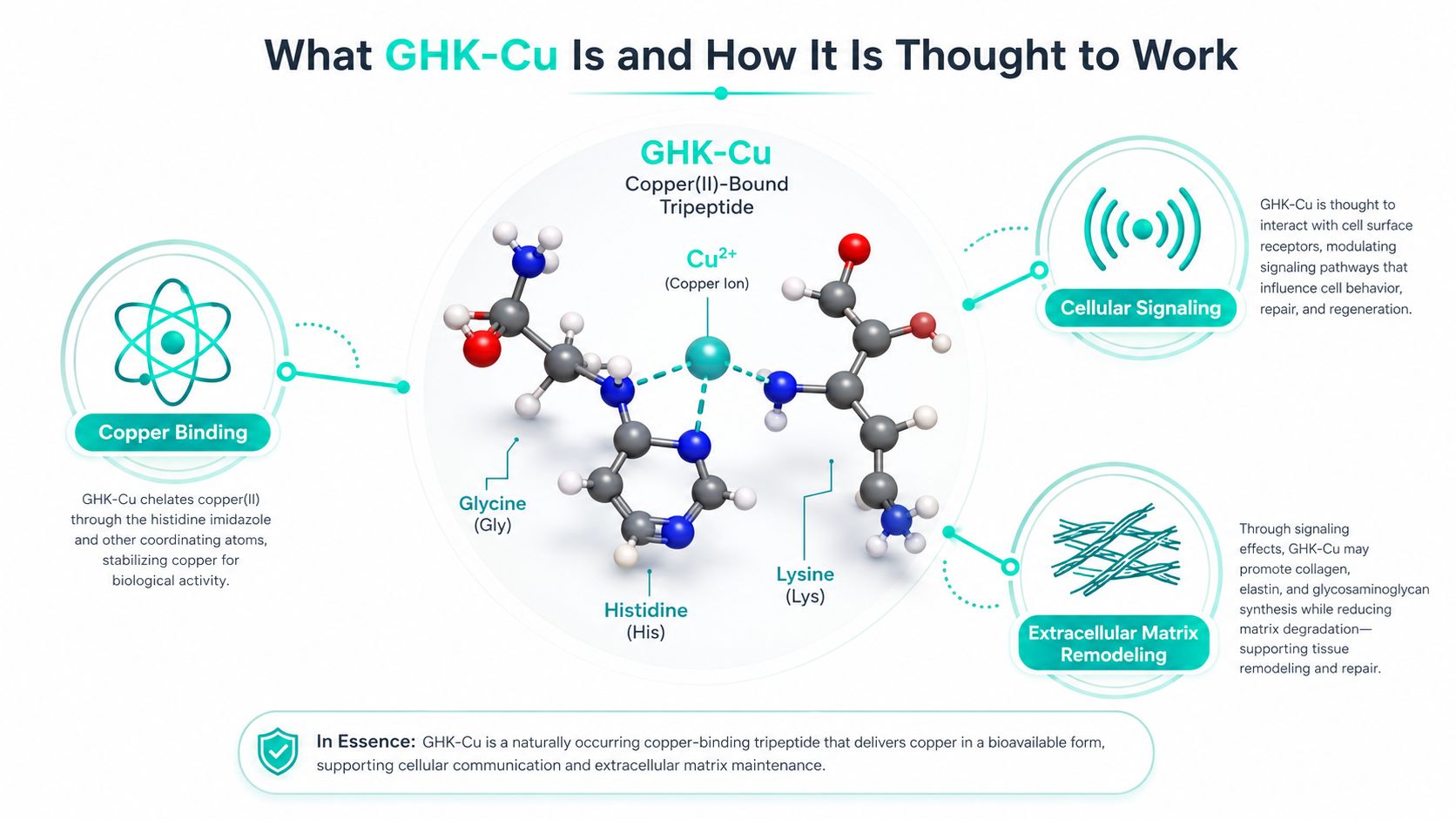
A peptide by itself is just a short chain of amino acids. Once it is bound to copper, it becomes a signaling complex that researchers and formulators discuss as a topical messenger. In scalp care, that distinction matters because the goal is not to clean the hair shaft. The goal is to support follicle biology through local contact.
That is also why GHK-Cu appears so often in hair-growth discussions compared with many other cosmetic peptides. It is usually presented as a primary active, not only as a supporting ingredient. In practical terms, buyers are usually purchasing a biological hypothesis, not a classic conditioner effect.
The product datasheet for one shampoo-grade material shows that copper tripeptide-1 products are commonly used at 0.001% to 0.1%, while a shampoo material sheet specifies 5000 ppm, or 0.5% active peptide and describes it as a clear, blue liquid. That range shows how much formulation context matters. Avena Lab copper tripeptide-1 datasheet If you want a neutral reference point for a research-grade starting material, this GHK-Cu powder listing gives a clearer view of the ingredient outside a finished shampoo base.
The hair-care claim is not that copper peptides create new follicles out of nowhere. The more careful version is that they may help support follicle biology through signaling, tissue remodeling, and local scalp conditions. That is a narrower claim, and it becomes even narrower once the product is a rinse-off shampoo with limited contact time.
For research buyers, that distinction is obvious. For consumers, it often gets blurred into one vague promise of “hair growth.” A better mental model is to treat GHK-Cu as a signaling ingredient whose value depends heavily on formula, exposure, and use pattern.
The strongest numerical claims around copper peptide shampoo come from research summaries and product discussions, not from large shampoo-only trials. One source says copper peptides can increase follicle size comparable to 5% minoxidil in some research comparisons. Another summarizes lab and small clinical work reporting follicle-size gains of up to 40%, density improvements of 30 to 40%, and shedding reductions of 25 to 30% over 2 to 6 months of consistent use. Those figures are attention-grabbing, but they should be read as summary claims rather than guarantees for a rinse-off product. Copper peptide research summary
A comparison to 5% minoxidil points to biological activity, but it does not mean a shampoo bottle will perform like a drug. Delivery format matters. A topical peptide that remains on the scalp for hours is not the same thing as a surfactant system that is rinsed away in minutes.
The delivery-focused study cited in that review adds one more useful detail. It reported that copper-peptide-treated follicles entered the early growth phase in as few as 6 days, versus about 9 days for minoxidil alone. That is a real mechanistic signal, but it still sits inside a formulation question rather than a direct consumer outcome.
A dermatology review notes that copper peptides may support scalp health and can be layered with minoxidil, but it also says large randomized trials are still needed and that they are not proven to regrow hair as a stand-alone treatment. A clinician commentary on the existing human study says the trial found no statistically significant improvement in hair length or thickness versus placebo. Those two points define the evidence gap better than any marketing page does. Healthline copper peptide review
The honest reading is simple, copper peptides look biologically interesting, but shampoo-specific human proof is still limited and mixed.
A serious copper peptide shampoo is not just GHK-Cu in a bottle. It has to balance surfactants, conditioning agents, pH, stability, and rinse-off behavior so the peptide remains available long enough to contact the scalp. Formulation mechanics matter as much as ingredient identity, because the active only helps if the vehicle can carry it through use.
Shampoo is a chemically busy environment. Surfactants lift oil and soil, conditioning agents reduce friction, and chelators can bind metals. If the system is not built carefully, a copper peptide can lose stability or become less available before it ever reaches the follicle.
The practical benchmark comes from the ingredient documents. One technical datasheet places copper tripeptide-1 use in the 0.001% to 0.1% range, while a shampoo ingredient sheet specifies 0.5% active peptide. Those numbers show that the category can be formulated very differently depending on whether the brand is aiming for a cosmetic trace level or a more assertive active load. Avena Lab copper tripeptide-1 datasheet
| Parameter | Typical Range | Function |
|---|---|---|
| GHK-Cu concentration | 0.001% to 0.1% in many cosmetic contexts, with one shampoo example at 0.5% | Determines dose delivered to the scalp |
| Scalp contact time | 3 to 5 minutes in product literature | Improves opportunity for follicle exposure |
| Shampoo matrix | Surfactant-based rinse-off system | Cleans while carrying the active |
| Delivery approach | Standard dispersion, encapsulation, or microemulsion | Affects uptake and stability |
Emerging delivery work points toward encapsulation and microemulsion systems as ways to improve peptide uptake in preclinical models. That does not remove the rinse-off problem, but it does explain why copper peptide shampoos should not be treated as equivalent. The vehicle can matter as much as the peptide.
A plain-language reading is straightforward. If the formula cannot keep the peptide in a stable state through storage, bottle opening, lathering, and rinse-off, the label's active name says less than the marketing implies. You are not just buying GHK-Cu, you are buying the delivery architecture around it.
Direct-to-lab peptide sourcing context
A cosmetic copper peptide shampoo and a research-grade peptide address different use cases. The first is built for consumers, inside a detergent matrix that has to cleanse, foam, and stay acceptable on the shelf. The second is prepared for controlled experimental work, where purity, identity, and lot verification matter more than fragrance or sensory feel. Marketing often blurs that gap, but the distinction is material.
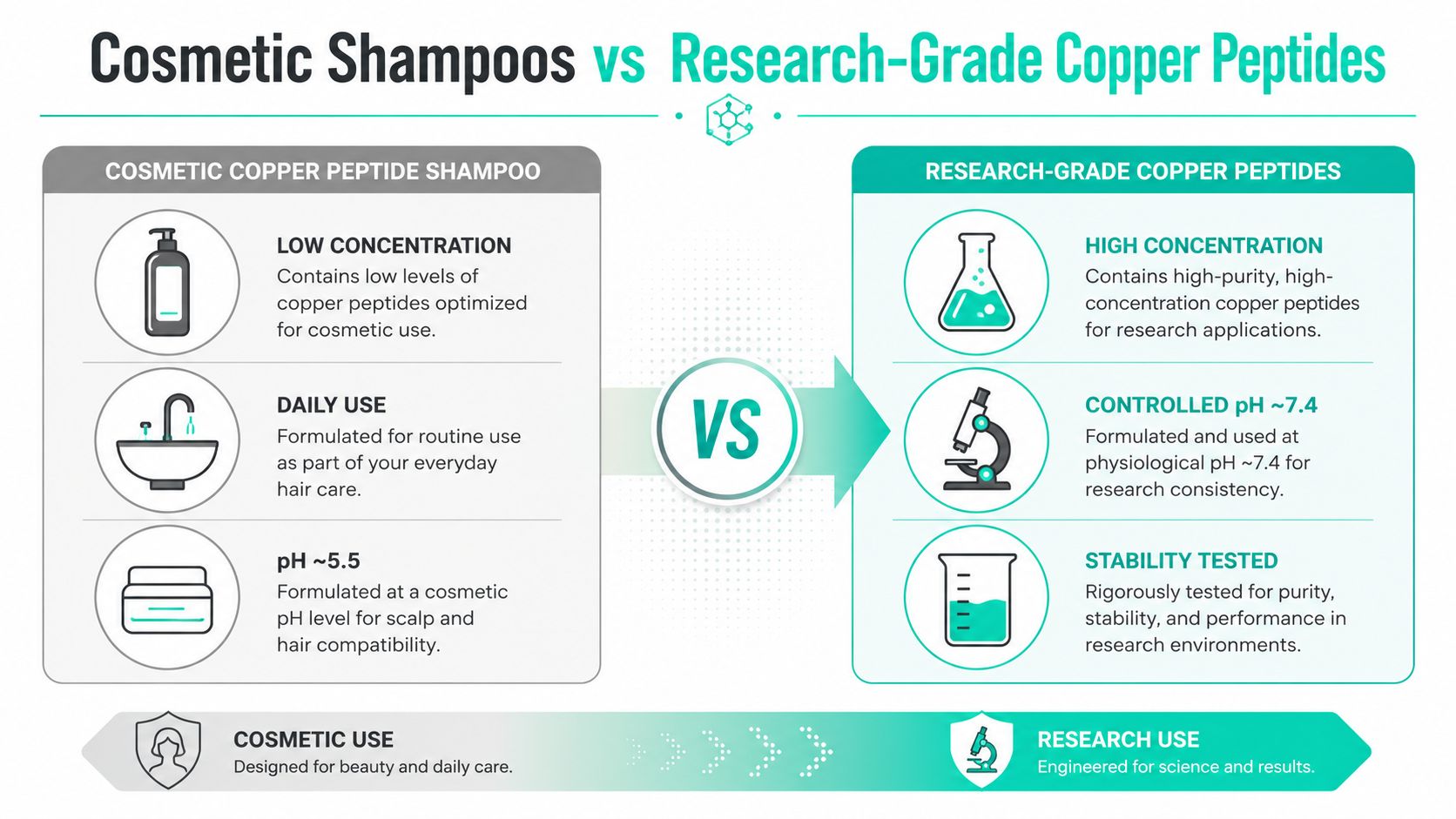
For a researcher, the first question is whether the material comes with a Certificate of Analysis, lot-specific identity confirmation, and disclosure of the analytical method used. Without that paperwork, it becomes much harder to interpret results or separate signal from formulation noise.
The buyer's question changes in cosmetics. A consumer wants to know whether the shampoo is reasonably formulated, whether the active concentration is disclosed, and whether the routine is practical. That is a different standard from lab verification, and a product can meet one standard while failing the other. A shampoo can be acceptable as a personal-care item and still be unsuitable for experimental use. Research peptide sourcing and quality context
Research suppliers often emphasize 99% purity because impurities can confound results. That figure does not prove effectiveness, but it matters in a lab where reproducibility is the point. In a shampoo, the same purity number carries less weight if the formulation does not keep the peptide stable or available during wash time.
The practical conclusion is straightforward. A consumer buying shampoo should focus on transparency, contact time, and routine fit. A scientist buying peptide material should focus on purity documentation and analytical traceability. Treating those standards as interchangeable leads to poor decisions in both directions.
Copper peptides are usually discussed as scalp-support ingredients, not as harsh actives. Most users tolerate them well, but tolerance is not the same as universal compatibility. If a scalp is already irritated, chemically processed, or overloaded with overlapping treatments, any active can become harder to judge.
The main caution is not a dramatic toxicity story. It's cumulative irritation and poor sequencing. A rinse-off product already reduces exposure compared with a leave-on serum, but that also means the scalp gets a shorter dose window and a smaller margin for error if the formula is aggressive.
A practical routine question is whether copper peptide shampoo can be used with minoxidil. The dermatology review notes layering with minoxidil is common, but that doesn't mean the two should be applied in a sloppy, back-to-back way without considering drying time and scalp comfort. The same source also notes caution around harsh chemical processing. Healthline copper peptide review
Copper peptides can be less predictable when paired with clarifying or heavily chelating washes, because those products are designed to remove buildup aggressively. Dye and bleach are another concern because freshly processed hair and scalp can be more reactive. The issue isn't just chemistry, it's how much stress the scalp barrier can handle at once.
If your scalp burns, flakes, or stays tight after washing, the formula is too strong for your routine, even if the label looks impressive.
The safest approach is to avoid treating shampoo as the only variable. Water temperature, contact time, frequency, and what else you apply to the scalp all shape the result. A well-tolerated formula used consistently is more useful than a stronger one that your scalp can't handle.
A defensible copper peptide shampoo should tell you what's inside, how it's delivered, and how long it's supposed to stay on the scalp. If a brand gives you none of that, the product is leaning on the ingredient's reputation instead of its formulation. That's a warning sign.
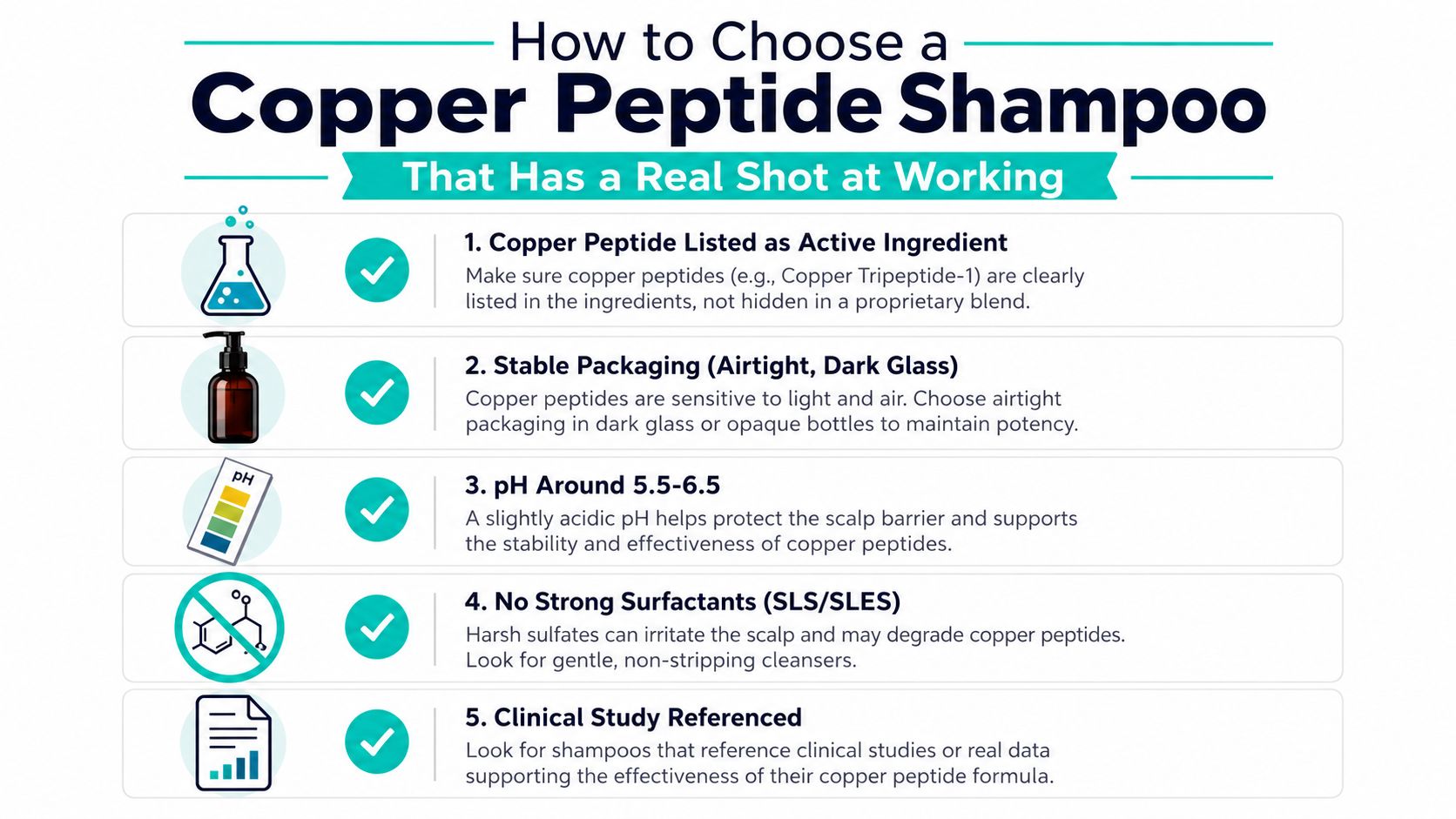
Start with the active list. GHK-Cu should be named clearly, and the concentration should be disclosed if the company expects you to judge potency. One market example shows that disclosure is possible, which makes vague labeling harder to excuse. HairGenetix product disclosure and market discussion
Next, look for contact-time guidance. A product that recommends a 3 to 5 minute window is at least acknowledging the short-contact problem. That doesn't prove efficacy, but it does show the brand understands the mechanism it's trying to sell. HairGenetix formulation notes
Then look at packaging and support materials. Airless or protective packaging makes more sense for unstable actives than a poorly sealed bottle left on a warm shower shelf. A detailed ingredient explanation or referenced study is also more useful than a generic “hair growth complex” claim.
| Buyer criterion | What to look for | Why it matters |
|---|---|---|
| Active disclosure | GHK-Cu named clearly | Lets you assess the product honestly |
| Contact-time guidance | 3 to 5 minutes or similar | Acknowledges rinse-off limitations |
| Routine fit | Works with your scalp and other treatments | Reduces irritation and sequencing errors |
| Verification | Third-party testing or lot documentation | Improves trust in quality control |
| Evidence language | References actual research, not hype | Helps separate signal from sales copy |
If your goal is maximum scalp exposure, a leave-on treatment is often the more honest format. Shampoo can still be useful, especially for people who want a wash-in habit and modest scalp contact, but it's a compromise. A compromise is fine if you know it's a compromise.
Third-party testing and peptide quality context
Use the contact time the brand provides, and don't assume a quick lather is enough. Product literature in this category commonly emphasizes a 3 to 5 minute window, because short contact time is one of the biggest constraints on rinse-off efficacy. HairGenetix formulation notes
Often, yes, but sequence matters. The dermatology review says layering with minoxidil is common, which makes this a routine-compatibility question rather than a prohibition. Let each product dry or settle as directed, and don't stack them in a way that clearly irritates your scalp. Healthline copper peptide review
The clearest summaries describe changes over 2 to 6 months of consistent use, not after a few washes. That timeline is drawn from mixed research and product summaries, so it should be treated as an approximate expectation, not a promise. Copper peptide research summary
They can be the same chemical species, but they are sold for different purposes. Research-grade material is about documentation, identity, and purity, while shampoo is about consumer use in a surfactant system. If you need controlled experimental material, the shopping criteria are completely different. GHK-Cu technical description
If you want research-grade peptides, clear documentation, and a supplier that treats quality control seriously, visit Celonyx Labs. Their catalog is built for buyers who care about purity, third-party testing, and dependable sourcing. For anyone evaluating copper peptide biology beyond marketing claims, that's the right place to start.
No controlled human study has measured hair count or follicle density after Epitalon exposure, and

Can peptides be shipped in hot weather without spoiling? Yes, with supported conditions. Learn to

Can you buy research peptides without a business account? Check seller eligibility, laboratory-use rules, and
FOR RESEARCH USE ONLY. Products sold by Celonyx Labs are intended exclusively for laboratory and scientific research. They are not intended for human or veterinary use, consumption, diagnosis, treatment, cure, or prevention of any disease. By purchasing from this site, you acknowledge that you understand the intended research purpose of these materials and agree to comply with all applicable laws and regulations.