AOD 9604 5mg Research Guide: Peptide Specs and Lab Use
You've just opened a shipment and found a small vial labeled AOD 9604 5mg. The

You open the vial, check the label, and immediately hit the same questions every bench scientist hits with Frag 176 191. Is the material the native fragment, what does the COA prove, and which readouts will stand up when somebody asks why this batch belonged in the experiment at all?
Those questions matter because this peptide sits at the intersection of structure, mechanism, and documentation. The wrong comparison can waste a week of work. The wrong handling step can blur a clean signal. And the wrong paper trail can make a result hard to defend even if the assay itself was run well.
A lab tech cracks open a chilled box, sets the vial on the bench, and scans the paperwork before touching a pipette. That's the true starting point for Frag 176 191 work, not a molecular diagram. The first question isn't whether the peptide has a story, it's whether the vial in front of you can support a controlled experiment without creating avoidable noise.
The practical stakes are simple. If the identity is fuzzy, you can't trust the comparison to another peptide. If the storage trail is weak, a later reviewer can question whether degradation or shipping conditions changed the material. If the experiment is framed around the wrong biological claim, you'll measure the wrong endpoint and end up with a pretty graph that doesn't answer the actual question.
Practical rule: treat the vial as a documentation problem before you treat it as a biology problem.
That mindset fits Frag 176 191 especially well because the literature itself is a mixed record. The fragment has historical importance in metabolic research, but human evidence is still limited, and the most useful papers are the ones that make their model choice obvious. The lab decision, then, isn't just “should we use it?” It's “what exactly are we trying to defend, and what batch evidence do we need before the work starts?”
The rest of the workflow follows from that. First, identify what the fragment is. Then decide whether the proposed mechanism matches the assay system. After that, compare the evidence base to the readouts you plan to use. If the material came from a supplier, the COA and handling instructions need to survive the same scrutiny as the biology.
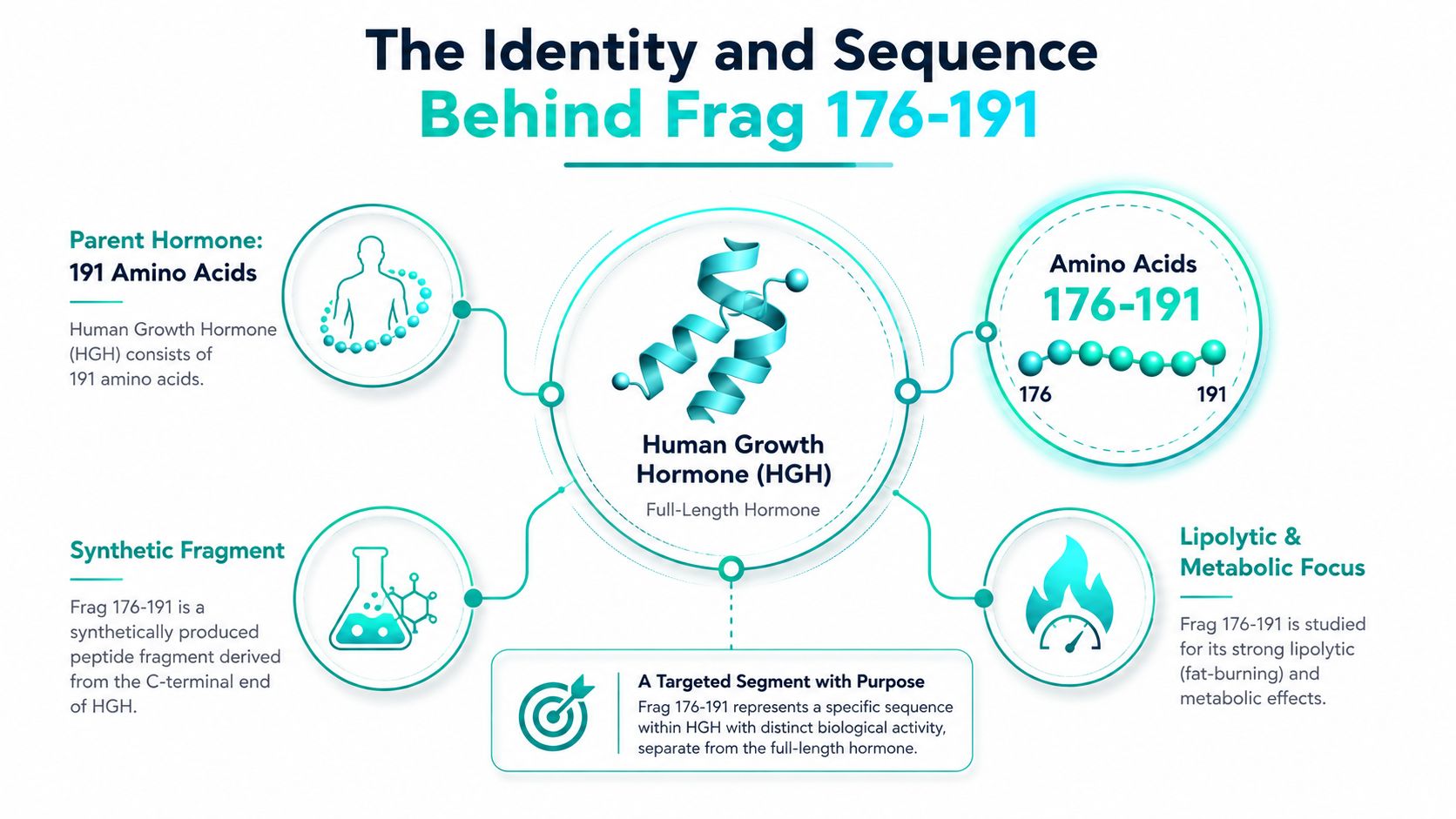
Human growth hormone is the parent molecule, but Frag 176 191 is not a reduced version of the full hormone. It is the C-terminal 176 to 191 region, a 16-amino-acid fragment isolated because researchers identified that segment as the part associated with fat-mobilizing activity particlepeptides.com. That distinction matters at the bench. You are not working with a diluted copy of HGH, you are working with a trimmed region selected for a specific research purpose.
A long technical memo can contain one paragraph that carries the instruction everyone needs. The full document still exists, but only that section gets tested, compared, and defended. In peptide work, the parent hormone provides context, while the fragment becomes the tool used for the assay question in front of you.
The fragment's size is the first practical identifier. Technical product sheets describe HGH Frag 176-191 as a 16-amino-acid C-terminal fragment with a molecular weight of about 1,815 to 1,817 g/mol technical data sheet. That mass range fits a small synthetic linear peptide, which is why sequence-based and mass-based QC sit at the center of identity confirmation.
For a new lab member, the takeaway is straightforward. The label should match the sequence position, the amino acid count, and the mass. If one of those does not line up, the material on the bench may still be a peptide, but it may not be the one your protocol assumes.
Researchers separated this region from full-length HGH because the fragment became a distinct research object, not just a shortened form of the hormone. Full HGH carries broad signaling implications. The fragment is handled as a narrower construct for metabolic work, especially studies around lipid handling. That narrower framing is why sequence identity carries so much weight in the methods section.
Bench note: if a sample's documentation cannot tie the vial to the 176 to 191 region unambiguously, do not treat it as interchangeable with full HGH or with another analog.
A lab usually meets Frag 176 191 through a simple question, what exactly is the peptide expected to do in the model, and what evidence is strong enough to defend that choice in the notebook or on the COA trail. The working idea is selectivity. In research models, the fragment is discussed as a peptide aimed at adipose-related activity rather than as a full-length HGH substitute, which is why it keeps appearing in lipid-metabolism discussions instead of broad endocrine replacement work. A recent review of the fragment's research history describes that focus in the context of metabolic study PMC review.
The practical comparison is narrower than the sales language around it. Full HGH carries receptor-linked effects that extend beyond fat tissue. The fragment was studied because researchers wanted the lipolytic region without the broader hormonal footprint, and that distinction is the one you need to defend when you choose readouts. If the documentation does not support that separation, the mechanism claim is too broad for a methods section.
If your assay is built around adipose tissue, lipid handling, or fat-mobilization readouts, the fragment can fit as a targeted research reagent. If the experiment needs canonical growth-hormone signaling, it does not. The fragment is not a stand-in for full HGH, and the literature around it works best when you treat it as a narrow metabolic question rather than a general endocrine model.
Protocol details decide how far you can trust the interpretation. Formulation, model choice, and assay conditions can shift how a peptide behaves in practice, even when the sequence looks correct on paper. A clean structural description does not guarantee a clean functional outcome. It only tells you the vial is aligned with the intended molecule.
The published summaries also expose the documentation gap that bench scientists feel right away. Claims about adipose selectivity are easy to repeat, but they are hard to operationalize unless the paper or vendor page identifies the tissue, the readout, and the controls. Without that trail, the mechanism stays a narrative instead of becoming a method.
Those three points keep the mechanism description defensible. Anything beyond them should be tied to the exact experiment on the bench.
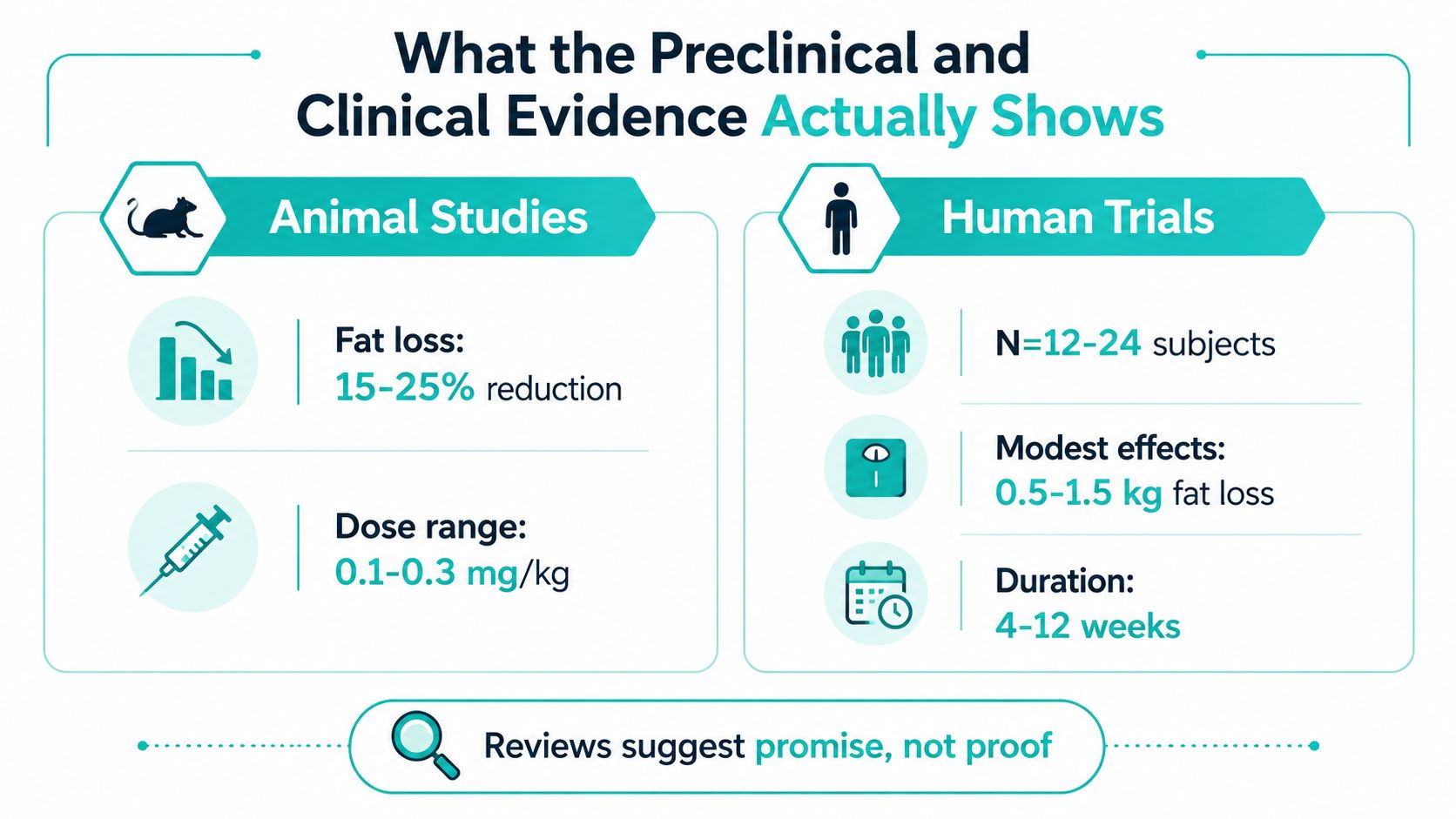
A lab team can read the Frag 176 191 literature without getting lost, because the evidence base is small and easy to map. Animal studies established the fat-loss angle, while human work stayed limited and did not turn the fragment into a broadly accepted therapy.
The most useful human summary is straightforward. A review noted that five clinical trials found no increase in IGF-1, no increase in insulin resistance, and no impaired glucose tolerance PMC review. That does not establish efficacy. It does show that the trials did not surface the metabolic liabilities people often associate with a growth hormone fragment.
The common mistake is to treat “safe-looking” as “proven effective.” Those are separate questions. The literature is better read as a record of how a hormone sub-region was isolated, modified, and tested across metabolic research models.
The human data are limited enough that endpoint selection matters as much as the peptide itself.
That is the frame I would use when choosing readouts. If the plan is to measure glucose tolerance, insulin resistance, or IGF-1, the trial summary argues for caution in how expectations are written into the protocol. If the plan is to look for adipose-specific changes in a preclinical system, the fragment's history fits better as a research tool.
Animal work can support a mechanistic hypothesis, but it does not close the translational gap. Human studies remain modest, and that boundary matters when a lab drafts protocols or internal reports. The fragment's value is partly historical, because it shows how researchers isolate a bioactive region, test it, and then decide whether the model justifies more work.
For a new team member, the takeaway is simple. Use the literature to choose endpoints and controls, not to promise an outcome the evidence has not earned.
The operational question most pages skip is the one that matters at ordering time. Do you want the native Frag 176 191 construct, or the AOD-9604 analog built from it? The historical link is clear. AOD-9604 was developed from the 176-191 fragment of human growth hormone and studied as a lipolytic, anti-obesity candidate, while the unmodified fragment is generally treated as a research-only construct rather than a broadly established human therapy particlepeptides.com.
That difference changes study design. The native fragment is the cleaner choice when you want to keep the sequence closer to the original HGH region and compare results against older fragment literature. The analog is more useful when your question is about a modified construct that has already been discussed in the context of lipolytic research.
A lab should ask three questions before picking one over the other.
That's a decision guide, not a product recommendation. The right choice depends on what your data need to prove.
| Feature | Frag 176-191, native | AOD-9604, modified analog |
|---|---|---|
| Sequence relationship | Native 176 to 191 HGH fragment | Developed from the 176 to 191 region |
| Research framing | Narrow fragment identity | Lipolytic, anti-obesity candidate history |
| Best use case | Comparing native-fragment studies | Working within analog-focused research designs |
| Documentation need | Strong sequence and mass confirmation | Strong analog identity confirmation |
The biggest trap is treating them as interchangeable because they share a common origin. They don't answer the same question. If the study asks whether a native sequence behaves in a specific model, use the native sequence. If it asks how a modified derivative fits into the metabolic literature, the analog belongs in the discussion.
The vial usually arrives lyophilized, and that means the first decision is solvent, not biology. For Frag 176 191, the right reconstitution approach depends on the assay you're planning, the concentration you need, and how long you expect the stock to sit before use. A one-size-fits-all recipe invites avoidable drift.
The internal logic is simple. Use the least disruptive diluent that still supports your assay, mix gently, and preserve aliquot integrity. If you're building a short-term working solution, plan around the experiment clock. If you're archiving stock, plan around stability and repeated freeze-thaw risk.
The Celonyx Labs reconstitution guide is one practical reference for setting up that workflow: Celonyx Labs peptide reconstitution guidance.
Those steps sound basic because they are. Most handling failures come from hurry, not chemistry.
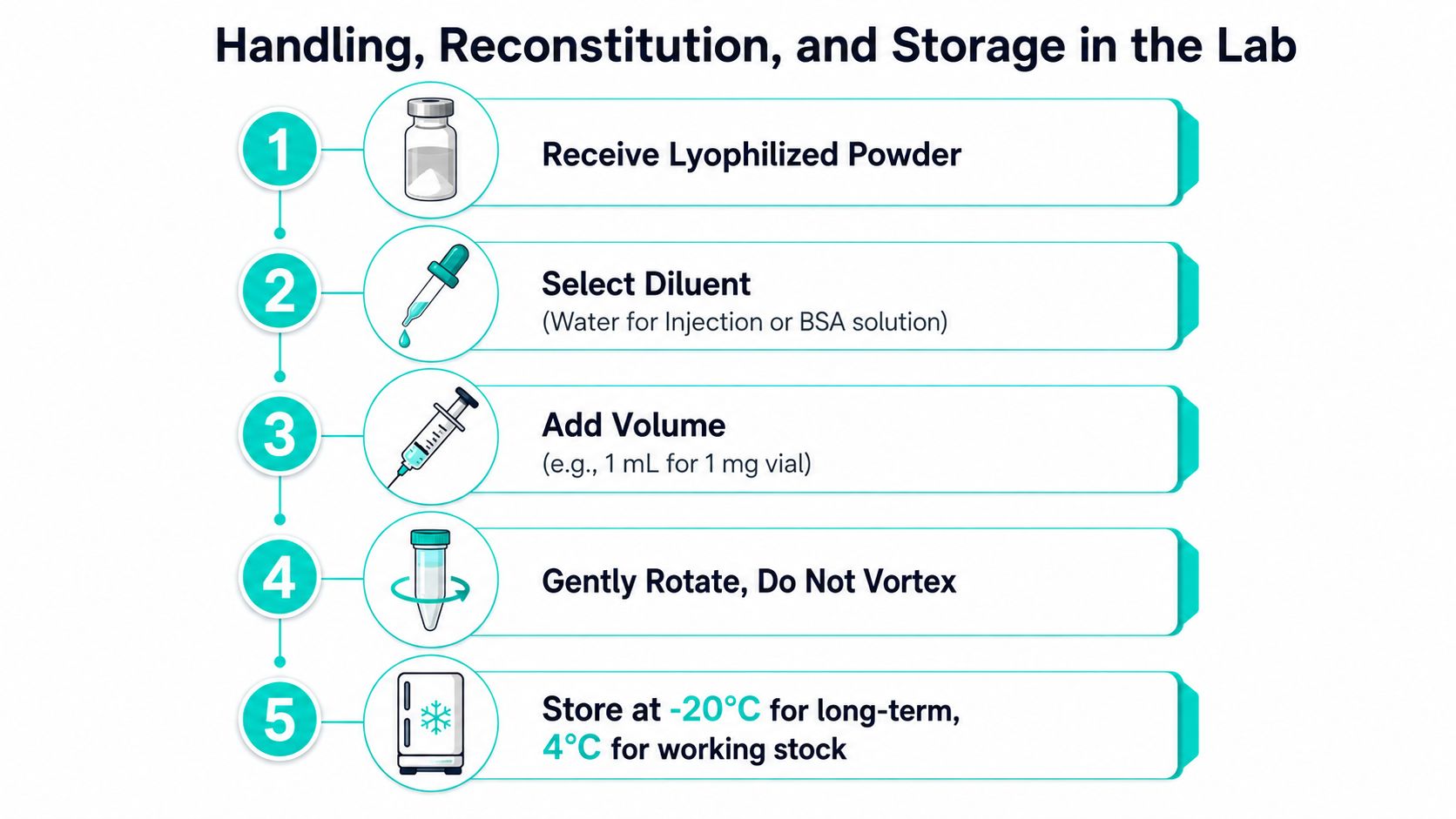
The usual failures are boring but costly. Oxidation, adsorption to plastic, and concentration drift can all blur a result enough to make interpretation messy. Storage temperature matters too. Working stocks and long-term archives should be separated so one experiment doesn't degrade the material for the next.
If a protocol doesn't state how aliquots are made, how long the reconstituted peptide sits, or what container is used, that omission deserves attention. The peptide may still be usable, but the experiment becomes harder to defend later.
A COA should answer one question, can you trace this vial back to a specific batch and trust what was tested? Public vendor pages often advertise 99% purity and third-party testing, but they don't always explain what was tested, how often COAs are updated, whether identity was confirmed with orthogonal methods, or how shipping and storage affect stability vendor page.
That gap matters. A generic purity claim is marketing. A batch-specific COA is evidence.
Start with the basics.
A missing line is often more important than a reassuring one. If a supplier says “third-party tested” but doesn't say what the third party measured, that isn't enough for a lab notebook, much less a paper.
The chromatography trace should support the stated purity, and the identity method should tell you the sequence matches the vial label. HPLC alone tells you about separation behavior. It doesn't prove sequence identity by itself. Mass spectrometry helps close that loop.
Auditor's rule: don't accept a COA that sounds impressive if it can't survive a batch trace audit.
The Celonyx Labs documentation page on verification is useful here as a supplier-facing example of what labs usually want to see: third-party peptide verification guidance. The broader point is bigger than any one vendor. If the document can't support procurement, storage, and internal review, it's not doing its job.
A vial of Frag 176 191 should be treated as research material with a paper trail, not as a consumer product with loose handling expectations. That status affects labeling, custody, storage, and disposal. If a lab handles it like a supplement, the documentation is already weak before the first assay starts.
Procurement should follow the same discipline used for other controlled reagents. Source history matters. Batch records matter. Contactability matters. If a supplier cannot explain what was tested, how it was stored, or who handled it before shipment, that supplier does not belong in a controlled workflow.
A sourcing guide for research peptide procurement is a useful framework for that kind of review.
Celonyx Labs publishes the operational details labs often need in a purchasing file, including store policies, customer support contacts, and a listed Dallas, Pennsylvania address. For a procurement team, that is not a sales pitch. It is the sort of record that makes a vendor easier to evaluate against institutional requirements.
If the documentation is thin, the better choice is usually to slow the order down, not push the experiment forward.
Treat Frag 176 191 like any other critical research reagent. Match the vial to the COA, tie the handling notes to the protocol, and keep the sourcing trail clean enough that a reviewer could inspect it without asking for a cleanup first.
If you are setting up a Frag 176 191 study and need batch-level documentation, research peptide catalog access, and clear order support, visit Celonyx Labs to review the available material and request the paperwork your protocol requires.
You've just opened a shipment and found a small vial labeled AOD 9604 5mg. The
Tesamorelin and sermorelin are compared for the same reason that weak evidence gets mistaken for

The shortest insulin syringe needle now used in mainstream practice is 6 mm, and a
FOR RESEARCH USE ONLY. Products sold by Celonyx Labs are intended exclusively for laboratory and scientific research. They are not intended for human or veterinary use, consumption, diagnosis, treatment, cure, or prevention of any disease. By purchasing from this site, you acknowledge that you understand the intended research purpose of these materials and agree to comply with all applicable laws and regulations.