HPLC MS Analysis for Peptide Research: A 2026 Guide
You're standing at the bench with a peptide vial, a vendor purity claim, and a
You're probably looking at a 5 mg vial of GHRP-6 because a study design has reached the point where reagent quality and handling start to matter more than broad theory. That's usually when mistakes happen. A peptide gets reconstituted in a convenient solvent instead of the right one for the assay. A stock sits too long in solution. A dose range is borrowed from a GH-release paper even though the actual endpoint is cytoprotection in a cell model where GH output is irrelevant.
That's where GHRP-6 5 mg stops being a catalog item and becomes a method variable.
GHRP-6 has a long research history, but the practical questions that affect reproducibility are still the ones new investigators ask at the bench: what exactly is in the vial, which salt form matters, how should the 5 mg format be reconstituted for your model, and how do you think about titration when you want non-GH effects without building an experiment around endocrine readouts? If you need a broader orientation to research peptides in laboratory workflows, start there. For GHRP-6 specifically, the details below are the ones that keep experiments clean.
A new postdoc receives a 5 mg vial of GHRP-6, prepares a stock by habit, runs a delayed cell assay two days later, and gets a protective signal that looks promising. At that point, the central question is not whether GHRP-6 can stimulate growth hormone release. The real question is whether the result reflects intact peptide, a controlled concentration, and an experimental design that separates endocrine signaling from direct cellular effects.
That is the standard for high-fidelity peptide research. With GHRP-6, reproducibility often breaks down before dosing begins. The usual failure points are mundane: incomplete material verification, a solvent choice made for convenience, stock concentrations that do not match the assay window, or handling conditions that introduce avoidable degradation. The 5 mg vial is popular because it fits pilot studies, receptor work, and small animal schedules without much waste. That convenience also encourages inconsistent bench practice.
GHRP-6 has a long research history under the code name SKF-110679 and is well established as a synthetic hexapeptide ghrelin receptor agonist. That background is useful, but it does not answer the practical questions that determine whether a dataset is interpretable. In my experience, the mistakes that cost time are rarely conceptual. They come from treating the vial as a generic peptide input instead of a defined reagent with specific constraints on reconstitution, storage, and dose selection.
For researchers who are newer to the field, a short grounding in research peptide handling and study context helps frame those constraints correctly.
The 5 mg format deserves special attention because it sits at an awkward middle scale. It is large enough to support repeated aliquoting and multi-condition screening, but small enough that every reconstitution decision changes the usable concentration range and the number of freeze-thaw events. That matters even more if the goal is to do more than confirm GH-secretagogue activity, and instead test reported cytoprotective or tissue-response effects under conditions where GH-driven and appetite-linked pathways could confound interpretation.
Practical rule: Treat the 5 mg vial as a chemistry problem first and a biology problem second. If identity, solvent environment, concentration, and handling window are not controlled, the assay result will not support a clean mechanistic conclusion.
This guide approaches GHRP-6 from that bench-level perspective. The focus is the part many summaries skip: how to use the 5 mg vial in real research models, how to think about reconstitution stability when timing is imperfect, and how to titrate exposure tightly enough to examine non-GH effects without letting the better-known endocrine activity dominate the readout.
A common bench mistake starts here. A 5 mg vial arrives labeled "GHRP-6 acetate," and the assumption is that sequence identity settles the chemistry question. It does not. For this peptide, the sequence is only the first control point. Salt form, counterion burden, and concentration planning all affect how cleanly a study can separate classic GH-axis signaling from the lower-signal cytoprotective effects that many groups now want to test.
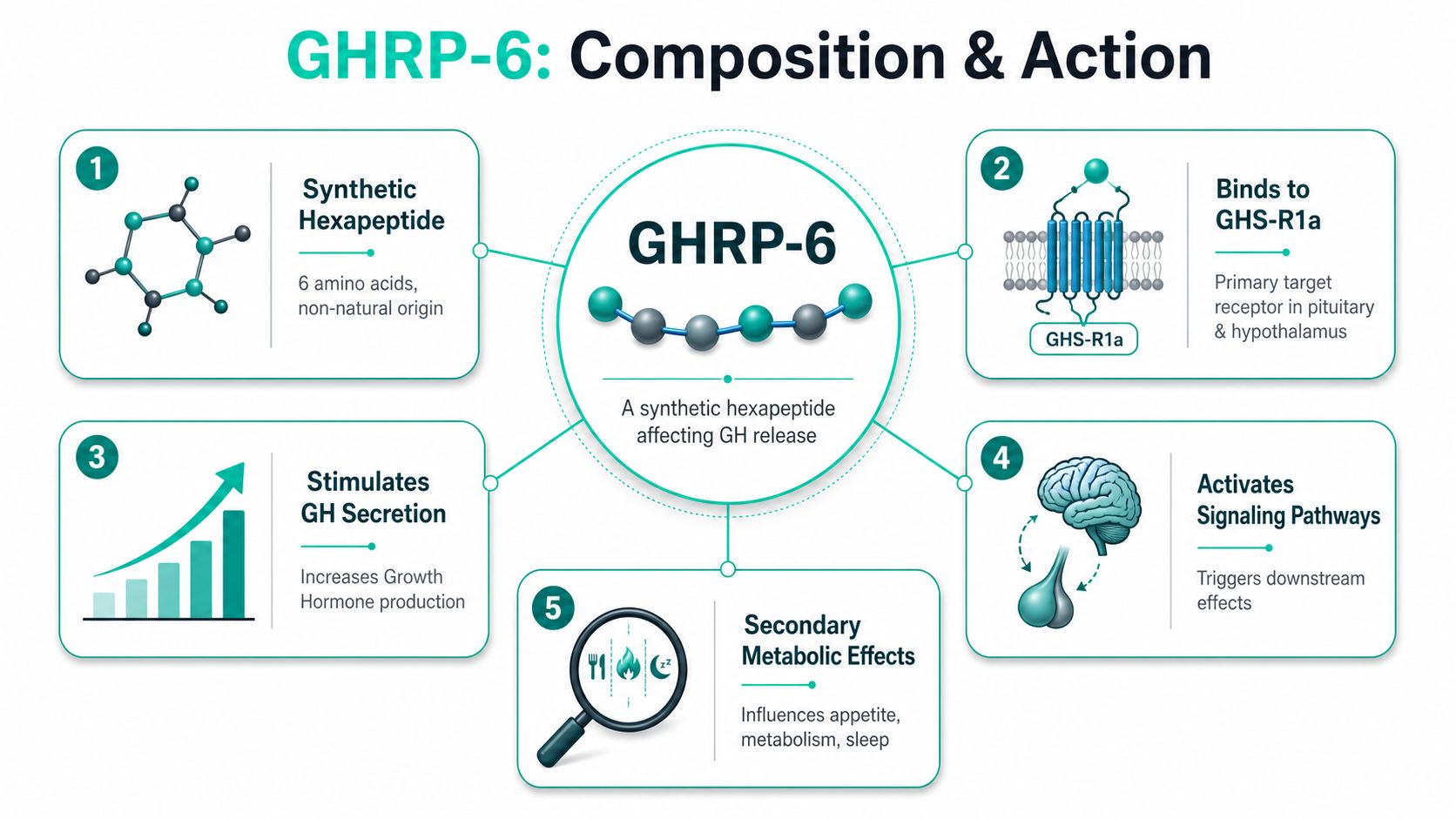
GHRP-6 is a synthetic hexapeptide with the sequence His-D-Trp-Ala-Trp-D-Phe-Lys-NH2. Its one-letter notation is HwAWfK-NH2, and the free base molecular weight is 873.02 g/mol. The reported mass for a prepared research lot can differ if the material is present as a salt, because the counterion changes how the final material is described and assessed in release testing. The acetate form is commonly selected for research use because it reduces concern about residual trifluoroacetic acid carryover in receptor and metabolism work, as described in the GHRP-6 acetate product chemistry summary.
That distinction affects experiments directly.
In receptor pharmacology, cell survival assays, and other systems that respond to small shifts in pH or trace contaminants, the counterion can change apparent activity enough to confuse interpretation. Sequence-confirmed material is not automatically assay-neutral material. Labs that get reproducible data usually record peptide sequence, salt form, stated purity basis, and reconstitution solvent as a single set of variables rather than treating them as separate paperwork fields.
A short reference table keeps the core parameters visible during study setup:
| Parameter | GHRP-6 detail |
|---|---|
| Class | Synthetic hexapeptide |
| Sequence | His-D-Trp-Ala-Trp-D-Phe-Lys-NH2 |
| Free base molecular weight | 873.02 g/mol |
| Primary receptor | GHS-R1a |
| Binding benchmark | Ki in the low nanomolar range |
GHRP-6 acts as an agonist at GHS-R1a, the ghrelin receptor. In practical terms, that means assay-relevant receptor engagement can occur at low concentrations, well below the mass levels some researchers choose by convenience when they reconstitute a 5 mg vial into a round-number stock. For mechanistic work, convenience concentrations are often the wrong starting point.
This matters most when the study goal is narrower than "show GH secretagogue activity." If the question concerns cytoprotection, tissue response, or stress signaling outside a dominant endocrine readout, dose selection has to limit the chance that strong GH-linked biology overwhelms the effect you are trying to measure. In my experience, this causes otherwise careful experiments to drift off target. The peptide is active enough that overconcentrated stocks and broad titration steps can turn a receptor-specific question into a mixed endocrine exposure study.
Three practical implications follow:
For GHRP-6, mechanism and formulation are tightly linked. If the experiment is meant to isolate non-GH effects, the peptide has to be treated as both a signaling ligand and a chemically sensitive reagent.
GHRP-6 is often encountered through its classification as a growth hormone secretagogue, and that's fair. It has a potent stimulatory effect on GH secretion, and its small molecular weight, metabolic stability, oral bioavailability, and relatively low price are part of why it has remained common in preclinical work, as summarized in the earlier clinical and product literature.
But limiting it to “GH peptide” is too narrow for current research use. The more interesting applications sit in tissue response models, where investigators care about survival signaling, fibrosis, and repair. In post-infarct animal models, GHRP-6 attenuated adverse ventricular remodeling and systolic dysfunction, with a strong trend toward reduced mortality of 10% versus 40% in controls, p = 0.0614, and it has been reported to prevent parenchymal fibrotic induration in more than 85% of treated cases while aborting hypertrophic scars in 90.5% of treated wounds, according to the open-access review on GHRP-6 and fibrosis-related models.
That same body of work also describes effects relevant to liver, kidney, and cardiac injury models, plus profound appetite stimulation as the most consistently documented side effect across studies. That appetite signal matters even when your endpoint isn't feeding behavior, because it reminds you that GHRP-6 often carries systemic biology into the experiment whether you wanted it or not.
The hard design problem with GHRP-6 5 mg is not whether it can stimulate GH. It can. The harder question is whether the model you're running needs that axis engaged.
Researchers using cardiac ischemia, hepatic injury, or cell-survival systems often want cytoprotection without endocrine confounding. That's where GHRP-6 becomes tricky. Existing literature supports the idea that some protective effects are at least partially independent of GH release, and a recent discussion of this gap notes that investigators still lack clear quantitative guidance for titrating the 5 mg vial to isolate non-GH pathways in routine experimental planning, as described in the Peptide Protocol Wiki discussion of GHRP-6 cardioprotective use cases.
A useful way to think about model selection is this:
| Research aim | What GHRP-6 can offer | Main confound |
|---|---|---|
| Pituitary or GH-axis work | Direct secretagogue activity | Appetite-related and peripheral effects |
| Cardiac or hepatic injury models | Cytoprotective and anti-fibrotic potential | Hard to cleanly separate from GH-linked downstream biology |
| Cell-based receptor studies | Defined GHS-R1a agonism | Reconstitution stability and peptide integrity |
Don't copy an in vivo GH-stimulation mindset into an in vitro survival assay. The same vial can support both, but the stock preparation and titration logic shouldn't be identical.
A 5 mg vial is convenient because it gives enough material for pilot work, replication, and concentration-ranging without forcing repeated procurement. It also creates a false sense of flexibility. If you reconstitute the full vial casually, you can lose more experimental value to degradation and handling variability than to any biological limitation of the peptide itself.
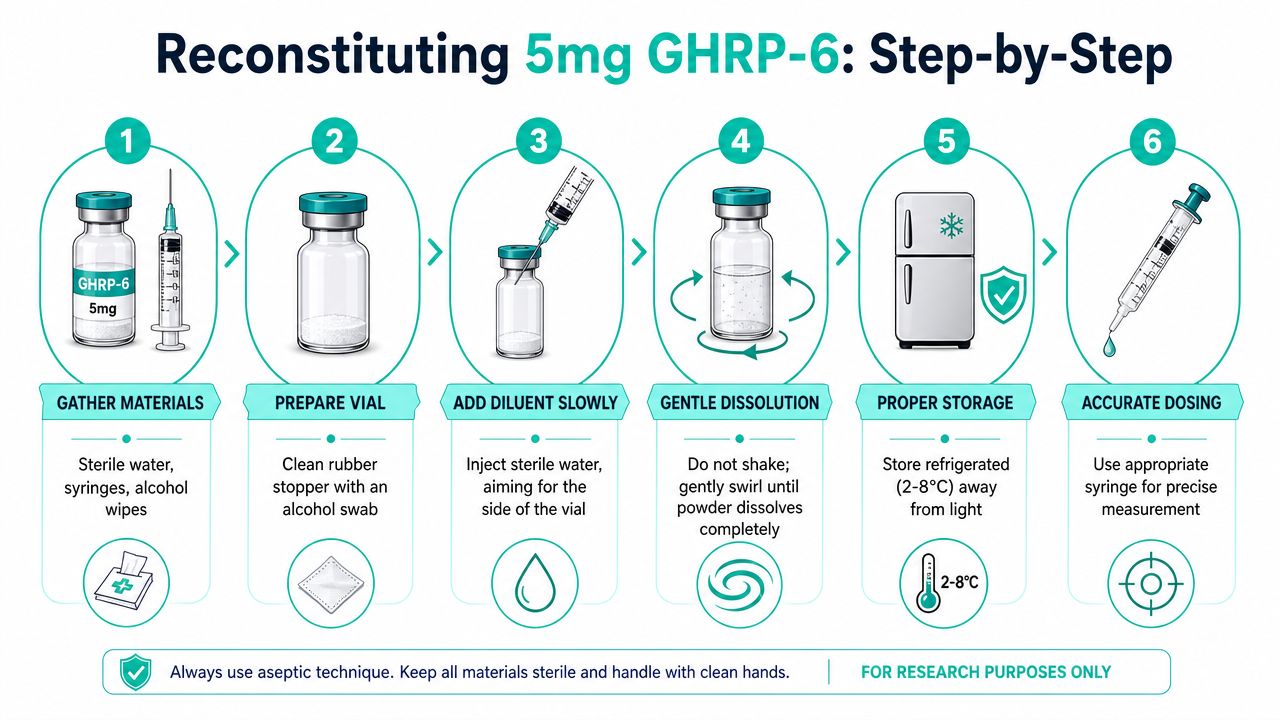
For a standard stock, many labs begin by deciding the target concentration backward from the assay. If you want a 1 mg/mL stock, a 5 mg vial requires 5 mL of diluent. That calculation is straightforward. What's less straightforward is whether that stock will remain suitable in your chosen solvent over the full window of use.
A practical workflow looks like this:
For a general primer on peptide reconstitution practices in research labs, that reference is useful. GHRP-6 deserves stricter discipline than many people give it.
A major unresolved issue is stability after reconstitution. There is an identified data gap in vendor-published stability information for reconstituted 5 mg GHRP-6 in low-volume aqueous solvents, and that gap matters because the peptide is described as prone to hydrolysis, with experimental validity compromised when handling protocols are built on guesswork, as discussed in the Frontiers in Pharmacology article on GHRP-6 cytoprotective research context.
Here's where labs often oversimplify.
Use the least disruptive solvent that maintains peptide integrity for the life of the experiment. If the assay is highly sensitive, prepare smaller working aliquots rather than relying on one repeatedly opened master tube.
A short demonstration can help visualize the physical handling steps:
Bench note: What works poorly is reconstituting the full 5 mg vial into a single large stock, using it intermittently, and assuming day-one and day-later material are equivalent. Unless your lab has validated that workflow, assume they aren't.
Store the lyophilized powder as a dry material problem. Store the reconstituted solution as a hydrolysis and handling problem. Those aren't the same, and treating them as the same is a common source of avoidable variability.
For the dry vial, your priorities are protection from moisture, light, and unnecessary temperature fluctuation. For the liquid stock, your priorities shift to reducing time in solution, minimizing exposure to room temperature, and avoiding repeated transfers. Once the peptide is in water, you've moved from passive storage to active degradation management.
The 5 mg format benefits from one simple habit: aliquot immediately after reconstitution if your workflow allows it. A single stock tube that gets opened repeatedly is a small procedural shortcut with a large downstream cost.
The most reliable storage habits are procedural, not heroic.
A concise reference for storing reconstituted peptides without unnecessary degradation is worth keeping in your SOP folder.
The peptide doesn't need to look cloudy or precipitated to be a bad reagent. Many failed peptide stocks still look perfectly normal.
A common failure point shows up before the vial ever reaches the bench. The label says GHRP-6, the purity claim looks acceptable, and the project moves ahead without anyone checking whether the supplier's records would hold up during troubleshooting six weeks later.
For a 5 mg vial, procurement should start with documentation quality, not catalog language. This format is often used across multiple assay days, pilot titrations, and follow-up repeats. If the material identity or lot history is weak, the resulting noise is hard to separate from true biology, especially when the goal is to isolate non-GH cytoprotective effects at lower exposure ranges rather than confirming only GH-axis activity.
Check four things before release into study use:
This screenshot reflects the kind of vendor environment researchers typically evaluate during procurement:
Independent verification helps, but receiving control matters just as much. Match the vial in hand to the batch record, archive the certificate package, and note any discrepancy immediately. If that chain breaks, later variance in receptor response, cell survival, or animal readouts becomes harder to interpret.
Purity is not just a purchasing criterion. It changes how confidently you can read the experiment.
GHRP-6 is often treated as a straightforward secretagogue, but the 5 mg vial is also practical for receptor pharmacology, injury models, and cell-based protection studies where the signal can be modest and concentration-dependent. In that setting, small differences in degradants, counterion load, or residual synthesis impurities can shift apparent potency, flatten a dose-response curve, or create false negatives at the low end of a titration series.
I pay close attention to this in studies designed to separate GH-mediated effects from direct cytoprotective effects. If the lot quality varies, investigators may blame model drift when reagent heterogeneity is the underlying problem.
Use a simple acceptance framework:
| Checkpoint | Why it matters |
|---|---|
| Identity confirmed | Reduces the risk of sequence or material mismatch |
| Purity reported clearly | Limits confounding from impurities and degradants |
| Lot documentation retained | Supports repeat work and failure analysis |
| Support is reachable | Resolves technical questions before dosing or assay setup |
No. It's often used that way, but that's too narrow. The same vial format also suits receptor pharmacology, tissue-injury models, fibrosis work, and cell-based survival experiments. The key is matching the preparation and titration strategy to the endpoint rather than to the peptide's most famous label.
The most consistently documented side effect across research studies is profound appetite stimulation, as noted in the earlier fibrosis and injury literature. If you're running animal work where feeding behavior or metabolic status could influence the endpoint, account for that prospect in the design.
Start with concentration math, not intuition. Decide the stock concentration you need for accurate pipetting, calculate the required solvent volume from the full 5 mg content, then derive working dilutions from that stock. For in vivo work, convert your final intended exposure into a per-animal or per-kilogram scheme using your institutional protocol. For in vitro work, build the dosing matrix from the assay volume and target final concentration.
In research settings, investigators do pair secretagogues with other GH-axis agents. Whether that's useful depends on the question. If you're trying to isolate direct cytoprotective effects, adding another endocrine-active reagent usually makes interpretation harder, not easier.
Using reconstituted stock beyond a validated stability window. With GHRP-6, that's especially risky because published vendor stability data for low-volume aqueous conditions remains limited.
If your lab needs GHRP-6 5 mg backed by stated 99% purity, independent third-party testing, and standard ecommerce ordering support for research use, Celonyx Labs is worth reviewing as a sourcing option.
You're standing at the bench with a peptide vial, a vendor purity claim, and a

PBS is a water-based salt solution of NaCl, KCl, Na2HPO4, and KH2PO4, adjusted to about

You're standing at the bench with a lipolysis assay ready to run, and the core
FOR RESEARCH USE ONLY. Products sold by Celonyx Labs are intended exclusively for laboratory and scientific research. They are not intended for human or veterinary use, consumption, diagnosis, treatment, cure, or prevention of any disease. By purchasing from this site, you acknowledge that you understand the intended research purpose of these materials and agree to comply with all applicable laws and regulations.