

Integrity Research BPC 157: How to Judge Vendor Claims
The advice you'll hear most often about buying BPC-157 for the bench is short: demand

A research-grade tesamorelin vial does not have a single standard cost: compare current supplier quotes for the same peptide quantity, specifications, and documentation. The vial amount alone does not capture your laboratory’s total procurement expense; include any separately quoted delivery, analytical verification, and preparation requirements. For a useful 2026 comparison, evaluate the documented material your experiment requires rather than the lowest vial total.
The useful comparison is a current quote tied to a defined specification—not a generic market average. Before comparing suppliers, establish exactly what each quotation covers and whether the material meets your protocol.
Use this sequence for your 2026 purchasing review:
For compound-specific sourcing considerations, see the guide to tesamorelin peptides for growth hormone research. Keep the purchasing decision separate from experimental design: a supplier listing does not establish the suitability of a material for your model.
A vial is a container, not a standardized analytical quantity. Two quotations described as research-grade tesamorelin are not equivalent unless their contents, specifications, and supporting evidence are comparable.
Your laboratory needs material that satisfies a defined purpose. A receptor assay, analytical method-development project, and reference-material application require their own acceptance criteria; a general research-use label does not replace those criteria.
Write the specification before requesting quotations. That order prevents a purchasing decision from quietly becoming a decision to accept less documentation or a different material.
Start with the amount supplied. Milligrams describe mass; milliliters describe volume, and the two cannot be compared directly without concentration information.
The basic conversions are fixed: 1 g equals 1,000 mg, and 1 mg equals 1,000 µg. Use the same mass unit throughout your purchasing worksheet so a unit change does not distort the comparison.
For a solution, a concentration of 1 mg/mL means 1 mg of material per 1 mL of solution. That relationship describes concentration only; it does not prescribe a preparation method, establish stability, or indicate an experimental dose.
| Quotation basis | Best for | What it helps you compare | Limitation |
|---|---|---|---|
| Per vial | Purchase-order entry | The quoted amount for one container | Does not normalize peptide quantity |
| Per stated milligram | Initial quantity comparison | Quotations expressed on the same mass basis | Depends on what the stated mass represents |
| Per documented peptide content | Analytical procurement review | Material quantity supported by content information | Requires an appropriate content measurement |
| Total procurement requirement | Project budgeting | Material plus separately identified purchasing requirements | Must use the same scope for every supplier |
These are comparison methods, not interchangeable measurements. Use the method that answers your purchasing question, and retain the original quotation alongside your normalized calculation.
For additional context, review research peptide vial size benchmarks by compound. Do not treat a general vial-size guide as evidence of a specific tesamorelin lot’s contents.
A purity result answers a different question from an identity result or a peptide-content measurement. Treat them as separate fields in your 2026 procurement record.
Chromatographic purity describes the relative contribution of detected components under the stated analytical method. An HPLC area percentage is not automatically the percentage of the vial’s total mass that consists of the intended peptide.
Identity testing supports whether the material corresponds to the intended compound. Mass spectrometry can support identity assessment, but interpret the result with the method and the other analytical evidence rather than as an isolated badge.
Peptide content concerns the amount of peptide in the supplied material. Water, counterions, and other non-peptide components can affect the relationship between total material mass and peptide mass.
Celonyx Labs sells 99%-pure, third-party-tested research peptides. That stated quality position does not replace your review of compound-specific and lot-specific evidence, nor does a purity percentage establish sterility, endotoxin status, or assay compatibility.
99% chromatographic purity does not automatically mean 99% peptide by mass. The meaning depends on the reported method and calculation basis; request a separate content measurement when your application requires it.
A larger vial is not automatically the better choice. Match the supplied quantity to your approved work, handling plan, and documented stability requirements rather than assuming more material creates better value.
Another peptide’s quotation is not a tesamorelin quotation. Differences in identity, synthesis, purification, quantity, and documentation prevent an unrelated listing from establishing what an equivalent tesamorelin vial should cost.
Separate differences in the material from differences in the purchasing arrangement. A quotation is useful only when you can identify what changes between offers.
For 2026 budgeting, keep each factor visible in a separate worksheet field. An unexplained difference between quotations is a reason to ask a precise question, not a reason to assume one supplier offers equivalent material on better terms.
A short, structured request reduces ambiguity. Give suppliers the same requirements and ask them to distinguish confirmed specifications from information that requires further verification.
State tesamorelin as the requested compound and specify the chemical form required by your protocol. Ask how the supplied quantity is determined and whether the reported amount is peptide content or another mass basis.
Request documentation linked to the material under consideration. Ask for the lot identifier, analytical methods, reported results, and testing dates so your laboratory can assess the evidence in context.
Request the supplier’s documented storage and shipping instructions for that material. If your workflow includes reconstitution, obtain relevant solvent-compatibility and stability information before selecting preparation supplies.
Ask for a dated quotation that separates the material from any additional charges or requested services. Record the quotation’s terms rather than assuming they apply to a later order.
Identify who approves the material and what evidence that person needs. Complete this review before committing the experimental schedule to a particular shipment.
The workflow is straightforward: define the material, review the lot evidence, confirm handling requirements, and approve the purchasing scope. Preserve that sequence in your procurement record.
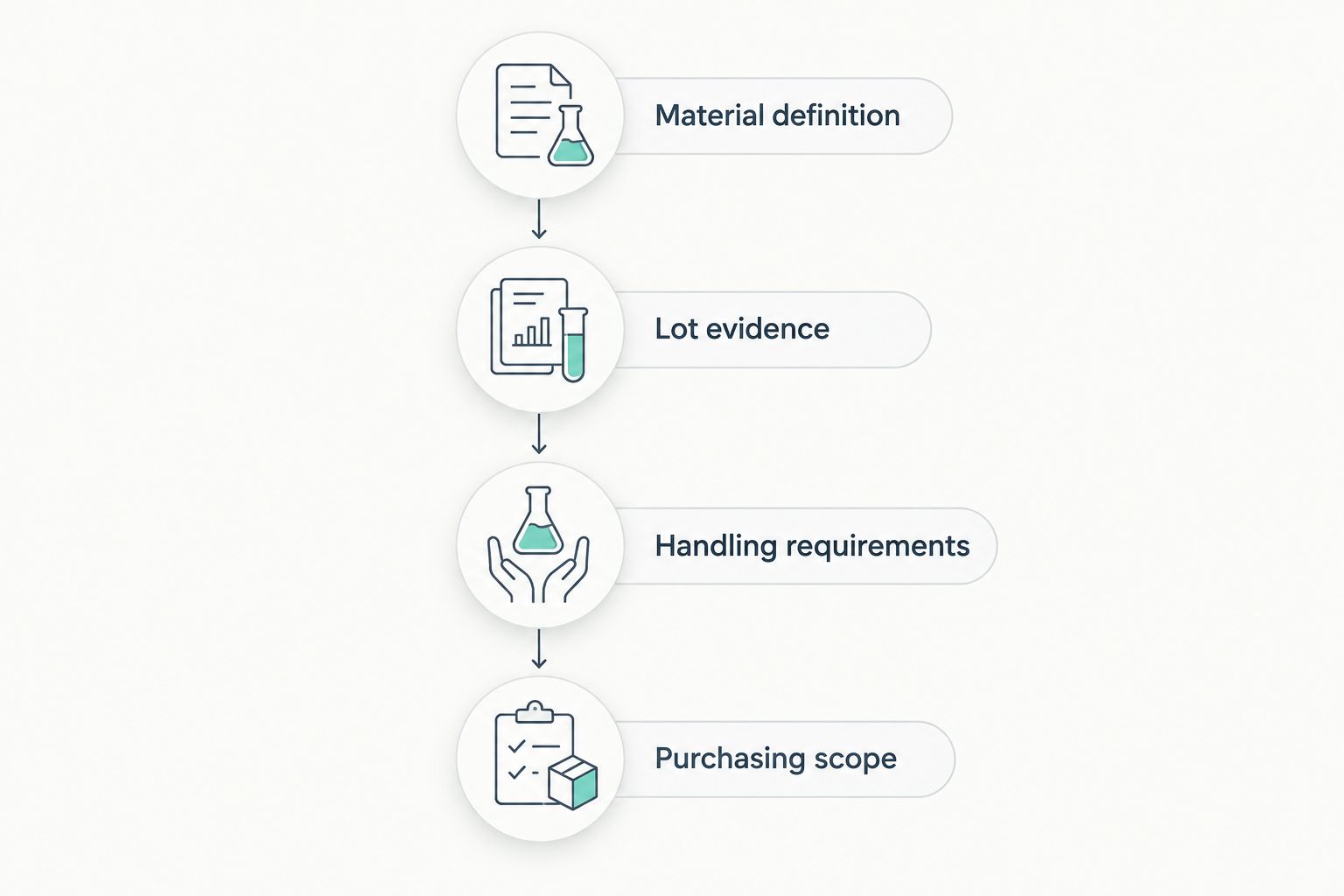
A complete request does not guarantee that every supplier will meet your specification. It gives your laboratory a consistent basis for accepting an offer, asking for clarification, or excluding a quotation from the comparison.
Preparation requirements belong in the project budget, but they must follow the approved protocol. Do not assume every lyophilized peptide uses the same solvent, concentration, container, or storage conditions.
If your application needs a particular buffer or analytical verification after preparation, identify that requirement before purchasing the material. Keep those requirements separate from the vial quotation so the laboratory can see what the full workflow involves.
Adding solvent changes concentration, not the original amount of peptide placed in the vial. The final concentration also depends on the actual amount present and the final solution volume, so retain the calculation basis in your laboratory record.
This is laboratory procurement guidance only. Research-use tesamorelin is not a substitute for a prescribed medicine, and this guide provides no instructions for human administration.
Celonyx Labs is best suited to laboratory researchers sourcing research-use peptides, not products for personal use. Its stated offering is 99%-pure, third-party-tested research peptides for researchers and scientists.
Those are relevant sourcing signals, but supplier-level statements are not the entire acceptance decision. Evaluate the exact compound, lot documentation, and specifications your work requires; do not extend a general quality statement into an unsupported claim about a particular assay.
For a 2026 supplier review, the practical benefit is a clear research-focused purchasing context. The limitation remains the same as with any supplier: your laboratory must establish whether the documented material meets its own requirements.
How much does a vial of tesamorelin cost for laboratory research?
Compare current supplier quotations for the same tesamorelin quantity, chemical specification, and documentation. A vial total alone does not account for differences in peptide content or separately quoted procurement requirements.
What should I compare besides the amount quoted per vial?
Compare stated peptide mass, chemical form, lot documentation, analytical scope, and delivery requirements. Keep preparation supplies and additional testing separate so every quotation covers the same purchasing scope.
Does 99% purity prove tesamorelin is suitable for my experiment?
99% purity alone does not establish experimental suitability. Review the analytical method, identity evidence, peptide content where relevant, and any additional specifications required by your protocol.
Is research-grade tesamorelin the same as a prescription product?
Research-use tesamorelin must not be treated as interchangeable with a prescription product. A research-use label does not establish suitability for human administration.
Can I compare tesamorelin with a different growth-hormone research peptide?
A different peptide does not establish an equivalent tesamorelin quotation. Compare tesamorelin offers with matched identity, quantity, specifications, and documentation rather than substituting another compound’s listing.
Does adding more solvent increase the amount of peptide in a vial?
Adding solvent does not increase the original amount of peptide in the vial. It changes concentration, which must be calculated using the documented material quantity and final solution volume.
What should I verify when reviewing Celonyx Labs research peptides?
Verify the exact compound, supplied quantity, lot-linked analytical evidence, and handling instructions against your laboratory’s requirements. Celonyx Labs describes its research peptides as 99%-pure and third-party-tested; those statements do not replace application-specific acceptance criteria.
A normalized comparison is only as sound as its denominator. Dividing a quotation by the label’s milligram amount does not establish a peptide-content comparison unless you know what that amount represents.
Before approving a tesamorelin purchase, ask one final question: does every quotation describe the same material on the same measurement basis? Resolve that question before treating the comparison as complete. For research use only; not for human consumption.
The advice you'll hear most often about buying BPC-157 for the bench is short: demand

Can cagrilintide be combined with GLP-1 peptides? Yes, in controlled research. Understand mechanisms, study controls,

Can Selank be combined with nootropic peptides? Yes, in controlled laboratory studies. Learn the controls,
FOR RESEARCH USE ONLY. Products sold by Celonyx Labs are intended exclusively for laboratory and scientific research. They are not intended for human or veterinary use, consumption, diagnosis, treatment, cure, or prevention of any disease. By purchasing from this site, you acknowledge that you understand the intended research purpose of these materials and agree to comply with all applicable laws and regulations.