

6 Acetic Acid: What It Means and Where It Fits in Research
What does “6 acetic acid” tell you about the bottle on your bench? Not much,
You're halfway through a cell-culture run when replicate viability starts drifting. The cells look healthy in one plate and stressed in another, so you check incubation, pipetting, and media preparation. The trail eventually leads to the PBS bottle, prepared by eye with an unverified pH and no documented salt weights.
PBS can look like “just saline,” but it's a controlled reagent in washes, dilutions, immunoassays, and sample handling. Small changes in ionic strength or pH can affect membrane integrity, antibody interactions, and protein solubility. A reliable buffer saline solution guide starts with one principle: measure every critical variable, and use the same documented workflow each time.
Phosphate-buffered saline, or PBS, is only useful when its composition is predictable. The standard formulation is designed to approximate physiological conditions closely enough for routine washing, dilution, and handling without sharply disturbing osmotic balance or pH. That narrow concentration window is why the recipe has settled around defined salt ratios rather than an informal range. The standard 1X formulation contains 137 mM sodium chloride, 2.7 mM potassium chloride, 10 mM disodium phosphate, and 1.8 mM monopotassium phosphate, with a final pH of about 7.4 (Sigma-Aldrich's 1X PBS preparation guidance).
A technician who adds salts by approximation may create a solution that appears clear and usable but behaves differently in an assay. Sodium chloride provides most of the solution's ionic strength, while the phosphate pair helps resist pH changes near physiological conditions. If either the salt balance or pH moves outside the laboratory's validated range, the buffer can become a hidden source of assay drift.
The word “PBS” doesn't identify one universal reagent. Your application may require a calcium-free formulation, a version containing calcium or magnesium, or a modified Dulbecco's PBS preparation with additional components. A calcium-free buffer is often the safer starting point for workflows involving chelation-sensitive reactions, while divalent-cation-containing variants may be selected for specific cell-adhesion studies. Those variants shouldn't be treated as interchangeable with standard PBS.
Sterility also depends on the downstream use. A buffer intended for routine bench washing has different practical requirements from one used directly with live cells, sensitive immunoassays, or imaging workflows. The water quality, pH target, sterilization method, storage conditions, and container-opening frequency should all appear in the relevant SOP.
Practical rule: Treat PBS as a process variable, not a background liquid. If an experiment is sensitive enough to require controlled temperature, timing, or pipetting, it's sensitive enough to require documented PBS preparation.
Use a calibrated balance, clean glassware, purified water, and a calibrated pH meter. Record the formulation, lot information for the salts, preparation date, final pH, sterilization method, and preparer initials. That record gives the team a way to distinguish a biological problem from a preparation problem.
A dependable workflow also prevents avoidable waste. The PBS solution guide from Celonyx Labs describes the same core preparation logic used in many laboratories: dissolve measured salts, adjust pH, and correct the final volume only after the pH is set. That order matters because the buffer concentration and the pH adjustment interact.
For routine work, the canonical 1X PBS formulation uses four salts in defined proportions. Per liter, the gram-scale recipe is 8.0 g sodium chloride, 0.2 g potassium chloride, 1.44 g disodium phosphate, and 0.24 g monopotassium phosphate, producing approximately 137 mM NaCl, 2.7 mM KCl, 10 mM Na₂HPO₄, and 1.8 mM KH₂PO₄ at pH about 7.4 (Sigma-Aldrich's PBS formulation reference).
A 10X stock scales the salt concentrations proportionally. It's made for later dilution, not for direct use in most washing or cell-handling steps. The working solution must be diluted accurately with purified water, and the resulting 1X solution should still be checked rather than assumed to be correct.
| Component | 1X Mass (g/L) | 1X Molarity | 10X Mass (g/L) | 10X Molarity | Physiological Role |
|---|---|---|---|---|---|
| Sodium chloride, NaCl | 8.0 | 137 mM | 80.0 | 1.37 M | Provides most of the ionic strength and supports osmotic balance |
| Potassium chloride, KCl | 0.2 | 2.7 mM | 2.0 | 27 mM | Contributes potassium ions to the salt balance |
| Disodium phosphate, Na₂HPO₄ | 1.44 | 10 mM | 14.4 | 100 mM | Supplies the basic phosphate component of the buffer system |
| Monopotassium phosphate, KH₂PO₄ | 0.24 | 1.8 mM | 2.4 | 18 mM | Supplies the acidic phosphate component and helps maintain pH |
| Final pH | About 7.4 | Not applicable | About 7.4 | Not applicable | Sets the working chemical environment |
The table reflects the standard 1X quantities and the proportional 10X scaling described in established PBS protocols, including the Cold Spring Harbor Protocols preparation method. The gram weights assume the specific salt forms listed. Substituting hydrated salts without recalculating the mass can change the molar composition, so the chemical form on the reagent label belongs in the SOP.
Variants are appropriate when the experiment requires them, but the names shouldn't be used loosely. PBS with calcium or magnesium contains divalent cations that can affect adhesion, enzyme activity, and precipitation behavior. PBS without calcium is preferable for applications where those ions could interfere. DPBS may include glucose or pyruvate, depending on the manufacturer and formulation.
The practical decision is to select one formulation for each validated use, assign it a clear name, and document whether it contains calcium, magnesium, glucose, or pyruvate. A bottle labeled only “PBS” leaves too much room for substitution and makes troubleshooting harder.
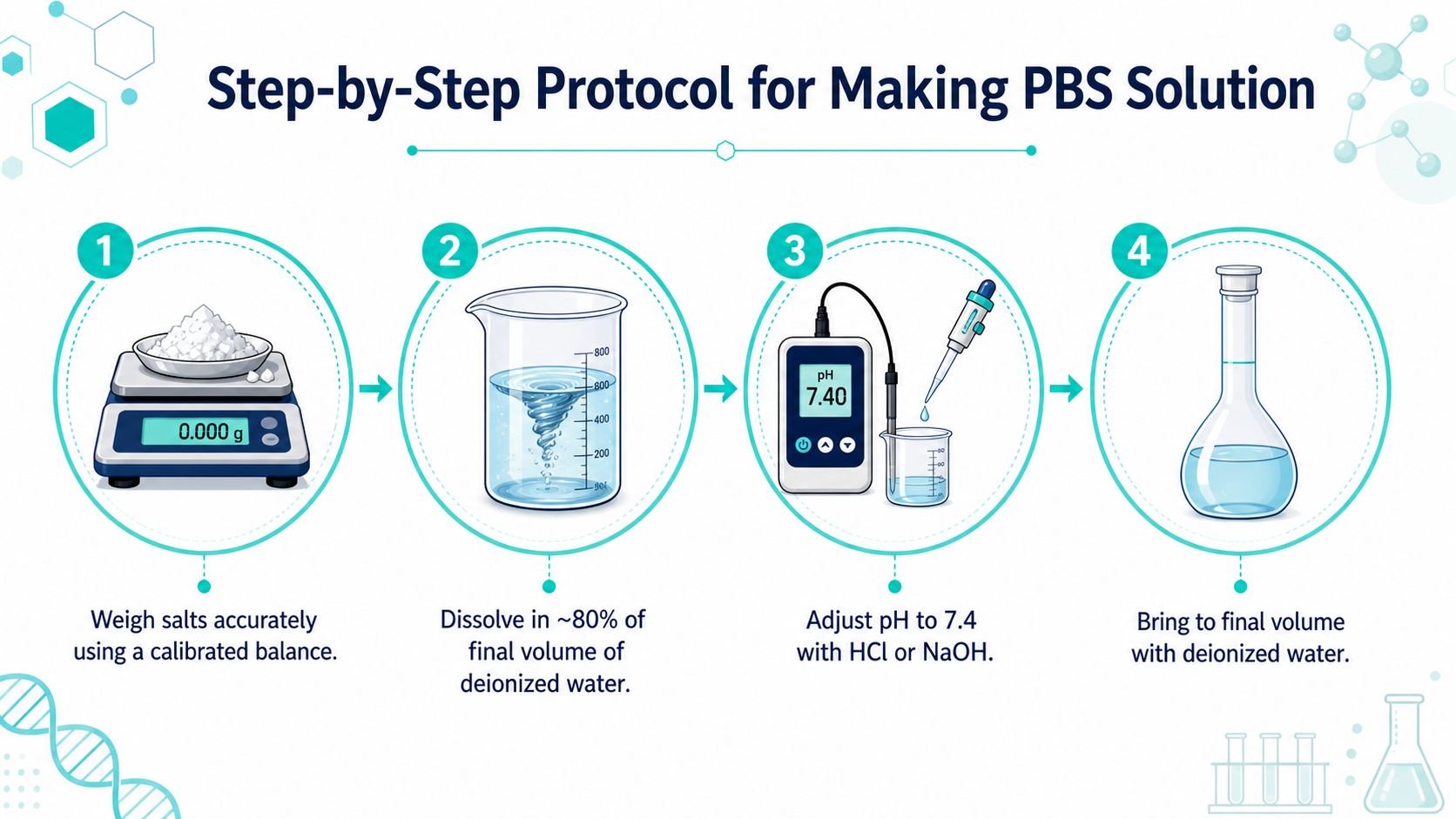
The most reliable answer to how to make PBS solution is procedural rather than approximate. Use the same order every time, and don't bring the mixture to its final volume until the pH has been adjusted.
Confirm the formulation. Check whether you're making 1X working PBS or a 10X stock, and verify the exact salt forms listed in the SOP.
Weigh each salt accurately. For 1 liter of 1X PBS, weigh 8.0 g NaCl, 0.2 g KCl, 1.44 g Na₂HPO₄, and 0.24 g KH₂PO₄. Use a calibrated balance and clean weighing vessels. Don't round small quantities by eye.
Start with roughly 800 mL of purified water. This leaves room for the pH-adjustment reagents and prevents overflow. Add the salts gradually while stirring until the solution is completely clear. The established 1X PBS protocol from Cold Spring Harbor uses this partial-volume approach before pH correction and final volume adjustment.
Calibrate the pH meter. Use the laboratory's approved calibration procedure and suitable standards. A recently calibrated electrode reduces the risk of accepting a silent measurement error.
Adjust to pH 7.4 with HCl or NaOH. Add the acid or base dropwise while stirring. For 10X stock, the concentrated solution can require proportionally more adjustment reagent, so add slowly and avoid overshooting.
Bring the solution to exactly 1 liter. Transfer the mixture to an appropriate volumetric container and add purified water to the final mark. Adding water before pH adjustment changes the concentration and can shift the apparent setpoint.
Verify the pH again after dilution. This second reading catches drift introduced during the final volume correction. If necessary, make a small dropwise correction and document the final reading.
Bench habit: Never top up to the final volume first and then make a large pH correction. Set the pH in the partial volume, complete the dilution, and verify the result.
Once the solution is clear and the pH is documented, sterilize it using the method validated for the downstream workflow. General protocols commonly use autoclaving for 20 minutes at 15 psi on a liquid cycle or filter sterilization, as described in the Cold Spring Harbor PBS protocol. Use sterile containers and aliquot in a way that limits repeated opening.
For scaling, multiply every salt mass and the final volume by the same factor. A half-liter preparation uses half of each listed mass, while a larger preparation requires the corresponding proportional quantities. Don't scale only the sodium chloride and assume the buffer will remain equivalent. Each component controls part of the final chemical environment.
The preparation sequence is also demonstrated in this laboratory protocol video:
Sterilization and stock concentration are separate decisions. A 10X stock can reduce preparation frequency, but it still needs a sterilization method that suits its formulation and use. Likewise, a freshly made 1X solution can be convenient for sensitive workflows, but it takes more preparation time and creates more opportunities for weighing or labeling errors.
Autoclaving is practical for standard PBS used in general cell-culture washes and routine histology workflows. The widely used protocol calls for 20 minutes at 15 psi on a liquid cycle, or filter sterilization as an alternative (Cold Spring Harbor Protocols). Heat treatment is straightforward when the formulation contains only heat-stable salts.
Filter sterilization is the safer choice when the solution contains heat-sensitive additives or when a formulation includes calcium or magnesium that may form phosphate precipitates during heating or storage. A 0.22 µm filter is commonly selected for sterile filtration, but the filter, vessel, and technique must be compatible with the solution volume and laboratory validation requirements.
Sterilization decision: Use the least disruptive validated method. Heat-stable, calcium-free PBS can often be autoclaved, while additive-containing or precipitation-prone variants deserve a filtration-first assessment.
Direct 1X preparation works well when usage is modest, the buffer is application-sensitive, or the laboratory wants to minimize repeated dilution steps. It also makes the concentration used at the bench explicit. The trade-off is more frequent weighing, pH adjustment, sterilization, and documentation.
A 10X stock makes sense for laboratories with regular PBS demand and a controlled dilution workflow. It reduces preparation frequency and can simplify inventory management, but incomplete dissolution, inaccurate final volume, or dilution mistakes can affect every working batch made from that stock. The 10X PBS preparation protocol emphasizes complete dissolution, calibrated pH measurement, exact final volume, and sterile aliquoting for this reason.
| Strategy | Method / Concentration | Shelf Life | Best For | Key Limitation |
|---|---|---|---|---|
| Fresh working solution | Direct 1X preparation, then validated sterilization | Set by the laboratory's stability validation | Sensitive assays and smaller workflows | Requires more frequent preparation |
| Concentrated stock | 10X preparation followed by accurate dilution | Set by formulation and local validation | Regular use and inventory control | Dilution and contamination errors affect multiple batches |
| Heat sterilization | Autoclaving of a compatible formulation | Set by local validation | Heat-stable, routine PBS | Can promote precipitation in some divalent-cation variants |
| Membrane sterilization | 0.22 µm filtration | Set by local validation | Additive-containing or heat-sensitive preparations | Requires compatible filters and controlled aseptic handling |
Storage space, opening frequency, contamination controls, and the sensitivity of the downstream assay should decide the strategy. If the lab repeatedly opens one large container, sterile aliquots may be safer than relying on a single bottle for every user.
For any workflow where sterility claims affect release decisions, pair the preparation record with the laboratory's established sterility testing process. Don't use a stock strategy just because it saves bench time if it makes contamination harder to detect.
Most PBS failures are traceable to a small number of habits. The solution may look acceptable while its pH, dissolution state, or precipitation behavior has already moved outside the intended specification.
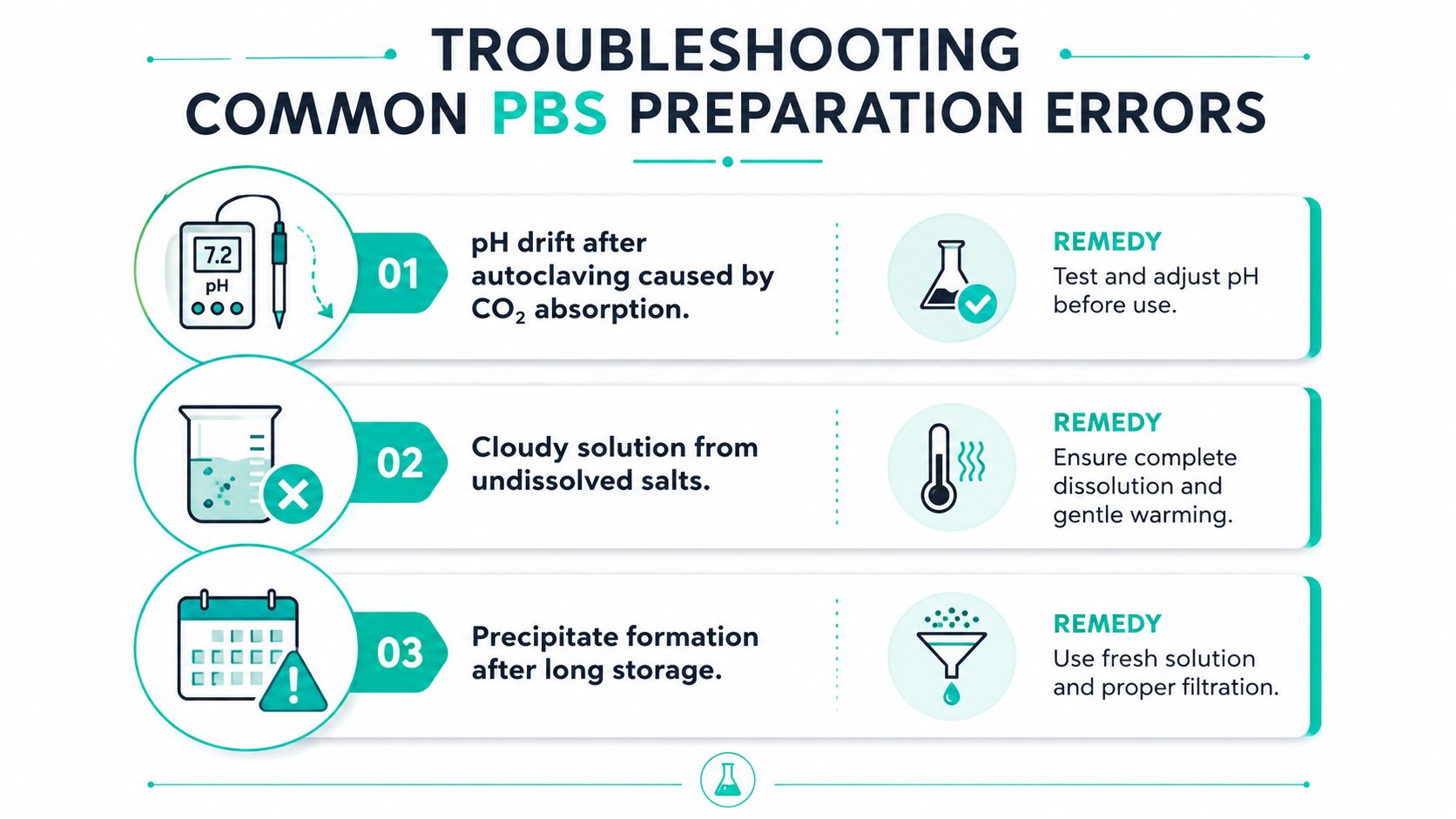
A pH reading can change after sterilization, cooling, or storage. Temperature affects the electrode response, and dissolved carbon dioxide can alter the solution's chemistry. Don't compare a hot post-autoclave reading directly with a room-temperature specification.
Let the solution return to the temperature defined in the SOP, then measure with a calibrated meter. If correction is permitted, add HCl or NaOH dropwise, mix thoroughly, and document the adjustment. If the buffer has been repeatedly opened or shows other signs of compromise, remaking it is safer than repeatedly correcting it.
Undissolved salts usually indicate incomplete mixing, inadequate dissolution time, or unsuitable preparation conditions. Adding all salts to a full final volume can make stirring difficult and leaves no practical room for pH adjustment.
Prepare the solution in roughly 800 mL of purified water at room temperature, stir until clear, and inspect the vessel before moving on. Don't sterilize a solution that still contains visible solids. If the material won't dissolve, stop and verify the reagent identity, salt form, water quality, and weighing record.
White precipitate is especially concerning in PBS variants that contain calcium or magnesium. Phosphate can interact with those ions, particularly during heating or cold storage. A clear solution before sterilization can therefore become cloudy afterward.
Use a compatible filter-sterilization approach for precipitation-prone variants, and follow the formulation's validated storage conditions. Don't shake the bottle and return visible crystals to an assay.
Discard rule: A buffer with cloudiness, particulates, or a pH outside the laboratory's approved range should be discarded and remade, unless your validated SOP specifically defines an acceptable corrective action.
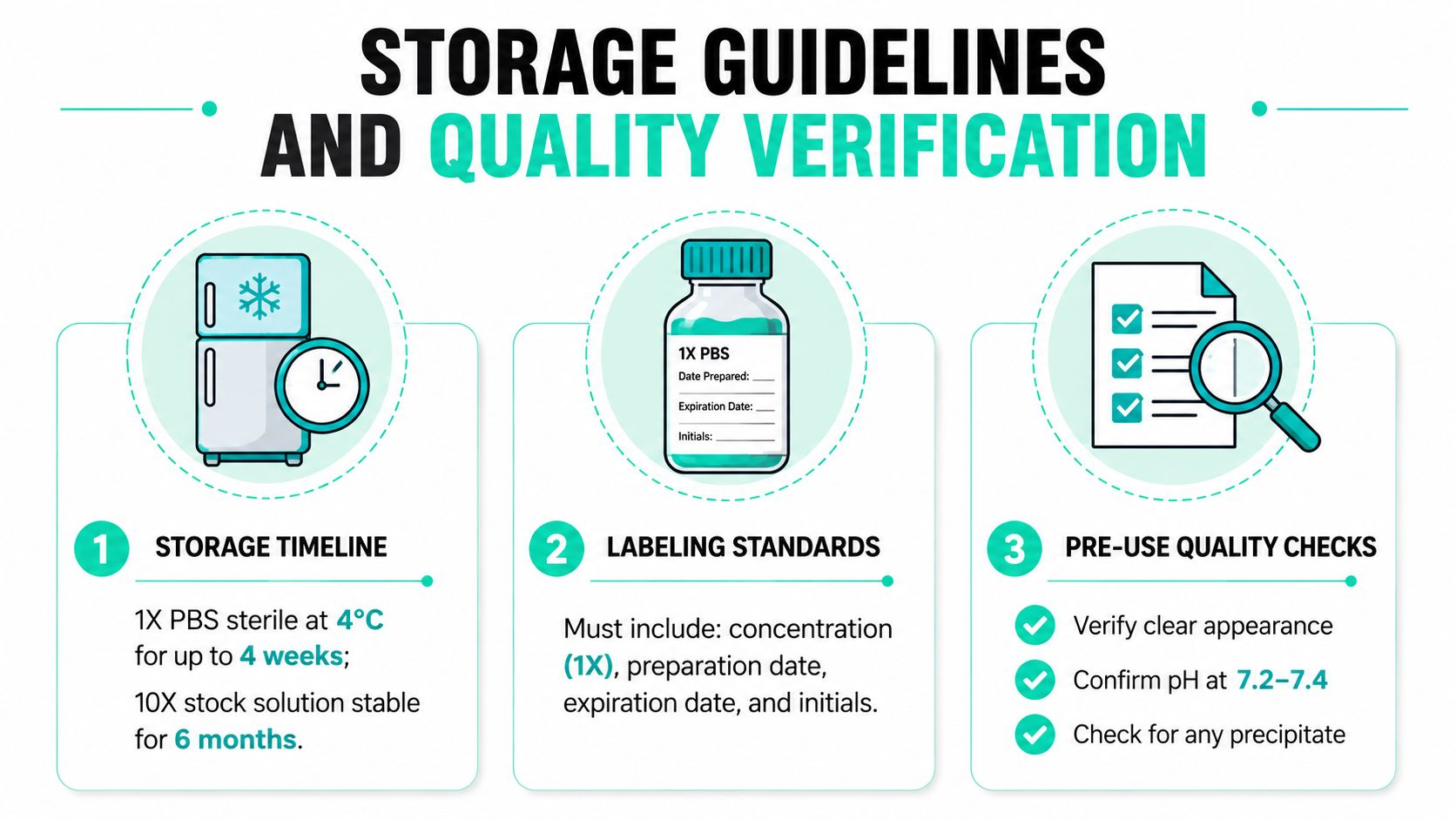
Storage decisions should be written on the label, not left to memory. For sterile 1X PBS, some laboratory guidance allows storage at 4°C for up to four weeks, while 10X stock guidance may specify six months unopened at room temperature and one month after first access. These timelines come from the supplied lab guidance and should be adopted only if they match your formulation, container, sterilization method, and local validation (St. John's Labs PBS preparation guidance).
Every container should identify:
Before use, inspect the solution against a light background. It should be clear, free from visible particles, and consistent with the approved appearance specification. Recheck pH with a calibrated meter when the application is sensitive or when the bottle has been stored, transported, or repeatedly opened.
Keep a simple batch record with the salt lots, measured masses, final volume, pH, sterilization cycle or filtration details, container identity, and any deviations. That documentation turns a vague “PBS problem” into a traceable preparation event.
Do not use expired or visibly contaminated material. Dispose of it according to institutional biosafety and chemical-waste procedures, including any required decontamination step before drain disposal.
Celonyx Labs supplies research peptides through an online laboratory catalog and references 99% purity and independent third-party testing for its products. Visit Celonyx Labs to review available research materials, product documentation, shipping information, and customer support options as you standardize your PBS and broader laboratory workflows.
What does “6 acetic acid” tell you about the bottle on your bench? Not much,
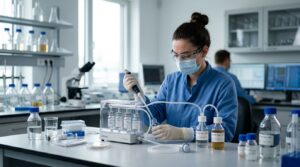
Best sterility testing kits for 2026 peptide labs: Endosafe nexgen-PTS wins on speed, Steritest for
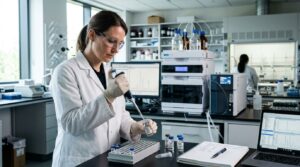
Compare the best peptide reference standards for analytical research in 2026, ranked by purity, COA
FOR RESEARCH USE ONLY. Products sold by Celonyx Labs are intended exclusively for laboratory and scientific research. They are not intended for human or veterinary use, consumption, diagnosis, treatment, cure, or prevention of any disease. By purchasing from this site, you acknowledge that you understand the intended research purpose of these materials and agree to comply with all applicable laws and regulations.