

Best low dead-space syringes for peptide research 2026
Choose a low dead space syringe for peptides by transfer volume, needle design, and material
Search for how to reconstitute IGF LR3 and you'll get the same answer almost everywhere: add a fixed volume of bacteriostatic water, roll the vial gently between your palms, refrigerate, and treat what's left as usable until it looks wrong. It's short enough to memorize and confident enough that nobody stops to question it.
The confidence is misplaced. The volume is arithmetic, and arithmetic is the easy part. Whether the vial in your hand should be opened at all is a decision about identity, approval, documentation, and who accepts responsibility if the answer turns out to be wrong. Most failed preparations in a peptide lab don't come from swirling too hard. They come from a seal broken before anyone checked the lot.
The gate rule: the paperwork closes before the seal does. A vial with no matching certificate, no approved solvent, and no named signatory isn't a protocol waiting to start. It's a vial that stays closed.
This walkthrough is for the person who signs the log: quality leads, principal investigators, and lab managers running IGF-1 LR3 work in academic, CRO, or preclinical settings. It treats reconstitution as a gated procedure with numbered steps inside the gate, and it says plainly where the honest answer is "no data exists for that" instead of a borrowed figure.
Six documents sit between the shipping box and the biosafety cabinet, and each one closes a specific question. None is optional, and none can be closed retroactively by a good-looking result, because the point of the packet is to know what you worked with before you learn what happened.
Start with the certificate of analysis. The lot number on the report has to match the lot number on the vial label exactly, and the report should show HPLC purity, mass spectrometry identity, and the date the testing was run. Those three answer one question: is the material on this bench the material that was tested. A certificate that's undated, generic, or tied to a different lot leaves you holding an unverified vial no matter how confidently the supplier describes it. Our guide to the peptide certificate of analysis walks through the fields to check line by line.
| Document | What to Confirm | Why It Matters | Record in Your Log |
|---|---|---|---|
| Certificate of analysis | Lot number matches vial label; HPLC purity and mass spectrometry identity reported | Confirms the material on the bench is the material that was tested | Lot number, test date, method |
| Product information sheet | Storage temperature, light protection and stated handling limits | Sets the boundaries the lab must work within | Document version and date |
| Research-use statement | Material is labelled for laboratory research only | Defines permitted use and prevents misuse | Copy filed with the order |
| Institutional protocol or SOP | Approved reconstitution steps, solvent source and handling limits | Replaces any generic online method | Protocol number and approval date |
| Responsible person sign-off | Principal investigator or qualified pharmacist confirms solvent and target concentration | Assigns accountability for the preparation | Name, date and signature |
| Biosafety approval | Work area and sterility controls cover peptide handling | Protects personnel and sample integrity | Approval reference number |
The product information sheet turns storage from a preference into a boundary. Whatever temperature range, light protection, and handling limits it states become the outer edge of what your protocol may do, and you record the document version and date so a later revision doesn't rewrite history. The research-use statement is short but load-bearing: it defines permitted use, so a purchase order that describes clinical or veterinary work doesn't match the material and shouldn't clear purchasing.
An institutional SOP or protocol names the reconstitution steps, the solvent source with vendor and grade, and the handling limits for the reconstituted material. This document outranks everything else, including the steps further down this page. Where your approved protocol and a general guide disagree, the protocol wins, and the difference gets noted rather than debated at the bench.
The principal investigator or qualified pharmacist then confirms two variables specifically, the solvent and the target concentration, and signs and dates that confirmation. A signature on a page that says "as directed" assigns nothing to anyone. Make the sign-off name the solvent by name and the concentration by number, because accountability travels with specificity.
Biosafety approval closes the last row. Peptide handling in a shared lab needs the cabinet, the waste stream, and the sterility controls inside an approved scope. If that approval predates peptide work in the space, the row is still open, even if the cabinets are certified and the benches look immaculate.
A volume calculator shortens the arithmetic once these rows are closed. We offer a Peptide Reconstitution Calculator on the Celonyx Labs site for exactly that stage, and it doesn't substitute for a single entry above.
If any row is missing or mismatched, the vial stays closed. Not "closed for now", closed, with the stop logged: date, time, the row that failed, and the initials of the person who caught it.
The issue then goes to the supplier or the protocol owner by phone or email, and the reply is filed in the same log before the next session begins. A certificate reissued for the correct lot, a written confirmation of solvent compatibility, a revised protocol page: each is a document, and each closes the row it answers. Verbal reassurance that "everyone uses that water" is not a document, and it doesn't close anything.
Stop condition: a missing row is a finding, not a delay to work around. Working around it is how a batch becomes untraceable.
With the packet closed, the procedure itself is short. The sequence below is written to be adapted to your approved protocol, and each step exists because of what it protects, either the material or the person handling it.
The flow below maps the setup phase that comes before the first drop of solvent.
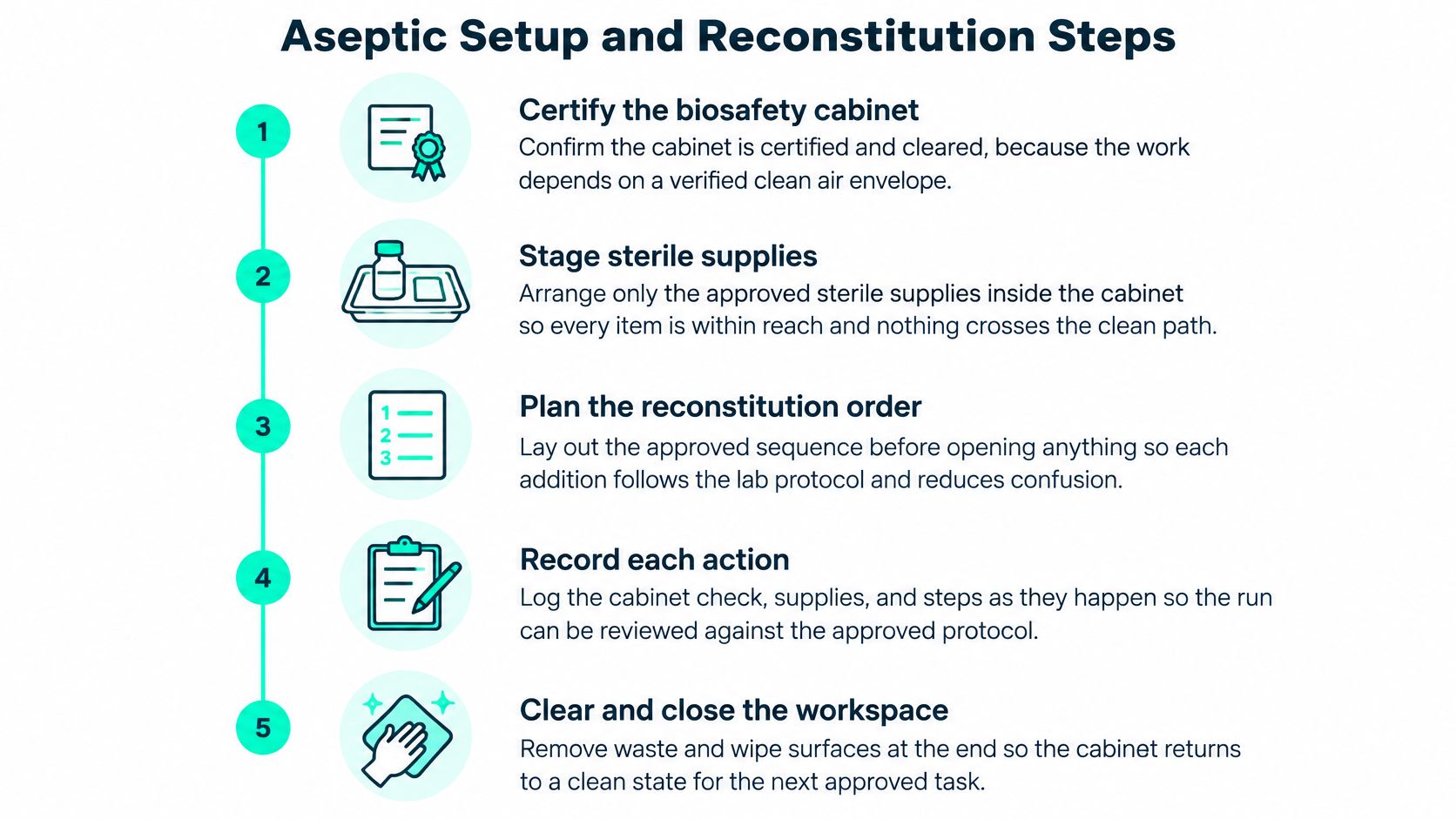
Done in that order, you finish holding a clear solution, free of visible particles, with a record that says precisely how it got there and who touched it.
The mistake is easy to make and hard to notice. Exactly one IGF-1 product in the United States carries an FDA-approved label, so teams borrow its numbers wholesale: the storage range, the post-entry window, the assumption that a diluent is a diluent. Those numbers belong to a different molecule in a different container.
The approved product is INCRELEX (mecasermin), and the FDA labeling for mecasermin describes it as a sterile, aqueous solution rather than a powder a user reconstitutes. It contains 10 mg/mL mecasermin in a formulation with 9 mg/mL benzyl alcohol, 2 mg/mL polysorbate 20, sodium acetate, sodium chloride, and water for injection at about pH 5.4. Its labeled storage is 2 to 8°C, with stability for 30 days after first vial entry and an instruction not to freeze it.
That entire set of figures is calibrated to one molecule, one concentration, one excipient blend, one container, and one validated sterility process. None of it establishes a safe diluent, a working concentration, a shelf life, or a handling procedure for IGF-1 LR3, which is an experimental analog without validated human-use preparation instructions.
The gap is real and it doesn't close itself. Unless a supplier provides molecule-specific data for the exact lot, the solvent, the pH after mixing, and the usable window for reconstituted IGF-1 LR3 are unknown, and any confident figure you find online for them belongs to somebody else's formulation.
Keep intended use in view while you work. Material sold for research must not be presented as suitable for human injection, and no unvalidated reconstitution method should be used for clinical, fitness, or self-administration purposes. Our IGF-1 peptides overview covers what the analog modification changes about the molecule.
Three items have to be in hand before the first numbered step runs: a lot-specific certificate of analysis, the supplier's written storage statement for that lot, and a solvent and target concentration named in an approved protocol. Two out of three isn't a start, it's a stop.
Records outlast the solution, which is why they carry more weight than the vial does. Getting the numbers straight first prevents the common habit of treating pharmacology as a storage instruction.
A 1999 rat wound-fluid study reported a measured half-life of 563 minutes for LR3-IGF-1 against 872 minutes for native IGF-1, roughly 9.4 versus 14.5 hours in that experimental compartment, as summarized in the pharmacology notes on IGF-1 LR3. Those figures describe biological clearance in rats. They say nothing about chemical stability in a reconstituted vial, and no validated human plasma half-life has been established for the analog to convert them into one.

Other matrices don't transfer either. A 2024 study by the National Health Laboratory Service and collaborators found that human serum IGF-1 remained stable for at least 72 hours regardless of delayed centrifugation or storage temperature, per the Clinical Chemistry and Laboratory Medicine report. That's a serum-handling result. It says nothing about a peptide solution in a septum-sealed vial, and citing it as a shelf life would be a category error.
Four separate measurements: biological clearance, solution stability, sterility, and potency retention each answer a different question. A record has to show which one was checked, by what method, on what date.
| Measurement | Evidence in hand | Record to keep |
|---|---|---|
| Biological half-life | 563 vs 872 minutes in a 1999 rat wound-fluid study | Source noted only; not a storage input |
| Solution stability | None published for IGF-1 LR3; a labeled post-entry limit exists only for the approved mecasermin formulation | Beyond-use date set by protocol owner |
| Sterility | Not established by appearance for reconstituted IGF-1 LR3 | Aseptic technique log and cabinet record |
| Potency retention | No assay data supplied for IGF-1 LR3 | Test results named in the protocol, with date |
The handling record itself stays short and specific. Keep the lot number, the date and time of reconstitution, a storage temperature log for the refrigerator or freezer the vial lives in, the freeze-thaw count, the number of withdrawals through the septum, any light exposure, and the beyond-use date assigned by the protocol owner rather than by whoever is holding the vial.
A multi-day usable window stays unvalidated until the supplier provides molecule-specific stability data, so assign the shortest date your evidence supports. If the evidence is a single aseptic preparation on a single day, the date says that. Our guide to storing reconstituted peptides covers the container and temperature side of that record in more detail.
The most common problem is the one people talk themselves out of: a solution that's cloudy or hazy where it should be clear. The rule has no exception for expensive vials. Stop, don't use it, and write down what you saw before the vial moves off the bench.
| Symptom | Likely Cause | Lab Action |
|---|---|---|
| Cloudy or hazy solution | Incomplete dissolution, contamination or excipient precipitation | Stop and do not use; record lot, photograph and report to supplier and protocol owner |
| Visible particles | Aggregation, contamination or container defect | Quarantine the vial; document and report; do not filter unless a validated protocol allows it |
| Unexpected pressure or volume on opening | Seal or fill issue | Note in log, keep vial unused, contact supplier |
| Label or lot mismatch | Wrong vial selected or incomplete records | Halt work and reconcile against the certificate of analysis before proceeding |
| Suspected contamination during aseptic steps | Break in technique or cabinet fault | Discard per SOP, investigate, and retrain staff as needed |
Visible particles deserve a separate word, because the instinct is to filter them out and carry on. Particles point to aggregation, contamination, or a container defect, and pulling the solution through a syringe filter outside a validated protocol turns a documented failure into an undocumented one. Quarantine the vial, photograph it, and report it.
An unexpected hiss or an odd fill volume at opening suggests a seal or fill problem, so the vial stays unused and the supplier hears about it. A label or lot mismatch halts work until someone reconciles the records against the certificate, even when the mismatch looks like a filing error.
Clarity is an optical property. Sterility is a microbiological one. One does not tell you anything about the other.
The published boundaries are worth reading carefully, and they're narrower than people assume. The FDA labeling for mecasermin requires protection from light, avoids freezing, and directs users to discard material that is cloudy or contains particles. Those conditions come from one specific formulation and don't automatically carry over to research-grade IGF-1 LR3, whose manufacturer-specific stability data may be absent.
Sterile water plus refrigeration is not a universal protocol. Dilution can reduce stability, every puncture of the stopper is another chance for contamination, and a clear appearance proves neither sterility nor biological activity. When something looks wrong, the decision path is short: verify the certificate and product instructions, confirm the solvent and target concentration with the responsible person, record the lot and the time of reconstitution, and refuse any beyond-use date the evidence doesn't support. Then log the stop, because the next person to open that cabinet needs to know what you found.
Reconstitution work gets easier when the supporting material arrives with the shipment instead of after it. Celonyx Labs supplies research peptides with stated 99% purity and independent third-party testing, and the site carries a Peptide Reconstitution Calculator for the volume step once your gate is open. Visit Celonyx Labs to review the catalog and the resources that travel with each order.
Choose a low dead space syringe for peptides by transfer volume, needle design, and material

Peptide supplier small order quantity guide: choose by vial size, batch evidence, and research fit.

Compare ghk-cu bpc-157 combination peptide research options. Choose separate vials by study needs, documentation, and
FOR RESEARCH USE ONLY. Products sold by Celonyx Labs are intended exclusively for laboratory and scientific research. They are not intended for human or veterinary use, consumption, diagnosis, treatment, cure, or prevention of any disease. By purchasing from this site, you acknowledge that you understand the intended research purpose of these materials and agree to comply with all applicable laws and regulations.