

Customer Support Email Contact for Celonyx Labs (2026 Guide)
Celonyx Labs customer support email is a practical first contact because 62% of customers used
You're standing at a pharmacy counter with a prescription bottle in one hand and a box of insulin in the other. The pharmacy technician asks whether you have a prescription for syringes, and you're suddenly unsure whether the answer depends on your diabetes diagnosis, your age, your state, or the pharmacy's own policy. For many people searching for insulin syringes over the counter, the confusing part isn't finding a product. It's understanding whether the pharmacy can sell it, how much it can provide, and which syringe matches the insulin being used.
The short answer is conditional. Insulin syringes are available without a prescription in most U.S. jurisdictions, but state laws remain uneven, and a pharmacy may apply additional procedures at the counter. The device itself is listed by the FDA as a sterile, single-use syringe for subcutaneous insulin administration with both prescription and over-the-counter status, as shown in the FDA device record. The sections below separate legal permission from pharmacy reality, then cover purchasing, sizing, alternatives, and disposal.
You arrive at the pharmacy with insulin but no syringe prescription. The question is simple, yet the answer depends on several separate rules. Over the counter, or OTC, means a product may be sold without a doctor's prescription. It does not guarantee an open shelf, unlimited quantities, or a completed sale at every pharmacy.
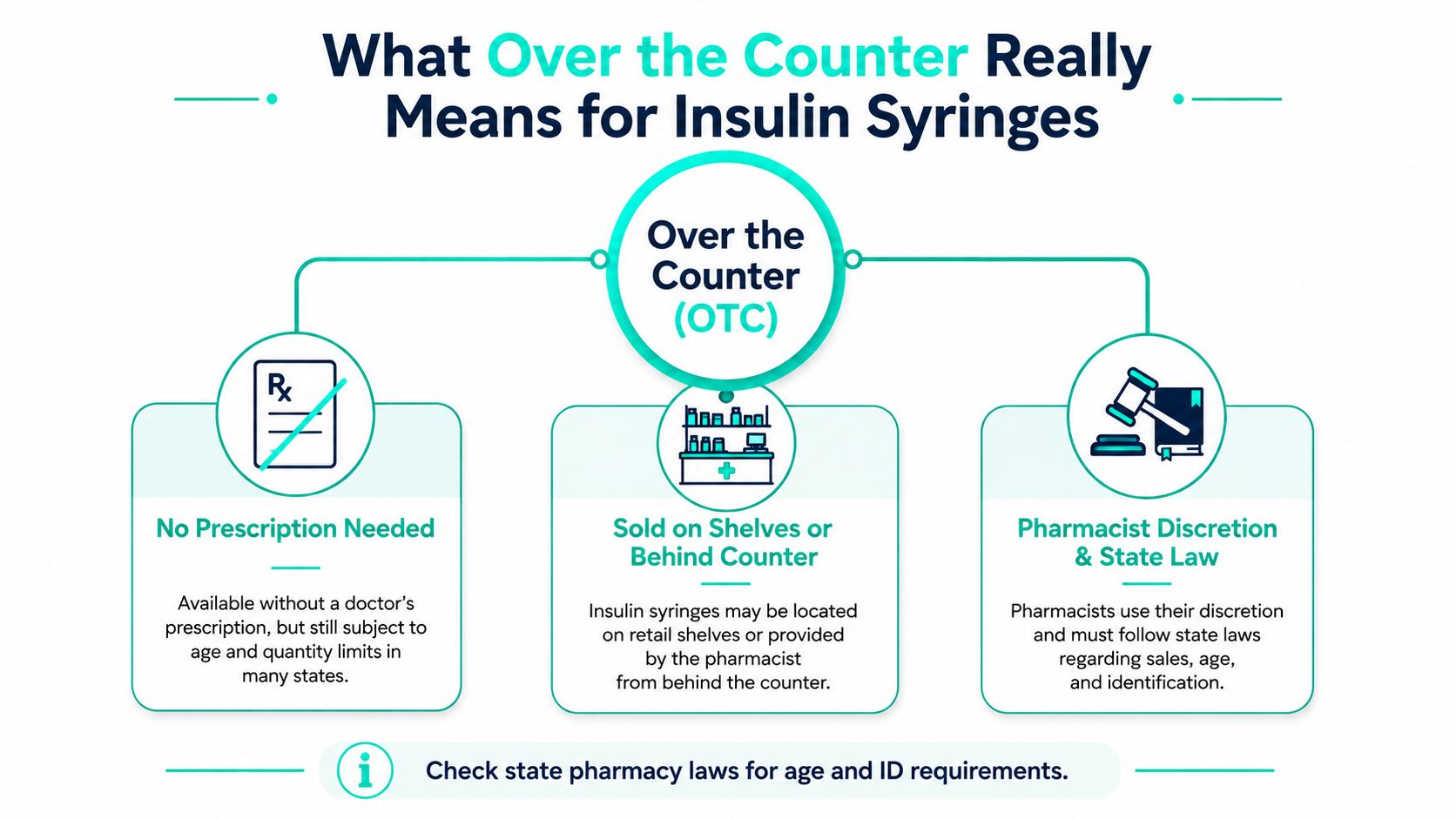
A pharmacy may keep insulin syringes behind the counter, request identification, apply an age cap, record the transaction, or set a quantity limit. These steps can exist even where state law permits OTC purchase. The key distinction is between legal permission and what a particular pharmacy can or will do.
The question “Can I buy insulin syringes without a prescription?” has four parts:
Insulin-specific devices may follow a different rule from generic hypodermic needles because some state statutes address equipment intended for insulin injection separately. A policy review of prescription laws and syringe access describes a long-running patchwork. Most U.S. jurisdictions permit OTC sales, while 10 states and Puerto Rico have significantly restricted sales through prescription-style laws. The named states are California, Delaware, Illinois, Maine, Massachusetts, New Hampshire, New Jersey, New York, Pennsylvania, and Rhode Island.
Age and quantity rules can change the result. A store may refuse a sale to someone below its age threshold, limit the number provided, or ask a pharmacist to review the request. Pharmacist discretion can affect the transaction even when no prescription is legally required.
Practical rule: “OTC” means a prescription may not be required. It does not promise unlimited quantity, automatic approval, or identical treatment at every pharmacy.
Your actual purchase can depend on location, age, quantity, inventory, and counter policy. Ask the pharmacy about those details before choosing a product.
A pharmacy may legally sell insulin syringes without a prescription, yet the counter can still apply age, quantity, identification, or pharmacist-review rules. U.S. law does not provide one national answer. The practical picture depends on state statutes, pharmacy regulations, and the store's own procedures.
The state-by-state pharmacy-law summary describes OTC access as common but sometimes conditional. Some pharmacies may dispense 10 syringes at a time or decline sales to anyone under 18 years old. In states with tighter controls, a purchase may still be allowed when the product is clearly intended for insulin injection and the pharmacist follows identification or recordkeeping requirements.
| Access Tier | Typical Rules | Example States |
|---|---|---|
| Broad OTC access | Adults may generally purchase insulin syringes without a prescription, subject to pharmacy policy | Texas, Florida |
| OTC access with conditions | Age checks, ID requests, quantity limits, records, or pharmacist review may apply | California, New York, Pennsylvania |
| Explicitly restricted or actively changing | Prescription-style restrictions may apply, or lawmakers may be considering changes to pharmacy duties | Illinois, New Jersey, Rhode Island |
These categories help organize the patchwork, but they cannot replace a current local check. California shows why a broad label can be incomplete. As of January 1, 1983, insulin syringes were classified as exempt medicines when furnished by a registered pharmacist for diabetes treatment as directed by a physician, according to the California-related policy material. Oklahoma took a different approach. A 1994 state act treated the sale and distribution of insulin syringes without a prescription as a statewide concern and voided local ordinances requiring prescriptions for those products, effective July 1, 1994, according to the state-access summary.
Insulin-specific syringes may receive different treatment from generic hypodermic needles because some statutes address equipment intended for insulin injection separately. Public-health policy also weighs access against concerns about age, documentation, pharmacist discretion, optional or mandatory sales, and the handling of injection equipment. The Virginia statute on hypodermic needles illustrates how syringe rules can sit within broader pharmacy and public-health frameworks.
Before visiting a store, check the state pharmacy board, the relevant state code, and a current public-health or syringe-access directory. Then contact the pharmacy. Legal permission and store procedure are separate layers, so both checks matter.
A smooth pharmacy visit starts before you enter the store. Call ahead, describe the product as an insulin syringe, ask whether the store sells it without a prescription, and confirm the current age, ID, quantity, and stock policy. Chain pharmacies may use a corporate procedure that's stricter than the minimum required by state law.
Bring a government-issued photo ID if you have one. You may also want the insulin packaging, your dosing information, or other documentation that helps the pharmacist identify the right syringe type. You shouldn't need to disclose more personal medical information than necessary, but a clear explanation that the syringe is for prescribed insulin use can help the pharmacist apply the relevant policy.
A pharmacist may decline a sale based on professional judgment, suspected non-medical use, missing identification, store policy, or uncertainty about the applicable rule. Don't argue at the counter. Ask whether the pharmacist can explain the policy or refer you to an appropriate syringe-access program.
For a broader overview of purchase considerations, review this guide to buying syringes and needles. The practical goal is simple: arrive with the right product description, verify the store's policy in advance, and leave with equipment that matches your prescribed insulin administration method.
A pharmacy isn't the only legitimate source of sterile syringes. The right channel depends on whether you need diabetes supplies, general sterile equipment, help with disposal, insurance billing, or a faster option when a pharmacy refuses or runs out of stock.
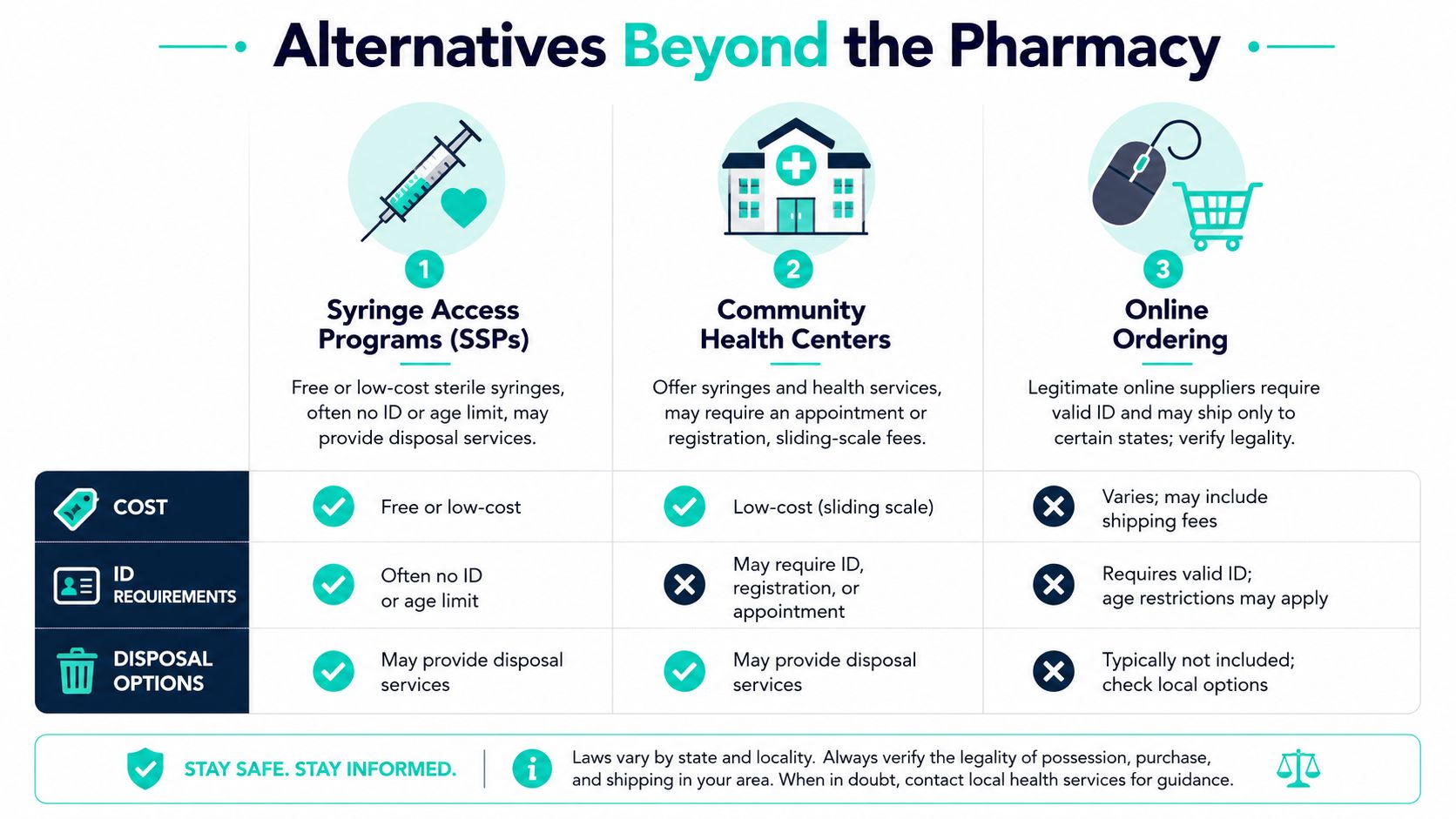
Syringe services programs, also called SSPs or needle exchanges, provide sterile supplies and may offer disposal services, health education, testing referrals, or connections to treatment. Many programs are designed to reduce barriers, so the first visit may involve little or no paperwork. Policies differ by program, including whether identification, age verification, appointments, or quantity limits apply.
SSPs can suit someone who needs sterile equipment quickly, wants a safe disposal route, or faces a pharmacy barrier. They may not be the right source for every insulin product or insurance-billed diabetes supply, so call first and explain that you're looking for insulin syringes.
Community health centers can connect patients with medical services and diabetes supplies. Some require registration or an appointment, while others may provide supplies through a sliding-scale arrangement. Ask whether the center dispenses insulin syringes directly, refers patients to a pharmacy, or can help arrange a mail-order benefit.
This channel works best when you also need clinical support, help understanding a prescription, or assistance navigating insurance. It's different from a cash OTC purchase because the center may verify eligibility or coordinate supplies as part of care.
Online access can be convenient, but the seller must follow the rules that apply where the package will be delivered. A retailer based in a permissive state can't necessarily ship insulin syringes into a restrictive state. Verify the seller's business identity, product labeling, sterile packaging, return policy, and destination-state requirements.
Be cautious with unverified overseas marketplaces and unmarked products. Use a verified U.S. pharmacy, established medical-supply retailer, or recognizable manufacturer, and avoid products that don't clearly identify the device and intended use. For laboratory-focused information about syringe-related equipment, see bacteriostatic water and syringes, but don't confuse research supplies with consumer diabetes-care products.
Insurance mail order is another distinct route. Your plan may require a prescription and may limit which brands or quantities it covers, even though the same general type of syringe may be available for cash without a prescription.
A first-time buyer may see several similar insulin syringes on the shelf. Check three specifications before choosing: barrel volume, needle gauge, and needle length. The markings, capacity, and needle dimensions must fit the prescribed insulin routine.
Barrel volume is measured in milliliters, while insulin doses are usually measured in units. Common purchasing ranges include 0.3 mL for doses under 30 units, 0.5 mL for about 30 to 50 units, and 1.0 mL for larger doses, as described in this syringe sizing guide. These ranges do not suggest changing a dose. Use the barrel size and unit markings specified by your clinician or pharmacist.
| Barrel Size | Typical Dose Range | Common Gauge | Common Length |
|---|---|---|---|
| 0.3 mL | Under 30 units | 29G to 31G | 5/16 inch, or 8 mm |
| 0.5 mL | About 30 to 50 units | 29G to 31G | 5/16 inch, or 8 mm |
| 1.0 mL | Larger doses | 28G to 31G | 5/16 inch, or 8 mm |
Gauge numbers run opposite to what many buyers expect. A higher gauge number indicates a thinner needle. Insulin syringes commonly range from 28G to 31G, and 29G through 31G are often selected for comfort. Length affects where the medication is delivered. The cited guidance identifies 5/16 inch, or 8 mm, as a frequently cited subcutaneous length. Shorter needles are also commonly favored to support subcutaneous rather than intramuscular delivery.
Choose markings that correspond to the insulin concentration and dosing instructions. A generic 1 mL syringe marked only in milliliters is not a casual substitute for an insulin syringe marked in units. A patient-safety analysis of hospital reports described errors involving syringe selection and mismatched markings. Its findings concern acute-care settings, not individual purchasing advice, but they explain why reading the graduations matters. Review the analysis of syringe-related insulin errors when considering why the intended device should match the insulin product.
Brands such as BD and NovoFine are familiar names in diabetes supplies, but the brand name does not replace a label check. Confirm the sterile packaging, unit scale, gauge, length, and intended use. Pen needles are a separate category. They attach to insulin pens and are not interchangeable with syringes used to draw insulin from a vial. When the package or markings are unclear, ask the pharmacist to compare the product with the prescribed insulin and instructions.
Used insulin syringes are sharps. Put each one into a puncture-resistant container as soon as possible after use, rather than carrying loose needles through the home. The FDA recommends using an appropriate sharps container and checking local disposal rules because collection options differ by community.
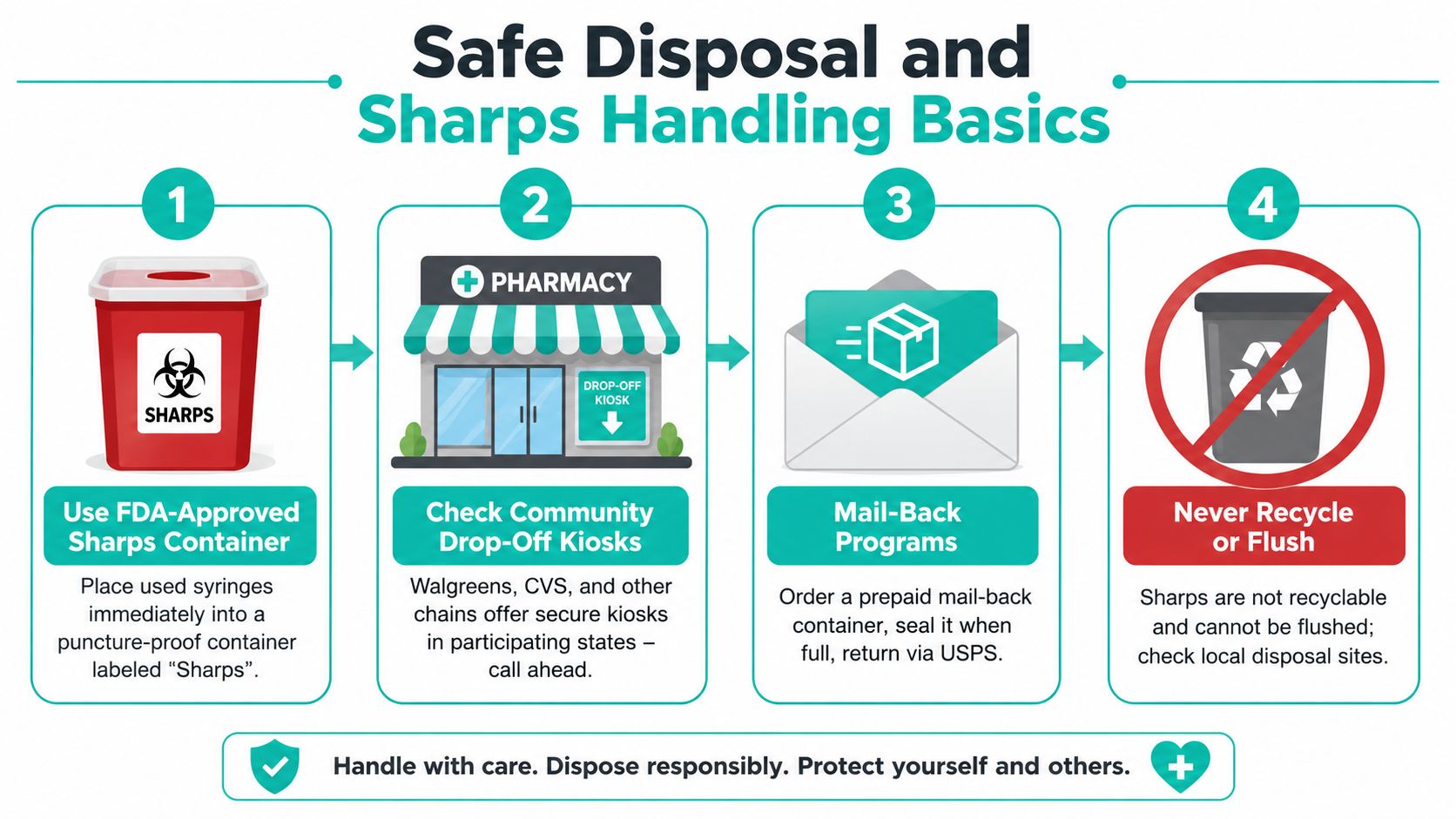
An FDA-cleared sharps container is the clearest choice. Depending on local availability, you may also find secure pharmacy drop-off kiosks, including participating Walgreens or CVS locations, mail-back programs with prepaid containers, hospital or clinic take-back events, and household hazardous-waste collection events. Call before visiting because participating locations and accepted materials can change.
If you don't have a commercial container, a heavy-duty household plastic bottle, such as a laundry-detergent bottle, may serve as a temporary alternative when local guidance allows it. Choose a container that won't puncture easily, keep the lid secured with strong tape, label it clearly as “Sharps,” and follow your local disposal authority's instructions.
Never put loose syringes in a trash bag, recycling bin, toilet, or ordinary household bin.
The same rule applies when traveling through the disposal process. Keep used sharps contained, and don't place them where sanitation workers, family members, children, or animals could encounter them. For domestic air travel, carry unused syringes in their original labeled packaging alongside the associated medication, and check current airline and security guidance before departure.
Avoid recapping whenever possible. If recapping is necessary under a specific procedure, use a one-handed scoop method, keeping the other hand away from the needle. Never hold the cap in one hand and guide the exposed needle into it with the other.
Disposal isn't an afterthought. Before buying, identify the nearest drop-off, mail-back, clinic, or household hazardous-waste option so the used syringe already has a destination.
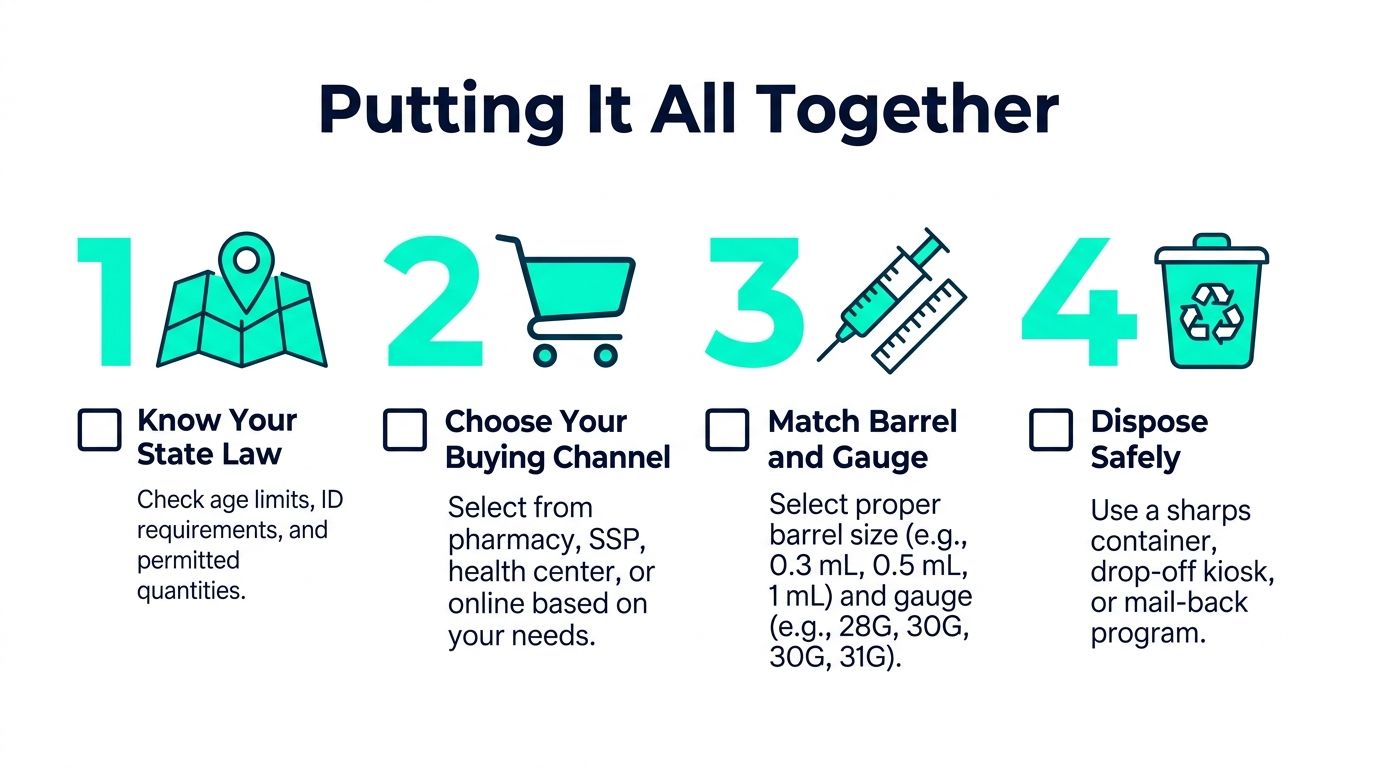
The safest way to approach insulin syringes over the counter is to treat the purchase as a four-part decision. You're checking the law, the seller, the device, and the disposal route. A “yes” at the legal level still requires a practical plan for the pharmacy counter and the used sharps afterward.
Check your state pharmacy board and current state guidance for insulin syringes. Look specifically for age requirements, ID or recordkeeping rules, quantity limits, and whether insulin-specific syringes are treated differently from generic hypodermic needles. Don't rely only on a search-result snippet because a pharmacy's current procedure may reflect a narrower operational policy.
Call a pharmacy to confirm stock and OTC policy. If the pharmacy can't complete the sale, contact a syringe services program, community health center, or compliant online supplier. An SSP may be the faster practical option when you need sterile supplies and disposal support, while a health center may be more useful when you also need care coordination.
Write down the barrel volume, unit scale, gauge, and length that your clinician or pharmacist has approved. A typical purchasing guide associates 0.3 mL with doses under 30 units, 0.5 mL with about 30 to 50 units, and 1.0 mL with larger doses, but those ranges don't replace individualized instructions. Confirm that the package says it's an insulin syringe and that the markings match the insulin concentration and prescribed dose.
Buy or locate a sharps container before opening the box. Then identify a pharmacy kiosk, clinic, mail-back service, or local hazardous-waste program that accepts filled containers.
If a pharmacist refuses the sale, ask whether the decision comes from state law or store policy, then request a referral or call another location. To verify an online supplier, review its U.S. business information, product labeling, sterile packaging, destination-state policy, and customer-service contact details. If you need supplies immediately and the pharmacy route is uncertain, a local SSP or community health center may provide a more direct answer.
The key distinction remains practical: legal permission doesn't guarantee a sale at every counter. Confirm the rule, call the store, choose the correct insulin syringe, and plan disposal before you buy.
Celonyx Labs provides research-focused peptides and laboratory supplies through its online catalog, including information about insulin-style syringes for small-volume laboratory work. Visit Celonyx Labs to review its catalog and contact options, and keep research products separate from supplies intended for personal diabetes care.
Celonyx Labs customer support email is a practical first contact because 62% of customers used

Peptide purity testing for CROs in 2026: the HPLC, mass spec, COA, and reference standard

Research peptides for independent researchers: verify CoAs, purity, reconstitution, and storage without institutional backup. Full
FOR RESEARCH USE ONLY. Products sold by Celonyx Labs are intended exclusively for laboratory and scientific research. They are not intended for human or veterinary use, consumption, diagnosis, treatment, cure, or prevention of any disease. By purchasing from this site, you acknowledge that you understand the intended research purpose of these materials and agree to comply with all applicable laws and regulations.