Mt 2 Peptide
The most popular advice about the MT-2 peptide is usually the least useful: treat it

No: a GLP-1 research peptide is not automatically semaglutide. Semaglutide is a specific GLP-1 receptor agonist, while “GLP-1 research peptide” is a broader label that does not establish a compound’s identity. Even when a research material contains semaglutide, it is not interchangeable with an approved semaglutide medicine and must remain restricted to its stated research use.
Semaglutide belongs to the GLP-1 receptor agonist category; the category is not a synonym for semaglutide. A label describing receptor activity tells you what a material is intended to study, not necessarily which molecule the vial contains.
Start with the exact compound name and supporting analytical records. The guide to peptide purity testing for contract research organizations addresses the testing side of that distinction.
| Term | What it identifies | Best for | Main limitation |
|---|---|---|---|
| Native GLP-1 | The endogenous glucagon-like peptide-1 hormone | Studying native GLP-1 biology | It is not structurally identical to semaglutide |
| Semaglutide research material | Material identified as the specific semaglutide molecule | Laboratory experiments requiring semaglutide | Research labeling does not establish pharmaceutical equivalence |
| GLP-1 research peptide | A broad research-category description | Initial classification of relevant compounds | The wording alone does not identify a molecule |
| Approved semaglutide medicine | A regulated drug product containing semaglutide | Prescribed medical use under its approved labeling | It is not interchangeable with a research-labeled vial |
The practical distinction is between category, molecule, and finished product. Your 2026 procurement record should identify all three separately rather than treating a broad category heading as a complete material specification.
A molecular mix-up changes the interpretation of an experiment. If your protocol calls for semaglutide but your purchasing record says only “GLP-1 peptide,” you have not documented that the test material matches the protocol.
Research suitability also depends on more than molecular identity. An authentic compound can still be unsuitable for a particular experiment if its concentration, formulation, impurity profile, or handling history is not adequately characterized.
For human use, the distinction is stricter. A research peptide is not a substitute for an approved medicine, regardless of a shared compound name or a high purity claim. Do not use this laboratory comparison to select a treatment, calculate a personal dose, or prepare an injection.
Semaglutide is an analogue of human GLP-1, not an unchanged sample of the native hormone. Its molecular modifications are part of its identity and help explain why the two compounds should not be treated as interchangeable experimental inputs.
Semaglutide contains 31 amino acid residues and a fatty diacid component with 18 carbon atoms. FDA prescribing information for semaglutide medicines describes this modified molecular structure; those structural details distinguish the molecule, not the suitability of a particular research vial.
Native GLP-1 and semaglutide act through the GLP-1 receptor, but shared receptor activity does not establish equivalent behavior in every assay. Your experimental conditions, endpoint, and exposure design determine what comparisons you can make.
For a 2026 study plan, name the exact test compound in the protocol. If you are comparing an analogue with native GLP-1, describe them as separate materials and document each material’s identity independently.
“GLP-1” can refer to the native hormone or appear as shorthand for a broader research category involving GLP-1 receptor activity. That ambiguity is precisely why the category wording is insufficient for purchasing or experimental records.
Look for the complete molecular designation rather than relying on a listing heading. If the documentation names a specific analogue, use that name throughout your inventory, protocol, and results.
“Semaglutide” names a specific molecule. It does not, by itself, establish the material’s purity, concentration, formulation, sterility, stability, or regulatory status.
A compound name answers the identity question only when supported by suitable evidence. Keep the naming decision separate from the decision that a material meets your experiment’s acceptance criteria.
An approved medicine is a finished pharmaceutical product with product-specific manufacturing, formulation, quality, and labeling requirements. A research material does not acquire those attributes merely because it bears the same active-compound name.
FDA prescribing information supports the distinction between semaglutide as an active molecule and a particular approved drug product. Its scope is that medicine’s composition and use; it does not validate unrelated research materials.
For laboratory procurement, this means you need evidence appropriate to your own intended experiment. For medical treatment, it means a research-labeled vial must not replace a prescribed medicine.
No. Chemical identity is necessary for identifying a compound, but equivalence between finished products requires more than matching the molecule’s name.
Formulation components and material attributes can affect how a sample behaves. Even within laboratory work, changing the supplied form without evaluating its effect introduces a variable that your protocol should address.
No. “For research use only” states an intended-use restriction; it is not a certification of pharmaceutical quality or permission for human use.
Treat the label as a boundary, not a quality shortcut. Evaluate the material against your laboratory’s documented requirements and keep any medical decision outside the research procurement process.
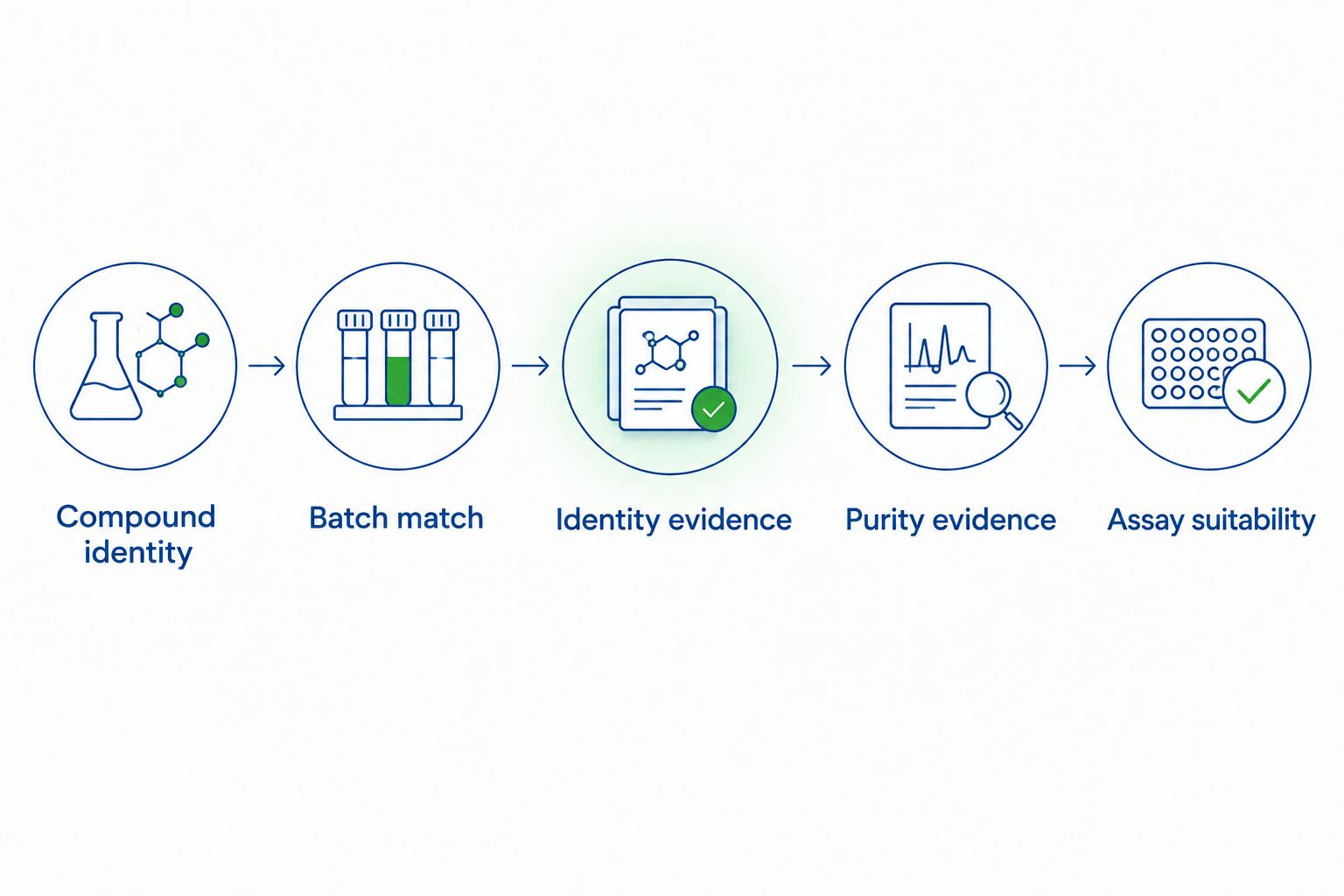
Verify the exact compound before evaluating whether it suits the experiment. A well-organized document trail helps prevent a category description from becoming an unsupported identity claim.
Use this sequence for a 2026 procurement review:
Keep the original records alongside your acceptance decision. A certificate filed without a link to the received batch cannot provide reliable traceability.
An analytical report is useful when you understand the question it answers. A chromatogram can support a purity assessment under the stated method; it does not automatically establish every attribute that matters to your experiment.
Likewise, an expected molecular-mass result supports an identity assessment but does not independently prove sterility or biological activity. Avoid turning one favorable result into a claim the method did not evaluate.
Ask whether the report includes enough context to interpret the result: sample identification, method, test date, and acceptance criteria where applicable. Preserve that context rather than copying only the headline percentage into your inventory.
A 99% purity result does not mean a material is 99% suitable for every use. The percentage describes a measurement under a particular analytical method, and its interpretation depends on the report.
For example, chromatographic area percentage is not automatically the same as the mass fraction of active peptide in the supplied material. Water, counterions, and other material components require their own consideration when relevant to your analytical purpose.
Celonyx Labs is best suited to laboratory researchers sourcing research peptides, not patients seeking semaglutide treatment. Its stated offering is 99%-pure, third-party-tested research peptides; those quality signals do not establish medical interchangeability or replace your laboratory’s review of the specific material.
The benefit of a stated purity level and independent testing is a clearer basis for reviewing analytical quality. The limitation is equally important: neither claim alone answers every question about identity, formulation, sterility, or functional performance.
For your 2026 acceptance decision, separate the following questions:
GLP-1 receptor activity is a starting point for classification, not a complete material specification. Materials grouped under that heading differ for reasons that matter to experimental design.
These differences do not create a universal ranking of research materials. Choose the documented compound and material attributes that match your protocol, not the broadest category label or the most prominent purity claim.
No, not as an undocumented substitution. Semaglutide and native GLP-1 are different molecules, so changing between them changes the test material and requires a scientific justification within your protocol.
If the purpose is to compare receptor agonists, include each compound as a defined experimental condition. Do not describe the resulting comparison as repeated testing of the same peptide.
Only when the certificate contains suitable, traceable identity evidence. A document title or purity percentage alone does not establish that the sample is semaglutide.
Review the reported methods and results, then confirm the document matches the supplied batch. If the identity evidence is insufficient for your experiment, obtain clarification or additional testing before accepting the material.
Use the exact compound name, supplied form, and batch identifier. Keep “GLP-1 receptor agonist” as a category descriptor rather than using it in place of the material’s identity.
For a 2026 lab notebook entry, preserve the supporting analytical documents and preparation record together. That makes the connection between procurement, material acceptance, and experimental results easier to audit.
Is GLP-1 research peptide the same as semaglutide?
No. GLP-1 research peptide is a broad label, while semaglutide is a specific GLP-1 receptor agonist; verify the exact molecule through batch-specific documentation.
Is native GLP-1 identical to semaglutide?
No. Semaglutide is a modified GLP-1 analogue containing 31 amino acid residues, not an unchanged sample of the native hormone.
Can research semaglutide replace my prescription medicine?
No. Research-use materials are not substitutes for approved semaglutide medicines and must not be used for self-treatment.
Does 99% purity prove that a peptide is semaglutide?
No. A 99% purity result describes the measured purity under a stated method; molecular identity requires appropriate supporting evidence.
Does third-party testing prove a research peptide is sterile?
No. Third-party testing establishes only the attributes evaluated by the reported methods; identity or purity testing does not independently establish sterility.
What should I check before selecting a GLP-1 research material?
Check the exact compound, supplied form, batch-matched identity and purity evidence, and compatibility with your experimental protocol. Keep the supporting records with your material acceptance decision.
Who are Celonyx Labs research peptides intended for?
Celonyx Labs research peptides are intended for laboratory researchers and scientists. They are for research use only, not substitutes for approved medicines.
The receptor category belongs in your study description; the exact molecule belongs in your material record. Keeping those fields separate prevents a shorthand label from becoming an unsupported claim about what was tested.
For Celonyx Labs research peptides, retain the research-use restriction alongside the quality documentation. High purity does not change intended use: for research use only, not for human consumption or self-administration.
The most popular advice about the MT-2 peptide is usually the least useful: treat it

How much does a vial of research grade BPC-157 cost? Compare current quotes by peptide

Is GLP-1 research peptide the same as semaglutide? No. Learn the molecular differences, check batch
FOR RESEARCH USE ONLY. Products sold by Celonyx Labs are intended exclusively for laboratory and scientific research. They are not intended for human or veterinary use, consumption, diagnosis, treatment, cure, or prevention of any disease. By purchasing from this site, you acknowledge that you understand the intended research purpose of these materials and agree to comply with all applicable laws and regulations.