

Is oxytocin peptide stable at room temperature for research use?
Is oxytocin peptide stable at room temperature? Only under validated conditions. Learn how formulation, handling,

Oxytocin peptide is not automatically stable at room temperature: suitability depends on whether it is dry or dissolved, its formulation, and the documented exposure conditions. A sealed lyophilized vial and a reconstituted solution require separate stability assessments. For research use in 2026, follow the material-specific storage instructions and use formulation-matched stability evidence before accepting a room-temperature hold.
An undocumented room-temperature hold introduces an uncontrolled variable into your experiment. If the material changes during handling, the nominal concentration written in your protocol no longer establishes the concentration of intact oxytocin reaching the assay.
Separate your storage policy from your bench-handling policy. The broader question of whether peptides lose potency at room temperature requires the same distinction: a brief preparation step is not evidence supporting prolonged storage.
Do not treat room temperature as an approved storage condition unless documentation supports it for the exact material. Start by identifying the physical state, formulation, container, and intended analytical endpoint. Then compare the actual exposure with the conditions studied.
| Material or condition | What supports its assessment | Advantage | Limitation |
|---|---|---|---|
| Sealed lyophilized oxytocin | Storage instructions and dry-state stability data | Dry storage limits water-mediated degradation pathways | Moisture, closure integrity, and temperature still matter |
| Reconstituted oxytocin | Solution-specific stability data | A defined solution supports controlled experimental preparation | Dry-state shelf life does not establish solution stability |
| Specifically stabilized formulation | Evidence matching the formulation and container | Stabilization can support a defined handling window | Results do not automatically transfer to another formulation |
| Vial with undocumented exposure | Exposure reconstruction and an approved assessment | Investigation can clarify whether use remains justified | Appearance alone cannot resolve chemical integrity |
These are assessment categories, not interchangeable storage recommendations. A study of a formulated oxytocin preparation does not establish the stability of research powder dissolved in a different solvent.
For your 2026 protocol, define what stable means before assigning a holding period. Retained intact peptide, acceptable impurity levels, and retained assay activity are related endpoints, but they are not the same measurement.
Lyophilization removes much of the water from a preparation. That can improve storage stability relative to an otherwise comparable aqueous preparation, but it does not make the peptide insensitive to its environment.
Check the supplier's instructions for the unopened vial, including protection from moisture and light where specified. Record the lot identity and distinguish unopened material from a vial that has already been accessed.
Do not borrow a dry-powder holding period from another peptide. Different sequences, residual moisture levels, counterions, and formulation components can produce different stability behavior.
If the handling procedure requires a cold vial to equilibrate before opening, keep it sealed during that step. Opening cold material in humid air can introduce condensation; the appropriate procedure must also remain consistent with the supplier's instructions.
The practical advantage of a sealed dry format is reduced exposure to aqueous degradation pathways. Its limitation is equally important: a dry appearance does not establish the amount of intact peptide remaining after an undocumented excursion.
Reconstitution creates a different material system. Solvent, pH, buffer composition, peptide concentration, and container surfaces become part of the stability question.
Do not carry the unopened vial's expiry or storage allowance over to the solution. Establish the solution's handling limit from documentation that matches the preparation you actually use.
A preservative does not automatically solve chemical instability. Bacteriostatic activity concerns microbial growth; it does not demonstrate that oxytocin remains chemically intact or retains its intended assay response.
Likewise, substituting a solvent because it works for another peptide does not establish compatibility. Follow a validated preparation method and confirm that the solvent is suitable for the downstream assay.
For a 2026 reconstitution record, capture the preparation date, solvent identity, final concentration, container, and assigned storage condition. Record subsequent bench exposure separately rather than treating refrigeration as a reset of the material's history.
Oxytocin contains 9 amino acid residues, including 2 cysteine residues connected by 1 disulfide bond. These structural features help explain why chemical identity and biological function deserve separate attention; they do not provide a room-temperature shelf life.
Oxytocin can undergo chemical degradation, including deamidation and disulfide-related changes. The rate and significance depend on the surrounding conditions, so a sequence description cannot replace stability measurements.
The main assessment factors are:
A single favorable result does not establish every combination of these factors. Define the conditions you intend to use, then ask whether the evidence covers them.
Place the affected material on hold while you assess the excursion. Do not declare it acceptable because the vial looks unchanged, and do not declare it unusable solely because it briefly left controlled storage.
Use this sequence to make a documented decision:
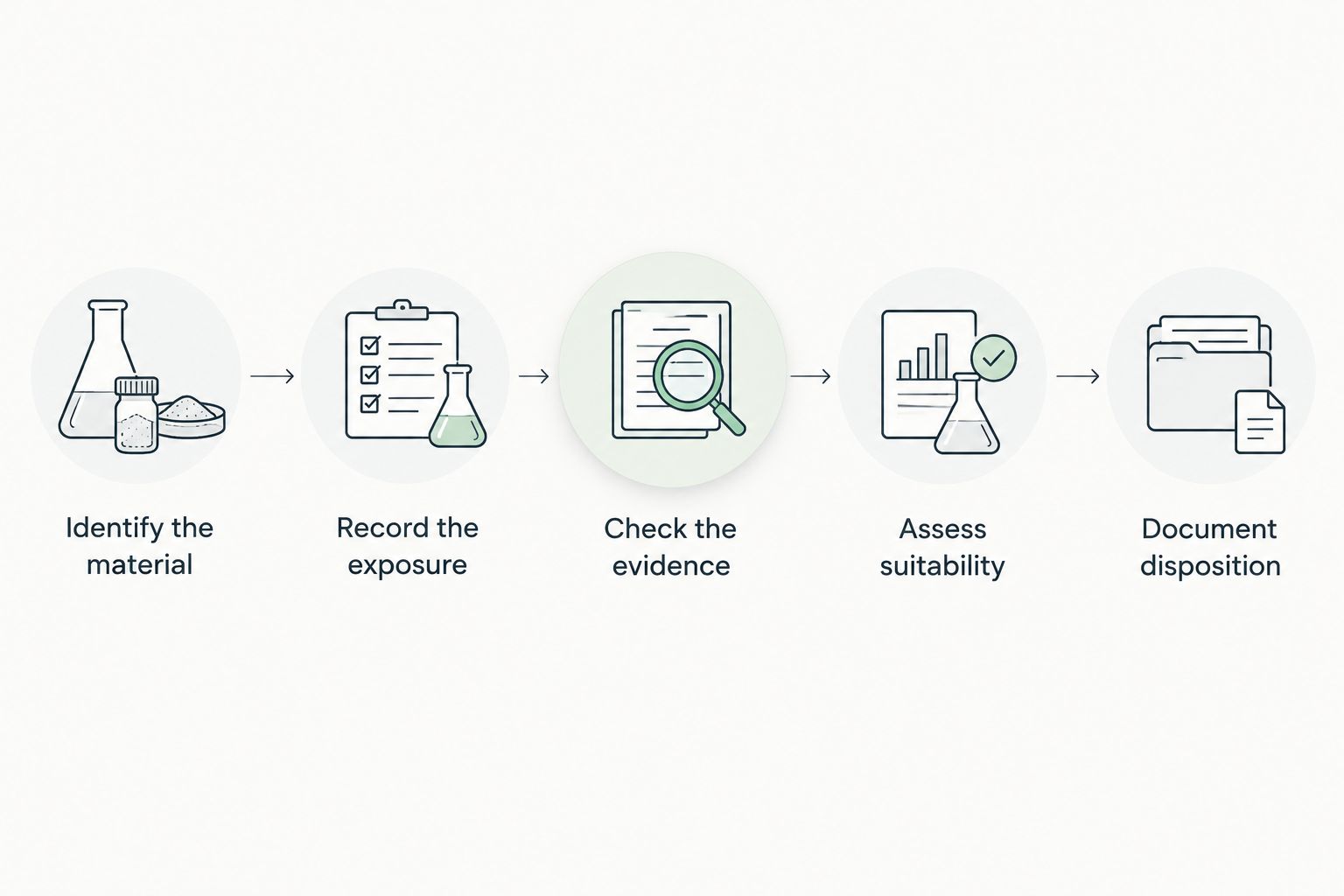
Returning a vial to its specified storage condition limits further exposure; it does not reverse chemical degradation that has already occurred. Keep the excursion record attached to the material's inventory entry so another researcher does not unknowingly treat it as unexposed stock.
A defensible room-temperature holding period comes from a study that matches the intended material and use. The evidence should describe the formulation, container, temperature, sampling schedule, analytical methods, and acceptance criteria.
A release certificate of analysis is not automatically a stability study. It describes results for the sample and testing represented by that document; it does not, by itself, establish performance after later bench exposure.
A stability-indicating chromatographic method evaluates intact peptide and relevant degradation products. Mass spectrometry can support identity assessment, while a fit-for-purpose biological assay addresses activity when activity is the endpoint your experiment requires.
Do not treat those methods as interchangeable. An identity result does not establish purity, and a purity result does not establish sterility or biological activity.
When commissioning work, define reagent stability requirements around the actual solvent, container, temperature profile, and assay endpoint; otherwise, a technically sound study can answer the wrong storage question. State what change would make the reagent unsuitable before testing begins.
For a 2026 study plan, separate chemical stability from functional suitability. Both can matter, but your acceptance decision must explain which measurements support the intended research application.
No. High initial purity does not establish a room-temperature holding period. Purity is a measured attribute under defined test conditions, not a prediction of every later storage outcome.
Celonyx Labs describes its research peptides as 99%-pure and third-party tested. Those are sourcing quality signals, but they do not substitute for an oxytocin-specific stability assessment or establish a holding period for a reconstituted preparation.
Celonyx Labs research peptides are best suited to laboratory researchers and scientists, not personal use. Keep the research-only purpose separate from any claim about clinical suitability, administration, or patient safety.
When comparing documentation, distinguish chromatographic purity from peptide content and retained activity. A reported purity percentage does not independently tell you the concentration of active material in an exposed working solution.
No. Visual inspection can identify some problems, but it cannot confirm chemical stability. A clear, colorless solution can still contain degradation products or a different concentration of intact peptide than expected.
Unexpected discoloration, visible particles, leakage, or a damaged closure justify investigation under your laboratory's procedure. Their absence is not an analytical pass.
Use appearance as an inspection record, not as the deciding release test. For experiments sensitive to reagent integrity, base acceptance on the applicable stability evidence and fit-for-purpose measurements.
Define room temperature as a measured, controlled condition rather than an informal description. Record the allowable temperature limits, monitoring method, location, and permitted exposure duration in the protocol.
A bench near a window, heat-producing instrument, or frequently opened door does not necessarily experience the same conditions as the room sensor. Choose a monitoring location that represents the material's exposure.
In your 2026 SOP, distinguish routine handling from an excursion. State who evaluates deviations and how cumulative exposure is tracked, so each researcher applies the same rule rather than inventing a new allowance at the bench.
Can I leave oxytocin peptide on the bench overnight?
Do not accept an overnight bench hold unless formulation-specific evidence supports that exposure. Record the actual conditions and assess the material under your laboratory’s excursion procedure before using it.
Is dry oxytocin more stable than reconstituted oxytocin?
A dry format generally reduces water-mediated degradation pathways, but that does not establish a specific holding period. Assess sealed lyophilized material and reconstituted solutions using separate, material-specific evidence.
Does refrigerating oxytocin after a warm exposure restore it?
Refrigeration does not reverse chemical degradation that has already occurred. Return the material to its specified storage condition and retain the exposure record for assessment.
Does bacteriostatic water keep oxytocin chemically stable?
Bacteriostatic water does not by itself establish oxytocin’s chemical stability. Preservative activity and retention of intact peptide are different questions, and solvent compatibility requires its own supporting evidence.
Does a clear oxytocin solution mean it is still suitable for research?
A clear solution does not confirm chemical integrity or retained biological activity. Use the applicable stability evidence and analytical acceptance criteria rather than appearance alone.
Can I use another supplier’s oxytocin stability data?
Another supplier’s data apply only to the extent that the tested material and conditions match your preparation. Compare formulation, concentration, container, temperature, methods, and acceptance criteria before relying on the results.
What should I ask a supplier about room-temperature stability?
Ask for storage instructions and stability or excursion data covering the exact material and physical state. For a solution, also ask whether the evidence matches your solvent, concentration, container, and intended holding period.
Track cumulative bench exposure, not just the longest single event. Repeated handling creates a material history that disappears if you record only the latest removal from storage.
For your next oxytocin experiment, add exposure start, exposure end, and disposition fields to the sample record. That simple change makes the eventual stability decision traceable without pretending that a generic room-temperature allowance exists.
For research use only. Not for human or veterinary use.
Is oxytocin peptide stable at room temperature? Only under validated conditions. Learn how formulation, handling,

Can IGF-1 LR3 be shipped to all 50 states? Verify the exact compound and destination,

How long does CJC-1295 stay stable after reconstitution? Use formulation-specific evidence, not a generic day
FOR RESEARCH USE ONLY. Products sold by Celonyx Labs are intended exclusively for laboratory and scientific research. They are not intended for human or veterinary use, consumption, diagnosis, treatment, cure, or prevention of any disease. By purchasing from this site, you acknowledge that you understand the intended research purpose of these materials and agree to comply with all applicable laws and regulations.