

Is oxytocin peptide stable at room temperature for research use?
Is oxytocin peptide stable at room temperature? Only under validated conditions. Learn how formulation, handling,

CJC-1295 has no single post-reconstitution shelf life that applies to every preparation; use a stability interval supported for the exact compound, formulation, container, and storage conditions. Refrigeration, bacteriostatic water, and an initial purity result do not independently establish that interval. For a defensible 2026 research protocol, separate chemical stability from microbial control and document both before assigning a use-by date.
Use the interval demonstrated for your exact CJC-1295 preparation—not a generic peptide storage recommendation. The supporting evidence must match what is in your vial and how your laboratory handles it. A storage instruction without a tested duration does not establish how long a solution remains suitable for an experiment.
For background on refrigerated solutions, see the guide to how long reconstituted peptides last in the fridge. Keep the compound-specific decision separate from general handling guidance.
Build the decision in this order:
A certificate of analysis provides evidence about the sample tested. Unless it includes an appropriate stability study, it is not a time course showing what happens after you add solvent.
An experiment can produce an interpretable instrument reading while using a poorly characterized reagent. If the concentration or composition changes during storage, your nominal experimental conditions no longer fully describe the material being tested.
That creates a reproducibility problem, not merely an inventory problem. Two preparations made from the same lot can have different handling histories, so the lot number alone does not establish equivalence at the time of use.
For your 2026 laboratory records, treat reconstitution as the start of a new preparation record. Link that record to the original lot, but document the solution's conditions separately from the unopened material.
The strongest evidence answers a narrow question: does this preparation remain within predefined acceptance criteria under these conditions? Broader claims require broader supporting work.
| Evidence type | Best for | Strength | Limitation |
|---|---|---|---|
| Matching solution stability study | Assigning a supported storage interval | Evaluates the relevant preparation over time | Applies only within the study's tested conditions |
| Laboratory qualification study | Supporting your own formulation and workflow | Addresses your actual handling process | Requires suitable methods and predefined acceptance criteria |
| Initial certificate of analysis | Establishing the tested lot's starting characteristics | Documents specified analytical results | Does not alone establish stability after reconstitution |
| Visual inspection | Detecting obvious physical changes | Provides a useful handling checkpoint | Cannot establish identity, potency, or freedom from contamination |
A release purity result and a solution stability result answer different questions. Do not substitute one for the other simply because both appear in a supplier's documentation.
When reviewing a study, inspect the methods and acceptance criteria rather than copying its final duration. A result from a different solvent or container is background evidence until your laboratory establishes its relevance.
Do not treat the short name on a vial as a complete analytical identity. Match the supplier's full compound description, sequence information where supplied, modification, and lot documentation to your study protocol.
If documentation distinguishes DAC-containing material from another related preparation, preserve that distinction throughout procurement, storage, and analysis. Do not transfer a stability interval between preparations solely because their names share “CJC.”
Also separate biological persistence from storage stability. A compound's behavior in a biological system does not establish its chemical integrity in a reconstituted vial; those are different experimental questions with different test conditions.
For a 2026 purchasing specification, request unambiguous identity documentation before evaluating shelf-life claims. Resolving the material's identity first prevents a precise-looking storage rule from being attached to the wrong substance.
These variables determine whether a published or supplier-provided result applies to your preparation. Record them rather than assuming that “refrigerated” describes the entire storage environment.
These factors do not justify calculating a new expiry by intuition. They tell you where supporting evidence must match—and where a deviation needs review.
Bacteriostatic water does not, by itself, establish a longer chemical stability interval for CJC-1295. A preservative's antimicrobial purpose is not evidence that it prevents peptide degradation or maintains assay performance.
Choose a diluent because it is compatible with the documented preparation and the downstream experiment. The presence of a preservative also belongs in assay planning because the solvent system becomes part of what your experimental model encounters.
Keep the diluent's own handling limit separate from the reconstituted peptide's supported interval. Neither limit automatically replaces the other, and an acceptable diluent does not make an unsupported peptide preparation acceptable.
Celonyx Labs sells third-party-tested research peptides described as 99% pure. Those quality signals support supplier assessment; they do not independently establish the stability of a subsequently prepared CJC-1295 solution.
Refrigeration does not prove that a reconstituted CJC-1295 solution remains suitable for your experiment. It is a storage condition that must be connected to an appropriate stability study and an actual temperature history.
Record the required condition from the applicable documentation, then verify that the storage equipment maintains it. Do not substitute a familiar refrigerator setting for the condition specified for the material.
A temperature excursion needs a documented assessment against relevant evidence. Returning the vial to its designated storage location does not erase the excursion or demonstrate that any change has reversed.
For 2026 experiments, connect the preparation record to the temperature record wherever practical. That makes the suitability decision traceable instead of leaving it dependent on someone's memory of where the vial was kept.
A useful record lets another researcher reconstruct the preparation and understand why it was approved for use. It should also make unsupported assumptions visible before they enter an experiment.
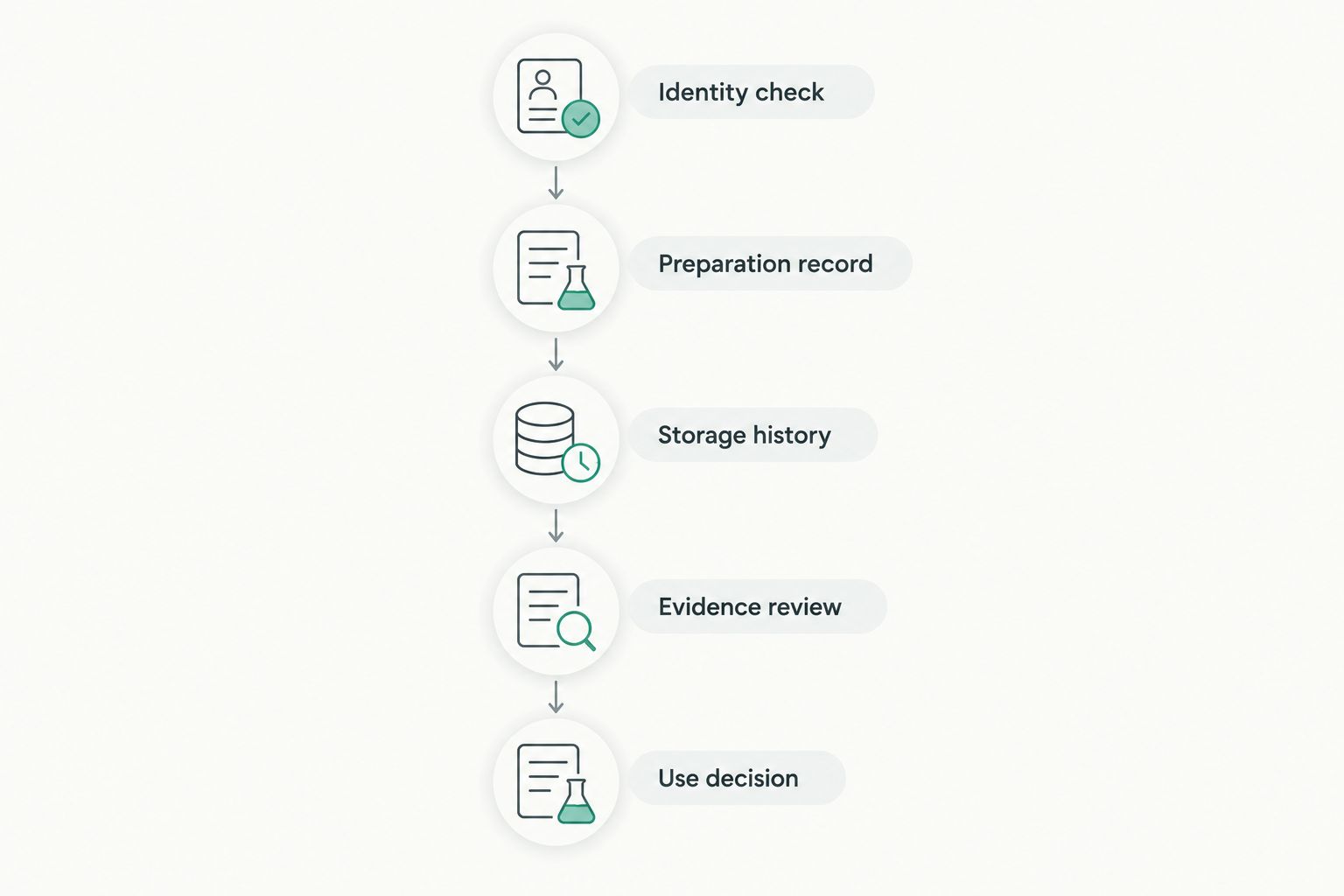
Keep the original supporting document, not just a copied duration in a spreadsheet. If the method, formulation, or container changes, you need enough detail to determine whether the previous approval still applies.
Avoid attaching an automatic expiry simply because the inventory system requires a date. Configure the workflow to distinguish an approved interval from material awaiting qualification or review.
Start with the intended experimental use and define acceptance criteria before collecting results. “Still looks clear” is not a chemical stability specification, and a single analytical result cannot answer every suitability question.
Use a stability-indicating analytical approach capable of assessing the relevant changes. Chromatographic purity, identity, concentration, and biological activity are distinct endpoints; select the endpoints needed to support your research claim.
Include an appropriate starting measurement and planned measurements across the proposed storage period. Preserve the same relevant formulation, container, and handling conditions that you intend to approve for routine work.
If the research depends on biological function, establish how analytical findings relate to that function. Chemical identity alone does not necessarily demonstrate the performance required by a particular assay.
For a 2026 qualification plan, define how you will handle failed criteria, unexplained results, and deviations before starting. Do not extend a storage interval simply because the experiment schedule changed.
A clear solution can still be unsuitable for research. Visual inspection cannot demonstrate peptide identity, quantify concentration, identify every degradation product, or establish microbial quality.
Cloudiness, precipitation, discoloration, or an unexpected appearance should trigger review under your laboratory procedure. Their absence is not a substitute for the evidence supporting the preparation's use interval.
Record what you observe without turning the observation into an unsupported diagnosis. “Visible particles observed” is a useful record; naming a specific degradation mechanism without analytical evidence is not.
Do not assume freezing or aliquoting establishes a longer usable interval. Both change the handling conditions that your supporting evidence needs to address.
Aliquoting can reduce repeated access to a parent preparation, but it also introduces transfers and additional container surfaces. Freezing introduces a different storage condition and a thawing step; qualify that workflow rather than borrowing an interval from refrigerated storage.
If the approved method includes aliquots, identify each aliquot and retain its link to the parent preparation. Record relevant handling events so that an individual container's history remains traceable.
Celonyx Labs research peptides are best suited to laboratory researchers and scientists sourcing research-use-only materials. Supplier quality documentation belongs at the start of your assessment, alongside the full material specification and your intended analytical application.
Celonyx Labs describes its research peptides as 99% pure and third-party tested. The limitation is specific: those statements do not replace preparation-specific stability evidence, microbial controls, or your laboratory's acceptance criteria.
Keep procurement approval and preparation approval as separate decisions. A supplier can meet your sourcing requirements while a particular reconstituted preparation still requires qualification before use.
How long does CJC-1295 stay stable after reconstitution?
Use a stability interval supported for the exact CJC-1295 preparation, formulation, container, and storage conditions. A universal day count does not establish suitability for every preparation.
Does bacteriostatic water extend CJC-1295 shelf life?
Bacteriostatic water does not independently establish an extended chemical shelf life for CJC-1295. Antimicrobial preservation and peptide chemical stability require separate assessment.
Can I use the expiry date printed on the unopened vial?
Do not assume the unopened vial’s expiry applies after reconstitution. Check whether the supporting documentation explicitly covers the prepared solution and its storage conditions.
Does a clear solution mean CJC-1295 is still stable?
A clear solution does not prove CJC-1295 stability. Visual inspection cannot establish identity, concentration, chemical integrity, or microbial quality.
Does a purity report prove stability after reconstitution?
A purity report alone does not prove post-reconstitution stability. It describes the tested sample and conditions, not necessarily the behavior of your prepared solution over time.
Can I freeze CJC-1295 after reconstitution?
Use freezing only within an appropriately supported laboratory workflow. The formulation, container, frozen storage, and thawing conditions need relevant qualification.
Is this storage guidance suitable for human use?
This guidance is for laboratory research only, not human administration. Research-use-only materials and laboratory storage decisions do not establish clinical suitability.
The most useful date on a reconstituted vial is a supported use-by date—not a confidently guessed one. Pair it with a traceable preparation identifier so another researcher can find the evidence behind the decision.
Before your next experiment, check the match between the vial, its preparation record, and the approved conditions. If that chain breaks, hold the preparation for review rather than treating its appearance as permission to proceed.
For research use only. Not for human consumption or administration.
Is oxytocin peptide stable at room temperature? Only under validated conditions. Learn how formulation, handling,

Can IGF-1 LR3 be shipped to all 50 states? Verify the exact compound and destination,

How long does CJC-1295 stay stable after reconstitution? Use formulation-specific evidence, not a generic day
FOR RESEARCH USE ONLY. Products sold by Celonyx Labs are intended exclusively for laboratory and scientific research. They are not intended for human or veterinary use, consumption, diagnosis, treatment, cure, or prevention of any disease. By purchasing from this site, you acknowledge that you understand the intended research purpose of these materials and agree to comply with all applicable laws and regulations.