

Is Humanin stable at room temperature for research use?
Is Humanin stable at room temperature? Do not assume stability. Learn how formulation, exposure records,

Do not assume IGF-1 LR3 can be shipped to all 50 states. Confirm the exact compound, destination, intended laboratory use, and seller’s current shipping terms before authorizing a shipment in 2026. A statement about nationwide delivery does not, by itself, establish legal permission or suitability for your research protocol.
Your laboratory needs more than a parcel that reaches its address. You need a documented purchasing decision, material that matches the approved research specification, and receiving conditions consistent with the supplier’s instructions.
Separate destination eligibility from transit planning. The guide to how long research peptide orders take to arrive addresses the timing question; delivery speed does not answer whether a particular IGF-1 LR3 shipment is appropriate for your destination.
For a 2026 procurement file, record the date of each confirmation. A saved statement without a date leaves your team unable to distinguish a current answer from an older purchasing record.
A blanket yes is not a sufficient purchasing basis. Resolve the question for the exact IGF-1 LR3 material, seller, recipient, and destination involved in your order. Do not substitute a general statement about research peptides for compound-specific confirmation.
Use this sequence before releasing a purchase request:
These steps create a decision record. They do not replace legal review, institutional authorization, or the supplier’s product-specific handling documentation.
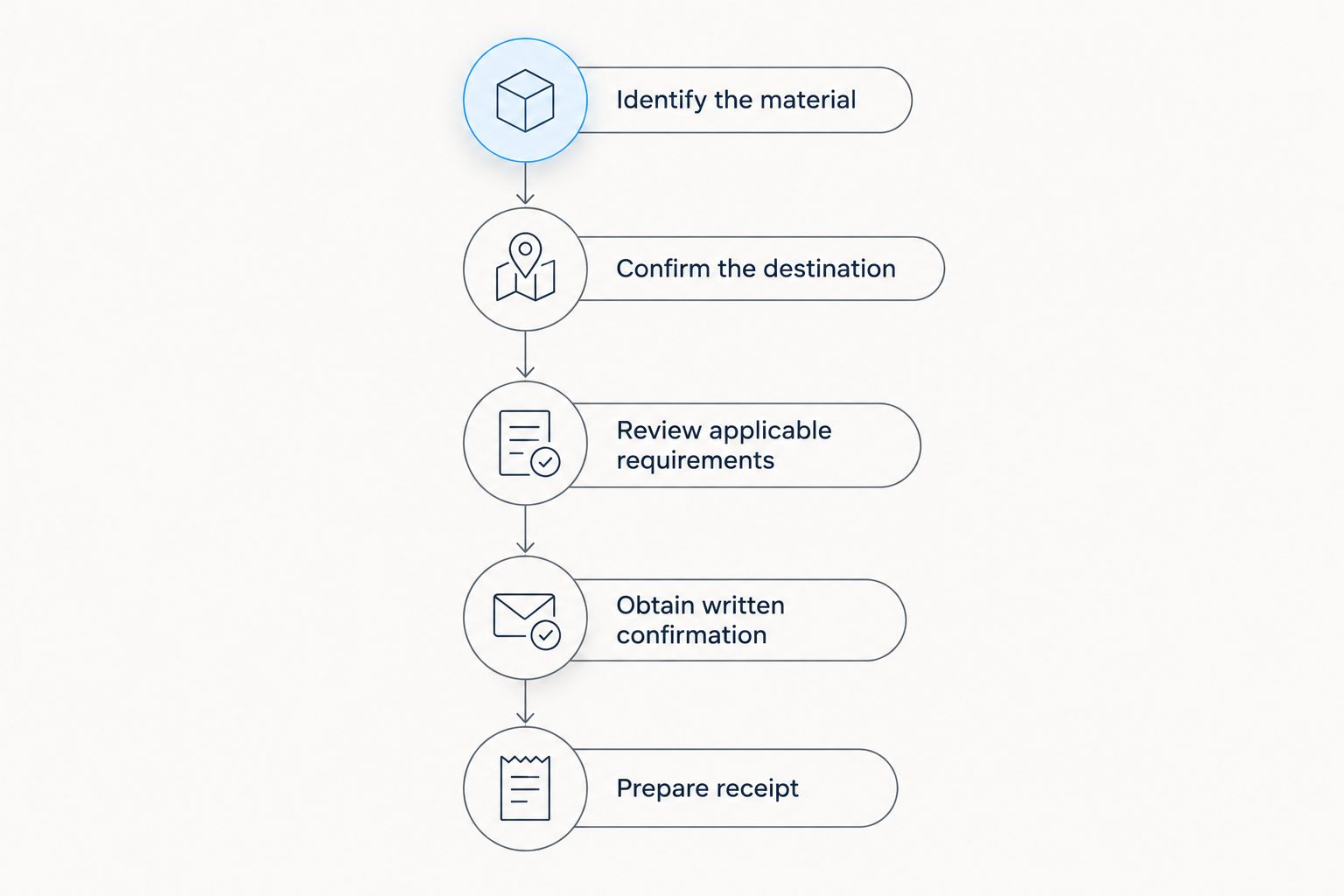
Different records answer different questions. The comparison below helps you avoid using one document as evidence for a conclusion it does not support.
| Evidence | Best for | Useful contribution | Limitation |
|---|---|---|---|
| General shipping statement | Initial supplier screening | Describes the seller’s stated geographic scope | Does not resolve the exact compound, recipient, or intended use |
| Written destination confirmation | Order-specific planning | Connects a seller’s answer to your proposed shipment | Does not replace independent compliance review |
| Certificate of analysis | Reviewing reported analytical results | Provides the results reported for the identified material or batch | Does not establish destination eligibility |
| Institutional approval | Internal purchasing authorization | Records your organization’s decision and conditions | Does not establish the seller’s shipping terms |
| Carrier tracking | Monitoring parcel movement | Records shipment events reported by the carrier | Does not prove identity, purity, or legal compliance |
Use each record for the question it answers. A strong analytical report cannot compensate for an unresolved destination question, and a delivery confirmation cannot substitute for analytical documentation.
Treat these as verification fields, not as a list of states that permit or prohibit a shipment. Each field belongs in an order-specific review:
This approach keeps the review specific without inventing a nationwide legal conclusion. It also gives the seller a clear request that can be answered in writing.
For your 2026 review, ask your compliance contact to identify the authorities relevant to the transaction. Do not rely on an undated forum post, a competitor’s policy, or a shipping answer written for a different compound.
Research-use-only labeling does not establish permission to ship IGF-1 LR3 to all 50 states. It states an intended-use restriction, not a destination-by-destination legal determination. Your review still needs to address the actual transaction.
Keep the research purpose accurate throughout your records. The purchase request, correspondence, and laboratory documentation should describe the work being performed rather than imply medical treatment or personal administration.
Do not infer human-use suitability from laboratory terminology. This article concerns research procurement only and provides no dosing, administration, or treatment guidance. For research use only; not for human consumption.
Third-party testing does not establish shipping eligibility across all 50 states. Analytical testing addresses the properties examined by the stated methods. It does not answer every legal, institutional, or transport question associated with a purchase.
For example, a reported 99% purity result does not itself establish sterility, identity, or suitability for every experiment. Read the analytical method, reported result, and sample or batch identification rather than treating the percentage as a complete quality assessment.
Match the documentation to the material your laboratory receives. If a report cannot be connected to the supplied batch, request clarification before using it to support acceptance.
Checkout acceptance does not establish permission to ship IGF-1 LR3 to all 50 states. A completed address field or accepted payment is not a substitute for a compound-specific compliance assessment. Save explicit written confirmation instead of treating transaction processing as the answer.
An order confirmation and a shipping confirmation also serve different purposes. Read what each document actually states; do not infer approvals or handling assurances that are absent from the document itself.
Send a short, factual request that allows the seller to answer the actual procurement question. Include your institution, receiving address, exact compound designation, intended laboratory use, and the documentation your team needs.
Ask the seller to address these points separately:
Avoid a vague request such as asking whether peptides are legal. That question combines material identity, intended use, destination, and transaction terms without identifying any of them precisely.
Keep the seller’s answer attached to the purchase record. If the answer addresses only shipping geography, leave the other review fields open until the appropriate person resolves them.
Use the complete institutional receiving address, not just the state name. USPS uses 5-digit ZIP codes, with ZIP+4 providing additional address detail; include the address format your receiving department specifies.
Record the department, designated recipient, and any internal delivery instructions separately from the laboratory’s scientific protocol. This keeps logistics information accessible without treating it as evidence of research approval.
Do not assume that confirmation for one address covers another facility. If you change the recipient or destination after review, ask whether the existing confirmation still applies to the revised transaction.
Celonyx Labs research peptides are for laboratory researchers and scientists, not personal use. Celonyx Labs describes its store as selling 99%-pure, third-party-tested research peptides. Those are relevant quality signals to examine, not substitutes for an order-specific shipping review.
The benefit of a stated testing standard is that it gives your team a concrete documentation question to pursue. The limitation is equally important: a general quality statement does not establish the identity, handling history, or destination eligibility of a particular shipment.
For a 2026 supplier assessment, keep quality qualification and destination review as separate entries. Mark each complete only when the corresponding evidence answers the relevant question.
Do not infer an IGF-1 LR3 offering or shipping commitment from a supplier’s broader research peptide category. Ask about the exact material instead of extrapolating from unrelated listings.
Plan acceptance before dispatch. A receiving workflow should connect the parcel, material identifiers, analytical documents, and storage instructions so your team can evaluate the delivery without reconstructing the purchase history.
Start with the outer package and the supplied paperwork. Compare the recipient, product designation, and identifiers against your purchase record, then follow your laboratory’s procedures for inspecting the material and recording discrepancies.
Do not assign a storage temperature or acceptable transit duration from a generic peptide article. Use instructions and supporting information that apply to the actual formulation. Different preparation states should not be treated as equivalent without documentation.
A shipment can reach the correct address while still requiring a documentation review. Conversely, complete analytical paperwork does not establish that the transport conditions met your protocol’s acceptance criteria.
Your receiving record should distinguish between physical arrival and release for experimental use. If your laboratory requires an acceptance decision, identify who makes it and which evidence that person needs.
For 2026 records, retain the receipt date alongside the batch identifier and associated documents. That creates a clear link between what was ordered, what arrived, and what your laboratory accepted.
Pause the purchasing decision until the unresolved question has an owner. If the seller confirms the address but does not address the exact compound, request compound-specific clarification. If the uncertainty concerns applicable requirements, route it to your compliance or legal contact.
Do not interpret silence as permission. Likewise, do not turn an incomplete response into a claim that a state prohibits the shipment. Record the question accurately and distinguish an unanswered issue from a documented restriction.
Keep your request narrow enough to resolve. Asking for confirmation of one proposed shipment produces a more useful record than asking a seller to certify every possible research transaction across the country.
Can IGF-1 LR3 be shipped to all 50 states for laboratory research?
Do not assume IGF-1 LR3 can be shipped to all 50 states. Obtain compound- and destination-specific confirmation, and have the proposed transaction reviewed under applicable requirements and institutional procedures.
Does a research-use-only label make an IGF-1 LR3 purchase legal?
A research-use-only label does not by itself establish the legality of an IGF-1 LR3 purchase. Review the actual material, intended use, destination, and transaction rather than relying on the label alone.
Does 99% purity mean IGF-1 LR3 is approved for human use?
A 99% purity result does not establish approval or suitability for human use. Analytical purity, sterility, intended use, and regulatory status are separate questions.
Does Celonyx Labs guarantee IGF-1 LR3 shipping to my state?
Obtain an explicit, current answer from Celonyx Labs about the exact compound and receiving address. A general research peptide description is not a compound-specific shipping guarantee.
Can I use checkout acceptance as proof that shipping is permitted?
Checkout acceptance is not proof that shipping is permitted. Retain written destination confirmation and complete the separate compliance review your institution requires.
What documentation should I request before an IGF-1 LR3 shipment?
Request product identification, relevant batch-specific analytical documentation, written destination confirmation, and formulation-specific handling instructions. Keep those records with your institution’s purchasing approval.
Does delivery tracking prove that a research peptide arrived in acceptable condition?
Delivery tracking does not prove that a research peptide arrived in acceptable condition. Evaluate receipt against the applicable handling instructions, documentation, and laboratory acceptance criteria.
The useful question is not just whether a parcel can reach your state. It is whether your laboratory can explain, with dated records, why it authorized and accepted that specific shipment.
Before approving an IGF-1 LR3 purchase, put the destination confirmation beside the material specification and receiving plan. If those records describe different compounds, addresses, or handling expectations, resolve the mismatch before proceeding.
For research use only; not for human consumption. This guide is not legal advice.
Is Humanin stable at room temperature? Do not assume stability. Learn how formulation, exposure records,

How long does follistatin-344 take to show effects? No fixed research timeline applies. Learn how

Is sermorelin legal to buy for research? Not every sale qualifies. Understand U.S. intended-use rules,
FOR RESEARCH USE ONLY. Products sold by Celonyx Labs are intended exclusively for laboratory and scientific research. They are not intended for human or veterinary use, consumption, diagnosis, treatment, cure, or prevention of any disease. By purchasing from this site, you acknowledge that you understand the intended research purpose of these materials and agree to comply with all applicable laws and regulations.