
What Is Solid Phase Peptide Synthesis? a Clear Guide
Solid phase peptide synthesis is a method that builds a peptide one amino acid at
KLOW is a vendor-defined four-component research blend containing BPC-157, TB-500, GHK-Cu, and KPV, commonly supplied as 50/10/10/10 mg totaling 80 mg. It has not been clinically validated as a combined intervention, so it should be treated as an experimental mixture, not a standardized pharmaceutical formulation.
You may be looking at a product page, a vial, and a certificate of analysis while still asking a basic question: what exactly am I holding, and what can I reasonably conclude from an experiment using it? That uncertainty matters because a blend can produce a measurable phenotype without telling you which constituent caused it, whether the components interacted, or whether the result would appear in another model.
The practical answer is to approach the KLOW blend peptide as a defined test condition that requires its own documentation. Research-use-only labeling, lot verification, component-specific controls, and cautious interpretation aren't administrative details. They're the foundation of a defensible experiment.
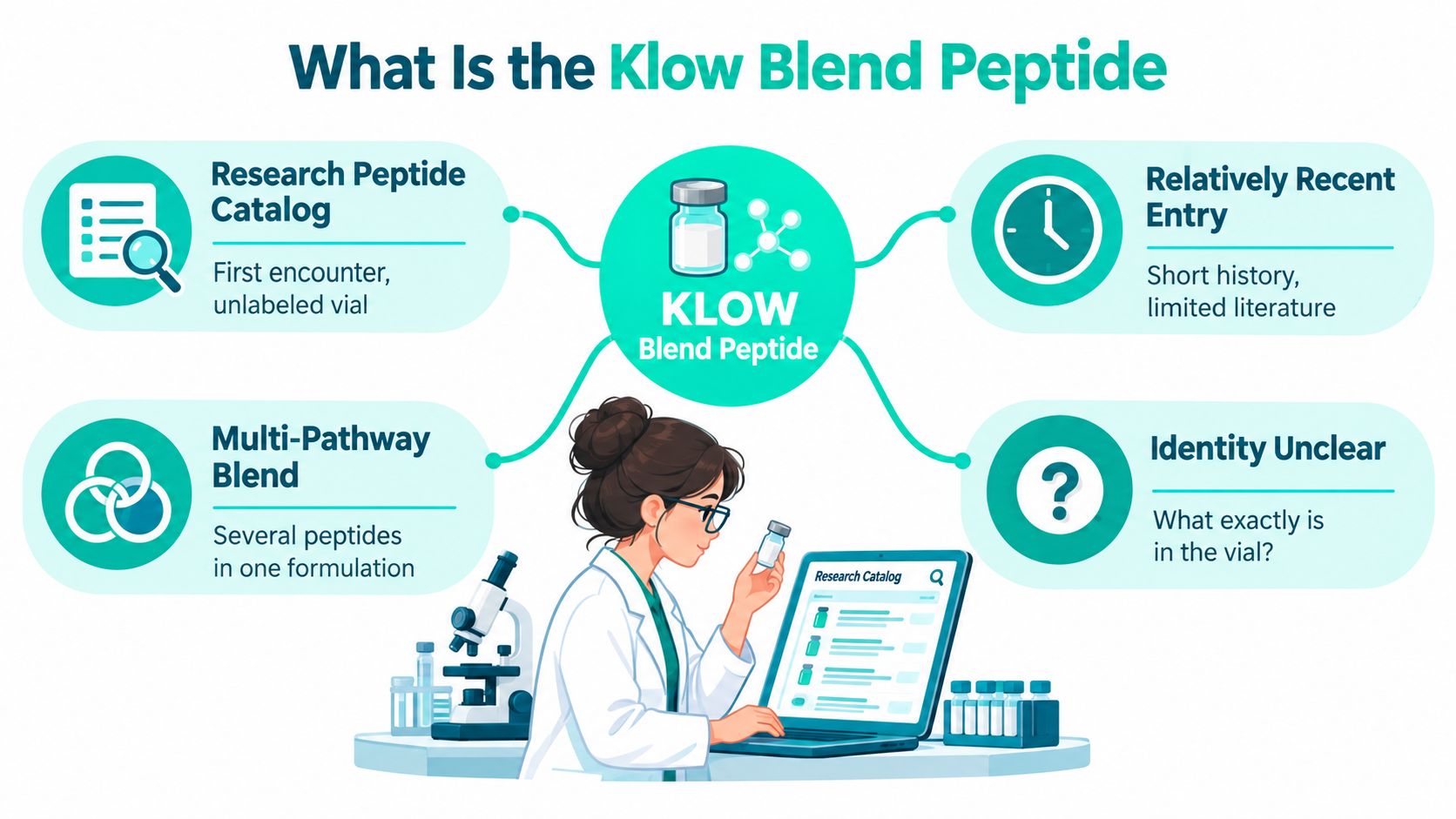
A researcher may open a KLOW product page, inspect the vial, and still lack a clear answer about what the name represents. KLOW is a relatively recent, vendor-defined research blend, not a historically standardized drug product or universally recognized pharmaceutical recipe (KLOW research overview).
One commonly reported configuration lists four peptides:
The stated total is 80 mg for that configuration. Treat those figures as a product description, not as a scientific standard. Another supplier, lot, or formulation may require separate verification.
The ingredients have separate research histories. GHK was reportedly isolated from human albumin fractions in 1973. Thymosin beta-4-related material is associated with actin-binding and cell-migration biology. BPC-157 came from gastric-peptide research, while KPV is the C-terminal tripeptide fragment of alpha-melanocyte-stimulating hormone (KLOW research overview).
Those backgrounds describe individual constituents. They do not show that the peptides were developed together, that the listed ratio is optimal, or that the mixture produces a clinically meaningful outcome. For context, what research peptides are explains the broader category, while KLOW requires its own identity and documentation review.
A defensible experiment starts with the vial as a product-specific test condition. Record the stated ratio, confirm the lot documentation, and separate observations about the mixture from conclusions about any individual peptide.
A vial produces one combined result, but its label names four different research materials. Separate those identities before interpreting any observation. A constituent's research history can guide assay selection, yet it cannot validate the mixture or show which component caused an effect.
GHK-Cu is a copper-containing peptide associated with extracellular-matrix biology, collagen remodeling, and related matrix signals. GHK was reportedly isolated from human albumin fractions in 1973. That historical detail belongs to GHK-Cu as an individual constituent, not to KLOW as a tested formulation.
For a study, GHK-Cu may suggest matrix-related endpoints, remodeling signals, or collagen-associated biology. Those endpoints still need controls matched to the cell model and exposure conditions. A mechanism described in product documentation does not demonstrate an effect in your culture system.
TB-500 is linked in product descriptions to thymosin beta-4-related research, including actin-binding and cell-migration biology. Its proposed readouts therefore differ from matrix-focused GHK-Cu assays, even when both are discussed using broad repair language.
Record the exact material supplied. Product names may group TB-500 with thymosin beta-4-related material, but related names should not be treated as interchangeable without analytical confirmation. Migration, matrix remodeling, and other overlapping signals also require assay designs that can separate them.
BPC-157 originated in gastric-peptide research and has been studied in angiogenesis and tissue-repair models (KLOW technical formulation). Vascular markers or repair-associated phenotypes may make it a relevant exploratory constituent.
That relevance is a reason to define an endpoint, not a prediction of the result. Cell type, concentration, exposure conditions, and assay timing can each change the observed phenotype. Record them separately so another investigator can reconstruct the test.
KPV is the C-terminal tripeptide fragment of alpha-melanocyte-stimulating hormone. Technical descriptions associate it with research involving inflammatory NF-κB/MAPK signaling, giving it a different mechanistic starting point from the other named constituents.
Treat the blend like four instruments recorded on one track. The combined signal may be measurable, but the recording alone cannot identify its source. Separate-component controls, matched exposure conditions, and interaction tests provide the documentation needed for defensible attribution. Researchers comparing formulations can also distinguish KLOW from an ipamorelin and tesamorelin blend, since each mixture requires its own identity and evidence review.
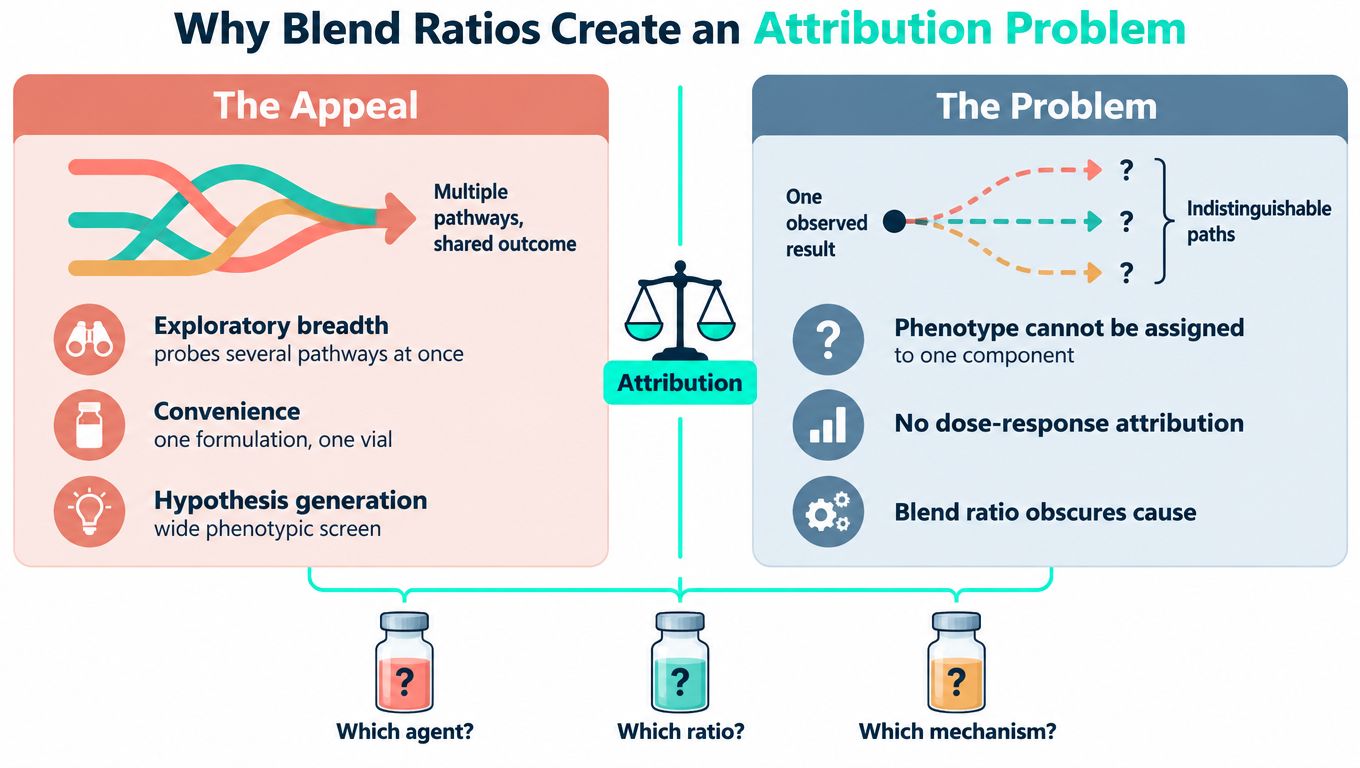
A blend may let a researcher examine several biological pathways in one exploratory condition. The difficulty appears when the first result arrives and the team asks, “Which component caused this?” That question requires more than the blend's label. It requires a record of what each peptide contributed to the tested exposure.
The commonly reported KLOW ratio assigns 50 mg of an 80 mg total to GHK-Cu, with 10 mg each for BPC-157, TB-500, and KPV. By labeled peptide mass, GHK-Cu accounts for 62.5%, and each other component accounts for 12.5%. These values describe the nominal formulation, not relative biological potency or evidence for a preferred dose.
Suppose a protocol reports only “KLOW at one concentration.” Another investigator cannot reconstruct each peptide's exposure unless the stated ratio and the actual lot composition are available. The result could reflect the total mixture, the larger GHK-Cu fraction, a smaller constituent, or an interaction among components. A single blend readout cannot distinguish those explanations.
For in-vitro work, report:
A phenotype cannot be assigned to one peptide from a blend result alone. Matched single-peptide controls and comparable exposure conditions are needed to test that attribution.
Keep the record at the lot level. A stated formulation describes what was intended, while assay interpretation depends on what the tested material contained.
The 50/10/10/10 configuration is a product-specific formulation convention, not a universal scientific standard for KLOW. Formulations may differ, so the certificate of analysis should govern claims about a particular lot.
A defensible protocol might state, “We tested the supplied four-component mixture at the measured component concentrations.” That wording reports the experiment without implying a validated dose rationale. It also preserves the distinction between an observed effect and an established causal explanation. For guidance on keeping experimental records distinct across peptide batches, record the lot identity, measured composition, and exposure conditions together.
A researcher receives a vial labeled as a four-peptide blend and finds that the literature discusses the ingredients separately. That gap defines the evidence problem. Available reviews report no peer-reviewed study characterizing the commonly cited GHK-Cu, BPC-157, TB-500, and KPV 50/10/10/10 formulation in humans, animals, or laboratory models (KLOW evidence review).
Claims of additive or synergistic effects therefore remain hypotheses. A research history for each component does not show that the mixture works better, behaves safely, or produces the same exposure pattern as any ingredient tested alone.
One reported Phase III study of native thymosin beta-4 ophthalmic solution used 0.1% treatment six times daily. After four weeks, complete corneal healing occurred in 6 of 10 active-treatment subjects and 1 of 8 placebo subjects. The reported between-group result was not conventionally statistically significant at p = 0.0656. This result may explain interest in thymosin beta-4, but it does not test the KLOW formulation.
A separate retrospective knee-pain case series included 16 patients receiving intra-articular BPC-157 with or without thymosin beta-4. Such findings can provide background rationale for studying individual constituents. They do not validate KLOW or identify which ingredient caused an observed response.
The experimental conditions are not interchangeable. An ophthalmic preparation differs from a multi-component mixture, and an intra-articular case series cannot establish how the blend behaves in a cell model or another organism.
Evidence for individual ingredients cannot establish KLOW efficacy, dosing, safety, or interactions. It also cannot show synergy. Co-formulation might produce additive, synergistic, antagonistic, or concentration-dependent effects, and the available evidence does not identify which explanation applies (KLOW research limitations).
Use a structured literature record that separates direct formulation evidence from background rationale. Thesis Book Project researcher tips can help document whether each source examined the exact mixture, one constituent, a different route, or only a proposed mechanism.
A plausible mechanism justifies testing a condition. It does not establish the result of that condition.
A purity number matters only when it can be connected to the vial being used. A claim such as 99% purity does not establish that every peptide in a four-component vial has the stated identity, ratio, or stability.
A defensible certificate of analysis should identify the lot, record the test date, name the analytical method, and provide identity confirmation. For a blend, the document should show whether each constituent was identified and quantified separately. Treat the COA like a chain-of-custody record: each entry should connect the tested sample to the material on your bench.
Begin with the vial label. The lot number printed on the container should match the number on the COA and shipment record. A generic PDF that lists only a product or catalog name cannot show that its findings apply to the material received.
Check for HPLC or UPLC purity testing and mass-spectrometry identity confirmation. For the blend itself, a research team should independently assess identity and relative composition using validated methods such as LC-MS and chromatographic purity profiling. The goal is to test the actual mixture, rather than assume that a product-level purity statement describes each component.
| Documentation Element | Generic COA | Batch-Tied COA |
|---|---|---|
| Lot number | Product or catalog reference only | Matches the vial and shipment |
| Test date | Missing or unclear | Clearly recorded for the tested lot |
| Purity method | “Purity tested” without method | HPLC or UPLC method identified |
| Identity confirmation | Not specified | Mass spectrometry or equivalent identity data |
| Component reporting | Total product claim only | Each constituent independently identified or quantified |
| Composition | Nominal ratio assumed | Measured or clearly documented ratio |
| Traceability | Difficult to audit | Connects product, lot, tests, and records |
A blend may have a reported purity value while its relative composition remains uncertain. Purity testing can describe impurities associated with an analyte, while an investigator also needs to know whether the four named peptides are present in the expected proportions. Those are related checks, not interchangeable ones.
Save the COA with the protocol, raw analytical files when available, procurement record, storage history, and reconstitution notes. If the document does not state the method or identify the tested lot, ask the supplier before starting the assay. An unclear answer belongs in the study record as a limitation, not in the results as verified material identity.
Before ordering a KLOW blend, establish whether the supplier can support the material with records you could defend in a lab review. A credible research-peptide vendor should provide clear information about the product, purchasing process, handling, and documentation, rather than relying on informal assurances.
Look for independent third-party testing, a stated purity level tied to an analytical method, storage and handling instructions, lot traceability, and a COA that matches the lot received. Public Terms and Conditions, Refund and Return, and Shipping policies also help create a documented procurement trail.
A polished PDF is only one piece of the assessment. Check whether the business publishes usable contact information, explains order and return procedures, and offers direct phone or email support for questions about documentation and availability. Those details show whether the supplier can resolve a discrepancy after purchase.
Shipping speed may reduce the wait before bench work, but it does not establish sample quality. Ask how the material is handled in transit and whether the shipment record identifies the same lot shown on the COA. Treat the chain of custody like a labeled sample tube. If one identifier changes, the record becomes harder to interpret.
Celonyx Labs lists research peptides with stated 99% purity and independent third-party testing claims. Its site also publishes store policies and identifies a Dallas, Pennsylvania address, 1194 Twin Stacks Drive, Unit B. Verify these details against the specific product and lot rather than treating them as proof of the material's identity (Celonyx Labs).
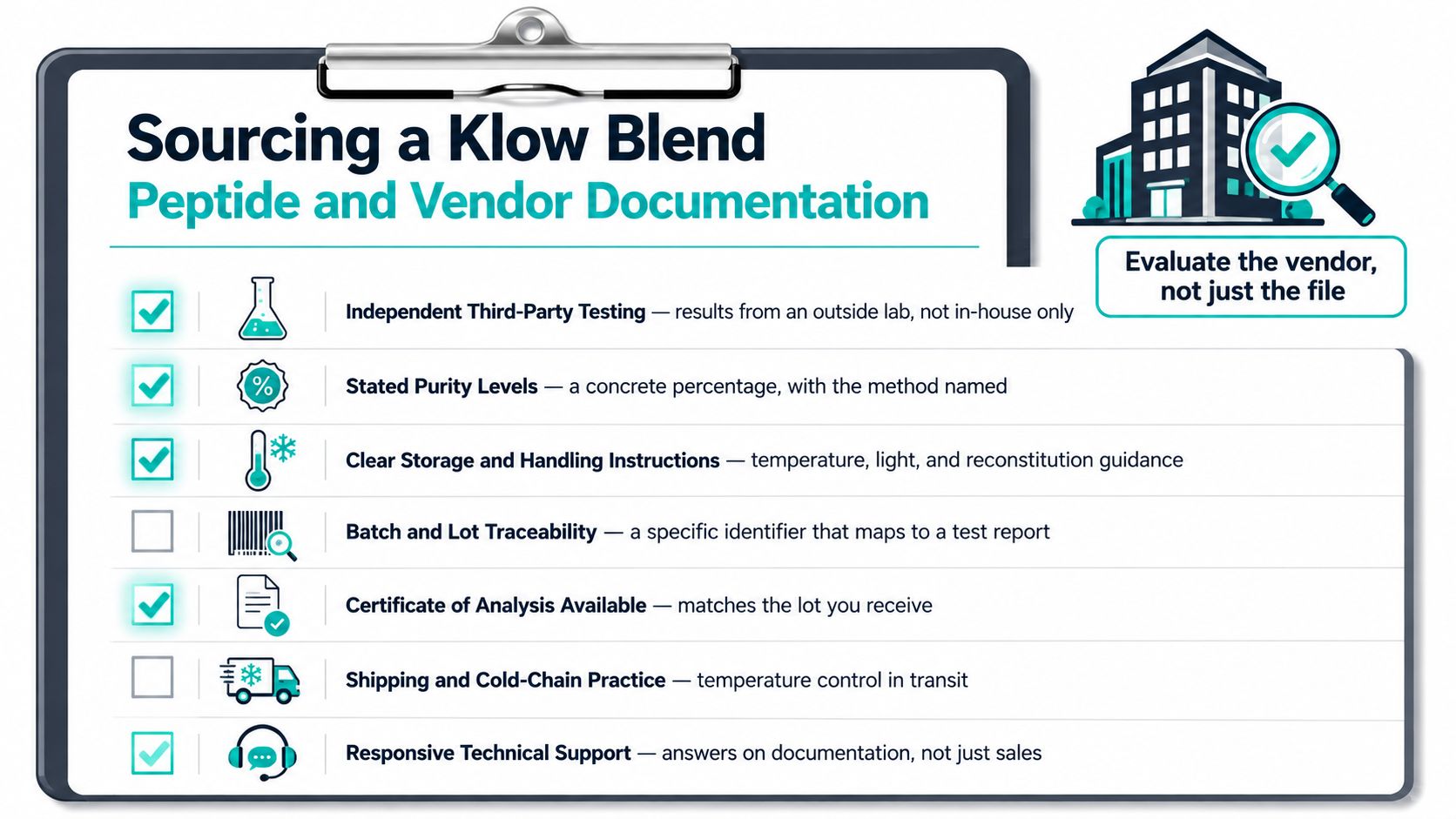
Record unanswered questions before the experiment starts. For an institutional lab, gaps in identity, lot, storage, or testing documentation can affect purchasing approval, sample acceptance, and the credibility of the final report.
Before the first assay, treat KLOW as an unvalidated experimental mixture. The components may have individual research histories, but the combination has no established combination pharmacokinetics, dose rationale, interaction profile, or human safety dataset. Conclusions must remain limited to the model and conditions tested (KLOW research limitations).
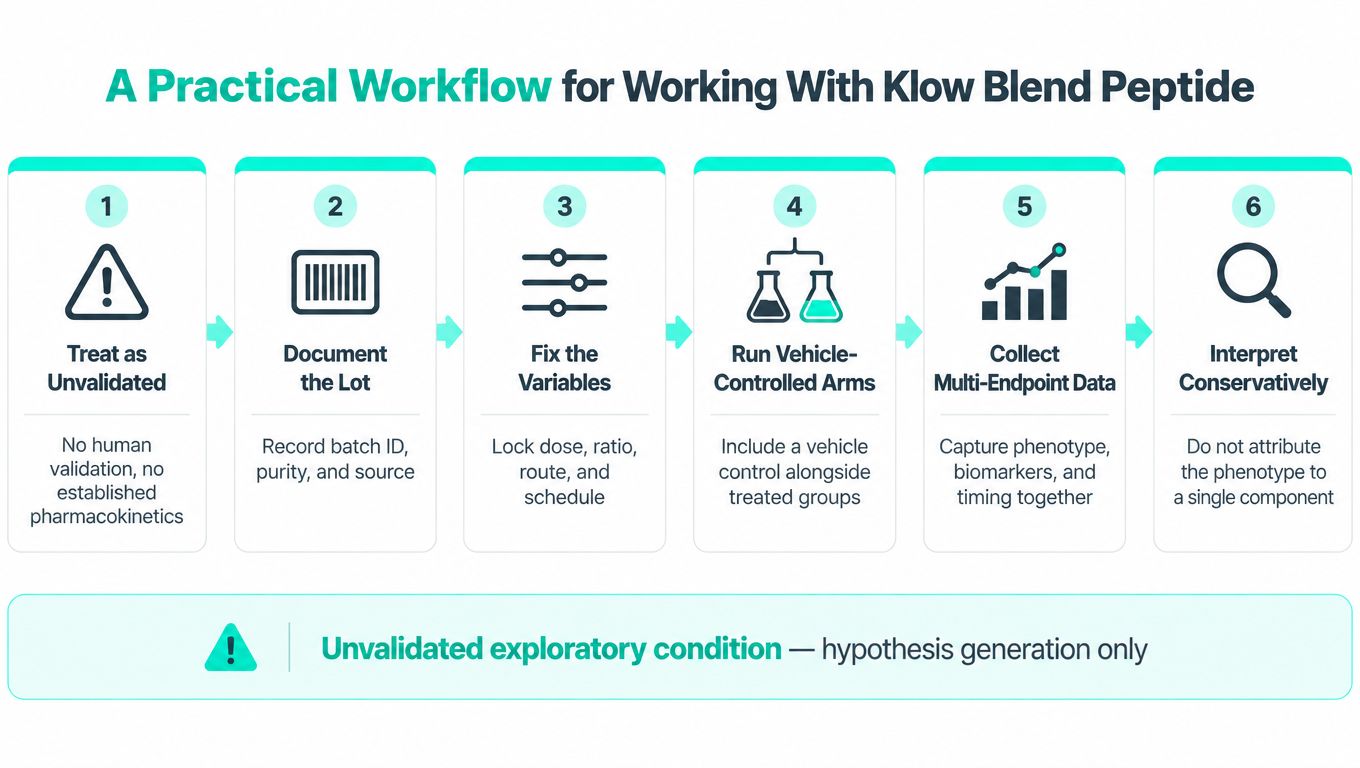
Create a record containing the supplier, lot number, nominal composition, COA, storage history, and receipt date. Check reconstituted stability across the planned assay window. Record the solvent, handling conditions, and exposure period so another investigator can identify where a result may have changed.
Plan attribution before collecting data:
A single blended condition can support a hypothesis, but it cannot identify which constituent caused the effect. Follow-up work should separate the components and test whether the response changes with dose, ratio, or interaction.
The KLOW blend peptide is a research formulation with a defined nominal composition but unvalidated combined behavior. Document the lot, verify the constituents, control the vehicle, and compare individual components before assigning causality.
Celonyx Labs supplies research peptides through an online catalog and presents product documentation, stated purity information, testing claims, ordering policies, and customer support for laboratory purchasers. Review its KLOW information and request lot-specific documentation before beginning the experiment.
Solid phase peptide synthesis is a method that builds a peptide one amino acid at

500 mcg equals 0.5 mg, a labeled research quantity, and no published human study establishes

Choose the best GHK-Cu peptide format for laboratory skin and wound-healing research. Compare documentation, assay
FOR RESEARCH USE ONLY. Products sold by Celonyx Labs are intended exclusively for laboratory and scientific research. They are not intended for human or veterinary use, consumption, diagnosis, treatment, cure, or prevention of any disease. By purchasing from this site, you acknowledge that you understand the intended research purpose of these materials and agree to comply with all applicable laws and regulations.