

Integrity Research BPC 157: How to Judge Vendor Claims
The advice you'll hear most often about buying BPC-157 for the bench is short: demand
The most common advice about buying LL-37 is to choose a high purity percentage and fast shipping. That's not enough. A certificate of analysis must describe the exact lot you'll receive and provide evidence relevant to your experiment, not display a reassuring purity badge.
If you're searching for “LL 37 peptide buy,” start with the intended assay rather than the checkout page. Laboratory procurement and human administration are different decisions, and neither a product label nor a published experiment bridges that gap.
Think of a peptide sequence as a serial number. Before comparing suppliers, ask whether the material is the molecule your protocol requires, rather than a fragment or modified analogue carrying a familiar name.
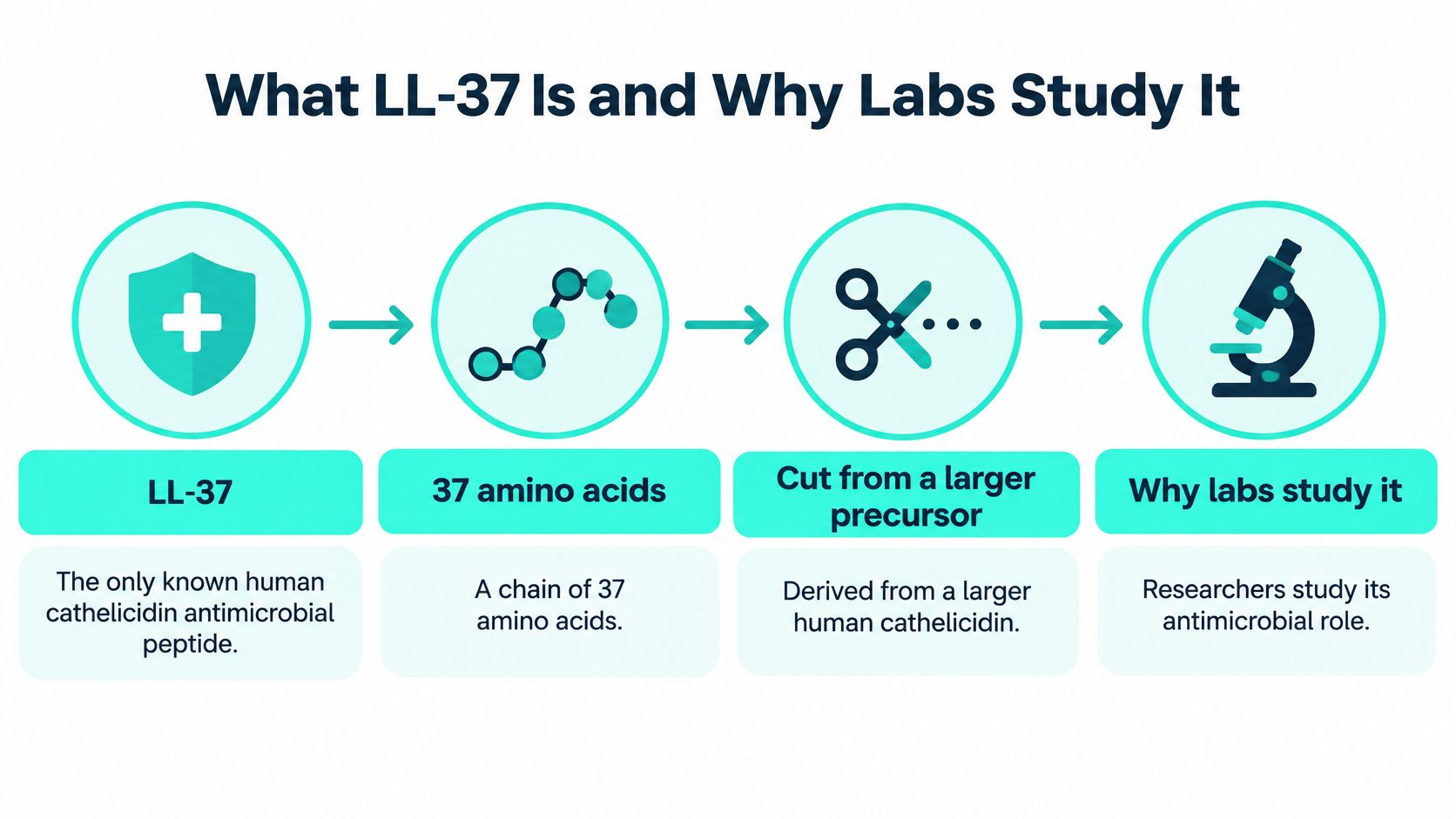
LL-37 is the only known human cathelicidin antimicrobial peptide, consisting of 37 amino acids and released by cleavage from the precursor hCAP-18, as described in this review of LL-37 biology. The name reflects its length, but a name on a vial isn't an identity test.
This concept map connects the molecule's identity with its research role.
LL-37 occurs across epithelial and immune-cell compartments, including skin, gastrointestinal and respiratory epithelia, monocytes, neutrophils, T cells, natural-killer cells and B cells. Its presence across these compartments helps explain why investigators study more than bacterial killing.
Its research roles include direct antimicrobial activity, binding and neutralization of bacterial lipopolysaccharide, and recruitment of immune cells. Investigators also examine inflammatory regulation, re-epithelialization and wound closure.
Those activities aren't interchangeable endpoints. An antimicrobial experiment asks whether organisms survive exposure; a tissue-repair experiment may ask whether cells migrate or close a gap, while separately checking whether the material damages them.
For application-focused purchasing, our guide to LL-37 peptides for antimicrobial research can help frame the questions to bring to a supplier.
Synthetic LL-37 can reproduce the native peptide's sequence without being physically extracted from human tissue. The authentication question is whether the supplied sequence corresponds to the mature peptide derived from hCAP-18, with any modification clearly disclosed.
Before accepting a product description, check the full-length sequence, its correspondence to mature LL-37, and the absence of unexplained truncations or modifications. A deliberately modified analogue may be useful, but it's a different experimental material.
For an additional visual introduction, the following video is available.
LL-37 has moved from mechanism-focused laboratory investigation into human research. That progression establishes scientific interest, not a general treatment recommendation.
A 2014 Phase I/II randomized, placebo-controlled study evaluated topical LL-37, also called ropocamptide, in 34 patients with chronic venous leg ulcers, according to this laboratory-to-clinic overview. The protocol used a 3-week placebo run-in, 4 weeks of randomized double-blind treatment and a 4-week follow-up, with 0.5, 1.6 and 3.2 mg/mL applied twice weekly.
The important purchasing lesson is the study's specificity: a topical preparation, a defined wound condition and a controlled protocol. Those features don't describe an injectable preparation, a systemic exposure or an unrelated cell-culture model.
Later trial listings include melanoma, diabetic foot ulcers and COVID-19. These listings indicate translational interest across different indications, not confirmed effectiveness across those diseases.
Evidence boundary: A published concentration belongs to the conditions in which investigators tested it. It isn't a universal starting protocol.
Development constraints also matter. Potential toxicity toward mammalian cells can complicate interpretation, while reduced antimicrobial activity in serum can make results from a simple buffer difficult to transfer into a more complex biological environment.
Say a laboratory reads a wound-healing paper and plans a cell-migration experiment. Copying the published concentration won't establish equivalence because the preparation, exposure environment and endpoint may differ.
The team should first establish a suitable concentration-response design, include viability measurements and document the differences between its model and the published protocol. A positive result should remain a finding about that model.
A careful experimental write-up should identify:
Bench and animal findings must not be presented as proof of human effectiveness or safety. Likewise, a supplier's reference to clinical investigation doesn't establish that its catalog material is equivalent to a preparation used in a controlled trial.
Analytical purity and fitness for an assay answer different questions. A chromatographic result describes the sample under a particular analytical method; it doesn't establish every property that could influence a biological experiment.
LL-37 binds anionic bacterial components, including lipopolysaccharide from Gram-negative organisms and lipoteichoic acid from Gram-positive organisms, and has reported effects on biofilms and neutrophil extracellular-trap responses, as discussed in this review of LL-37 antimicrobial and immune activity. A preparation can therefore alter an experimental readout without bacterial killing being the sole explanation.
Truncated sequences, oxidation products, counter-ion differences, concentration errors and aggregation can affect interpretation. Some problems concern what's present; others concern how much active peptide reaches the experimental system or how it behaves there.
Concentration deserves particular attention. Ask whether the stated quantity represents peptide content or total material, including water and counter-ions, before calculating a working solution.
The assay environment matters too. LL-37's positively charged, amphipathic structure supports interaction with bacterial membranes, but physiological salt can weaken electrostatic interactions, according to this review of antimicrobial peptide membrane mechanisms.
Controls to match to the experiment
| Experimental system | Controls and reporting required | Main risk |
|---|---|---|
| Cell culture | Endotoxin and cytotoxicity controls | Pro- and anti-inflammatory effects vary by cell type |
| Antimicrobial assay | Buffer composition, peptide concentration and exposure time reported | Physiological salt can weaken electrostatic activity |
| Animal work | Institutional approval and route-specific review | The route of administration changes the hazard profile |
Qualify a reference lot and compare new material using concentration-response curves rather than a single challenge condition. Include bacterial growth or viability controls and host-cell viability measurements where those endpoints matter.
For example, an apparent reduction in an inflammatory signal is difficult to interpret if the same preparation also reduces host-cell survival. Measuring the desired response without measuring viability can leave the team unable to distinguish modulation from toxicity.
A headline purity figure is a starting specification, not a guarantee of reproducibility. The practical question is whether the analytical record and functional controls together support the experiment you intend to run.
Use the following checklist against the specific lot offered for shipment. A certificate bearing the correct product name but a different batch identifier doesn't document the vial in hand.
Certificate of analysis checklist for an LL-37 lot
| Document item | What a usable record shows | Red flag |
|---|---|---|
| Lot or batch number | Identical to the vial label | Generic certificate with no lot number |
| Test date | Dated testing tied to the same lot and supported by applicable stability information | Undated or old release data without stability support |
| Identity by mass spectrometry | Measured mass consistent with the declared full-length LL-37 sequence and modifications | No mass data or mass not stated |
| Chromatographic purity | Actual HPLC or UPLC trace with the method named | A single percentage with no trace |
| Peptide-related impurities | Impurities listed with measured levels and identification criteria | Impurities not reported |
| Endotoxin | Result reported for cell-based or animal work | Silence on endotoxin |
| Water, counter-ion and residual solvents | Reported where relevant to the assay | Not addressed |
| Storage and freeze-thaw limits | Stated conditions with supporting stability data | Missing storage instructions |
| Stated activity assay | Functional test with method described | Purity claim with no activity data |
Start with the lot number and test date. The date should establish when the offered material was evaluated; an older result requires an appropriate stability basis, not automatic rejection or automatic acceptance.
Next, inspect the mass-spectrometry record against the declared sequence and chemical form. A matching mass supports identity, but mass alone doesn't resolve every possible sequence or impurity question.
Chromatographic purity needs the actual trace and method, not just a typed result. Ask how peaks were integrated and whether the method can meaningfully assess the impurities relevant to the specification.
FDA peptide-product guidance addresses identity, purity, strength or potency and consistency, including identification of peptide-related impurities at 0.10% or higher. Use that as a quality-review reference, not as a claim that every research reagent has received regulatory approval.
Endotoxin reporting should include the test method, units and acceptance criterion. Silence doesn't mean absence, and a result without units can't support a meaningful comparison with an experimental requirement.
Water, counter-ion and residual-solvent information helps the laboratory interpret composition and concentration. Storage instructions should identify the material state they cover, because a claim for unopened powder doesn't automatically establish stability after reconstitution.
A stated activity assay should describe the test system and endpoint. If no functional data exist, record that gap and decide whether your laboratory can qualify the material before using it in the main study.
A missing test isn't a passing result. It's an unresolved purchasing question.
Our peptide certificate of analysis guide provides further context for reading these records. Request the lot-specific certificate and supporting chromatogram in writing before placing the order, then retain them with the experiment record rather than relying on a product page that may change.
Start with the storage limits in the lot documentation, not a generic peptide-handling recipe. The laboratory should have an approved receiving and preparation procedure before the shipment arrives.
Treat unexpected cloudiness, incomplete dissolution or a labeling discrepancy as a reason to pause. Don't change solvent or handling conditions and continue under the original protocol.
A concentration calculator can help with arithmetic, but it can't establish solvent compatibility, stability or identity. We offer a Peptide Reconstitution Calculator for planning calculations; the lot documentation and approved laboratory method still govern preparation.
Recordkeeping rule: Store the handling log with the analytical records so another investigator can reconstruct what entered the assay.
Storage conditions are part of material qualification. They belong in the experimental record alongside the certificate, not only on a freezer label.
A polished website, testimonials and rapid fulfillment don't establish analytical quality. Compare suppliers by how clearly they document the material and how they handle a discrepancy.
Confirm that LL-37 is listed and available before planning around a supplier. A broad research-peptide catalog doesn't establish availability of every molecule.
Send the same specification to each candidate supplier and compare completeness. A prompt but partial reply may be less useful than a complete technical response that identifies missing tests clearly.
Keep shipping assessment separate from molecular qualification. For broader context on fulfillment partners and supply-chain questions, you can browse logistics provider articles from Novocargo; logistics information doesn't replace a peptide's analytical record.
Pressure to buy for human use, vague therapeutic claims and reluctance to share lot documentation should stop the comparison. At Celonyx Labs, we provide published ordering policies and customer support for product and order questions, but buyers should still evaluate the records relevant to the specific material they intend to purchase.
Can you buy LL-37 for human use? A research-use-only purchase gives you a reagent, not a treatment. The label states intended use; it does not establish safety, efficacy, prescribing legality or suitability for self-experimentation, and paying for a catalog vial creates no lawful path to human administration.
LL-37 is not an FDA-approved drug, and safety questions in the research literature include possible immunogenicity, peptide-related impurities and effects that vary by tissue. A development name or a human wound investigation does not authorize a catalog product for injectable or systemic use.
A supplier's checkout answers one question: whether they will sell to you. National rules differ, and cross-border fulfillment can raise customs, import and institutional-compliance questions the seller never sees. The RUO label works like a key card. It opens the laboratory door and nothing else.
All Celonyx Labs peptides are labeled "For Research Use Only." Our explanation of research-use-only peptides sets out how laboratory intended use differs from clinical claims.
For academic laboratories, CROs and biotech teams, the decision belongs to the people responsible for the protocol, the safety review and procurement. Where human research is proposed, authorization must come through the applicable regulatory and institutional pathway, not through a reagent order.
Release the purchase only when the following conditions are satisfied:
If a condition fails, pause the order, request the missing evidence or choose material that meets the specification. Save the certificate and chromatogram with the experiment record and share them with the safety or procurement office responsible for approval. Keep in mind that a certificate documents one lot and one assay; a clean result from an earlier batch does not qualify the vial in your hands.
Research-use-only material is not for human use.
Celonyx Labs offers research peptides through an online catalog, with customer support for product and ordering questions. Visit Celonyx Labs to review current listings and purchasing policies, then confirm availability and the documentation needed for your laboratory's specification before ordering.
The advice you'll hear most often about buying BPC-157 for the bench is short: demand

Can cagrilintide be combined with GLP-1 peptides? Yes, in controlled research. Understand mechanisms, study controls,

Can Selank be combined with nootropic peptides? Yes, in controlled laboratory studies. Learn the controls,
FOR RESEARCH USE ONLY. Products sold by Celonyx Labs are intended exclusively for laboratory and scientific research. They are not intended for human or veterinary use, consumption, diagnosis, treatment, cure, or prevention of any disease. By purchasing from this site, you acknowledge that you understand the intended research purpose of these materials and agree to comply with all applicable laws and regulations.