
Amino 1 MQ Explained for Laboratory Research
Amino 1 MQ is 5-amino-1-methylquinolinium, a quaternary quinolinium small-molecule inhibitor of NNMT, not a peptide.
Tracked listings put the MOTS-c peptide price at roughly $0.75 to $12.50 per milligram, with reported median prices near $3.76 to $4.00 per milligram. Those figures aren't directly comparable until you normalize for peptide mass, shipping, testing, and documentation.
You've got two quotes open for the same research peptide. The vial prices look almost identical, but one supplier provides lot-specific HPLC and mass-spectrometry results while the other offers only a general purity statement. The lower-looking quote may leave your lab paying later for verification, or repeating work if the material doesn't meet your requirements.
That's why I treat advertised price as a starting point, not a purchasing decision. A defensible comparison accounts for total landed and verification cost, then checks whether the product fits the intended use. Research material, clinical investigational product, and products marketed for personal use are different categories, not interchangeable versions of the same purchase.
Suppose a lab manager receives two quotes for MOTS-c. The vial prices are close enough that the first comparison seems simple. Then the documentation arrives: one supplier provides results tied to the specific lot, including HPLC and mass-spectrometry data; the other provides a generic purity claim with no batch identifiers or supporting results.
Those quotes don't establish equivalent value. The first supplier has provided evidence a laboratory can review before use. The second has provided a claim that still needs checking. If the lab must arrange independent testing, wait for results, or replace material that fails its acceptance criteria, the apparent saving can disappear. The difference between the quotes isn't just the vial. It's what the purchase includes and what the lab must do next.
Procurement rule: Compare what arrives with the product, not just what appears beside the product name.
Before ordering, ask each supplier for the same information: the vial's peptide mass, the lot number, the test methods, the chromatogram, mass-spectrometry identity confirmation, and the certificate of analysis. Ask whether shipping is included and whether the listed price is standard or promotional. If the supplier can't connect its documentation to the lot being sold, don't treat the purity claim as equivalent to lot-specific verification.
For the comparison to be useful, calculate the price per milligram from the actual amount in the vial, then list shipping and any separate testing costs. Record the documents received, not just the supplier's verbal assurances. An experienced buyer doesn't choose the lowest headline figure; they choose the quote whose contents and costs they can defend to a principal investigator, procurement office, or quality team.
MOTS-c is a 16-amino-acid mitochondrial-derived peptide encoded by a small open reading frame within mitochondrial 12S ribosomal RNA. It was first characterized in 2015. Research has examined its relationship to insulin sensitivity and metabolic homeostasis, including proposed signaling associated with glucose utilization, skeletal-muscle responses, and AMPK-related activity. The foundational MOTS-c research gives buyers a basis for understanding the reagent's scientific identity, not a basis for treating it as an established medicine.
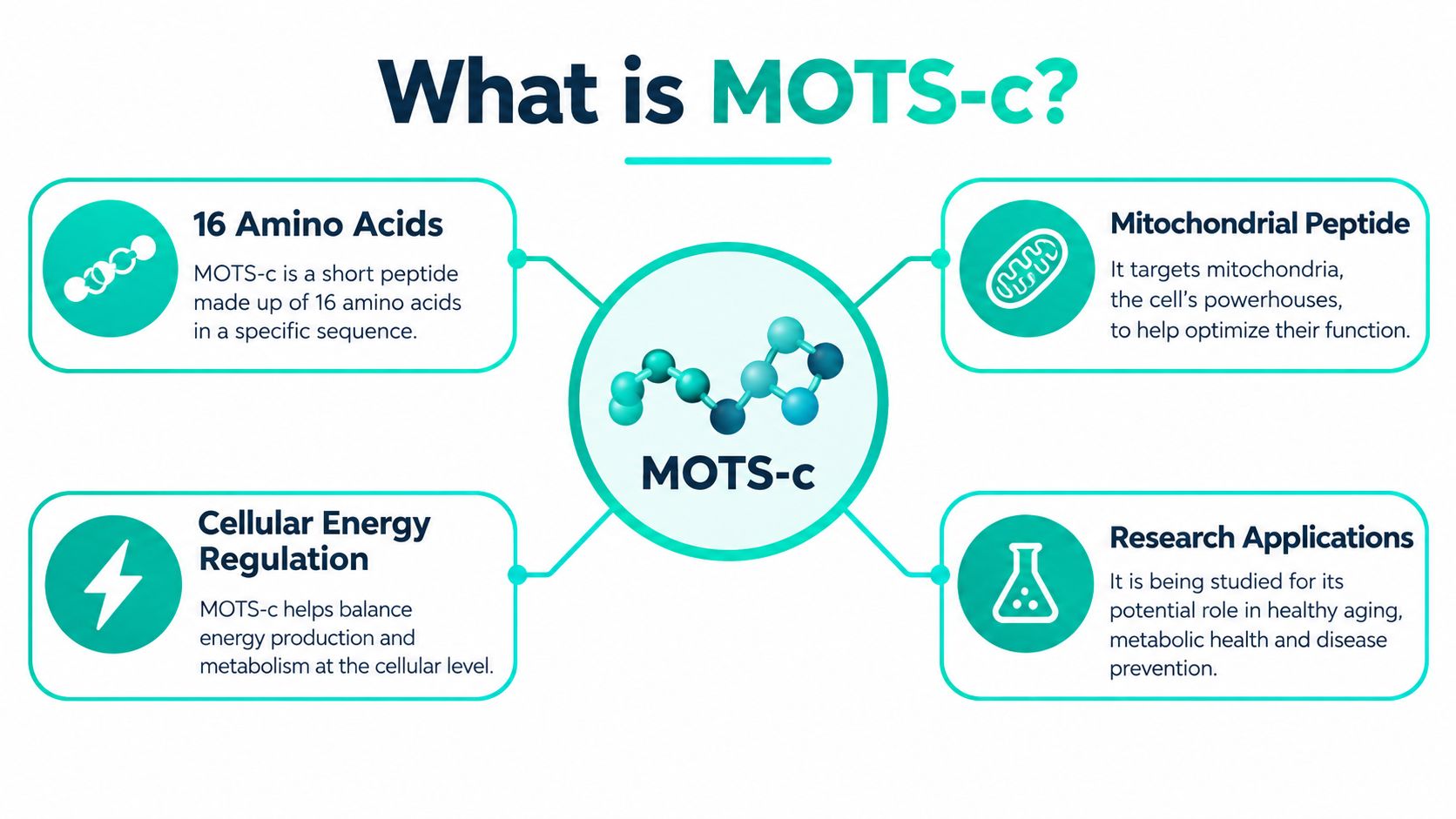
That distinction matters to procurement. MOTS-c remains a specialized research reagent rather than a mature, standardized therapeutic product. Price can reflect small-scale production, synthesis complexity, vial size, analytical testing, and supplier positioning. It shouldn't be read as a clinical-market price or as evidence of proven treatment value.
Human research has measured physiological responses, but those findings don't set a therapeutic price or establish an approved use. In a study involving healthy controls and women with polycystic ovary syndrome, intralipid infusion raised circulating MOTS-c to 232 ± 124% of baseline in controls and 349 ± 206% in the PCOS group; insulin infusion blunted the lipid-associated response, while an eight-week moderate exercise intervention didn't change circulating MOTS-c in either group. The human study helps explain why researchers may investigate MOTS-c in metabolic, endocrine, exercise, and mitochondrial signaling. It doesn't establish a recommended dose or clinical value.
For a buyer, the practical takeaway is straightforward: you're paying for a defined research material and its supporting documentation. Don't use the price of a research vial to infer therapeutic legitimacy, and don't treat promotional wellness claims as a substitute for evidence or regulatory status.
The biology identifies the peptide. Procurement specifications determine what a particular quote means. I evaluate four cost drivers: purity, testing, batch size, and supplier accountability. Each can change the price, but none should be accepted as a substitute for the others.
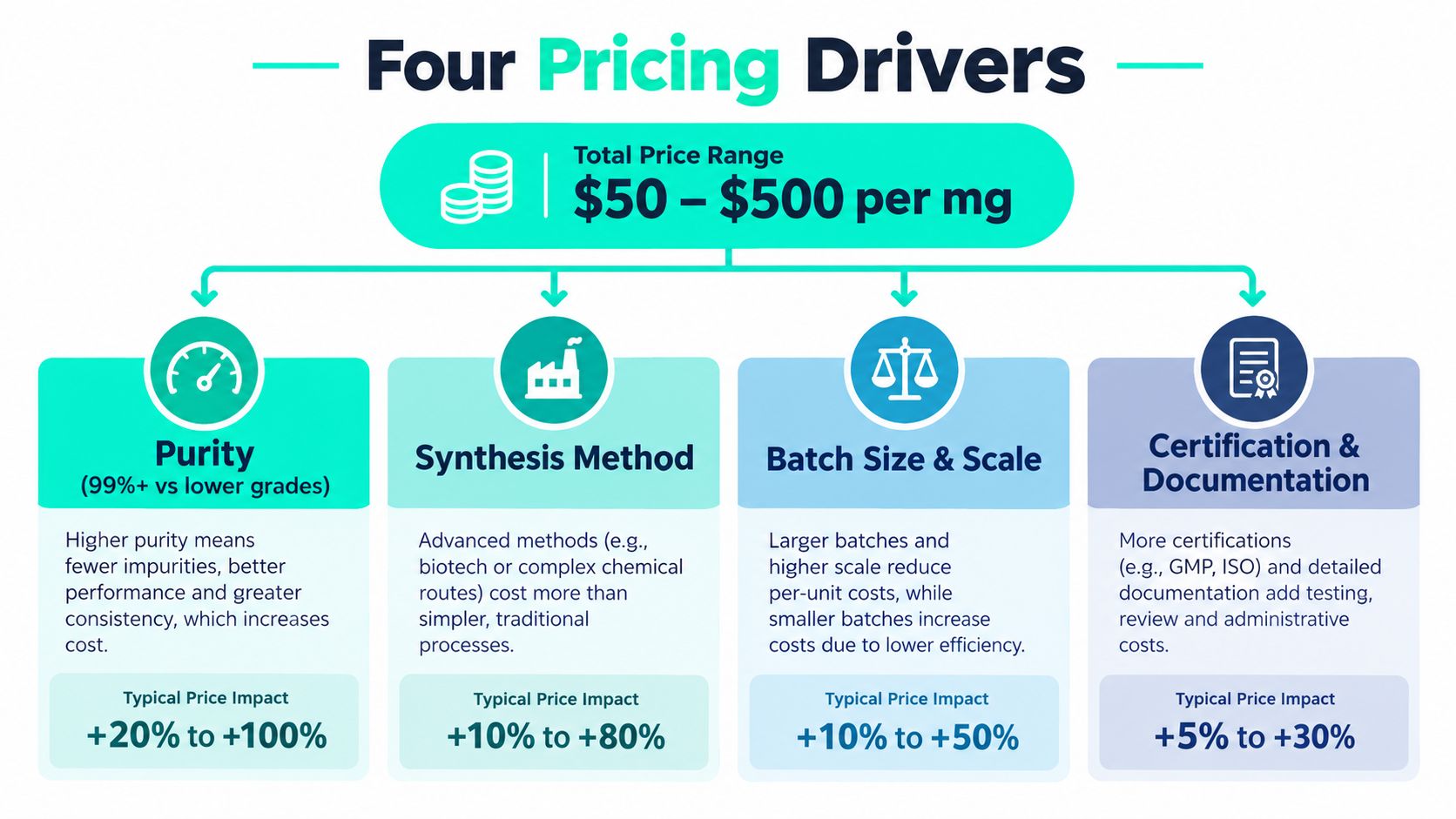
A stated purity percentage is useful only when you know what method produced it and which lot was tested. A supplier may publish a high figure, but that figure alone doesn't show whether the product's identity was confirmed or whether the results apply to the batch you'll receive. Published buying guidance recommends HPLC purity of at least 98% and mass-spectrometric confirmation of the expected approximately 2,174.5-Da molecular mass. The MOTS-c purchasing guidance outlines why both purity and identity belong in a comparison.
Third-party analysis can add confidence, but it also contributes to the quote. The useful question isn't whether testing is mentioned. Ask what was tested, by which method, and whether the report is tied to the lot. A percentage without a chromatogram or identity confirmation leaves key questions unanswered.
A quote for a small vial and a quote for a larger quantity shouldn't be compared by total price alone. Vial mass, current lot availability, and the economics of small-batch synthesis can change the price per milligram. Confirm the exact amount of peptide included, then check whether a volume discount changes the documentation or merely the unit price.
Look for published policies, usable contact details, and a clear process for resolving discrepancies. Testimonials can inform your impression of customer service, but they don't replace analytical records. A supplier should be able to answer specific questions about the lot without asking your lab to rely on marketing language.
Public trackers show a wide spread, not one universal MOTS-c peptide price. One aggregator reported a median of approximately $4.00 per milligram across 303 usable listings, with observed prices from $1.40 to $12.50 per milligram and total vial prices from $14 to $800. A separate tracker reported a median of $3.76 per milligram across 113 vendors, with its lowest observed price at $0.75 per milligram. The tracked MOTS-c pricing data is best used as a reference range, not a promise that two listings contain equivalent material.
| Source | Median USD/mg | Low observed USD/mg | High observed USD/mg | Vial price range |
|---|---|---|---|---|
| Aggregator with 303 usable listings | Approximately $4.00 | $1.40 | $12.50 | $14 to $800 |
| Separate tracker covering 113 vendors | $3.76 | $0.75 | Not reported | Not reported |
Normalize every offer before drawing a conclusion. Divide the vial price by the stated peptide mass to get USD per milligram, then record shipping and any separate testing fees in their own columns. Don't compare a promotional price with a standard price as if both will be available at checkout.
The key limitation is that nominal mass and verified peptide mass aren't automatically the same thing. A listing might state a vial quantity, but the buyer still needs documentation to establish what was measured and how. The tracker data also don't explain every difference among listings, so treat the spread as a signal to investigate rather than proof that a particular offer is good or poor.
A very low quote isn't automatically wrong. It is, however, a reason to request batch-specific HPLC and mass-spectrometry records before treating the material as comparable to a better-documented offer. Make the decision on the normalized evidence package, not on the lowest number in a search result.
A certificate of analysis (COA) should let you connect the test results to the exact material you're buying. Start with the lot number. If the COA doesn't identify the lot on the quotation or product, it may not describe the vial your lab receives.
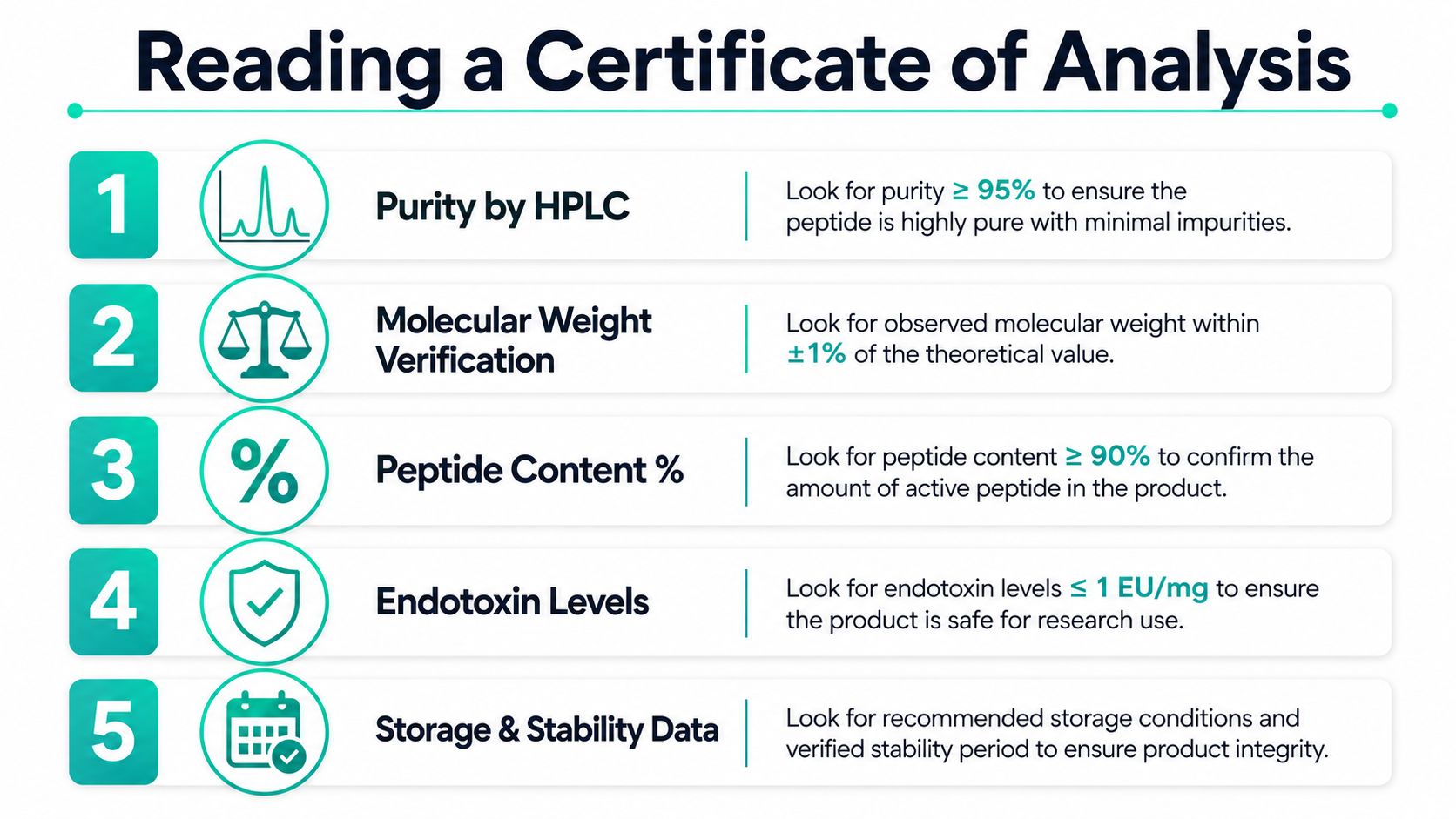
Review the COA in this order:
You can review Celonyx Labs peptide test results as an example of the kind of supplier-facing quality information buyers should assess. Still, don't assume that a general testing reference replaces the records for a specific lot. Ask for the actual lot-specific COA and supporting data before order placement.
If records are missing, independent testing becomes part of the project budget. Available testing-cost data put independent U.S. laboratory HPLC purity testing at approximately $150–$300 per sample, LC-MS identity confirmation at $200–$400, and a broader panel for endotoxin, heavy metals, residual solvents, and moisture at $800–$2,000 per sample. The peptide testing cost information gives buyers a way to estimate what verification may add when supplier documentation is insufficient.
Don't accept a COA as decoration. If it isn't lot-specific, method-specific, and reviewable, it doesn't close the verification gap.
A MOTS-c quote only makes sense once you know what the purchase is for. Research material, clinical investigational product, and a product marketed for personal use are separate categories. Price alone can't move a product from one category into another.
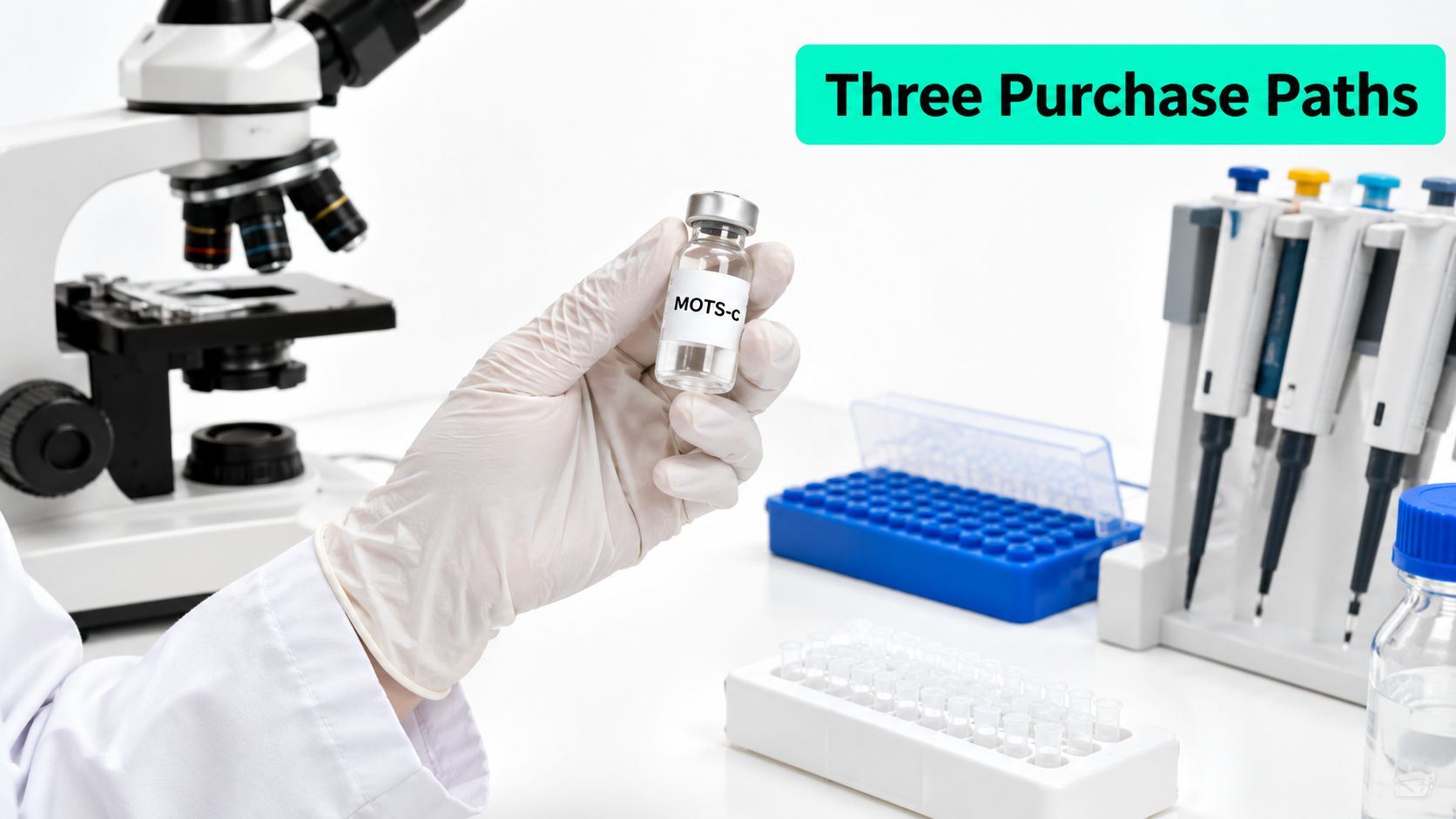
Laboratories buy research-use material for defined experimental work, such as in-vitro or animal research. The buyer should assess identity, purity documentation, fill amount, handling, and whether the supplier's terms fit the lab's procurement requirements. A higher price may reflect documentation or handling, but the lab still has to verify what the product and its records support.
A clinical investigational product belongs under an authorized research protocol, with controls appropriate to that study. The registered Phase 2a study NCT07505745 is described as an ongoing investigation designed for approximately 120 adults with prediabetes and overweight or obesity. That is not proof of efficacy or safety, and it doesn't make research-supply vials interchangeable with clinical-trial material. The clinical-trial status discussion distinguishes ongoing investigation from established clinical use.
A product promoted for wellness or performance isn't equivalent to either a research reagent or an investigational product supplied under a protocol. A premium price doesn't establish clinical quality, effectiveness, or legal suitability. Before paying for any claim about personal benefit, ask what regulatory basis and product-quality evidence support it.
The purchasing decision should follow intended use and compliance requirements, not an assumption that an expensive vial is a more advanced version of a less expensive one. If your work is research, buy against your lab's specifications. If the use is clinical investigation, follow the authorized protocol and its supply controls. Don't use price as a shortcut for deciding that two categories are interchangeable.
Two suppliers may quote the same peptide mass and still offer very different purchases. Set the specifications first, then request quotes against the same requirements. State the required mass, intended research use, and documentation your lab needs. Unequal specifications make prices impossible to compare fairly.
Use one worksheet for every quote:
Calculate price per milligram, then compare the landed cost and any verification expense. Keep multi-vial line items visible so the quoted quantity is clear. A lower unit price matters only when the documentation and total amount supplied meet your requirements.
For market context, use deep research features for academics to organize available material, while separating supplier statements from primary records. Research tools do not verify a lot. The discussion of how research peptide bulk-order costs are assessed can help frame the cost questions to ask.
Celonyx Labs states 99% purity and references independent third-party testing. Its published supplier information can help institutional buyers direct questions about documentation, but your purchasing decision should rest on the lot-specific records for the order. Request and review those records before comparing the quote with alternatives.
Return to the two quotes that looked almost identical. The defensible choice isn't automatically the cheaper vial or the quote with the most polished presentation. It's the offer whose price per milligram, shipping, testing evidence, and verification requirements you can document and explain.
Keep the decision rule simple: normalize every quote to USD per milligram, identify what the supplier has tested, and add any costs required to bring the material up to your lab's acceptance standard. Confirm that the purchase category matches the intended use. If a price sits below the documented market range, treat it as a verification trigger, not a bargain.
Shipping belongs in the same budget view. Check the stated terms and delivery conditions before comparing offers, and review Celonyx Labs shipping information as one example of the operational details a buyer should confirm. A reliable purchasing record captures the product, the lot, the evidence, and the total cost together. That's the number that protects your research budget.
For research buyers, Celonyx Labs offers MOTS-c labeled for laboratory research use, with stated purity information and a route to confirm testing documentation with its team. Review the product details and ask for the records tied to your intended purchase at Celonyx Labs.
Amino 1 MQ is 5-amino-1-methylquinolinium, a quaternary quinolinium small-molecule inhibitor of NNMT, not a peptide.

Choose full-length ll-37 peptide for baseline antimicrobial research. Compare material specifications, purity evidence, endotoxin testing,

Choose native VIP peptide for neuroinflammation research. Compare reference standards, labeled tracers, and PACAP-38, with
FOR RESEARCH USE ONLY. Products sold by Celonyx Labs are intended exclusively for laboratory and scientific research. They are not intended for human or veterinary use, consumption, diagnosis, treatment, cure, or prevention of any disease. By purchasing from this site, you acknowledge that you understand the intended research purpose of these materials and agree to comply with all applicable laws and regulations.