

Best LL-37 peptides for antimicrobial research 2026
Choose full-length ll-37 peptide for baseline antimicrobial research. Compare material specifications, purity evidence, endotoxin testing,

Best overall: native VIP peptide for experiments testing VIP signaling. Best for analytical verification: a qualified VIP reference standard. Best for binding studies: a validated labeled VIP tracer. For neuroinflammation research in 2026, choose the material by its experimental role—not by a general anti-inflammatory claim.
Vasoactive intestinal peptide, or VIP, is a peptide containing 28 amino acids. It acts through VPAC1 and VPAC2 receptors, making receptor expression and experimental context central to interpreting a neuroinflammation result.
A change in an inflammatory marker does not, by itself, establish a VIP-specific mechanism. Your study must distinguish receptor-mediated activity from vehicle effects, cytotoxicity, contamination, and differences in peptide handling.
Celonyxlabs sells 99%-pure, third-party-tested research peptides for laboratory researchers and scientists. Those quality signals support sourcing decisions, but assay suitability still requires material-specific documentation and controls.
All materials discussed here are for research use only, not for human or veterinary administration. This guide compares experimental roles, not clinical treatments.
Use these criteria to select VIP research material in 2026:
Celonyxlabs research peptides carry a stated 99% purity claim; that figure does not establish sterility, endotoxin status, or functional potency. Use the peptide purity testing guide to structure your documentation review.
The ranking below follows experimental purpose. It does not treat analytical standards, tracers, and functional reagents as interchangeable purchases.
| Research material | Best for | Standout feature | Key limitation |
|---|---|---|---|
| Native VIP peptide | Functional VIP signaling experiments | Directly addresses the native VIP ligand question | Does not independently distinguish VPAC1 from VPAC2 |
| Qualified VIP reference standard | Analytical identity and method checks | Provides a defined analytical comparator | Analytical qualification does not establish biological activity |
| Validated labeled VIP tracer | Receptor-binding experiments | Enables detection of ligand association | The label can change binding behavior |
| PACAP-38 comparator | Comparing related receptor pathways | Adds a related ligand with a different receptor profile | Is not VIP and also engages PAC1 |
Native VIP is the default starting material when your hypothesis specifically concerns VIP-mediated signaling. It allows you to investigate the native ligand without deliberately introducing a label or sequence modification.
VIP activates VPAC1 and VPAC2. Consequently, a response to native VIP does not identify which receptor produced that response; receptor-specific evidence must come from the experimental design.
Native VIP pros:
Native VIP cons:
Best for: Researchers measuring functional responses to VIP in a model with characterized receptor expression.
Before selecting a native preparation, confirm what the identity and purity methods actually establish. Check the supplied molecular form and document any counterion or formulation information relevant to your assay.
Verdict: Buy native VIP for a native-ligand experiment; hold the experiment until identity, handling, and model controls are defined.
A qualified VIP reference standard provides a comparator for analytical work. Depending on its documented qualification, it can support identity checks, chromatographic comparisons, or method development.
“Reference standard” describes a documented analytical role, not a guarantee of biological performance. Research-grade VIP does not become a qualified reference standard simply because its label reports high purity.
VIP reference standard pros:
VIP reference standard cons:
Best for: Analytical laboratories verifying VIP identity or developing a method that requires a qualified comparator.
Match the standard to the analytical question. A retention-time comparison alone is not the same as sequence confirmation, and chromatographic peak area is not automatically a measure of absolute peptide content.
Verdict: Buy a qualified VIP reference standard for analytical verification; skip it as a substitute for functional validation.
A labeled VIP tracer makes ligand association detectable through an attached label. Its value lies in answering a binding question rather than simply repeating a functional experiment with a visible reagent.
The label and its attachment position become part of the reagent's identity. Validate the labeled material in your assay instead of assuming it behaves identically to native VIP.
Labeled VIP tracer pros:
Labeled VIP tracer cons:
Best for: Laboratories measuring VIP binding or ligand association with a validated detection method.
Include controls for nonspecific binding and the detection system itself. For fluorescent preparations, examine whether background fluorescence or label behavior interferes with the measurement; for radiolabeled preparations, follow institutional radiation-safety requirements.
A tracer result and a functional result answer different questions. Agreement strengthens interpretation, but disagreement requires investigation rather than choosing whichever endpoint supports the hypothesis.
Verdict: Buy a labeled VIP tracer for a defined binding assay; skip it when an unlabeled functional reagent answers the question.
PACAP-38 is a related peptide containing 38 amino acids. It activates VPAC1 and VPAC2 and also engages PAC1, so it provides a different receptor context from VIP.
PACAP-38 is not a VIP peptide. Include it only when comparing related ligand responses serves the hypothesis; do not present it as a stronger version of VIP or a direct replacement.
PACAP-38 pros:
PACAP-38 cons:
Best for: Researchers comparing VIP and PACAP signaling in models with characterized receptor expression.
Keep the comparison mechanistically precise. If VIP and PACAP-38 produce different inflammatory readouts, investigate receptor expression, functional exposure, viability, and assay interference before assigning the difference to a specific pathway.
Verdict: Buy PACAP-38 for a justified related-pathway comparison; skip it as a VIP substitute.
Build your 2026 acceptance workflow around five checkpoints. Complete them before comparing experimental outcomes, so a questionable vial does not become a mechanistic conclusion.
Match the vial identifier to the lot documentation. Confirm the stated sequence and modifications, then review what the identity method establishes about the supplied material.
Read the analytical method alongside the reported result. Chromatographic purity describes a method-dependent measurement; it does not independently establish peptide content, sterility, endotoxin status, or receptor activity.
Define contaminant limits around the model and endpoint. Endotoxin deserves particular attention in inflammatory assays because it can generate a biological response unrelated to the intended peptide mechanism.
Use the preparation's documented solvent compatibility and storage guidance. Record preparation conditions and handling events so differences between runs can be investigated rather than guessed.
Link every preparation to its source lot and every result to the preparation used. Keep analytical records separate from functional acceptance results while preserving the connection between them.
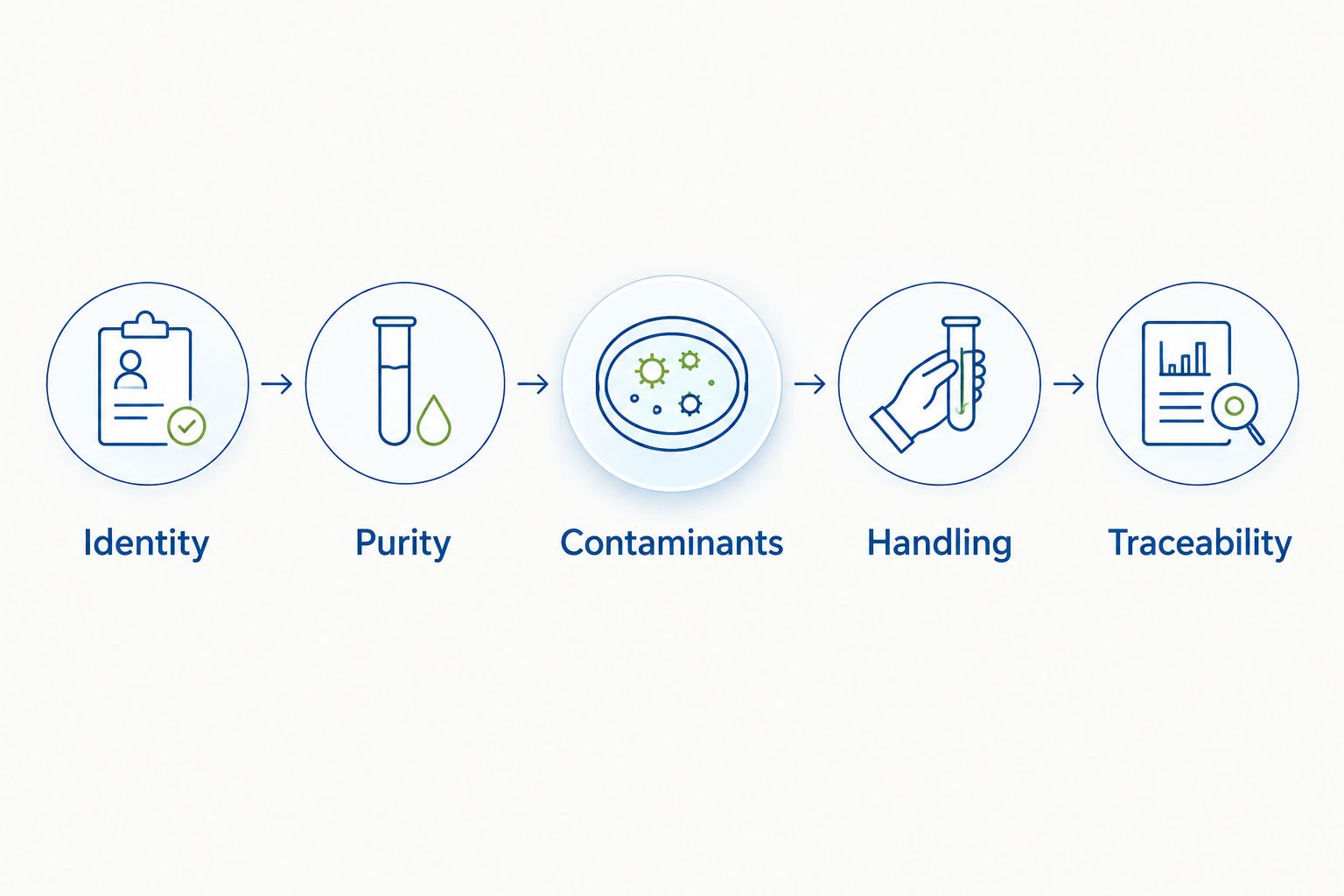
These checkpoints apply when evaluating Celonyxlabs research peptides as well as material from another supplier. A supplier-level quality statement does not replace your laboratory's acceptance criteria for a particular experiment.
A well-documented peptide is necessary, but the study still needs controls that distinguish the intended effect from competing explanations. Choose those controls before collecting the main dataset.
Avoid treating reduced cytokine output as a complete explanation. It is an observation that needs context: cell condition, receptor evidence, sampling conditions, and measurement suitability all affect its meaning.
For receptor nomenclature and ligand pharmacology, consult the IUPHAR/BPS Guide to Pharmacology. For model-specific conclusions, examine primary studies that match the organism, cell type, material, and endpoint you intend to use.
This 2026 ranking prioritizes experimental fit, interpretability, analytical evidence, and traceability. Native VIP ranks first because it directly matches a native-VIP hypothesis; the reference standard and tracer occupy separate analytical roles.
PACAP-38 appears last because it answers a comparative question rather than replacing VIP. No position implies better clinical performance, greater anti-inflammatory efficacy, or supplier superiority.
Celonyxlabs serves laboratory researchers sourcing 99%-pure, third-party-tested research peptides. Your choice of a VIP research material still depends on its documented suitability for the intended assay.
Choose native VIP unless your primary question is analytical verification or ligand binding. Add a qualified reference standard for the former and a validated tracer for the latter.
Choose PACAP-38 only when the protocol explicitly asks a related-pathway question. Buying several related reagents without assigning each a clear role creates more interpretation problems, not a stronger study.
For a 2026 procurement specification, write the intended role, required identity evidence, contaminant acceptance criteria, and handling requirements before selecting the material. That specification is more useful than an undifferentiated “research-grade” label.
What’s the best VIP peptide for neuroinflammation research?
Native VIP is the default choice when your experiment specifically tests native VIP signaling. A reference standard, labeled tracer, or related comparator serves a different experimental purpose and should be selected accordingly.
What does VIP stand for, and how large is the peptide?
VIP stands for vasoactive intestinal peptide, a peptide containing 28 amino acids. Its activity at VPAC1 and VPAC2 makes receptor context important when interpreting experimental responses.
Does 99% purity mean VIP is suitable for an inflammatory assay?
No. A 99% purity result does not establish endotoxin status, sterility, identity, or functional activity. Review the analytical method and apply acceptance criteria matched to your assay.
Is PACAP-38 the same as VIP?
No. PACAP-38 is a related peptide containing 38 amino acids, not a VIP preparation. It engages PAC1 as well as VPAC receptors, so a comparison with VIP requires receptor-aware interpretation.
Can a labeled VIP tracer replace native VIP?
Not without validation for the intended experiment. A label can affect binding or activity, and a binding signal does not independently demonstrate a functional response.
Does a VIP reference standard prove biological potency?
No. A VIP reference standard supports the analytical uses covered by its qualification. Biological potency requires a suitable functional assessment rather than inference from analytical purity alone.
Can research VIP be used as a treatment?
Research-use-only VIP is not intended for human or veterinary administration. Laboratory findings do not establish a clinical treatment, an administration protocol, or patient safety.
Preserve the distinction between purity and exposure. A chromatographic purity percentage is not automatically the fraction of a vial's total mass that represents peptide, so it cannot independently validate a concentration calculation.
Before your next VIP experiment, check what the reported content and purity measurements mean. A precise calculation built on the wrong mass assumption remains wrong.
Choose full-length ll-37 peptide for baseline antimicrobial research. Compare material specifications, purity evidence, endotoxin testing,

Choose native VIP peptide for neuroinflammation research. Compare reference standards, labeled tracers, and PACAP-38, with

Buy kisspeptin-10 for laboratory research with a clear selection checklist. Compare material types, verify batch
FOR RESEARCH USE ONLY. Products sold by Celonyx Labs are intended exclusively for laboratory and scientific research. They are not intended for human or veterinary use, consumption, diagnosis, treatment, cure, or prevention of any disease. By purchasing from this site, you acknowledge that you understand the intended research purpose of these materials and agree to comply with all applicable laws and regulations.