

BPC 157 500mcg Explained: What the Evidence Shows
500 mcg equals 0.5 mg, a labeled research quantity, and no published human study establishes
Amino 1 MQ is 5-amino-1-methylquinolinium, a quaternary quinolinium small-molecule inhibitor of NNMT, not a peptide. Its reported enzyme-inhibition IC50 is 1.2 micromolar, a laboratory measurement rather than a human dose.
Advice that starts with peptide reconstitution or weight-loss expectations skips the question a laboratory needs to answer first: what substance is in the vial? A familiar product name, a purity claim, and an interesting biological mechanism answer different questions. None can substitute for the others.
For investigators, the useful starting point isn't a proposed treatment protocol. It's a traceable chemical identity, followed by an assay plan that separates enzyme inhibition, cellular responses, and evidence about safety.
Amino 1 MQ is a search phrase, not a complete material specification. Before ordering or preparing stocks, a researcher should translate that phrase into a standardized chemical name and a defined chemical form.
PubChem's chemical identity record lists 5-amino-1-methylquinolinium, also named 1-methylquinolin-1-ium-5-amine, under CID 950107. The cation is represented as C10H11N2+, while the commonly identified iodide salt is C10H11IN2.
Think of the consumer-facing name as a nickname on a package. The standardized name, counterion, formula, and database identifier are the label that lets separate laboratories determine whether they're discussing the same substance.
The naming relationships are easier to follow when separated visually.
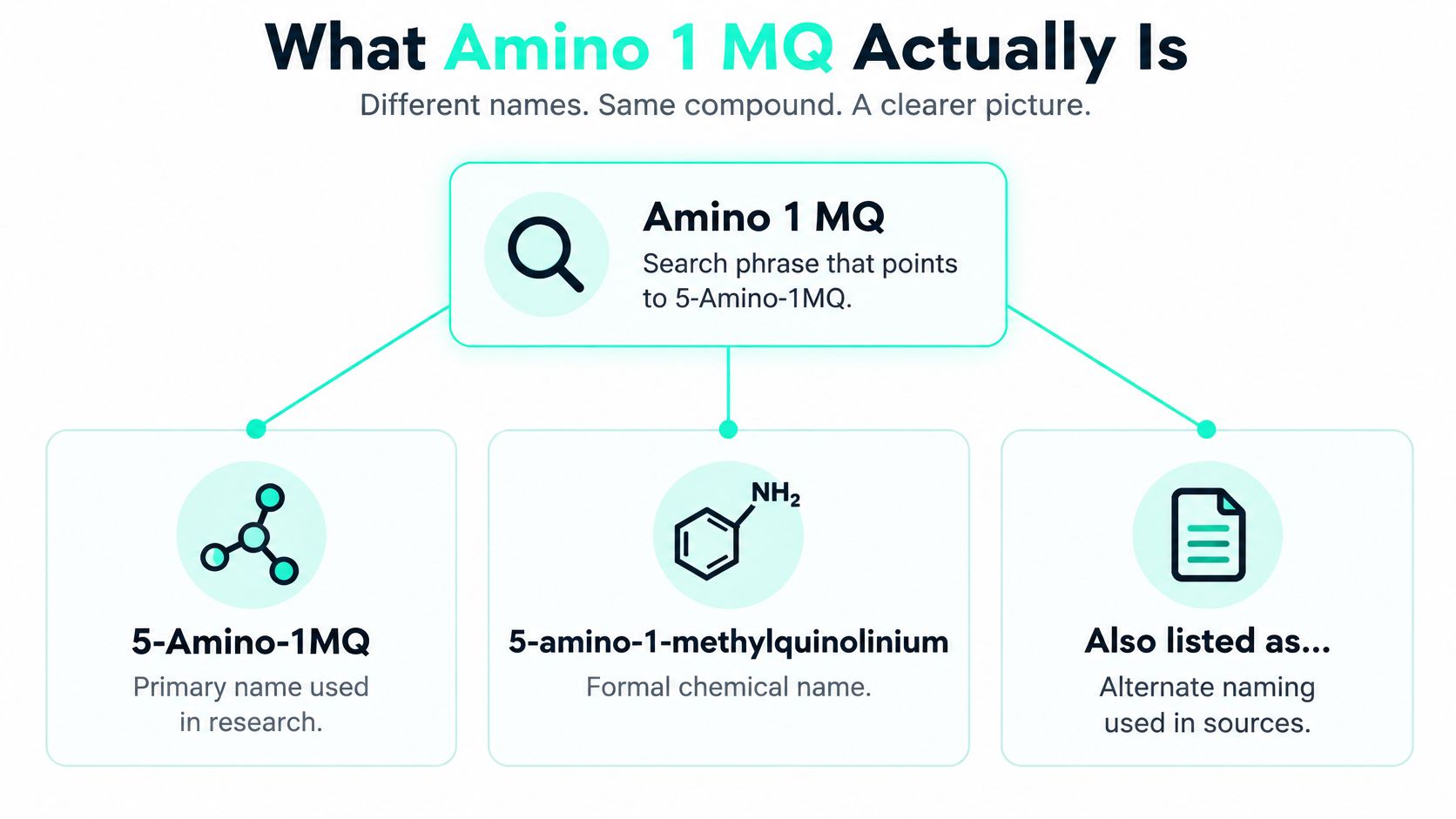
The distinction between cation and salt isn't cosmetic. A chemical record may describe the charged molecular component, while a supplier's certificate describes the complete material supplied with its counterion. Those descriptions can be compatible, but they aren't interchangeable entries in a stock-preparation calculation.
For example, a laboratory notebook that records only the abbreviated product name leaves the next researcher guessing which chemical form was weighed. A more useful entry identifies the supplied form and connects it to the certificate for that lot.
Use these fields as acceptance criteria, not optional catalog details:
This is a quaternary-ammonium quinolinium small molecule, not a conventional peptide. That classification matters when researchers choose analytical methods, interpret mass-spectrometry results, and decide which molecular-weight entry belongs in their calculations.
Don't resolve a mismatch by assuming the supplier used shorthand. Ask for clarification and retain the answer with the lot documentation before the material enters an experiment.
NNMT, nicotinamide N-methyltransferase, transfers a methyl group from S-adenosyl-L-methionine, or SAM, onto nicotinamide. The reaction produces 1-methylnicotinamide, often abbreviated MNA, and connects nicotinamide metabolism with cellular methyl-donor use.
Blocking that reaction can alter MNA production and the availability of nicotinamide for NAD+ salvage. But an investigator still needs to establish which response an assay measured. An enzyme result and a change in fat synthesis aren't equivalent observations.
Sigma-Aldrich's pharmacological record reports the 1.2 micromolar IC50, measured with 50 micromolar SAM and 100 micromolar nicotinamide carboxamide, together with cellular EC50 values of 2.3 micromolar for lowering adipocyte MNA and 30 micromolar for reducing lipogenesis.
| Endpoint | Reported value | Assay context | Question it answers |
|---|---|---|---|
| NNMT inhibition | IC50 described above | Biochemical enzyme assay with specified substrate concentrations | How much compound produces half-maximal enzyme inhibition under these conditions? |
| Adipocyte MNA reduction | Lower cellular EC50 described above | Measurement of a metabolic product in adipocytes | How does exposure affect the product associated with NNMT activity? |
| Lipogenesis reduction | Higher cellular EC50 described above | 3T3-L1 cell-based response | How does exposure affect a downstream cellular phenotype? |
IC50 describes a half-maximal inhibitory concentration in the specified assay. EC50 describes the concentration associated with a half-maximal measured effect. Neither is a universal property that can be detached from its endpoint and experimental conditions.
Practical rule: Choose concentrations around the question your assay asks, not around whichever potency figure is easiest to find.
The same supplier record reports no effect on related methyltransferases or enzymes in the NAD+ salvage pathway in the cited testing context. That supports a claim about the tested conditions, not unrestricted selectivity across every biological system.
A laboratory should therefore preserve the distinction between biochemical activity, cellular target-related changes, and downstream phenotype. If lipogenesis changes, the result doesn't independently establish how much NNMT was inhibited. If MNA decreases, that doesn't automatically establish the magnitude of a downstream metabolic response.
These measurements support experimental hypotheses and concentration selection. They don't establish clinical efficacy, human safety, or an approved human use.
An animal experiment can identify a research signal without establishing a treatment. The mistake is treating a short preclinical observation as if researchers had already characterized human exposure, tolerability, and benefit.
The foundational work involved diet-induced-obese mice receiving repeated parenteral dosing over 11 days, with reported reductions in body weight and white-adipose mass without reduced food intake, as summarized in the preclinical identity and evidence overview. That observation doesn't establish an equivalent human dose, route, or outcome.
The evidence-graded safety review describes little effect on 3T3-L1 viability at 10 micromolar, modest cytotoxicity at 100–300 micromolar, and approximately 40% cytotoxicity at 600 micromolar. It also summarizes tolerability at a total 60 mg/kg/day in a very small animal group and reports no registered Phase 1–3 human trial or published human clinical study as of April 2026.
Those findings need different interpretations. A cell-viability assay addresses the cells, exposure period, and readout used in that experiment. An animal tolerability observation addresses the animals and conditions tested. Neither defines safe human exposure.
Research documentation should be evaluated for its actual model and endpoints, rather than its scientific appearance.

A reviewer should ask what evidence addresses:
These aren't objections that a high-purity certificate can resolve. They require appropriately designed biological studies, toxicology, and human research.
A mechanistic hypothesis explains why an experiment is worth doing. It doesn't demonstrate a clinical benefit.
The appropriate conclusion is narrow: the preclinical findings justify investigation, while human safety and efficacy remain unestablished in the evidence described. Turning those findings into a self-administration protocol would go beyond what the experiments support.
A concentration-response experiment should connect compound exposure, target-related biochemistry, and cell condition. Selecting a concentration because it appeared in a summary isn't enough to establish that connection.
The laboratory research review of 5-Amino-1MQ reports approximately 12.1 micromolar NNMT IC50 for the parent 1-methylquinolinium scaffold, compared with the amino-substituted compound's potency noted earlier, a roughly tenfold improvement. It also describes cultured-adipocyte work at approximately 0.5–10 micromolar, with concentration-dependent intracellular MNA decreases and NAD+ increases at higher experimental concentrations, and lists the iodide salt's molecular weight as approximately 286.11 g/mol.
The workflow below separates compound selection from the evidence needed to interpret a response.
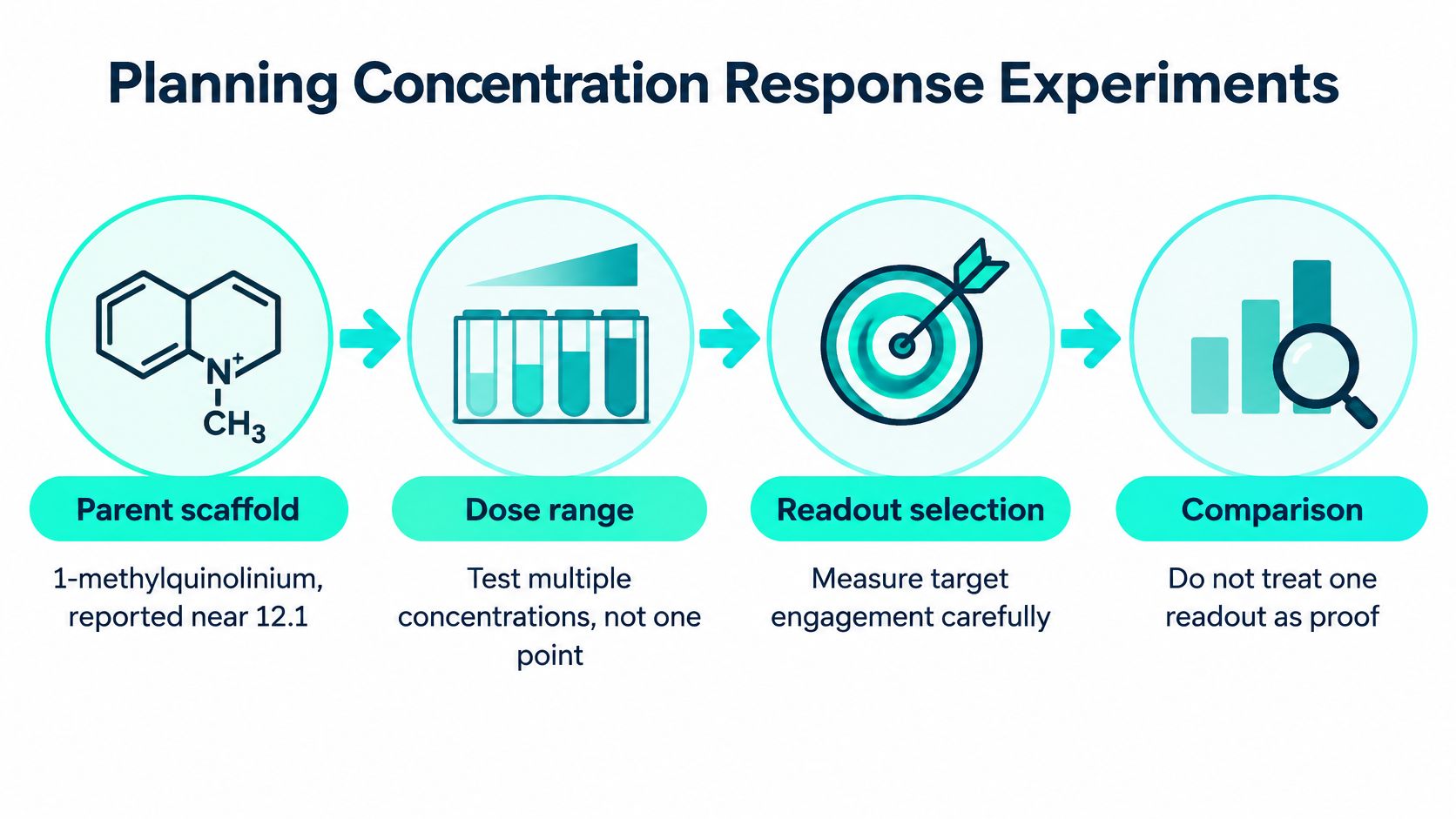
Use the published concentration range as experimental context, not as a universally validated range for every model. Researchers should establish suitable conditions for their cells, exposure schedule, and analytical methods.
A coherent pattern across these measurements is more informative than an isolated lipogenesis result. Even then, researchers should describe what they measured rather than claiming that a single metabolite proves target engagement.
Confirm the supplied form before converting mass into moles. Divide the mass in grams by the molecular weight appropriate to that form, then divide the resulting moles by the final solution volume in liters.
Don't use a free-cation molecular weight to calculate a stock prepared from the iodide salt. Record the weighed material, molecular-weight basis, solvent, final concentration, preparation date, and lot together.
For assay documentation and acceptance criteria, consult the laboratory's procedures alongside these method development guidelines. Prespecifying the measurements makes ambiguous results easier to investigate.
A supplementary video can support discussion, but it shouldn't replace the compound-specific assay record.
A catalog category isn't a chemical classification. When buyers encounter Amino 1 MQ beside research peptides, they shouldn't assume that the same preparation instructions, analytical expectations, or quality terminology apply.
The practical problem starts when a procurement team copies a peptide workflow into a small-molecule purchase specification. The resulting paperwork may look complete while leaving the actual chemical form or identity method unresolved.
A researcher accustomed to peptide documentation might look for a familiar mass report and a purity percentage, then overlook whether the result establishes the identity of the supplied quinolinium salt. A purchasing team might also accept general preparation language that wasn't written for this material.
The distinction between categories is worth teaching explicitly; a guide to what research peptides are can help teams separate peptide terminology from the compound-specific requirements here. It shouldn't be used as a substitute for this material's analytical documentation.
Ask procurement questions that marketing summaries often leave unanswered:
A chromatographic purity result describes the sample according to the method used. It doesn't, by itself, establish that the dominant component is the intended substance.
Identity testing addresses a different question: whether the material matches the proposed chemical identity. Biological activity requires relevant biological evidence, while sterility, endotoxin status, and residual solvents each require appropriate assessments.
Buyer's distinction: A purity result describes an analytical outcome. It isn't a general certificate of suitability.
The mouse observations discussed earlier don't repair missing procurement documentation or establish a human dosing basis. They belong to the biological evidence record, not the material-release checklist.
The useful purchasing decision is therefore not “peptide-branded or not.” It's whether the supplier can provide identity-confirmed, lot-traceable research material with documentation appropriate to the intended assay.
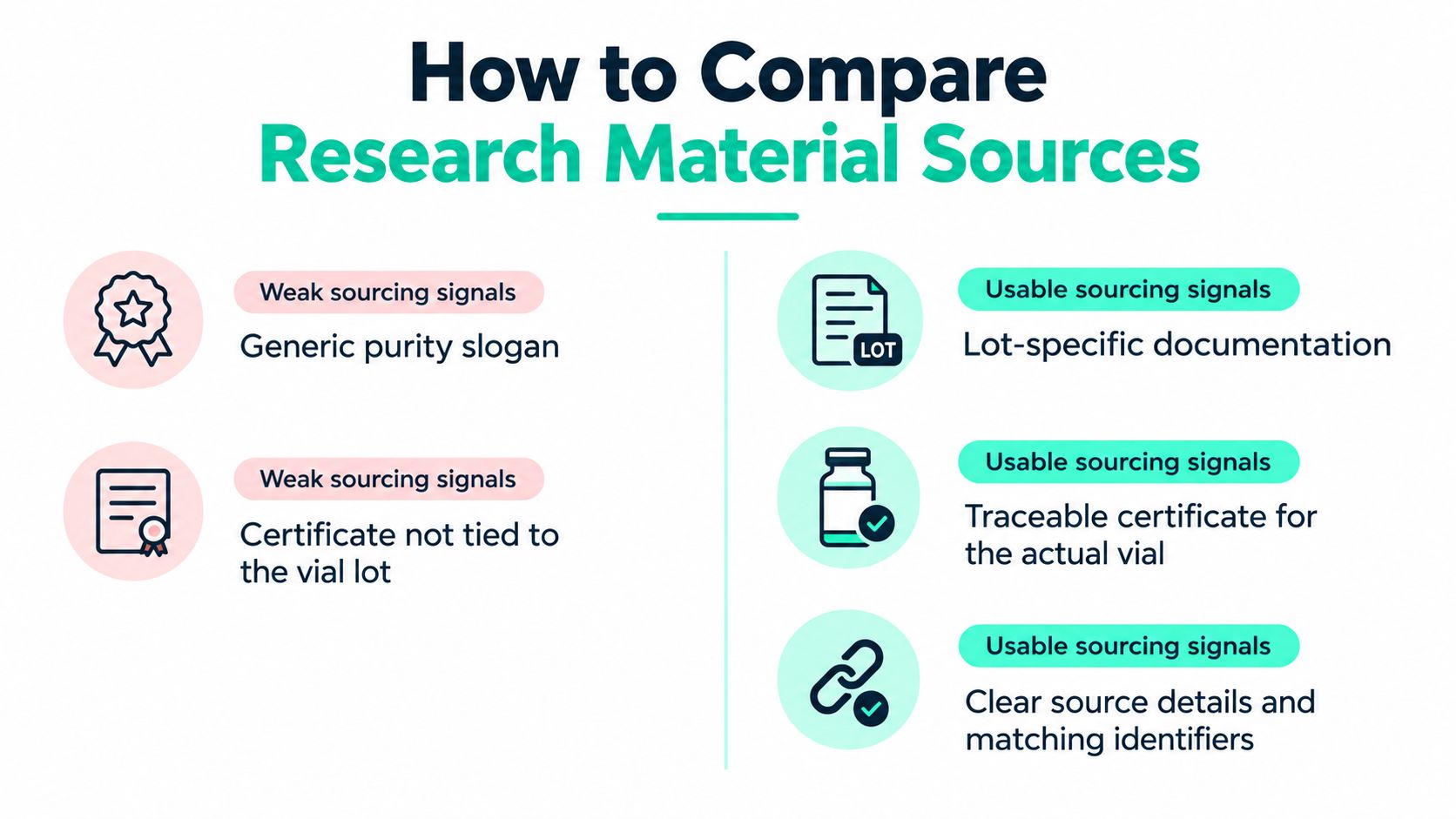
A clear product page and a useful analytical record answer different questions. For a defined quinolinium small molecule such as Amino 1 MQ, supplier descriptions can help identify what is being offered, while testing records help assess whether a particular lot matches that description. The distinction matters: peptide labeling, a purity percentage, or short-term mouse findings cannot independently confirm chemical identity or establish human evidence.
The comparison below separates general assurances from documentation a laboratory can review.
| Weak sourcing signal | More usable documentation |
|---|---|
| Generic purity slogan | Lot-specific certificate with method and test date |
| Certificate unrelated to the shipped vial | Matching lot identifiers on vial, certificate, and receiving record |
| Chromatography without identity evidence | HPLC or UPLC purity assessment plus an appropriate identity method |
| Undefined chemical form | Explicit salt, counterion, and calculation basis |
| Broad quality assurance language | Inspectable results and clear limits on what was tested |
Orthogonal testing uses methods that provide different kinds of information. Chromatography can assess components under a specified method; LC-MS and NMR, where appropriate, can provide additional identity evidence. A chromatographic purity percentage alone does not answer whether the main component is the intended compound.
Read mass-spectrometry results in context. A detected cation may support part of an identity assessment, but it does not document every component of a salt or establish the supplied chemical form.
Celonyx Labs provides an example of a peptide catalog with sections for New Arrivals and Bestsellers, references to independent third-party testing, shipping descriptions, and phone and email support. These are catalog and service details, not confirmation that the company supplies Amino 1 MQ.
The published catalog describes 99% purity. That figure is a supplier-stated quality claim; on its own, it does not establish the identity of a particular lot or the method behind the result. Purchasing teams can also review the company's terms, privacy, refunds and returns, and shipping policies.
The listed business address is 1194 Twin Stacks Drive, Unit B, Dallas, PA 18612, with phone support at 570-761-6154. Contact information helps resolve order questions, while analytical records address the material itself.
Before accepting a vendor's material, request the lot certificate and examine what each method supports. Confirm that identifiers match across the vial and records, and document questions that remain unresolved. The overview of third-party testing laboratories offers procurement context; the actual report for the received material should guide its assessment.
At receipt, treat the vial as a characterized research chemical with its own identity and handling record, not as a peptide preparation. Compare the label, receiving record, and certificate before releasing it to the bench. Resolve discrepancies and record any corrections rather than changing the notebook without documentation.
Keep the molecular-weight basis with the preparation date and stock record. This is the calculation's reference point: without it, another researcher may not know which chemical form was used.
Follow handling and storage instructions for the specific lot. If they are missing or inconsistent, ask the supplier for clarification. Do not guess a temperature, solvent, stability period, or freeze-thaw allowance.
The guide to bacteriostatic water can help laboratories review practices for that reagent. It does not establish that the solvent is suitable for Amino 1 MQ. Choose a solvent only with compound-specific support and compatibility with the planned assay.
Set acceptance requirements before ordering: standardized name, supplied form, lot-linked analytical methods, and a stated research-use purpose. Assign someone to review the documentation before the material is used, not after an unexpected result.
For catalog peptide orders, contact the supplier through its published Dallas, Pennsylvania phone and email channels to ask about availability, documentation, shipping, and return terms. For this quinolinium compound, base acceptance on its own certificate and chemical requirements.
Fast shipping may help with scheduling. Third-party testing may support documentation review, but neither confirms that a report matches the compound received. Check the report against the lot and the material's identity requirements.
For laboratory peptide procurement, Celonyx Labs offers an online research-peptide catalog, published quality information, and order support. Review its testing information and purchasing policies, while keeping Amino 1 MQ qualification tied to compound-specific identity records rather than peptide labeling.
500 mcg equals 0.5 mg, a labeled research quantity, and no published human study establishes

Choose the best GHK-Cu peptide format for laboratory skin and wound-healing research. Compare documentation, assay

Choose lot-verified melanotan 1 peptide for pigmentation research. Compare material specifications, purity evidence, and documentation
FOR RESEARCH USE ONLY. Products sold by Celonyx Labs are intended exclusively for laboratory and scientific research. They are not intended for human or veterinary use, consumption, diagnosis, treatment, cure, or prevention of any disease. By purchasing from this site, you acknowledge that you understand the intended research purpose of these materials and agree to comply with all applicable laws and regulations.