
6 Acetic Acid: What It Means and Where It Fits in Research
What does “6 acetic acid” tell you about the bottle on your bench? Not much,
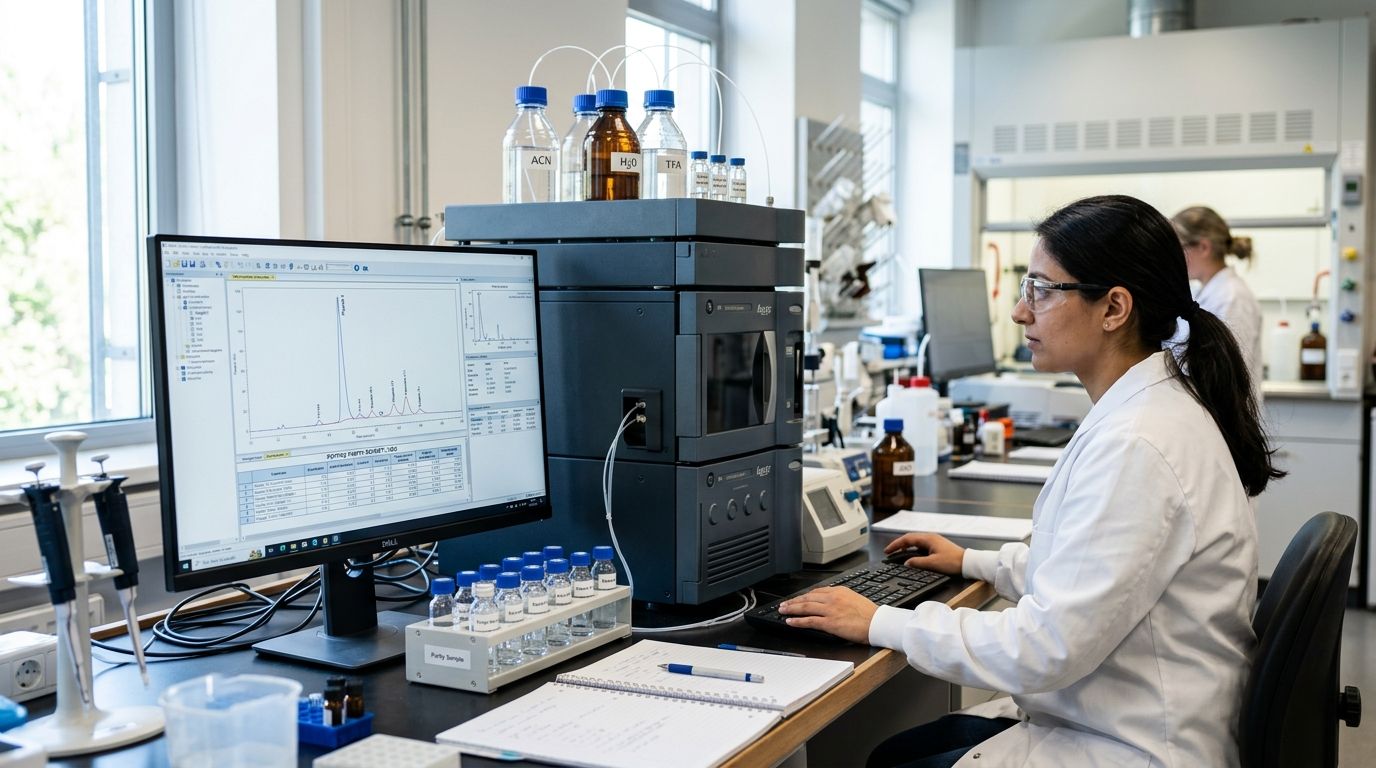
Best overall: Waters Empower. Best for multi-vendor instrument labs: Thermo Scientific Chromeleon CDS. Best for cost-conscious independent labs: DataApex Clarity. Peptide purity testing lives or dies on peak integration accuracy, and the chromatography data system (CDS) running your HPLC determines whether a co-eluting impurity gets flagged or buried.
Peptide purity data is only as trustworthy as the software that integrated the peak. A 99% purity claim on a certificate of analysis depends on whether the CDS resolved the main peak from truncated sequences, deamidated variants, and solvent adducts — or lumped them together. Labs that publish or submit peptide data to regulators need software with a defensible audit trail; labs running quick internal checks don't.
Celonyx Labs sources 99%-pure, third-party-tested research peptides, and the labs performing that testing run one of the platforms below. If you're evaluating a third-party peptide testing lab for your own samples in 2026, ask which CDS they use before you ask about turnaround time — it tells you more about data integrity than the marketing page does.
| Tool | Best For | Standout Feature | Key Limitation |
|---|---|---|---|
| Waters Empower | Regulated, GxP-adjacent peptide labs | Full 21 CFR Part 11 audit trail and e-signature stack | Steep learning curve for new analysts |
| Thermo Scientific Chromeleon CDS | Multi-vendor instrument fleets | Single interface across Thermo, Waters, Agilent, Shimadzu hardware | Advanced modules require add-on licensing |
| Agilent OpenLab CDS | Agilent-instrument academic labs | Tight native integration with Agilent LC/MS | Weaker support for third-party instruments |
| Shimadzu LabSolutions | Shimadzu-instrument workflows | Direct control of Shimadzu Nexera and Prominence systems | Limited cross-vendor data handling |
| DataApex Clarity | Small research labs on a budget | Lower total cost of ownership, modular licensing | Smaller validation/support ecosystem than the majors |
| OpenChrom | Exploratory, non-regulated research | Open-source, scriptable, no per-seat license | No vendor validation package or Part 11 audit trail |
Waters Empower is the CDS most widely deployed across pharma and contract testing labs, and it's built around the audit-trail and e-signature requirements that regulated peptide purity reporting demands. It handles method development, system suitability, and peak integration for complex peptide impurity profiles inside one validated environment.
Waters Empower pros:
Waters Empower cons:
Waters Empower is best for: labs that submit peptide purity data externally or operate under a quality system.
Verdict: Buy if regulated reporting is part of your workflow in 2026.
Chromeleon CDS runs instruments from Thermo, Waters, Agilent, and Shimadzu from a single interface, which matters for research labs that accumulated HPLC hardware from different vendors over the years rather than standardizing on one brand.
Thermo Scientific Chromeleon CDS pros:
Thermo Scientific Chromeleon CDS cons:
Thermo Scientific Chromeleon CDS is best for: labs running a mixed fleet of LC systems from different manufacturers.
Verdict: Buy if your bench has more than one instrument brand.
OpenLab CDS is Agilent's native chromatography platform, and it's the natural pick for labs whose HPLC and LC/MS systems are entirely Agilent hardware. It integrates directly with Agilent's InfinityLab series with minimal driver friction.
Agilent OpenLab CDS pros:
Agilent OpenLab CDS cons:
Agilent OpenLab CDS is best for: research labs standardized entirely on Agilent hardware.
Verdict: Buy if every HPLC on the bench is already Agilent. Skip otherwise.
LabSolutions controls Shimadzu's Nexera and Prominence LC lines directly, and it's a common choice in university and contract labs that bought Shimadzu systems for their price-to-performance ratio.
Shimadzu LabSolutions pros:
Shimadzu LabSolutions cons:
Shimadzu LabSolutions is best for: labs running Shimadzu-only HPLC setups.
Verdict: Hold — fine if you're locked into Shimadzu hardware, not worth switching to otherwise.
Clarity is a modular CDS built for labs that need reliable peak integration and reporting without the licensing overhead of the major pharma-grade platforms. It supports a wide range of detector and instrument types through open drivers.
DataApex Clarity pros:
DataApex Clarity cons:
DataApex Clarity is best for: independent research labs without a formal quality system.
Verdict: Buy for small labs prioritizing cost control over full GxP compliance.
OpenChrom is an open-source data processing platform that reads raw chromatography files without a per-seat license, which appeals to academic and early-stage research groups doing exploratory peptide work rather than submission-grade testing.
OpenChrom pros:
OpenChrom cons:
OpenChrom is best for: exploratory research where regulatory submission isn't the goal.
Verdict: Wait until you know whether your peptide data ever needs regulated documentation.
Each tool was weighed against the six criteria above: audit-trail depth, peak integration accuracy on co-eluting peptide impurities, instrument compatibility, USP <621>/<1225> alignment, export flexibility, and vendor support. Waters Empower and Thermo Scientific Chromeleon CDS lead because they cover all six; the rest trade one or more of those for cost or narrower hardware focus.
Need peptides tested to a verified purity standard
Research peptides sourced with third-party purity documentation, not just a label claim.
Default to Waters Empower if your peptide purity data ever leaves the building — for publication, client reporting, or regulatory submission in 2026. Choose Thermo Scientific Chromeleon CDS if your bench runs instruments from more than one manufacturer. Pick DataApex Clarity if you're an independent lab watching every dollar and don't need a formal quality system behind the data. If you already own Agilent or Shimadzu hardware exclusively, stick with the manufacturer's native platform rather than paying to switch.
Whatever software processes the peaks, the peptide sample entering the column matters just as much. Purity results are only meaningful when the research peptides going into the run were sourced and stored correctly in the first place — degraded stock produces impurity peaks that have nothing to do with manufacturing quality.
What’s the best HPLC data analysis tool for peptide purity testing in 2026?
Waters Empower is the best overall pick for regulated peptide purity testing in 2026 because of its full 21 CFR Part 11 audit trail and validation documentation. Thermo Scientific Chromeleon CDS is the better choice for labs running mixed-vendor instrument fleets.
Is Chromeleon better than Empower for peptide research?
Chromeleon is better when your lab runs instruments from multiple manufacturers, since it controls Thermo, Waters, Agilent, and Shimadzu hardware from one interface. Empower is stronger for labs standardized on a single validated workflow.
Do I need 21 CFR Part 11 compliance for peptide research?
You need it if your purity data is submitted externally, published, or reviewed under a formal quality system. Exploratory internal research without external reporting can often run on a non-compliant platform like OpenChrom.
What is USP <621> and why does it matter for HPLC?
USP <621> is the chromatography general chapter covering system suitability requirements for HPLC methods. Aligning your CDS reporting to it makes purity data easier to defend if a third-party lab or reviewer questions the results.
Can I use free or open-source software for HPLC purity data?
OpenChrom works for exploratory, non-regulated peptide research since it has no license cost. It lacks a 21 CFR Part 11 audit trail, so it isn’t suitable once regulated reporting enters the picture.
Does the CDS affect the purity percentage on a certificate of analysis?
Yes. Peak integration settings determine whether co-eluting impurities are resolved from the main peptide peak or merged into it, which directly changes the reported purity figure.
Which HPLC software works best with Agilent instruments?
Agilent OpenLab CDS has the tightest native integration with Agilent LC and LC/MS hardware. Cross-vendor labs get more value from Thermo Scientific Chromeleon CDS instead.
How much does HPLC data analysis software cost?
Pricing varies by license type, module count, and instrument count, so check current vendor quotes directly rather than a fixed figure. DataApex Clarity generally carries a lower total cost of ownership than Empower, Chromeleon, or OpenLab.
The software rarely explains a bad purity result — the sample prep usually does. A peptide that sat improperly reconstituted or stored above recommended conditions before the HPLC run will show impurity peaks that no amount of integration software can distinguish from a manufacturing defect. Check your storage containers and reconstitution protocol before you blame the CDS.
What does “6 acetic acid” tell you about the bottle on your bench? Not much,
Best sterility testing kits for 2026 peptide labs: Endosafe nexgen-PTS wins on speed, Steritest for
Compare the best peptide reference standards for analytical research in 2026, ranked by purity, COA
FOR RESEARCH USE ONLY. Products sold by Celonyx Labs are intended exclusively for laboratory and scientific research. They are not intended for human or veterinary use, consumption, diagnosis, treatment, cure, or prevention of any disease. By purchasing from this site, you acknowledge that you understand the intended research purpose of these materials and agree to comply with all applicable laws and regulations.